
Font size
 Worksheets
Astronomy Unit Test Review
Total questions: 61
Worksheet time: 3hrs 6mins

Completed in 24 hours
Rotation
Revolution
Completed in a year
Rotation
Revolution

The movement of Earth spinning on its axis is called what?
Rotation
Revolution

If we are on the side of the Earth that is facing away from the sun, it is _____________.
Day
Night

What do we call the movement of the Earth around the Sun?
Rotation
Revolution

The path that the Earth takes as it revolves around the sun is called its ______________.
Orbit
Axis

Why do different parts of the Earth's surface get different amounts of sunlight and heat?
The Earth is tilted on its axis
The Earth is straight up and down on its axis
The Earth stops spinning

When the part of the Earth you live in is tilted toward the sun, what season is it?
Winter
Summer
Spring
Fall

What would happen if the Earth wasn't tilted?
The Earth would get too warm
There would be no night
We wouldn't have different seasons

Increasing the mass of a planet would:
Increase the force of gravity of the planet acting on the star.
Increase the force of gravity of the star acting on the planet
Decrease the force of gravity of the star acting on the planet.
Decrease the force of gravity of the planet acting on the star.
Besides increasing a star's mass, what else would increase the force of gravity acting on that planet?
Increasing the mass of the planet.
Decreasing the distance between the planet and the star
Increasing the distance between the planet and the star.
Increasing the velocity of the planet orbiting the star.
As one object gets closer to another object, the force of gravity will increase.
True
False
The bigger an object is, the smaller the force of gravity.
True
False
Which statement about gravity is true?
Astronauts float because gravity does not exist in space.
Gravity is a universal force of attraction that exists between all objects.
Planets further away from the Sun always have less gravity.
Gravity is a pushing and pulling force.
As the distance between two masses decreases, the gravitational force between them _______.
Increases
Stays the same
Decreases
Draw what you think the Earth's motion would look like if the force of gravity was sudden "turned off."


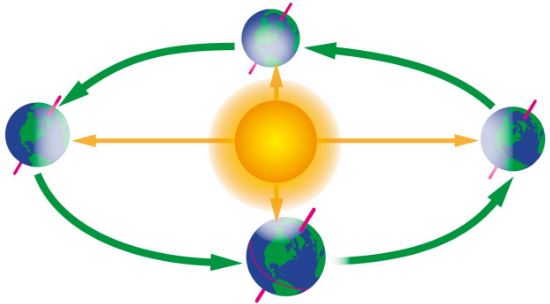


1. Based on the model above, which season is point X most likely experiencing?
spring
summer
winter
fall or autumn
Why is summer warmer than winter?
The hemisphere experiencing summer is tilted more directly toward the sun
During summer, the entire planet is closer to the sum
The sun radiates more energy during the summer
The earth spins slower on its axis during the summer

Which rays are DIRECT? A or B
A
B
Which rays are INDIRECT? A or B
A
B
Which rays are spread out?
Direct
Indirect
Which rays do not spread out?
Direct
Indirect
Which rays are stronger?
Direct
Indirect
Which rays are weaker?
Direct
Indirect
Which rays heat the Earth more?
Direct
Indirect
Which rays heat the Earth less?
Direct
Indirect
Winter rays are?
Direct
Indirect

Which season is represented by this figure?
Winter
Summer

Which season is represented by this figure?
Winter
Summer
Which term is used to describe the phase of the moon in which the visible surface of the moon is completely illuminated?
new moon
full moon
waning crescent
waxing gibbous
Which moon phase occurs when exactly half of the visible surface of the moon is illuminated by the sun?
quarter moon
new moon
full moon
crescent moon

Generally, any beach location will have (a) each day.

Tides are caused by...
the rotation of the Earth
the orbit of the Moon
the gravitational pull of the Sun and Moon
wind currents

When do Spring Tides occur?
During the new moon and full moons
During the crescent moons
During the Spring
During the gibbous moons

What do you call small tides where the high tide is not as high as usual and the low tides are not as low as usual?
neap tides
spring tides
orbital eccentricity
orbital declination

The tide in the picture is a (a) .
During this tide, the high/low tides will be (b) than usual.

The tide in this picture is a (a) .
During this tide, the high/low tides will be (b) than usual.

During the moon phases shown in the image Earth will experience a -
Spring Tide
Neap Tide

During the moon phase shown in the image Earth will experience a -
Spring Tide
Neap Tide

