
 Worksheets
Chapters 6-7 Gallopade Test
Total questions: 53
Worksheet time: 27mins
Name
Class
Date
1.
Select your U.S. History class period.
a)
Period 1
b)
Period 4
c)
Period 5
d)
Period 6
2.
Enter your "First Name".
4 lines
3.
Enter your "Last Name".
4 lines
4.

1) This is a statement made by George Washington at the Constitutional Convention. George Washington’s statement addressed what idea?
a)
The American government could serve the people better as a monarchy.
b)
The American government was operating in the best interests of the people.
c)
The American government would fail if the Articles of Confederation were not changed.
d)
The American government needed to return to the ideals in the Declaration of Independence.
5.
2) What was the name of the first attempt to create a written government following the American Revolution?
a)
the Federalist Papers
b)
the Articles of Confederation
c)
the Bill of Rights
d)
the Continental Congress
6.
3) How did the Northwest Ordinance of 1787 impact the United States?
a)
It legalized slavery in the Ohio River Valley.
b)
It gave settlers free land if they agreed to establish farms.
c)
It protected areas occupied by Native Americans from settlement.
d)
It established a procedure to admit new states to the nation.
7.

4) This diagram shows several characteristics of the Articles of Confederation. These characteristics show that which situation was true after the American Revolution?
a)
The men who wrote the Articles of Confederation believed the government should have three branches.
b)
The Articles of Confederation was able to address all the issues that arose in the new nation.
c)
The men who wrote the Articles of Confederation did not trust a national government and gave more power to the states.
d)
The Articles of Confederation was written to establish a temporary government.
8.
5) Which event showed the weakness of the Articles of Confederation and led to a convention to consider changing the government?
a)
the surrender at Yorktown
b)
Shays' Rebellion
c)
Bacon's Rebellion
d)
the Stono Rebellion
9.
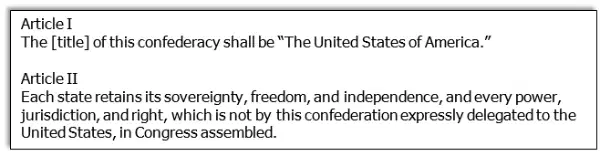
6) This is an excerpt from an early governing document of the United States. What aspect of this document reflects the political fears of the time period?
a)
There was no concentration of power in a single authority.
b)
There were powers reserved for Congress specifically.
c)
There was a statement barring alliances with the British.
d)
There was an emphasis on the power of the chief executive.
10.
7) Which provisions of the Articles of Confederation were weaknesses that were corrected by the Constitution?
Select ALL that apply.
a)
The federal government did not have the power to enforce laws.
b)
The federal government could not levy direct taxes.
c)
The federal government lacked a judicial branch.
d)
The federal government could not acquire and manage new territories.
e)
The federal government could not enter into treaties.
11.
8) Why did the United States Constitution replace the Articles of Confederation?
a)
The Articles of Confederation were temporary and expired in 1789.
b)
The Articles of Confederation were too weak to govern the nation.
c)
The Articles of Confederation were never ratified by South Carolina.
d)
The Articles of Confederation were destroyed in the American Revolution.
12.
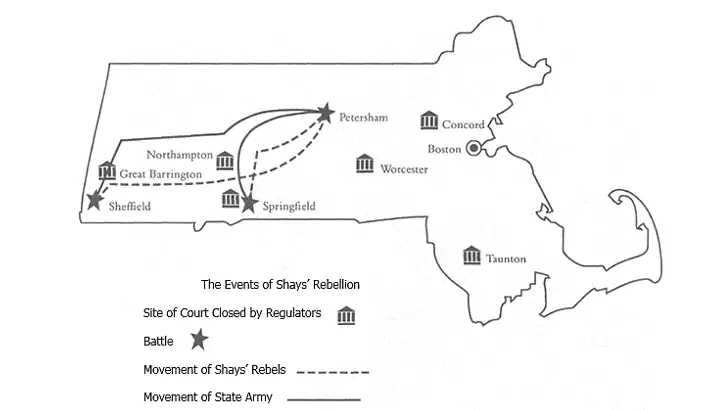
9) This is a map of the strategic sites of the events of Shays’ Rebellion in 1786. Based on the map, what conclusion can be drawn about Shays’ Rebellion?
a)
Shays’ rebels avoided interrupting the work of legal institutions.
b)
The state army battled with Shays’ rebels at every closed court.
c)
Clashes between Shays’ rebels and the state army occurred in the western part of the state.
d)
The capital city, Boston, was the main focus of activity for Shays’ rebels.
13.
10) Which statement best explains why the Articles of Confederation were an unsuccessful form of government?
a)
The national government could not support an army.
b)
The national government did not have the power to enforce laws.
c)
There was no formal presidential election process.
d)
Not all of the states were represented in the unicameral legislature.
14.
11) What sparked Shays' Rebellion?
a)
Merchants in Massachusetts refused to accept paper money for goods.
b)
Massachusetts printed excessive amounts of currency.
c)
Farmers in Massachusetts were unable to pay state taxes and mortgages.
d)
New York placed excessive taxes on goods from Massachusetts.
15.

12) This quote is from a letter Thomas Jefferson wrote to James Madison in 1787. What event is Jefferson most likely referencing in this letter?
a)
Boston Tea Party
b)
Louisiana Purchase
c)
Northwest Ordinance
d)
Shays’ Rebellion
16.
13) What was the primary goal of both the Articles of Confederation and the Constitution?
a)
to list the powers of state governments
b)
to create economic stability
c)
to list the individual rights of citizens
d)
to establish organized governments
17.
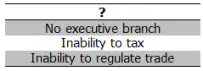
14) What is the best heading for this outline?
a)
Weaknesses of the Articles of Confederation
b)
Strengths of the United States Constitution
c)
Reasons for American Independence
d)
Features of State Governments
18.

15) This is an excerpt from the Northwest Ordinance of 1787. How did this ordinance and the Land Ordinance of 1785 support the goal in this excerpt?
a)
They required the federal government to build schools in towns with more than 5,000 people.
b)
They required that all children under the age of 12 attend school.
c)
They required teachers to attend training programs and be certified.
d)
They required that part of the income from land sales be put toward public education.
19.

16) These are excerpts from a law passed in 1787. What was the main purpose of this law?
a)
to establish a process for settling new territories
b)
to give voting rights to all male citizens
c)
to end slavery in the northern states
d)
to prevent self-government in new territories
20.
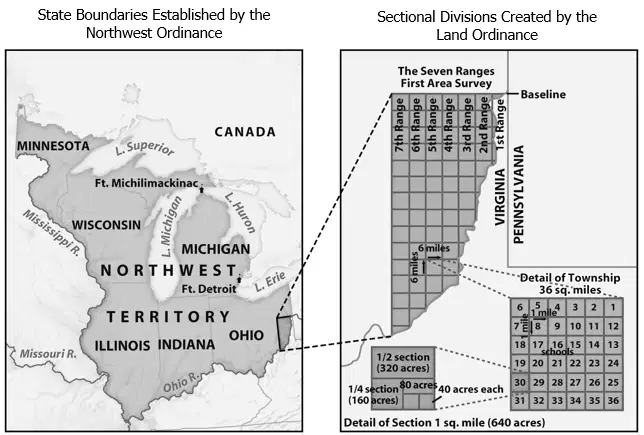
17) These maps show the results of the Northwest Ordinance and the Land Ordinance. What was significant about these two ordinances?
a)
They required territories to preserve parts of the lands for Native Americans.
b)
They established a precedent for newly formed states to be equal to the original 13.
c)
They maintained the balance between free and slave states in the nation.
d)
They allowed the United States government to control the economic activity of new territories.
21.
18) What problems with the Articles of Confederation led to its ultimate failure as a system of government? Select two that apply.
a)
The Articles of Confederation allowed for tax abuses similar to the British tax policy.
b)
The Articles of Confederation did not establish executive or judicial branches of government.
c)
The Articles of Confederation gave more political representation to northern states.
d)
The Articles of Confederation did not give states enough power to govern themselves.
e)
The Articles of Confederation created a centralized government that was too weak.
22.

19) This chart shows two differences between the Articles of Confederation and the Constitution. Based on the chart, how does the Constitution differ from the Articles of Confederation?
a)
The Constitution granted greater power to the federal government.
b)
The Articles of Confederation made national defense the top priority of the government.
c)
The Constitution strengthened the sovereignty of the states.
d)
The Articles of Confederation led to an economically stable nation.
23.
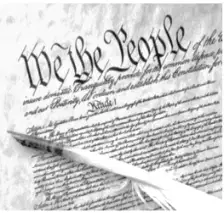
20) Which United States document is shown in this picture?
a)
United States Constitution
b)
Articles of Confederation
c)
English Bill of Rights
d)
Declaration of Independence
24.
21) What did the Three-Fifths Compromise determine?
a)
the size of the Supreme Court
b)
the question of federal vs. state supremacy
c)
how slaves would be counted for taxation and representation
d)
the geographic limitations on slavery
25.
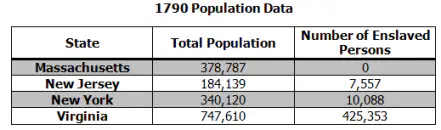
22) Which state would have received the least political benefit from the 3/5ths compromise?
a)
Massachusetts
b)
New Jersey
c)
New York
d)
Virginia
26.
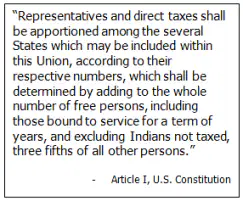
23) Read the excerpt and answer the question. Who are considered "all other persons" in this excerpt from the Constitution?
a)
women
b)
slaves
c)
Loyalists
d)
Native Americans
27.
24) How did the Great Compromise settle the question of congressional representation?
a)
It gave all states equal representation in both houses of Congress.
b)
It created a bicameral Congress with one house represented equally and one house based on population.
c)
It based representation on the amount of money a state contributed to the national government.
d)
It used population to determine the number of Senators from each state.
28.
25) Which statement regarding the framers of the Constitution is accurate?
a)
They reflected a broad cross-section of society, and included a mix of race, class, and gender.
b)
Although women were not included, men from all races and social classes were present.
c)
Only wealthy, influential men were present at the Philadelphia Convention.
d)
There were a few minorities in attendance, but the group was predominately white and male.
29.
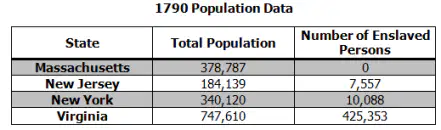
26) According to the data in this table, which state would have the most power in the House of Representatives?
a)
Massachusetts
b)
New Jersey
c)
New York
d)
Virginia
30.
27) At the Constitutional Convention, what was the difference between the Virginia Plan and the New Jersey Plan?
a)
The Virginia Plan called for representation based on population, whereas the New Jersey Plan called for equal representation.
b)
The Virginia Plan called for equal representation, whereas the New Jersey Plan called for representation based on population.
c)
The Virginia Plan included slaves in determining representation, while the New Jersey Plan did not.
d)
The Virginia Plan did not include slaves in determining representation, while the New Jersey Plan did.
31.
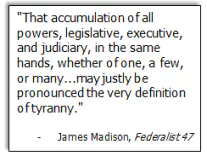
28) What concept, embedded in the Constitution, aims to combat the problem Madison describes in this quote?
a)
national supremacy
b)
individual liberties
c)
republicanism
d)
separation of powers
32.
29) Which action is an example of the executive branch using checks and balances to ensure the legislative branch does not overstep its power?
a)
The Senate approves a nominee to the Supreme Court.
b)
The president vetoes a law passed by Congress.
c)
The House of Representatives votes to override a presidential veto.
d)
The president appoints a new justice to the Supreme Court.
33.
30) As chief executive, what is the president's main job?
a)
to appoint state governors
b)
to determine the constitutionality of laws
c)
to carry out and enforce laws
d)
to approve laws made at the state level
34.
31) The first ten amendments were added to the Constitution to support which constitutional principle?
a)
checks and balances
b)
federalism
c)
individual rights
d)
separation of powers
35.

32) This chart lists the principles of the Constitution. What is the ultimate purpose for these principles?
a)
to prevent an invasion from a foreign nation
b)
to ensure that the government does not become too powerful
c)
to make it possible to elect the most qualified candidates to offices
d)
to establish equal rights for all people
36.
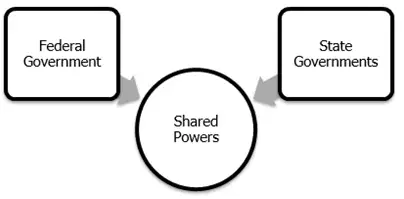
33) This diagram depicts a principle of the Constitution. Which principle of the Constitution is depicted in the diagram?
a)
checks and balances
b)
federalism
c)
limited government
d)
separation of powers
37.
34) The constitutional belief that the authority of the federal government comes from the people is known as what?
a)
antifederalism
b)
confederation
c)
federalism
d)
popular sovereignty
38.
35) What is the purpose of the separation of powers included in the Constitution?
a)
to allow the president enough freedom to meet with foreign diplomats and leaders
b)
to protect the rights of state courts and their ability to pass local laws
c)
to meet the needs of small states that were unable to create strong local governments
d)
to stop one branch of the government from having too much power
39.
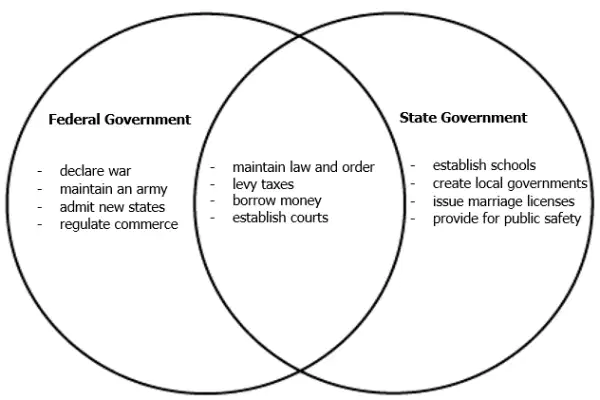
36) This Venn diagram compares the powers of the federal and state governments under the United States Constitution. Based on this Venn diagram, what is true about the United States government?
a)
Power is shared between the federal and state governments.
b)
State governments have more power than the federal government.
c)
The federal government can take over the powers of the state governments at any time.
d)
The federal government holds powers that should belong to the state governments.
40.
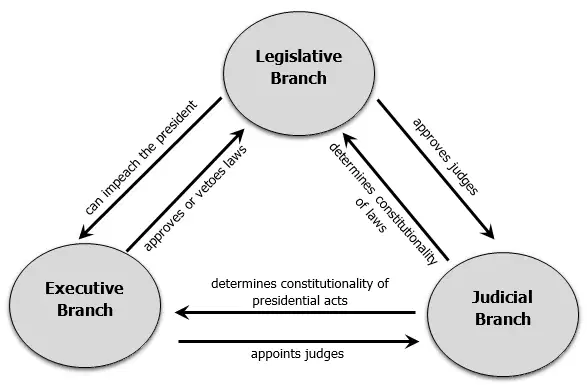
37) This chart shows the structure of the federal government. This chart is an example of which constitutional principle?
a)
checks and balances
b)
federalism
c)
individual rights
d)
popular sovereignty
41.
38) Which branch of government interprets the laws of a country?
a)
executive
b)
judicial
c)
legislative
d)
all of them
42.
39) Which statement best explains why the Constitution of the United States is known as a "living" document?
a)
It only had to be ratified by 9 of the 13 original colonies.
b)
It was created by elected leaders at a democratic convention.
c)
It established a democratic government where all citizens could vote.
d)
It can be amended to meet the changing needs of society.
43.
40) What is the role of the legislative branch?
a)
to make laws
b)
to enforce laws
c)
to approve state laws
d)
to interpret the laws
44.
41) What is the primary function of the Electoral College?
a)
to familiarize incoming members of Congress with the workings of the legislative branch
b)
to elect a president by allowing each state to send a set number of delegates to cast a vote for the state
c)
to educate voters about the candidates and their views on the issues
d)
to count the number of popular votes cast in a national election
45.
42) What was one way the Constitution differed from the Articles of Confederation?
a)
The Constitution gave more power to the state governments.
b)
The Constitution forbid the government from taxing the people.
c)
The Constitution set up three branches of government.
d)
The Constitution was more difficult to amend.
46.
43) Why did Antifederalists insist on the inclusion of the Bill of Rights before supporting ratification of the Constitution?
a)
They believed the federal government lacked the authority to enforce laws without it.
b)
They wanted to ensure the sovereignty of the federal government over state governments.
c)
They believed provisions needed to be included to ensure the voting rights of all free citizens.
d)
They wanted protections to ensure the government could not infringe on individual rights.
47.
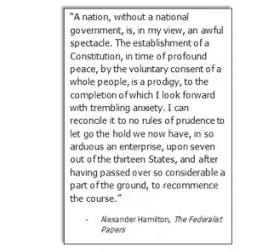
44) Read this excerpt and answer the question. What was the position taken in The Federalist Papers?
a)
The Constitution is necessary and should be ratified.
b)
State constitutions should be similar to the U.S. Constitution.
c)
States should have the power to veto federal laws.
d)
States should pay all debts related to the American Revolution.
48.
45) The ability to speak freely, the guarantee of a fair trial, and the opportunity to carry a weapon are all protected by what?
a)
the Declaration of Independence
b)
the Preamble to the Constitution
c)
the Bill of Rights
d)
the First Amendment
49.
46) Vocab: What is the definition of "confederation"
a)
a national body with a judicial branch
b)
a union of loosely affiliated states
c)
to give official approval
d)
a strong government with legislative power
50.
47) Vocab: What is the definition of "ratify"
a)
official announcement of an important matter
b)
to undo or cancel a law
c)
to give official approval
d)
a short publication about a particular topic
51.
48) Vocab: What is the definition of "Constitution"
a)
the idea that government authority comes from the people
b)
rights that are imbued through nature
c)
laws of nature that govern all humans
d)
the basic principles and laws of a nation
52.
49) Vocab: What is the definition of "democracy"
a)
the ultimate source of government power
b)
a form of government in which the people rule
c)
freedoms that are protected by law
d)
a form of government with a single, strong leader
53.
50) Vocab: What is the definition of "popular sovereignty"
a)
a popular king who commands the respect of his subjects
b)
freedoms that are protected by law
c)
people chosen to speak or make decisions for another person
d)
the idea that government gets its authority because the people allow it
100 %

