wayground logo

Free Printable Worksheets

Font size

S
M
L
XL
Worksheets

Test: Unit 2

Total questions: 53

Worksheet time: 44mins

Name
Class
Date
1.

Mendeleev organized the elements by atomic mass in each of the rows. How are they actually organized?

a)

Mass Number

b)

Atomic Number

c)

Number of Neutrons

d)

Number of Electron Shells

2.

Each column is called a ​ (a)   and each row is called a ​ (b)   on the Periodic Table.

Choose from the below words
group
period
valence
3.

What is true about a group on the periodic table?

a)

They have similar electron configurations

b)

They have similar properties

c)

They have different properties

d)

They have the exact same electron configurations

4.

Which of the following is true when going across a period on the periodic table?

a)

They decrease in atomic number

b)

They increase in atomic number

c)

Each element in a period has a similar electron configuration (example all s1)

d)

Each element in a period has the same number of electron shells.

5.

Which of the following are properties of metal?

a)

Do not conduct electricity

b)

Conduct Electricity

c)

Malleable

d)

Usually liquid at room temperature

6.

Which of the following are properties of non-metals?

a)

Do not conduct electricity

b)

Conduct heat and electricity

c)

Malleable

d)

Usually gas at room temperature

7.

What is true about the valence electrons of an atom?

a)

They are on the outermost shell and do not interact in bonding

b)

They are on the inside shells and do the bonding

c)

They are on the inside shells and do not interact in bonding

d)

They are on the outermost shell and do the bonding.

8.

Which group of elements does not normally react with anything?

a)

Alkali Metals

b)

Alkali Earth Metals

c)

Halogens

d)

Noble Gases

9.
How many protons are in Beryllium?
a)
4
b)
9
c)
5
d)
2
10.
How many valence electrons does Beryllium have?
a)
1
b)
2
c)
3
d)
4
11.
How many valence electrons does carbon have?
a)
1
b)
3
c)
4
d)
5
12.
When two or more atoms join together, the following can be formed
a)
elements
b)
molecules only
c)
molecules and/or compounds
d)
compounds only
13.
Electrons have the following charge
a)
positive
b)
negative
c)
neutral
d)
radioactive
14.
Protons have the following charge
a)
negative
b)
positive
c)
neutral
d)
radioactive
15.
Ions are: 
a)
atoms with a positive or negative charge
b)
atoms with no charge
c)
atoms with ONLY a positive charge
d)
atoms with ONLY a negative charge
16.
When an atom loses a valence electron, it becomes a(n) _____________ ion.
a)
positive
b)
negative
c)
neutral
d)
polyatomic
17.
Negative ions form when atoms _________ valence electrons.
a)
lose
b)
gain
c)
share
18.
Atoms are most stable when their outer shell is filled with electrons.
a)
true
b)
false
19.
How are covalent bonds formed?
a)
Sharing of electrons
b)
Transfer of electrons
20.
How are ionic bonds formed?
a)
Transfer of electrons
b)
Sharing of electrons
21.
Ionic bonds are between...
a)
Metal and Non-metal
b)
Non-metal and Non-metal
c)
Metal and Metal
22.
Covalent bonds are between...
a)
Metal and Non-metal
b)
Non-metal and Non-metal
c)
Metal and Metal
23.
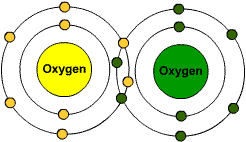
Is this image an example of covalent bonding?
a)
Yes
b)
No
24.

Atoms want...

a)
A full outer shell of electrons
b)
One electron short of a full shell
c)
kit kats
25.
Name the following compound: 
CO2
a)
monocarbon dioxide
b)
carbon oxide
c)
carbon dioxide
d)
oxygen carbonide
26.
What is the correct formula for this molecule?
a)
NH
b)
N3H
c)
NH3
d)
NH4
27.
In the equation,          2Mg + O2 ---> 2MgO, which are the reactants?
a)
Mg and O
b)
MgO
c)
Mg and MgO
d)
O and MgO
28.
Balance this equation, Ca + H2O --> CaO + H2
a)
Ca + 2H2O --> CaO + 2H2
b)
2Ca + H2O --> CaO + H2
c)
Its balanced as it is
d)
Cannot be balanced
29.
What coefficients are needed to correctly balance the equation?
_Bi   +   _O2   >   _Bi2O3
a)
3,2,3
b)
2,3,2
c)
4,3,2
d)
none of these
30.

Why must chemical equations be balanced?

a)

So that the equation doesn't explode

b)

The reaction won't happen until it is balanced

c)

Based on the Law of Conservation of Matter, matter cannot be created or destroyed.

d)

Based on the Law of Conservation of Energy, energy cannot be created or destroyed.e

31.
The left side of the equation below is called
a)
Products
b)
Reactants
32.
The right side of the equation below is called the
a)
products
b)
reactants
33.
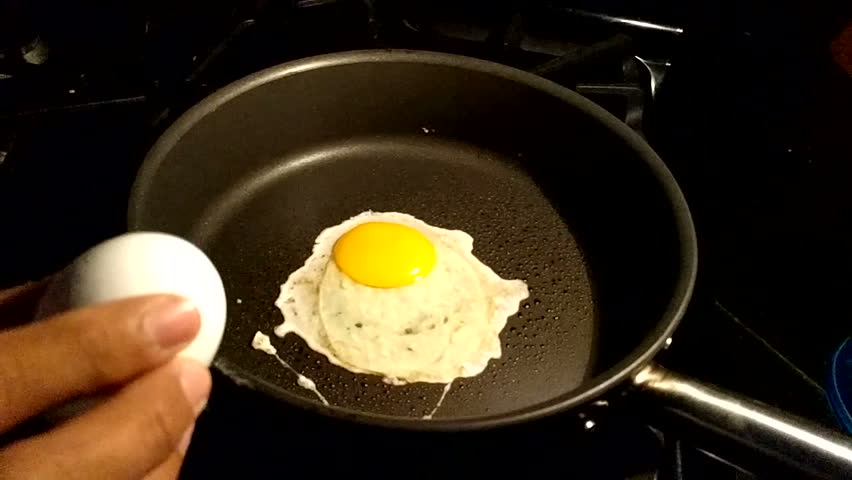
Baking bread and cooking an egg are examples of....?
a)
Endothermic processes
b)
Exothermic processess
c)
None of these 
34.
In an endothermic reaction, heat is ...
a)
taken in or absorbed
b)
given out or released 
35.
Exothermic reactions...
a)
Absorb energy
b)
Release energy
c)
Release Color
d)
Absorb Color
36.
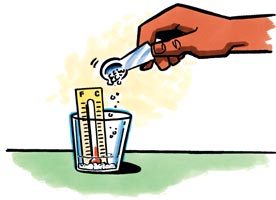
The thing that does the dissolving
a)
Solute
b)
Solvent
c)
Colloid
d)
Solution
37.
What is a solute?
a)
The substance that does the dissolving in a solution.
b)
The substance that is dissolved into the solution.
c)
The mixing of different substances.
d)
The process in which neutral molecules lose or gain electrons
38.
Water can dissolve many things so it is called the .....
a)
wonderful water
b)
cohesion
c)
liquid
d)
universal solvent
39.
What happens in ALL chemical changes?
a)
Change in state of matter
b)
A new substance is formed
c)
Bubbles are produced
d)
An explosion
40.
Ice melting
a)
Chemical Change
b)
Physical Change
41.

According to the law of conservation of mass, how does the amount of each element on the product side compare to each element on the reactant side?

a)

The amount of atoms on each side is equal

b)

The amount of atoms on the product side is greater

c)

The amount of atoms on the reactant side is greater

d)

Depends on the reaction

42.
Which of the following describes a precipitate?
a)
a liquid forms when a block of metal is heated
b)
a solid forms when one liquid is poured into another
c)
a gas forms when a solid is placed in a liquid
d)
bubbles form when an acid is poured on a rock
43.
In chemical reactions, what does the principle of conservation of mass mean?
a)
Matter is not created or destroyed.
b)
The total mass of the reactants is greater than the total mass of the products.
c)
The total mass of the reactants is less than the total mass of the products.
d)
Matter is not changed.
44.

What does a represent?

a)

Proton

b)

Neutron

c)

Electron

45.

What does b represent?

a)

Proton

b)

Neutron

c)

Electron

46.

What does c represent?

a)

Proton

b)

Neutron

c)

Electron

47.

What is the atomic mass of this element?

a)

20

b)

60

c)

40

d)

41

48.

What is the symbol of this element?

a)

Calcium

b)

P

c)

Ca

d)

C

49.

A molecule is

a)

a singular particle of a particular element

b)

another name for an element

c)

2 or more atoms that are combined

50.

What is the number of protons that the element in this image contain?

a)

14

b)

7

c)

15

d)

18

51.
"C" is the element symbol for which element?
a)
calcium
b)
carbon
c)
chlorine
d)
cadmium
52.

What is the atomic number of this element?

a)

20

b)

60

c)

40

d)

41

53.
A _________ is a substance made of two or more DIFFERENT elements chemically combined. 
a)
mixture
b)
compound
c)
substance