
 Worksheets
Dr. Skaggs Unit 3 Review
Total questions: 56
Worksheet time: 4hrs 44mins
Which of the following was a reason for the establishment of the University of Georgia?
Because state legislators wanted to educate young men to build railroads.
To train students in new technology to help the economy of the state of Georgia.
Because educated young people are needed for a free government.
To provide education for female students.
What impact did the headright system have on Georgia?
The headright system allowed Blacks to gain equal rights.
The headright system gave the government power to move Georgia’s capital
The headright system provided American Indians with jobs.
The headright system gave land to veterans of the American Revolution.
Which of the following describes the impact of the land lottery on Georgia?
It allowed Georgians to purchase land cheaply, and 100,000 families received land through the system.
It allowed the state to open schools and teach Georgia's citizens about the government.
It allowed veterans from the Revolutionary War a way to participate in Georgia's government.
It allowed state legislators the opportunity to sell land to companies and receive bribes in return.
Read the information below and answer the question:
-Many of Georgia’s legislators were eventually removed from office.
-The federal government paid $1.25 million for Georgia to cede (give up) its western land.
-Georgia lost land west of the Chattahoochee River.
What does this information describe?
Impact of the Georgia's Land Lottery
Impact of the Yazoo Land Fraud
Impact of the westward movement of Georgia's capitol.
Impact of the headright system.
Which of the following describes the impact of railroads on Georgia? Select TWO correct Answers.
Railroads led to the creation of towns in Georgia.
Railroads decreased the costs of shipping goods in Georgia.
Railroads made it easier to remove seeds from cotton.
Railroads provide state legislators a way to remove Native Americans from Georgia.
Which of the following is the best explanation of John Marshall’s role in the Cherokee removal from Georgia?
He was the President of the United States who fought to protect Cherokee rights.
He was a Senator from Georgia who argued that the Cherokee had no right to land.
He was the governor of Georgia who wanted to protect the Cherokees' right to land and gold.
He was the Chief Justice of the Supreme Court who ruled the Cherokee were their own sovereign nation.
Which of the following BEST explains how the Dahlonega Gold Rush led to the removal of the Cherokee from Georgia?
The Dahlonega Gold Rush led white Georgians to move to Cherokee land.
The Dahlonega Gold Rush led Chief McIntosh to sign of the Treaty of Indian Springs.
The Dahlonega Gold Rush led the state of Georgia to move their capital to Cherokee land.
The Dahlonega Gold Rush led the Supreme Court to declare that Cherokees owned the gold in their land.
Read the information below and answer the questions.
Cherokee Chief
Fought against the removal of the Cherokee from their land.
Negotiated a deal with the federal government to remove the Cherokee
Who does this information describe?
John Marshall
John Ross
Andrew Jackson
William McIntosh
Read the information below and answer the question.
President of the United States
Wanted the Indian Removal Act
Refused to enforce the Supreme Court Decision in Worcester v. Georgia
Who does this information describe?
John Marshall
John Ross
Andrew Jackson
William McIntosh
Read the information below and answer the question:
Chief of the Muscogee Creek
Sold the remainder of Muscogee Creek land in Georgia.
Punished by the Muscogee Creek for selling the land.
Who does this information describe?
John Marshall
John Ross
Andrew Jackson
William McIntosh
How did the invention of the cotton gin impact Georgia?
The cotton gin caused the price of slaves to decrease because less workers were needed.
The cotton gin caused a decrease in the cost to ship goods to market.
The cotton gin had little to no impact on Georgia.
The cotton gin caused the number of slaves in Georgia to increase greatly.
Why did the Cherokee believe the Supreme Court’s decision in Worcester v. Georgia would protect their lands from settlement?
The court said that the US government must pay the Cherokee Nation for any land.
The court said that the selling of land must be supported by a majority of the tribe’s members.
The court said that because Cherokee served in the army, they had the same rights as all citizens.
The court said that the Cherokee Nation was not subject to US laws because it was a sovereign nation.
What was the primary purpose of the Indian Removal Act of 1830?
To provide financial compensation to Native American tribes for their land.
To encourage relocation of Native American tribes to lands west of the Mississippi River.
To protect the rights of Native American tribes in their ancestral lands.
To establish a system for the fair distribution of land among settlers and Native American tribes.
How did the Yazoo Land Fraud contribute to the distrust of the government by Georgia's citizens?
It exposed the corruption of Georgia's legislators who sold land to companies at a low price in exchange for bribes.
It led to the unfair distribution of land through the land lottery system, favoring wealthy individuals.
It resulted in the forced removal of Native American tribes from their ancestral lands without proper compensation.
It caused a decline in the value of land, leading to economic hardship for Georgia's citizens.
According to the headright system, how much land did the head of the household, first get?
50 acres
200 acres
100 acres
250 acres
What were the two largest Native American tribes affected by land distribution in Georgia?
Choctaw and Cherokee
Creek and Cherokee
Chickasaw and Cherokee
Cherokee and Seminole
What was Georgia's third state capital?
Atlanta
Milledgeville
Macon
Louisville
In what year was the University of Georgia chartered (founded)?
1785
1765
1775
1755
Which list shows Georgia's capitals arranged in the correct chronological order?
Savannah, Augusta, Louisville, Milledgeville, Atlanta
Milledgeville, Augusta, Savannah, Louisville, Atlanta
Savannah, Atlanta, Milledgeville, Augusta, Louisville
Louisville, Augusta, Milledgeville, Savannah, Atlanta
What waterway became Georgia's western boundary after the Yazoo Land Fraud?
Savannah River
Oconee River
Chattahoochee River
Mississippi River
The University of Georgia was the first ________________________sponsored university in the USA.
agriculture
private
group
state
Before the Yazoo Land Fraud, what two present day states were once part of Georgia?
Mississippi and Tennessee
South Carolina and Alabama
Alabama and Mississippi
Alabama and Louisiana
Why did the capital of Georgia continue to be moved westward during the early 1800s?
State officials wanted the capital to be in their hometown.
Those were the largest cities in the state
It was moved to the governor's hometown
to be closer the population of people
People bought a ticket for a chance to win land if their name was drawn from a barrel.
Apple Barrel land system
Land Lottery
headright system
Yazoo land act
Why was William McIntosh, a Creek chief, killed by members of the Creek Nation in 1825?
for refusing to sell Creek land to the Georgia state government
for agreeing to give Creek land to the United States government
for trading with the French despite their attempts to take Creek land
for attacking federal troops ordered to remove the Creek from their land
Under the _______ white men could receive up to 1,000 acres of land based on the size of their families and how many slaves they owned.
Headright System
Yazoo Land Act
Land Lottery
Homestead Act
Colonists throughout the colonies were angry with Britain about the Stamp Act and many protested against it.
Which of the following is a reason why Georgia colonists did not respond in this way?
Georgia had a larger population than other colonies.
The Trustees supported the Stamp Act
Georgia's Royal Governor supported the patriots.
The economy of Georgia depended more on Great Britain
Why were Georgians less mad about the Proclamation of 1763 than other colonists?
It gave them the power to trade with American Indians in Georgia.
Georgia gained land and resources from the Spanish and American Indians.
They did not have to pay the taxes that other colonists had to pay.
It created a new buffer colony between Georgia and the Spanish in the west.
Which statement is true about Loyalists and Patriots in Georgia during the time BEFORE the Revolutionary War?
There were more Patriots than Loyalists.
The Governor of Georgia was a Patriot.
Most Georgians were Loyalists.
Loyalists left Georgia before the war began.
How did the Battle of Kettle Creek help the Patriot cause in Georgia during the American Revolution?
The battle gave the Patriots access to a port and helped them break Britain's blockade.
The battle caused most American Indians in the region to stay neutral in the war.
The battle convinced the French to support the United States against Britain.
The battle boosted Patriot morale and helped them get supplies that they needed.
Which statement about the Siege of Savannah and its outcome is correct?
The siege was a failed attempt by Americans forces to retake Savannah from the British.
The siege was a failed attempt by British forces to retake Savannah from the Americans.
The siege was a successful attempt by American forces to retake Savannah from the British.
The siege was a successful attempt by British forces to retake Savannah from the Americans.
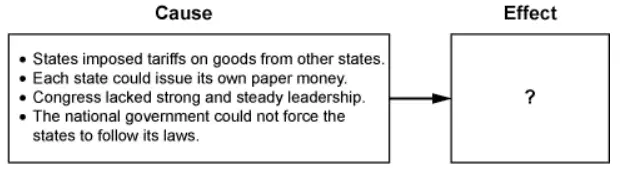
Use the diagram to answer the question.
Which of these statements correctly completes the "Effect" box on the right?
The Bill of Rights was added to the Articles of Confederation.
The Articles of Confederation were replaced by the Constitution.
The Constitution was amended to win approval by the Federalists.
The Continental Congress adopted the Declaration of Independence.
What was the purpose of the preamble to the Declaration of Independence?
To outline the form and responsibilities of each branch of government
To say that people can overthrow a government that takes away their natural rights
To describe how colonists felt they had been hurt by the King of England
To say the Thirteen Colonies were declaring their independence from England
Which of the following was NOT a power given to the national government under the Articles of Confederation?
The power to declare war
The power to coin money
The power to levy taxes
The power to send and recall ambassadors

Answer the question to the left
Georgia's British Royal Governors
Georgia's Revolutionary War Heroes
Georgia's Delegates to the Constitutional Convention
Georgia's Signers of the Declaration of Independence
What was the main reason why Georgia colonists did not respond to the Stamp Act protests?
Georgia had a smaller population compared to other colonies.
The Trustees opposed the Stamp Act.
Georgia's Royal Governor supported the Stamp Act.
The economy of Georgia was not affected by the Stamp Act.
Which statement is true about Loyalists and Patriots in Georgia before the Revolutionary War?
There were more Loyalists than Patriots.
The Governor of Georgia was a Loyalist.
Most Georgians were Patriots.
Loyalists left Georgia before the war began.
Why were Georgians less upset about the Proclamation of 1763 compared to other colonists?
It allowed them to trade with American Indians in Georgia.
Georgia gained land and resources from the Spanish and American Indians.
They were exempt from the taxes imposed on other colonists.
It created a buffer colony between Georgia and the Spanish in the west.
Which statement about GA regarding the French and Indian War is correct?
Georgia gained new territory.
Georgia’s colonists suffered great losses of life and property
Georgia was a buffer zone in the fighting between the French and Indians
Georgia was the only colony to support the French against the British in the war
Why did Georgia NOT want to fight against Great Britain in the Revolutionary War?
Georgia was friends with Great Britain
Georgia was afraid of Great Britain
Georgia was financially dependent on Great Britain
Georgia would lose land
During the French and Indian War, why did most of the Native American tribes' side with the French?
The Indians were trading partners with the French
The Indians were trading partners with Great Britain
The Indians were trading partners with Spain
The Indians were trading partners with Italy
Which statement BEST describes Georgia’s gains from the French and Indian War?
GA gained lands to the south and east
GA gained lands to the north and west, part of Florida, and water access
GA gained land, naval stores and timber, farm acreage, and new settlers
GA gained the Creek and Cherokee Indian lands and gold mines
Which statement BEST describes how the French and Indian War led to America’s Revolutionary War?
Great Britain gained control of Canada
France lost the Louisiana Territory
France incited rebellion in the colonies and enticed Spain to move into the territory
To get money to repay war debts, Great Britain taxed the colonies
What law forbade colonists to move west of the Appalachian Mts?
Proclamation of 1763
Proclamation of 1825
Proclamation of 1732
Proclamation of 1822
Thanks to the Proclamation of 1763, Georgia’s southern boundary was moved to what river?
Mississippi River
St Mary's River
Nile River
Chattahoochee River
What is the opening part of the Declaration of Independence called?
articles
preamble
grievances
amendments
What is included in the middle part of the Declaration of Independence?
Amendments
Preamble
Grievances
Statement of Separation
When was the Declaration of Independence approved
July 4th, 1776
August 9th, 1865
January 1777
Also called Tories
loyalists
patriots
whigs
also called Whigs
Patriots
Whigs
Tories
Loyalist
Elijah Clark led the fight in which war?
Battle of kettle Creek
Siege of Savannah
Which Battle did the Patriots win?
Battle of Kettle Creek
Siege of Savannah
This attack made Georgia the only colony officially retaken by the British
Battle of Kettle Creek
Siege of Savannah
America's first written Constitution?
Articles of Confederation
Declaration of Dependence
Constitution of 1850
Stamp Act
The US Constitution was actually signed by only TWO of the Georgia’s four delegates. Who are they?
William Few, Abraham Baldwin
George Walton, Lyman Hall
William Few, Lyman Hall
George Walton, Abraham Baldwin
Who was the black soldier who was seriously wounded at the Battle of Kettle Creek?
Austin Dabney
George Washington
George Walton
Elijah Clark

