wayground logo

Free Printable Worksheets

NEW

Font size

S
M
L
XL
Worksheets

Integrated Science 2 Pre-Test

Total questions: 45

Worksheet time: 34mins

Name
Class
Date
1.

Who proposed the idea that all things are made up of indivisible atoms?

a)

Leucippus

b)

Democritus

c)

Epicurus

d)

Dalton

2.

Which scientist discovered the electron?

a)

John Dalton

b)

J.J Thomson

c)

Ernest Rutherford

d)

Niels Bohr

3.

According to Dalton's atomic theory, what are elements made of?

a)

Indivisible and indestructible particles called atoms

b)

Positively charged nucleus and negatively charged electrons

c)

Electron orbitals

d)

A solid sphere

4.

What did Rutherford's Gold Foil Experiment conclude?

a)

Atoms are mostly empty space

b)

Atoms have a solid and indivisible structure

c)

Atoms have a positively charged nucleus

d)

Atoms have electrons orbiting the nucleus

5.

Which scientist proposed the planetary model of the atom?

a)

J.J Thomson

b)

Ernest Rutherford

c)

Niels Bohr

d)

Erwin Schrödinger

6.

According to Bohr's atomic model, where are electrons located?

a)

In a solid sphere

b)

In electron orbitals

c)

In a positively charged nucleus

d)

In specific orbits around the nucleus

7.

What did Schrödinger's atomic model propose about the location of electrons?

a)

They are located in a solid sphere

b)

They are located in specific orbits

c)

They are located in electron orbitals

d)

They are located in the nucleus

8.

Who proposed the plum pudding model of the atom?

a)

J.J Thomson

b)

Ernest Rutherford

c)

Niels Bohr

d)

Erwin Schrödinger

9.

Which atomic model proposed that electrons are located in electron orbitals?

a)

Dalton's model

b)

Thomson's model

c)

Rutherford's model

d)

Schrödinger's model

10.

Which of the following is the best definition for matter?

a)

anything that has mass and volume

b)

the amount of space a substance occupies

c)

how much something weighs on earth

11.

True or False:

Atoms are the basic building blocks of most of the matter around you.

a)

true

b)

false

12.

Which of the following parts of an atom are positively charged?

a)

neutron

b)

proton

c)

electron

d)

nucleus

13.
Which two subatomic particles make up the nucleus of an atom?
a)
Protons and Electrons
b)
Neutrons and Electrons
c)
Electrons and Protons
d)
Protons and Neutrons
14.
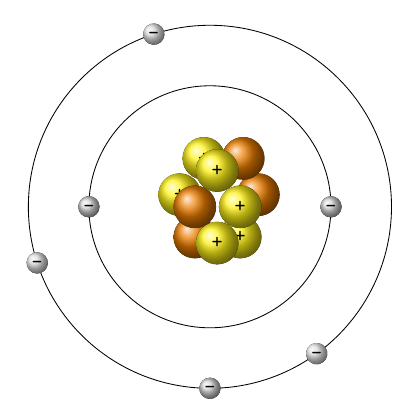
How many protons does this atom have?
a)
3
b)
6
c)
4
d)
2
15.
Isotopes are atoms that have different
a)
Mass numbers
b)
Element names
c)
Atomic Numbers
16.
A positively charged ion is formed when
a)
A neutron is lost
b)
An electron is lost
c)
A neutron is gained
d)
An electron is gained
17.
Two neutral atoms that have the same atomic number and different mass numbers are
a)
Ions
b)
Isotopes
c)
Alpha particles
d)
Different elements
18.
State of matter composed of tightly packed molecules, resulting in a firm substance
a)
Precipitate
b)
Gas
c)
Solid
d)
Liquid
19.
A change in the physical properties of a substance,  which is usually reversible 
a)
Chemical Change
b)
Physical Change
c)
Mass
d)
Conservation of Matter
20.
The Smallest unit of an element 
a)
Atom
b)
Element 
c)
Cell 
d)
Compound
21.
Basic building block of physical matter: cannot be broke down to a simpler structure.
a)
Molecule 
b)
Element 
c)
Solution 
d)
Atom
22.
The smallest unit of a compound 
a)
Element 
b)
Molecule 
c)
Atom 
d)
Cell
23.
A homogeneous mixture of two or more substances
a)
Suspension 
b)
Solution 
c)
Formula 
d)
Compound
24.

Which of the following is a compound?

a)

halo-halo

b)

Salt

c)

Silver

d)

Oxygen

25.

What is a pure substance made of 2 or more elements chemically combined in a specific ratio (Ex. Water)?

a)

Element

b)

Compound

c)

Mixture

d)

Solution

26.

If an unknown substance has a bitter taste and turns red cabbage blue, the substance is most likely a(n) _____.

a)

acid

b)

base

27.

Baking soda is a weak base. Hydrochloric acid is a strong acid. What would happen if these two were mixed?

a)

Nothing would happen.

b)

Neutralization would occur.

c)

It would explode.

28.
A greater applied force is required to move an object with a greater mass than one with a smaller mass.
a)
True
b)
False
29.
The SI units for force are...
a)
Kilograms
b)
Newtons
c)
Meters per second
d)
Pounds
30.
How does Newton’s third law explain how a rocket takes off?
a)
The rocket’s acceleration is positive, while the gasses acceleration is negative but the direction is the same. 
b)
The rocket is at rest until ignition.
c)
The hot gasses move in one direction, while the rocket moves in the opposite direction but with equal force.
31.
A 20 kg bike accelerates at 10 m/s2.  what was the force?
a)
25 Newtons
b)
20 Newtons
c)
200 Newtons
d)
10 Newtons
32.
Leanna decided to rearrange her bedroom by moving her dresser to the opposite wall. She tried pushing it, but found that the dresser would not move. What force was Leanne NOT able to overcome?
a)
electrical force
b)
magnetic force
c)
balanced force
d)
frictional force
33.
Magnets can be a useful tool. Look closely at the picture below which shows a magnet and various metal objects.
What will happen as the magnet moves closer to the metal objects?
 
a)
The magnet will attract the objects.
b)
The magnet will become heavier.
c)
The magnet will push the objects away
d)
Nothing will happen to the objects
34.
The illustration below shows what happened when a balloon touched a girl’s hair.
Which type of force caused the girl’s hair to cling to the balloon?
 
a)
magnetic force
b)
frictional force
c)
electrical force
d)
gravitational force
35.
Bernoulli’s principle states that the pressure in a fluid decreases as its velocity increases. 
a)
True
b)
False
36.
The buoyant force on floating objects equals the weight of the floating object 
a)
true
b)
false
37.
Archimedes' Principle states that... 
a)
The buoyant force acting on an object equals the volume of the fluid displaced by the object. 
b)
The buoyant force acting on an object equals the weight (force of gravity) of the fluid displaced by the object.
c)
The buoyant force acting on an object will always be equal. 
38.
When the weight of an object is greater than the buoyant force, the object will ... 
a)
Sink
b)
Float 
c)
Expand
d)
Shrink
39.

This principle states that the faster a fluid moves, the less pressure the fluid exerts.

a)

Bernoulli's Principle

b)

Newton's Principle

c)

Pascal's Principle

d)

Archimedes' Principle

40.
What is the formula for density?
a)
density = mass x volume
b)
density = mass / volume
c)
density = mass + volume
d)
density = mass - volume
41.
The ship was able to float in the water because its weight was the same as the weight of the water it displaced.
a)
True
b)
False
42.
The amount of force pushing on an area is the definition of....
a)
Fluid
b)
Viscosity
c)
Barometer
d)
Pressure
43.
What principle is this hydraulic press showing?
a)
Archimedes' Principle
b)
Bernoulli's Principle
c)
Pascal's Principle
d)
Principle Testa
44.
The force exerted per unit area is known as
a)
pressure
b)
viscosity
c)
buoyancy
45.
Pressure is calculated or we can solve it using the formula
a)
Pressure = force/area
b)
Pressure = area/force
c)
Pressure = distance/time
d)
Pressure = mass/time