
 Worksheets
Quarter 1 Championship 23
Total questions: 74
Worksheet time: 6hrs 10mins


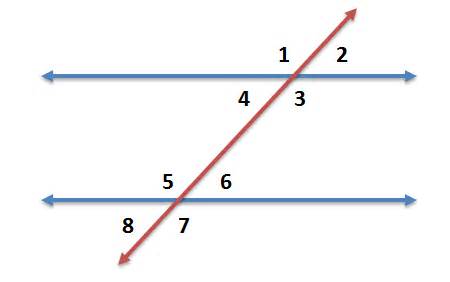

Which set of angle measures could be the interior angles of a triangle?
25°, 30°, 35°
35°, 60°, 75°
45°, 60°, 75°
60°, 90°, 120°


Hint: x + x + x = 180
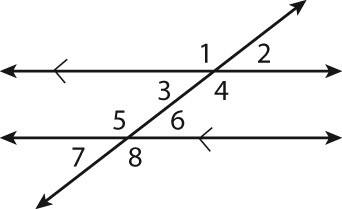

Which two angles are supplementary
∠1 and ∠3
∠2 and ∠6
∠4 and ∠6
∠7 and ∠8
What is the first step to solve?
x-6=-4
subtract 6
add 6
subtract 4
add 4
Solve:
−5+42−8
(a)
What is the first step to solve?
7m=−2
Add 7
Divide 7
Multiply 7
Add 2
What is the first step to solve?
-5 = -2x
Add 5 to both sides
Add 2 to both sides
Divide by 2 on both sides
Divide by -2 on both sides
For the equation, what is the first step to solve?
−5+y=8
Add 5 to both sides
Subtract 8 from both sides
Subtract 5 from both sides
Divide both sides by 5


(a)

Find the missing angle
(a)
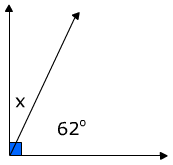

Which equation matches the image?
x + 77 = 180
y + 77 = 90
77 - 180 = y
77 + y = 180
Solve: 5x - 14 = 8x + 4
(a)

Find the missing angle (the one with the '?')
(a)

Find the measure of Angle C--Be careful!
(a)

Find the missing angle (the one with the '?')
(a)

Find the measure of Angle C--be careful!
(a)
Choose all that apply: Which angle measurements below are supplementary to each other?
144 and 36
36 and 54
40 and 50
126 and 54
21 and 159
Choose all answers that apply: Find the angle measurements that are complementary to each other.
75 and 105
75 and 15
25 and 65
34 and 146
38 and 52


11 - 3x = 44
10 - 3x = 4
-3x + 11 = 44
3x = 27.

5x + 7 = 12
What is the first step to solve this equation?
x - 5 = 7 - 2x
Add 7 to both sides of the equation
Add 2x to both sides of the equation
Subtract 2x from both sides of the equation
Subtract 5 from both sides of the equation
What is the next step to solve this equation?
3x - 5 = 7
Add 5 to both sides of the equation
Add 3x to both sides of the equation
Subtract 5 from both sides of the equation
Subtract 7 from both sides of the equation
What is the first step to solve this equation?
3n - 4 = -2 + 2n
Add 2n to both sides of the equation
Add 3n to both sides of the equation
Subtract 2n from both sides of the equation
Subtract 4 from both sides of the equation
What is the next step to solve this equation?
n - 4 = -2
Add 4 to both sides of the equation
Add n to both sides of the equation
Subtract n from both sides of the equation
Subtract 4 from both sides of the equation
What is the first step to solve this equation?
k + 6 = -4k - 9
Add k to both sides of the equation
Add 4k to both sides of the equation
Subtract 9 from both sides of the equation
Subtract 4k from both sides of the equation
What is the next step to solve this equation?
5k + 6 = -9
Add 9 to both sides of the equation
Add 6 to both sides of the equation
Subtract 6 from both sides of the equation
Subtract 5k from both sides of the equation
What is the first step to solve this equation?
3x + 6 = 10 + 3x + 4x
Add 4x to both sides of the equation
Combine like terms 3x and 4x on the same side of the equation
Add 3x and 6 to get 9x
Add 6 and 10 to get 16
What is the next step to solve this equation?
3x + 6 = 10 + 7x
Add 6 to both sides of the equation
Add 10 to both sides of the equation
Add 7x to both sides of the equation
Subtract 7x from both sides of the equation
What is the next step to solve this equation?
-4x + 6 = 10
Add 6 to both sides of the equation
Add 10 to both sides of the equation
Add 4x to both sides of the equation
Subtract 6 from both sides of the equation

Which of the following is NOT a rigid transformation?


Put each in its appropriate category


Rotation 90 degrees Clockwise
Rotation 90 degrees Counterclockwise
Reflection over the x-axis
Reflection over the y-axis

What are the three types of rigid motions for geometric figures?
I. Sliding
II. Flipping
III. Turning
I. Translation
II. Mirror Type
III. Circulation
I. Translation
II. Reflection
III. Rotation

What does congruence mean?
Two objects are congruent if they are the same size and shape.
Two objects are congruent if they are NOT the same size and shape.
Two objects are congruent if they are the same size.
Two objects are congruent if they are the same shape.
When you translate, (x-4 ,y) will move _____.
4 units right
4 units left
4 units up
4 units down

Describe the rotation.
Rotate 90 degrees clockwise about the origin
Rotate 90 degrees counter clockwise about the origin
Rotate 180 degrees about the origin
Rotate 180 degrees


Describe the transformation in the image.
Translation
Reflection
Rotation

Start with the point (2,3).
Reflect across the x-axis
Rotate the point 180 degrees
Which quadrant contains the final point?
I
II
III
IV
Start with the point (-5,-4).
Translate Right 1 and Up 2
Rotate the point 90 degrees Clockwise
Which quadrant contains the final point?
I
II
III
IV
Start with the point (3,-1).
Reflect across the y-axis
Rotate 90 degrees Counterclockwise
Which quadrant contains the final point?
I
II
III
IV
Start with the point (5,5).
Rotate 180 degrees
Reflect across the y-axis
Which quadrant contains the final point?
I
II
III
IV
Point x is at (8,12)
The point is dilated with a scale factor of 41 to form x'
What are the coordinates of x'?
(make sure to enter coordinates correctly!)
(a)
Point x is at (-15,20)
The point is dilated with a scale factor of 51 to form x'
What are the coordinates of x'?
(make sure to enter coordinates correctly!)
(a)

a
b
c
d

What will the equation look like after you combine like terms?
-5x + 5 = 35
x + 5 = 35
5x + 5 = 35
-x + 5 = 35


Find the measure of x:
(a)

ELIMINATOR!
Find the perimeter of the large triangle.
(a)

