
 Worksheets
Space Unit (Marking Period 1) Review
Total questions: 72
Worksheet time: 38mins
Hubble's Law states that galaxies are moving away from us and the farther the galaxy the ____ it's moving.
slower
faster
If you trace the galaxies' movement backwards, scientists believe they
come together at a point of singularity
spread out further
bounce around randomly
The Big Bang created energy and it expanded in all directions. E=mc^2 explains how this energy turned into
matter
redshift
cooling

What is the unit for distance on the graph? (Click on the graph to enlarge it.)
Mpc
km/s
km
What is the unit for velocity on the graph? (Click on the graph to enlarge it.)
Mpc
km/s
km
How fast should a galaxy be moving if it is located 25 Mpc away from Earth? (Click on the graph to enlarge it.)
14,000 km/s
10,000 km/s
18,000 km/s
How far away from Earth is a galaxy that is moving at 4,000 km/s? (Click on the graph to enlarge it.)
2 mpc
4 mpc
7 mpc
What is wrong with the title of this graph?
There is nothing wrong with this title.
The title is not in the format: "How DV affects IV."
The title is not in the format: "How IV affects DV."

Which wavelength is longest on the visible light spectrum?
red
violet (blue)
orange
green
Which shows objects that are moving AWAY from Earth using the Doppler Effect?
red-shifted
blue-shifted
yellow shifted
As objects move AWAY from Earth, their apparent wavelength
spreads out and gets larger.
squeezes closer and gets smaller.
does not change.

What happens as galaxies move away from Earth?
The apparent wavelength lengthens and shifts towards red.
The apparent wavelength shortens and shifts towards red.
The apparent wavelength lengthens and shifts towards blue.
The apparent wavelength shortens and shifts towards blue.
Scientists hypothesized that the early universe would have been composed of 75% H, 25% He, and less than 1% Li. Upon close study they found:
This was almost exactly the amount actually there which supports the Big Bang Theory
This was almost exactly the amount actually there which does not support the Big Bang Theory
This was very different from the amount actually there which supports the Big Bang Theory
This was very different from the amount actually there which does not supports the Big Bang Theory

Which element is NOT in this star?
hydrogen
helium
magnesium
calcium
Electromagnetic waves transfer ____ from one place to another.
energy
matter
color
the speed of light
Wavelengths with higher frequencies mean they have
greater energy.
less energy.
All electromagnetic waves travel at
the speed of light.
the speed of sound.
the speed of a mechanical wave.
Reorder the following from highest frequency (low wavelength) to lowest frequency (long wavelength).
gamma waves
visible light waves
microwaves
radio waves
This term describes the beginning of a star when it is just clouds of dust and gas (H and He).
Nebula
Protostar
Nuclear Fusion
Brown Dwarf
Main Sequence
If the temperature in the protostar reaches 15 million degrees Celsius, this will happen and the star will start to glow.
Nebula
Protostar
Nuclear Fusion
Brown Dwarf
Main Sequence
If nuclear fusion does NOT happen the star will become a
Nebula
Protostar
Nuclear Fusion
Brown Dwarf
Main Sequence
A star spends most of its "life" here fusing Hydrogen into other elements. Eventually the Hydrogen will run out and the star will begin to "die."
Nebula
Protostar
Nuclear Fusion
Brown Dwarf
Main Sequence
When H Hydrogen runs out, small mass stars will begin to shed their outer layers and swell into a
red giant.
red supergiant.
black hole.
white dwarf.
neutron star.
In a small mas star, a red giant will become ____ when there is no fuel left to burn.
red giant
red supergiant
black hole
white dwarf
neutron star
A large mass stars will become a ____ when the H (hydrogen) runs out.
red giant
red supergiant
black hole
white dwarf
neutron star
When a red supergiant runs out of hydrogen, the huge iron core will collapse under its own weight creating a
red giant
red supergiant
black hole
supernova
neutron star
Supernovas leave behind either a _____ or _______ (select 2)
red giant
red supergiant
black hole
supernova
neutron star
Elements other than H, He, and Li can be created during the main sequence but only up to ___
Carbon (6 protons)
Neon (10 protons)
Oxygen (8 protons)
Iron (26 protons)
Supernovas are such powerful blasts that many other nuclei are fused together forming elements from Fe (26 protons) through
Uranium (92 protons)
Bohrium (107 protons)
Ruthenium (44 protons)
All of them
When two atoms come together and join nuclei under the perfect temperature and pressure _____ occurs.
fusion
fission
When a single element splits its nuclei to become 2+ elements it's known as _______.
fusion
fission
_______ ______ involves the release of an alpha particle (He [2 protons]). The atomic number decreases by 2.
Alpha Decay
Beta Decay
Gamma Decay
______ ______releases an electron. When the electron is ejected one neutron TURNS INTO a proton. This increases the atomic number by 1 and changes the identity of the element.
Alpha Decay
Beta Decay
Gamma Decay
__________ ___________ releases high energy photons.
Alpha Decay
Beta Decay
Gamma Decay
Which type of decay can be blocked by clothing or paper?
Alpha Decay
Beta Decay
Gamma Decay
What type of decay can be blocked using a thin sheet of metal?
Alpha Decay
Beta Decay
Gamma Decay
Which of the following statements is true?
During fusion the number of protons is conserved but the element is not.
During fusion the number of protons is not conserved but the element is.
During fusion the number of protons and the element is conserved.
During fusion the number of protons and the element are not conserved.
What is the element creased by fusing He + He?
Be
B
C
N
What is the element creased by fusing C + He?
O
F
N
Ne
What element would Iron (Fe [26]) become if it went through alpha decay?
Cr [24]
Ni [28]
Mn [25]
Co [27]
What element would Iron (Fe [26]) become if it went through Beta Decay?
Cr [24]
Ni [28]
Mn [25]
Co [27]
none of these - gamma decay releases photons (light)
What element would Iron (Fe [26]) become if it went through Gamma Decay?
Cr [24]
Ni [28]
Mn [25]
Co [27]
none of these - gamma decay releases photons (light)
Which type of energy is stronger: chemical or nuclear?
chemical
nuclear
__________ energy is stored energy.
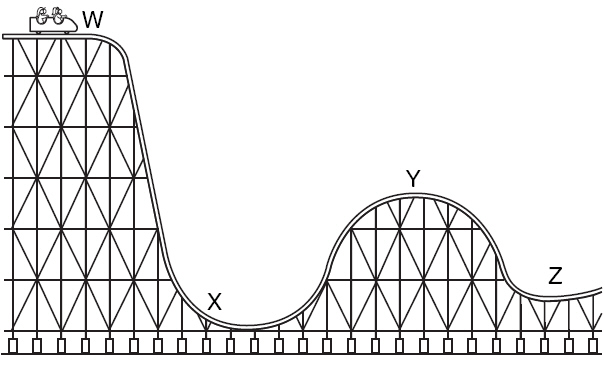
At which point is potential energy greatest?
Heat is a measure of molecular motion. Faster molecular movement = hotter. Which energy form is this?
Thermal
Sound
Electrical
Mechanical
Electromagnetic
Which energy form is described as the vibrations of energy through a substance?
Thermal
Sound
Electrical
Mechanical
Electromagnetic
Which energy form is described as the movement of electrons as in lightning and electricity?
Thermal
Sound
Electrical
Mechanical
Electromagnetic
Which energy form is described as the the energy of motion which is the movement of objects or substances from one place to another?
Thermal
Sound
Electrical
Mechanical
Electromagnetic
Which energy form travels in waves and includes visible light, gamma rays, radio waves, and solar energy?
Thermal
Sound
Electrical
Mechanical
Electromagnetic
Which energy form is stored in bonds of atoms and molecules such as fossil fuels, food, batteries, and matches?
Chemical
Nuclear
Stored Mechanical
Gravitational
Which energy form is stored in the nucleus of an atom? It is the energy that holds the nucleus together as in the nucleus of a uranium atom, the Sun/stars.
Chemical
Nuclear
Stored Mechanical
Gravitational
Which energy form is stored in objects by the application of a force? For example: compressed springs or elastic energy.
Chemical
Nuclear
Stored Mechanical
Gravitational
Which energy form is described as energy of a place or position? For example: water in a reservoir behind a hydropower dam
Chemical
Nuclear
Stored Mechanical
Gravitational
Which of the following elements is fuel for a star?
H
Be
C
O
The fusion of hydrogen + hydrogen creates which of the following elements?
He
Li
H
Be
True or False: Small mass stars (like our sun) have a longer lifespan than large mass stars.
True
False

Which types of energy (From the diagram) reach the surface of Earth?
Radio
Visible light
X rays
Gamma Rasy
As a star ages what happens the quantity (amount) of H and He?
The amount of H decreases as it fuses into larger elements such as He.
The amount of H increases as it fuses into larger elements such as He.

Which process releases provides the most energy?
Chemical
Fission
Fusion

How do we know that the sun's energy comes from fusion and not from chemical processes?
Chemical processes (such as a bonfire) are short lived and would not last as long as our sun has.
Flames need oxygen to burn and space has no oxygen so the sun must be using nuclear fusion.
Stars are made primarily of hydrogen and helium which are known to fuse under the correct temperature and pressure.
What were the first three elements to form (even before stars appeared).
H
He
Li
Be
Stars can create larger elements through fusion up through and including _____.
iron [26]
U [92]
Li [3]
O [8]
Supernovas can create larger elements through fusion up through and including _____.
iron [26]
U [92]
Li [3]
O [8]
Which of the following can be determined by looking at a star's electromagnetic waves through a spectrometer?
A star's composition (what's inside it)
Whether the star is moving towards or away from us
How far the star is from Earth
All of these
Which of the following are true?
Kinetic energy is energy in motion and potential energy is stored energy.
Potential energy is energy in motion and kinetic energy is stored energy.
Which of these occur during fusion?
The number of protons and neutrons are conserved and the atom is not conserved.
The number of protons and neutrons are not conserved and the atom is conserved.
The number of protons and neutrons and the atom are all conserved.
The number of protons and neutrons and the atom are not conserved.

What would the element be when C + H are fused?
N
O
F
Ne
What would happen to a Nitrogen atom if it underwent Alpha Decay?
--> He + B
--> He
--> He + F
--> F
What would happen to a Nitrogen atom if it underwent Beta Decay?
--> O
--> He
--> F
--> C
What would happen to a Nitrogen atom if it underwent Gamma Decay?
--> N + He
--> N + photons
--> F
--> C

