
 Worksheets
U3 Exam Review Lectures 3 and 4
Total questions: 67
Worksheet time: 50mins
Reorder the following steps (1-5) of a muscle contraction
Nerve Impulse reaches Neuromuscular Junction
Acetylcholine (ACH) Released by Motor Neuron
ACH binds to Muscle Receptor Sites
Action Potential charge travels down muscle cell
Impulses reaches the SR and Ca+ channels open
Reorder the following (6-10) of the muscle contraction
Ca+ ions diffuse from the SR and bind to troponin molecules
Tropomyosin molecules move and expose specific sites on actin where myosin heads can bind
Cross-bridges form, linking actin and myosin
Actin filaments are pulled toward the center of the sarcomere by pulling of the cross-bridges, increasing the overlap of the thin and thick filaments
The muscle fiber shortens as contractions occurs

The part of the sarcomere that C (Blue) refers to is the...
Actin
Myosin
Troponin
Tropomyosin
Actin
Myosin
Troponin
Tropomyosin
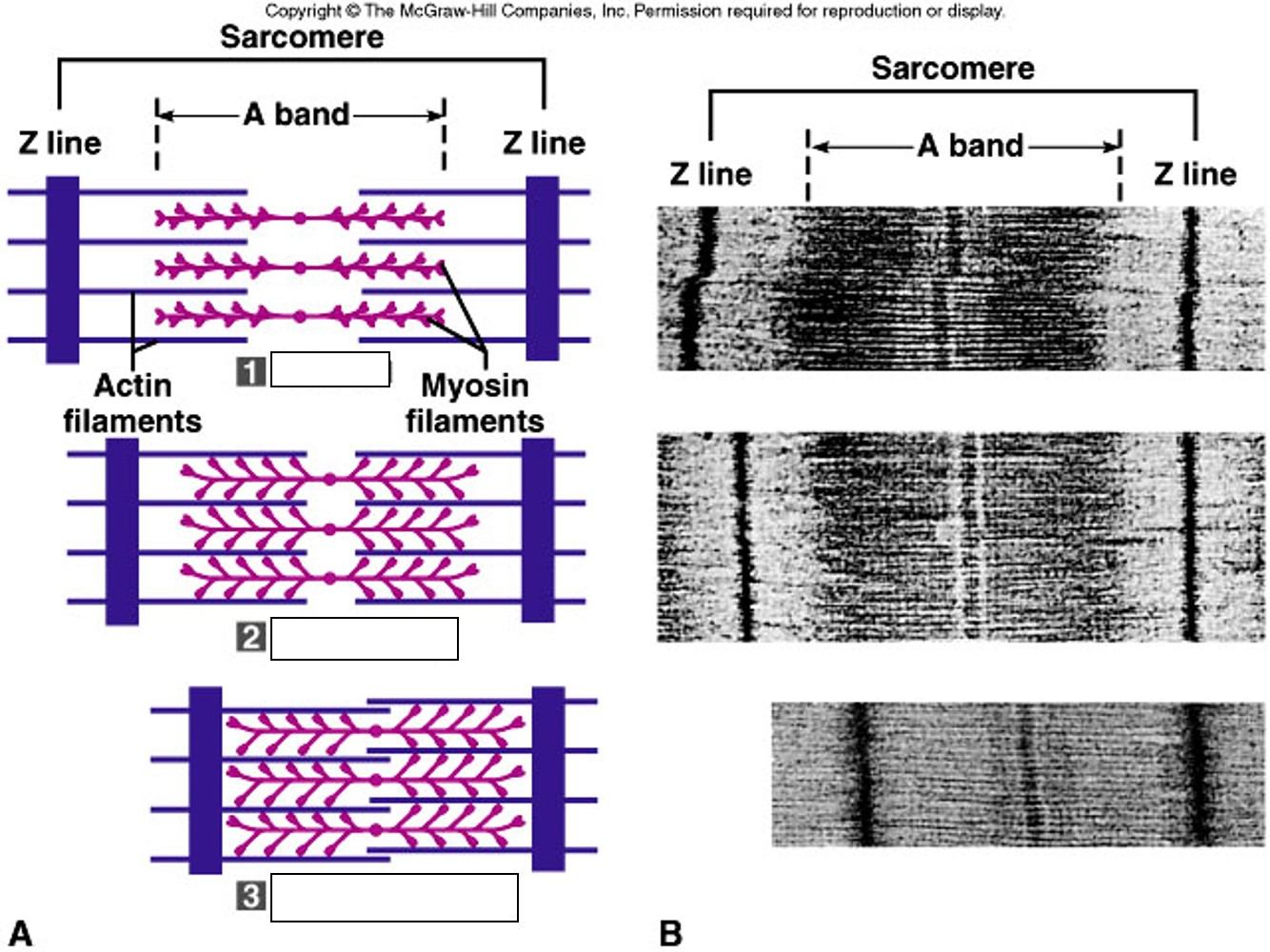
Relaxed
Contracting
Fully Contracted
None of the above
What state is the sarcomere in #2
Relaxed
Partially Contracted
Fully Contracted
None of the above
Relaxed
Contracting
Fully Contracted
None of the above
It disappears
gets closer together
It gets bigger
None of these
Sarcomere
Osteon
Myofilament
Muscle fiber
Sarcomeres
Sarcoplasm
Actin
Myosin
ATPase
Sarcoplasmic reticulum
Actin
Myosin

How may sarcomeres are shown above?
6
5
4
3
Put steps of contraction in order.
rest, nerve action, ACh released, transmitted, Ca released
ACh released, Ca released, nerve action, transmitted, rest
rest, nerve action, Ca released, ACh released, transmitted
ACh released, Ca released, transmitted, nerve action, rest
When the action reaches the muscle cell, it travels down the....
Sarcolemma
T Tubules
Sarcoplasmic Reticulum
Calcium Channel
After calcium is released from the SR, it binds to _________
troponin
tropomyosin
actin
myosin
Troponin moves the ____________ uncovering binding sites.
actin
troponin
tropomyosin
myosin
A calcium deficiency would
create uncoordinated muscle contractions
allow muscle contraction, but not relaxation
prevent contraction by preventing myosin from binding to actin
have no effect on contraction
Another name for the prime mover is
antagonist
agonist
synergist
fixator
A muscle that helps the agonist is called a
antagonist
agonist
synergist
fixator
What is the opposing muscle group for the quadriceps?
biceps
lower back
hamstrings
obliques

In knee flexion, which is the agonist? (the one contracting or getting shorter)
hamstrings
quadriceps
What is the agonist and what is the antagonist in a bicep curl?
biceps are the agonist, triceps are the antagonist
triceps are the agonist, biceps are the antagonist
A muscle can be a agonist for one movement and an antagonist for a different movement
true
false
The agonist and antagonist work in __________ to create movement
tandem
random
opposition
synchronization

Identify the quadriceps
5
8
6
13
Identify the hamstrings
5
8
6
13
Identify the tibialis anterior
5
8
6
13
Identify the gastrocnemius
5
8
6
13
Identify the sternocleidomastoid
1
9
7
10
Identify the trapezius
1
9
7
10
Identify the deltoid
3
2
11
8
Identify the pectorals
3
4
7
12
Identify the biceps
3
4
11
12
Identify the triceps
3
4
11
12
Identify the abdominals
3
4
11
12
Identify the latissimus dorsi
3
4
11
12
This muscle group rotates the head and flexes the neck
Trapezius
Pectorals
Sternocleidomastoid
Latissimus dorsi
This muscle group elevates, depresses, and retracts the scapula
Trapezius
Pectorals
Sternocleidomastoid
Latissimus dorsi
This muscle group abducts the arms
deltoid
biceps
triceps
pectorals
This muscle group flexes the shoulder (arms forward)
deltoid
biceps
triceps
pectorals
This muscle group flexes the elbow
deltoid
biceps
triceps
pectorals
This muscle group extends the elbow
deltoid
biceps
triceps
pectorals
This muscle group bends the torso in a forward direction (think crunches), balance
abdominals
latissimus dorsi
trapezius
sternocleidomastoid
This muscle group adducts the arms
abdominals
latissimus dorsi
trapezius
sternocleidomastoid
This muscle group flexes the hip (legs forward)
quadriceps
hamstrings
tibialis anterior
gastrocnemius
This muscle group extends the hip (legs back)
quadriceps
hamstrings
tibialis anterior
gastrocnemius
This muscle group moves in a dorsiflexion motion
quadriceps
hamstrings
tibialis anterior
gastrocnemius
This muscle group moves in a plantar flexion motion
quadriceps
hamstrings
tibialis anterior
gastrocnemius


What type of contraction is happening here??
isostabilize
isokinetic
isotonic
isometric

What is the correlation between muscle fatigue and oxygen debt?
When O2 decreases, muscle fatigue increases
When O2 increases, muscle fatigue decreases
When O2 is obtained, muscle fatigue decreases
The lesser the oxygen debt, the lesser the muscle fatige
What is the correlation between lactic acid, ATP, and muscle contractions?
increase in lactic acid, decrease ATP, decrease in muscle contraction
increase in lactic acid, decrease ATP, increase in muscle contraction
increase in lactic acid, increase in ATP, decrease in muscle contraction
increase in lactic acid, increase in ATP, increase in muscle contraction

