
 Worksheets
9.1 Homework 2
Total questions: 66
Worksheet time: 43mins
Digital sound always sounds better quality than analogue.


How is sound stored on a computer?

What is the process called for converting analogue sound into binary (digital format)?

What is the term for how many samples are taken per second?
Sample Rate
Sample Resolution
Binary
File Size

Where will your internet files be right after you download them?
Videos
My Computer
Document
Downloads

How many tracks are in this project?
2
3
4
1
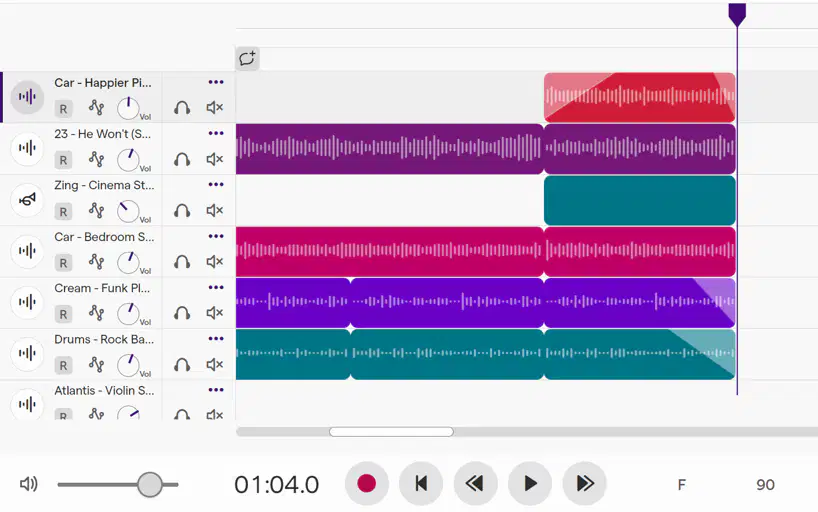
How many minutes and seconds does this piece go for?
1 hour 4 minutes
90 seconds
1 minute 4 seconds
14 minutes
What is sampling?
The number of bits used to represent a digital sound.
Turning a microphone on and off to only record sound at certain times.
Taking measurements of an analogue sound wave at regular intervals.
Combining two digital sound waves into one.
Label the product life cycle diagram in order.
Maintenance
Design a Solution
Develop the Product
Testing & Evaluation
Which of the following describes utility software?
Programs designed to help optimise, maintain and protect a computer system.
Programs that perform a specific task. The user chooses to have these on their device, and every device will be different.
Program to control the general operation of a computer system. Provides an easy way to interact with computer systems and run apps.
Which of the following describes application software?
Programs designed to help optimise, maintain and protect a computer system.
Programs that perform a specific task. The user chooses to have these on their device, and every device will be different.
Program to control the general operation of a computer system. Provides an easy way to interact with computer systems and run apps.
Which of the following describes an operating system?
Programs designed to help optimise, maintain and protect a computer system.
Programs that perform a specific task. The user chooses to have these on their device, and every device will be different.
Program to control the general operation of a computer system. Provides an easy way to interact with computer systems and run apps.
(a) is the physical parts of the computer and (b) is the programs that run on a computer.
Which type of engineer works to create a product that clients directly use?
Software
Product
Hardware
Software
Which type of engineer works to support product engineers and maintains the software?
System
Product
Hardware
Software
Match the following
Product Manager
Decides what needs creating.
Designer
Works out what it will look like.
Software Engineer
Programs it.


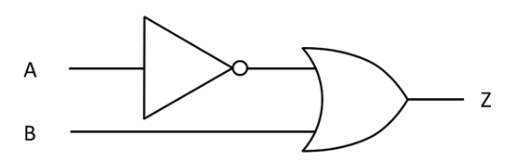
What is the Logic Expression for this circuit?
Z = NOT (A AND B)
Z = NOT (A OR B)
Z = (NOT A) AND B
Z = (NOT A) OR B

If A was 1 and B was 0 in this circuit, what would Q be?
0
1

In this circuit, if A and B were both 0, what would R be?
0
1
Label the Fetch-Decode-Execute Diagram with appropriate descriptions.
Completes the instruction
Collects an instruction from memory
Understands the instruction
What is the definition of memory in computer science?
To store data and instructions currently being used
Which of these is a type of memory?
Which of these is not a type of memory?
Cache
RAM
Virtual Memory
Hard Drive
Why might we use Virtual Memory?
When the RAM is full, instructions can be stored here
Which of these best describes the purpose of the RAM?
To store the all software on the computer system.
To provide long-term storage for files and documents.
Main memory for currently used data and instructions.
To perform calculations and execute instructions.
Label this computer system diagram.
Storage
Input
Output
Process
Memory
Which type of memory is in close proximity to the CPU, and therefore the fastest to access?
RAM
ROM
Virtual Memory
Cache
Which type of memory is in furthest from the CPU, and therefore the slowest to access?
RAM
ROM
Virtual Memory
Cache
Name the optical device that is fairly fragile and easy to snap or scratch.
Solid State / Flash Storage
Magnetic Storage
Optical Storage
Solid State / Flash Storage
Typically has the largest storage capacity and is the cheapest per GB.
Magnetic Storage
Solid Sate / Flash Storage
Optical Storage
Which type of storage is read by a laser?
Magnetic Storage
Optical Storage
Solid State / Flash Storage

How do magnetic storage devices store data?
Using a laser
Using memory cells
By grouping magnets together
By using positive and negative charges
Label these storage devices.
CD
SD Card
Cassette Tape
Hard Disk Drive
Label these storage devices
Blu-ray Disc
Solid State Drive
USB Flash Drive
Floppy Disk

Is the object in the image....
An Embedded System?
General Purpose System?
Music System?
Gaming System?
Which is a disadvantage of an embedded system?
As it is written for specific hardware it often uses low energy consumption.
Smaller in size.
Difficult to program and requires specialist knowledge.
Low cost.
True or False, Embedded Systems use Microprocessors to control specific functions relating to the device they are installed on?
True
False
Which of the following is not an example of an embedded system?
Smart refrigerator
Airfryer
Desktop computer
Microwave
True or False: Embedded systems are always connected to the internet.
True
False
Which component is responsible for storing non-volatile data in an embedded system?
RAM (Random Access Memory)
CPU (Central Processing Unit)
Flash Memory
Cache Memory
There are four main differentiating factors between an embedded system and a typical workstation or server. They are:
Purpose...
...must be specific.
Design...
...is very simple.
Cost...
...is cheap.
Human involvement...
...should be very little.
In binary, what is 1 + 1?
01
10
2
11
When you shift a binary number to the left you will...
Multiply
Divide
When you shift a binary number to the right you...
Multiply
Divide
Moving one place right will
Multiply numbers by 4
Divide numbers by 4
Multiply numbers by 2
Divide numbers by 2
Moving one place left will
Multiply numbers by 4
Divide numbers by 4
Multiply numbers by 2
Divide numbers by 2
A two place right shift on 01001110
00010011
00000010
00100100
00010010
When doing binary division using right shifts the answers are:
Rounded up
Rounded down
What binary digit do you add when doing any logical shift, to use as a placeholder?
0
1
Complete a 2 place right shift on the binary number:
0 1 1 0 1 0 0 0
1 1 1 0 1 0 0 1
0 0 0 1 1 0 1 0
0 1 1 0 1 0 0 0
1 0 1 0 0 0 0 0
Complete a 1 place right shift on the binary number:
0 0 0 0 1 1 0 0
(a)

