
 Worksheets
Protein Synthesis
Total questions: 48
Worksheet time: 27mins
_________ is the process where the sequence of mRNA directs the sequence of amino acids to form a polypeptide chain.
meiosis
transcription
genetic coding
translation
Each 3 letter unit on mRNA is called a _____
molecule
acid
codon
enzyme
Which base is NOT found in RNA?
Uracil
Guanine
Cytosine
Thymine
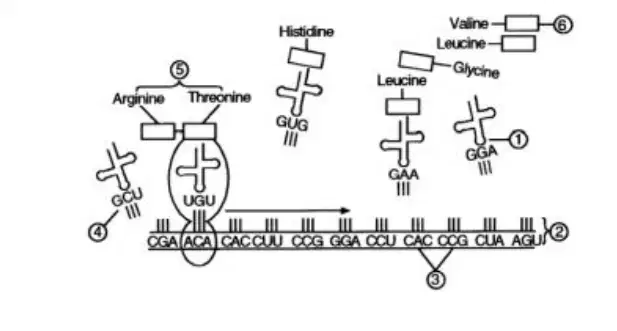
According to the picture, which amino acid will be bonded to CUU?
Histidine
Glycine
Valine
Leucine
The "m" in mRNA stands for _________
messenger
marker
molecule
maker
During translation, what is being produced?
DNA
molecules
proteins
RNA
In DNA, there are 4 base pairs: adenine is complimentary to _________
guanine
uracil
cytosine
What are proteins made of?
links of amino acids
links of DNA
links of nucleotides
links of RNA
What does the "t" in tRNA stand for?
transmit
transfer
transcribe
triple
In RNA, there are 4 base pairs: adenine is complimentary to _________
guanine
uracil
cytosine
Where is DNA found?
cytoplasm
ribosomes
nucleus
cell wall
What does mRNA do during protein synthesis?
takes amino acids to ribosomes
goes from the nucleus to the ribosome to make proteins
is part of the ribosome
in charge of holding on to the genetic sequence of all proteins
What is the complimentary codon to the following in mRNA:
CGA
CGT
GCT
GCU
GGU
What does the "r" in rRNA stand for?
round
rotation
ribbon
ribosomal
What does tRNA do during protein synthesis?
part of the ribosome
holds genetic sequence of all proteins
part of the cytoplasm
transports amino acids to ribosomes
In DNA, there are 4 base pairs: guanine is complimentary to _________
adenine
uracil
cytosine
DNA is known as a __________
protein
single helix
ribonucleic acid
double helix
What molecule is used during transcription that uses information from DNA to create proteins?
RNA
protein
DNA
lipid
Where does RNA go after it leaves the nucleus?
centrioles
vacuoles
ribosomes
mitochondria

Which amino acid does CAA code for?
Arg
Ser
Gln
Ile
RNA is known as a __________
protein
single helix
ribonucleic acid
double helix
The sugar in DNA is _______
ribose
glucose
deoxyribose
celulose
The sugar in RNA is _______
ribose
glucose
deoxyribose
celulose
How many base pairs are in RNA?
1
2
3
4
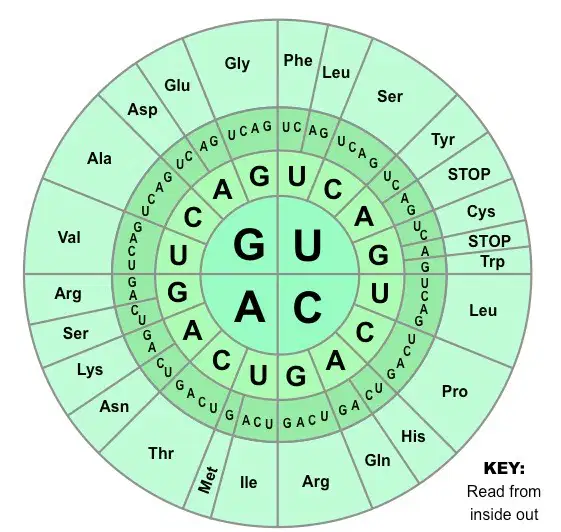
Which amino acid does this segment of DNA code for?
TTT
Arg
Lys
Gln
Ile
What is the complimentary sequence in DNA for the following segment?
TGAC
ACTC
ACUG
UCTG
Are all mutations to genetic information harmful?
yes
no
What is the complimentary codon to the following in mRNA:
TAG
UTC
ATC
UUC
What molecule do organisms get the information for making proteins from?
RNA
enzyme
DNA
amino acids
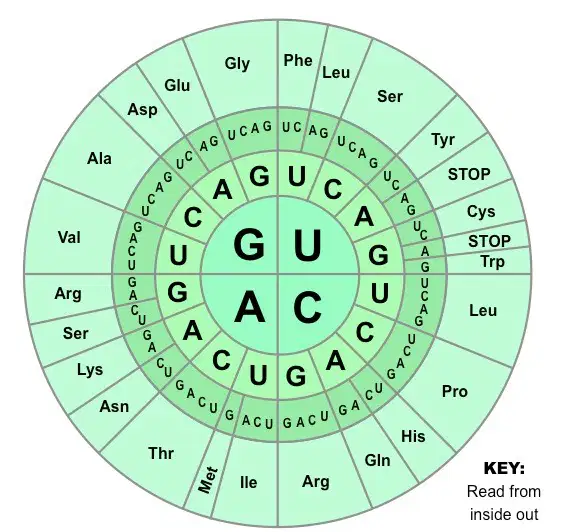
What is the amino acid sequence for the following mRNA sequence:
UCA-GUU-CCG
Ser-Val-Pro
Val-Pro-Ser
Met-Pro-Ser
Ser-Pro-Val
What is the complimentary strand in the following DNA sequence:
GATC
CUAG
CTUG
CTAC
A change in a DNA sequence that results in the same amino acid during protein synthesis would:
have a positive or negative effect
be neutral (have no effect)
What is formed when amino acids are linked together?
nucleotides
more amino acids
proteins
DNA
What is the complimentary RNA strand in the following DNA sequence:
GATC
CTAG
CUTG
GUAC
A deletion of a DNA nucleotide that results in several different amino acids during protein synthesis would:
have a positive or negative effect
be neutral (have no effect)
How many base pairs are in DNA?
1
2
3
4
Ribosomes take the genetic information from mRNA and create which of the following?
more DNA
proteins
more RNA
enzymes
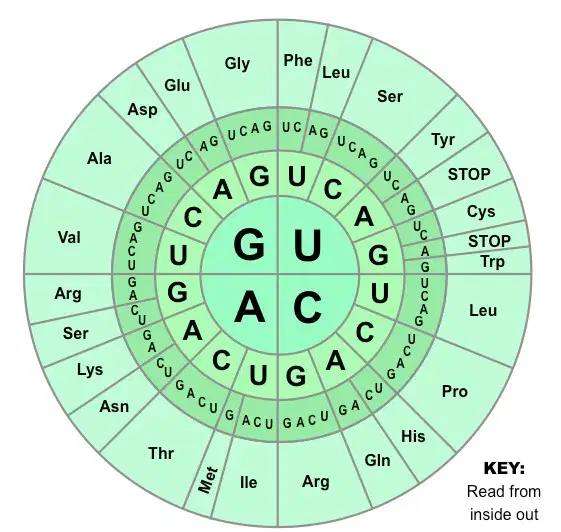
The following sequence of DNA would translate to which amino acid?
ATG
Leu
STOP
Tyr
Arg
In order to create a protein, what does an organism need?
instructions to assemble amino acids
organisms don't make proteins
amino acids
no instructions are needed to assemble amino acids
TRUE/FALSE
A codon never codes for more than one amino acid.
true
false
A change in a noncoding sequence of DNA would:
be harmful
be neutral (no affect)
Going from DNA to RNA is a process called _________
translation
replication
cell cycle
transcription
TRUE/FALSE:
A codon may code for the same amino acid as another codon.
true
false

Name this structure
double helix
nucelotide
twisted ladder
hydrogen bond

This is what part of the nucleotide?
phosphate group
nitrogen base
sugar
fatty acid

This is what part of the nucleotide?
phosphate group
nitrogen base
sugar
fatty acid

This is what part of the nucleotide?
phosphate group
nitrogen base
sugar
fatty acid
Which of the following are the steps of translation? Select all that apply.
Initiation
Termination
Elongation
Complimentary

