
 Worksheets
respiratory G10
Total questions: 29
Worksheet time: 16mins

What is Label A ?
Trachea
Stomach
Ribs
Diaphragm
What is Label B ?
Trachea
Stomach
Right Lung
Diaphragm
What is Label C ?
Trachea
Esophagus
Right Lung
Diaphragm
What is Label D ?
Trachea
Esophagus
Pharynx
Epiglottis
What is Label E ?
Nasal Cavity
Brain
Mouth
Epiglottis
What is Label F ?
Red Blood Cells
Capillaries
Aveolar Sac
Alveoli
What is Label F ?
Red Blood Cells
Capillaries
Aveolar Sac
Alveoli
What is Label G ?
Red Blood Cells
Capillaries
Aveolar Sac
Alveoli
What is Label H ?
Red Blood Cells
Capillaries
Aveolar Sac
Alveoli
What is Label I ?
Right Lung
Plual Cavity
Aveolar Sac
Left Lung
What is Label J ?
Right Lung
Plual Cavity
Main Bronchi
Left Lung
The main function of the respiratory system is to deliver (a) to your cells. This allows them to undergo respiration, allowing them to function, grow and repair.
Another main function of the respiratory system is to remove ______ _______ gas from the body. This can be toxic to the cells if it is not removed.
nitrogen
oxygen
carbon dioxide
helium
The pipe connecting your mouth to your lungs. It is covered in cartilage to keep its shape and help protect it.
(a)
Select ALL the organs that ARE parts of the respiratory system
Heart
Bronchi
Trachea
Capillaries
Small intestine
Select the answer that is most scientifically accurate:
air goes in and out and that's how our body gets oxygen
air gets delivered to our cells through some pipes
oxygen is absorbed from the air and delivered to our cells
oxygen diffuses from the air in our lungs, into our blood cells which then transport the oxygen to our cells
The diaphragm moves down, the ribs expand out and the chest rises. What will happen?
Air will be drawn into the lungs (inhalation/breathing in)
Air will be pushed out of the lungs (exhalation/breathing out)
The diaphragm moves up, the ribs compress inward and the chest becomes smaller. What will happen?
Air will be drawn into the lungs (inhalation/breathing in)
Air will be pushed out of the lungs (exhalation/breathing out)
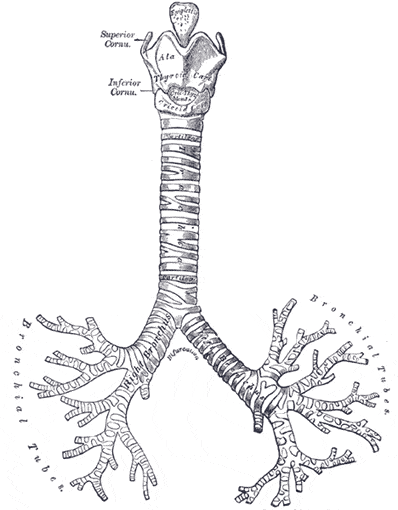
The two main branches from the trachea are called the __________________.
bronchi
alveoli
capillaries
bronchioles
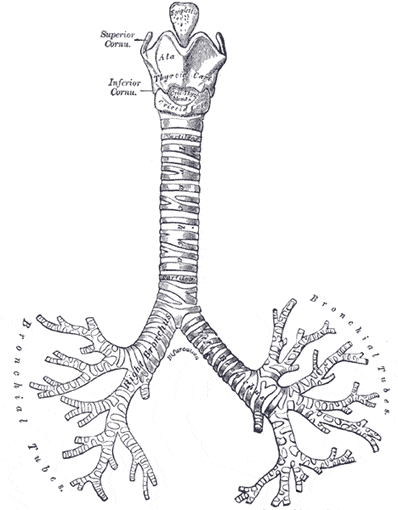
What is tube that is also known as your wind pipe?
esophogus
bronchi
trachea
alveoli
The passage that connects the nose, mouth, windpipe and esophagus is the __________________.
larynx
pharynx
trachea
pleural fluid
The main organ in the respiratory system is the
Heart
Lungs
Alveoli
What is known as the voice box?
pharynx
larynx
esophagus
tonsils
The parts of the respiratory system that allows air to enter the body are ...........
Nose and Pharynx
Diaphragm & lung
Lung and Alveoli
Nose and Mouth

The part of the respiratory system labelled E is the _____________.
trachea
alveoli
pharynx
diaphragm
The part of the respiratory system labelled E is the _____________.
trachea
alveoli
pharynx
diaphragm

In the diagram, part C labels the
voice box
epiglottis
throat
lung

The part of the diagram labeled F is the __________________.
diaphragm
alveoli
epiglottis
larynx

In the diagram, the throat is labeled by the letter _______________.
A
B
D
F

