
 Worksheets
M3 Cat A 24/04 day 1 recap
Total questions: 25
Worksheet time: 9mins
Name
Class
Date
1.
What is the charge of a single electron?
a)
+0.1602×10⁻¹⁸ coulombs
b)
−0.1602×10⁻¹⁸ coulombs
c)
−0.1620×10+18 coulombs
2.
What charge is carried by an atom that has fewer electrons than protons?
a)
It carries a neutral charge.
b)
It carries a negative charge.
c)
It carries a positive charge.
3.
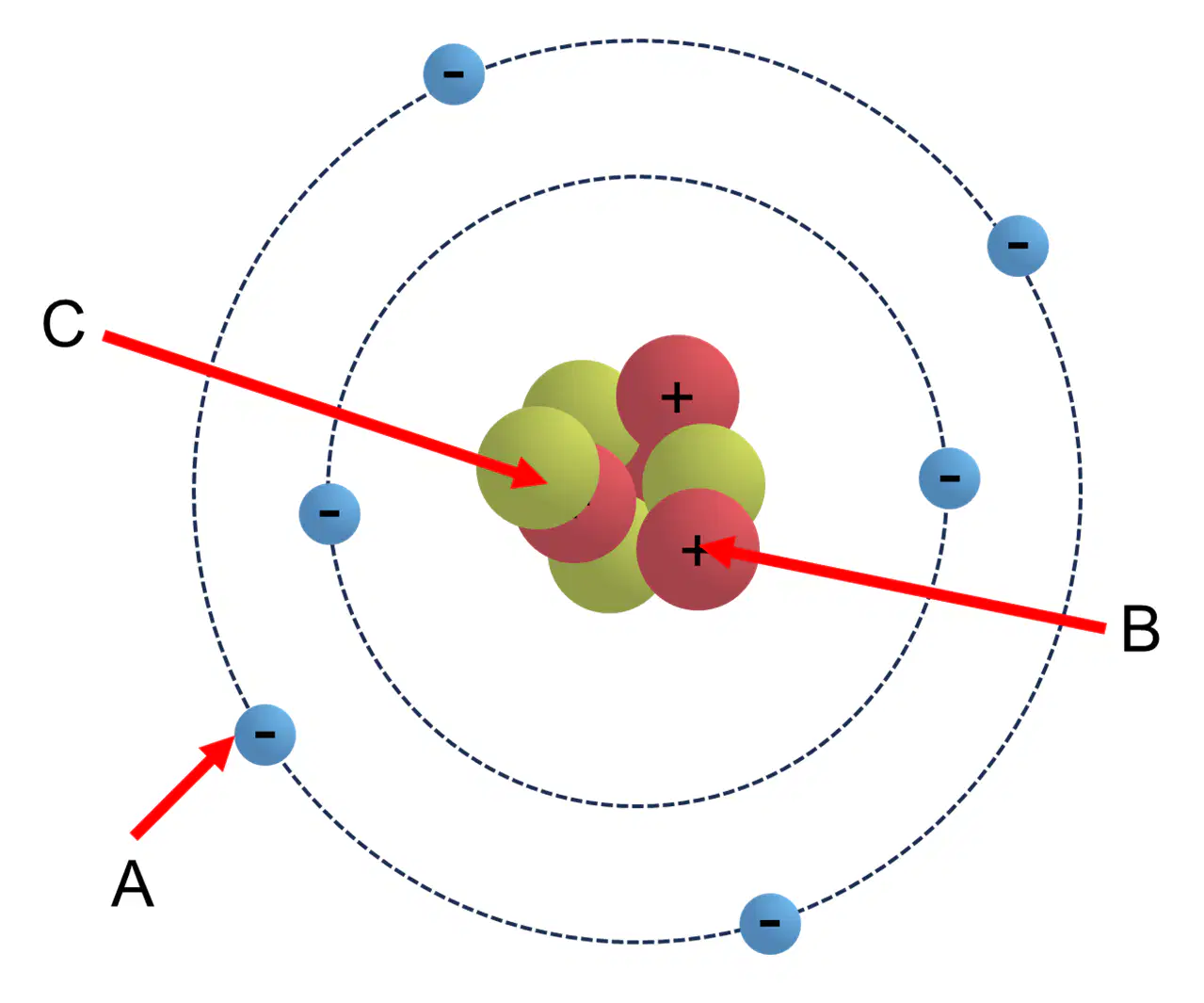
Identify the parts of an atom as indicated on the following figure.
a)
A = Neutron, B = Proton, C = Electron
b)
A = Ion, B = Proton, C = Neutron
c)
A = Electron, B = Proton, C = Neutron
4.
Which of the following elements is NOT a metallic conductor?
a)
Copper
b)
Aluminium
c)
Germanium
5.
When is an atom electrically neutral?
a)
When there are more protons than electrons.
b)
When there is an equal number of protons and electrons.
c)
When there are more electrons than protons.
6.
What term is used to describe a positively or negatively charged atom?
a)
Neutron
b)
Ion
c)
Proton
7.
Which parts of the atom are usually considered to make up its mass?
a)
The electrons and neutrons
b)
The protons and neutrons
c)
The protons only
8.
How many electrons does a semiconductor generally have in its outer orbit (electron shell)?
a)
More than four
b)
Less than four
c)
Exactly four
9.
Which two materials are examples of conductors?
a)
Silver and aluminium
b)
Carbon and mica
c)
Porcelain and silicon
10.
Which of the following materials is the best insulator?
a)
Silicon
b)
Porcelain
c)
Copper
11.
Which statement about electric charges is correct?
a)
Like charges attract each other.
b)
Unlike charges repel each other.
c)
Unlike charges attract each other.
12.
Which symbol is used for charge?
a)
R
b)
Q
c)
S
13.
Which of the following is an application of electron current in a vacuum?
a)
A cathode ray tube
b)
An aircraft battery
c)
An inductive circuit
14.
What happens to a glass rod rubbed with silk?
a)
The glass rod gives up electrons and becomes negatively charged.
b)
The glass rod gives up electrons and becomes positively charged.
c)
The glass rod gives up electrons and becomes neutrally charged.
15.
How many volts is equal to 0.002kV?
a)
20 volts
b)
2 volts
c)
0.2 volts
16.
Which unit is corresponds to 0.001 ampere?
a)
Microampere
b)
Kiloampere
c)
Milliampere
17.
What is voltage sometimes also called?
a)
Magnetomotive force
b)
Electromotive stress
c)
Electromotive force
18.
Which direction do electrons flow?
a)
Negative to positive
b)
Positive to negative
c)
Negative to negative
19.
Which symbol is indicating a low resistance value?
a)
mΩ
b)
MΩ
c)
kΩ
20.
What is the relationship between Conductance and Resistance?
a)
High Resistance - Low Conductance.
b)
High Resistance - High Conductance.
c)
Low Resistance - Low Conductance.
21.
Which of the following is a property of a conductor?
a)
High resistance
b)
Low resistance
c)
No resistance
22.
Which of the following materials is commonly used as a semiconductor?
a)
Copper
b)
Silicon
c)
Iron
23.
What is the unit of electrical resistance?
a)
Ohm
b)
Volt
c)
Ampere
24.
Which of the following materials is commonly used as an insulator?
a)
Copper
b)
Rubber
c)
Aluminium
25.
What is the unit of electric current?
a)
Ampere
b)
Volt
c)
Ohm
100 %

