
 Worksheets
CIW 1D0-541 Exam
Total questions: 121
Worksheet time: 10hrs 5mins
With regard to databases, what is normalization?
The process of reducing the cardinality of a relation
The process of organizing and refining relations
The process of duplicating data to reduce the number of tables
The process of limiting data stored in a table to a specific range of values
Which three pieces of information did E.F. Codd describe as necessary to retrieve a data value from a relational database?
Attribute, domain, and tuple
Entity, relation name, and domain
Table name, primary key, and entity
Attribute, relation name, and primary key
What is a virtual table?
A virtual table is a relation created as the result of data manipulation; it exists only in computer memory, and is not a permanent part of the database.
A virtual table is a relation stored in the database; it is used when multiple users access the same relation in a database.
A virtual table is a relation derived from the database data dictionary; it contains metadata about a base relation. A virtual table is a relation derived from the database? data dictionary; it contains metadata about a base relation.
A virtual table is a relation that consists of primary and foreign keys for a particular set of relations in a database.
Your enterprise has reached the conceptual design phase for a database project. What is the desired goal at the end of this design phase?
A set of normalized relations
A reviewed entity-relationship (ER) model
An entity-relationship (ER) model with no redundant data
A set of denormalized relations
In which phase of database design do you identify entities, attribute domains, and relationships?
Logical
Physical
Application
Conceptual
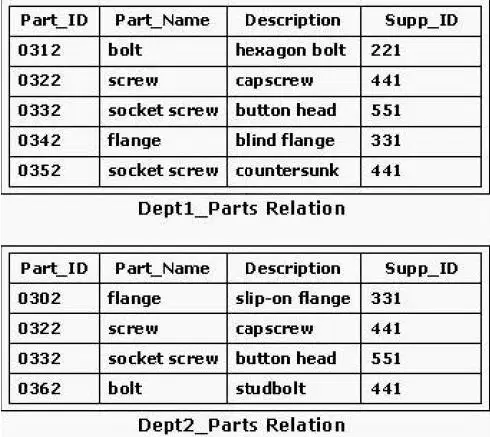
Consider the Dept1_Parts and Dept2_Parts relations shown in the exhibit. Which of the following SQL statements would create a set difference of the two relations with the widest variety of Structured Query Language dialects?
SELECT * FROM Dept1_Parts EXCEPT(SELECT PartJD FROM Dept2_Parts);
SELECT * FROM Dept1_Parts MINUS (SELECT Part_ID FROM Dept2_Parts);
SELECT * FROM Dept1_Parts DIFFERENCE (SELECT Part_ID FROM Dept2_Parts);
SELECT * FROM Dept1_Parts WHERE Part_ID NOT IN (SELECT Part_ID FROM Dept2_Parts);
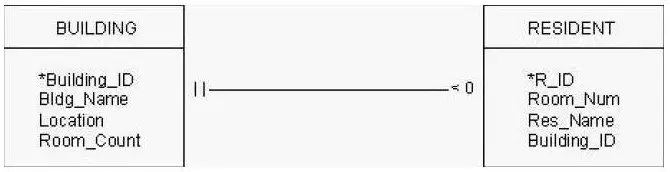
Consider the Information Engineering diagram shown in the exhibit. Building_ID, R_ID, Room_Count and Room_Num are integer numbers, whereas Bldg_Name,
Location and Res_Name are all represented by variable-length strings with a maximum of 20 characters.
Which SQL statement best implements the RESIDENT relation shown in this diagram?
CREATE TABLE RESIDENT ( R_ID INTEGER NULL PRIMARY KEY, Room_Num FLOAT, Res_Name VARCHAR, Building_ID INTEGER NULL, FOREIGN KEY Building_ID REFERENCES BUILDING (Building_ID));
CREATE TABLE RESIDENT ( R_ID INTEGER NOT NULL PRIMARY KEY, Room_Num BINARY, Res_Name VARCHAR (20), Building_ID INTEGER NOT NULL, FOREIGN KEY Building_ID REFERENCES BUILDING (Building_ID));
CREATE TABLE RESIDENT ( R_ID INTEGER NOT NULL PRIMARY KEY, Room_Num INTEGER, Res_Name VARCHAR (20), Building_ID INTEGER NOT NULL);
CREATE TABLE RESIDENT ( R_ID INTEGER NOT NULL PRIMARY KEY, Room_Num INTEGER, Res_Name VARCHAR (20), Building_ID INTEGER NOT NULL, FOREIGN KEY Building_ID REFERENCES BUILDING (Building_ID));
Which term describes one or more database operations that are executed as a single unit?
Update
Transaction
Encapsulation
Operational group
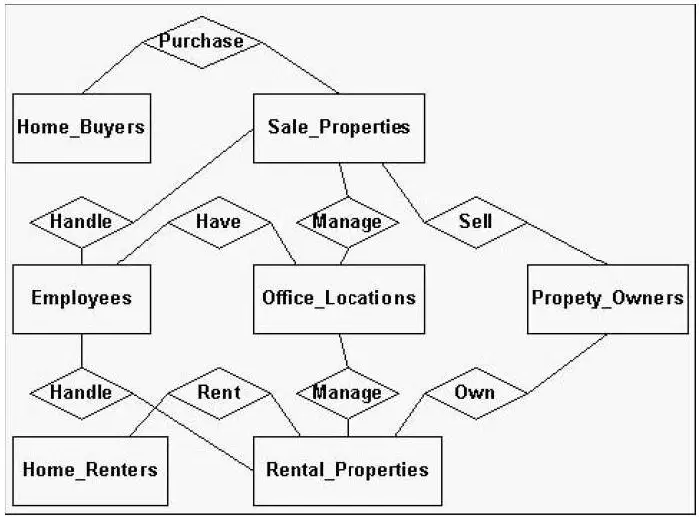
Your enterprise is involved in planning a database project. The exhibit shows the result of one phase of the database design life cycle. Which term best describes the diagram shown in the exhibit?
Information Engineering (IE) data model
Corporate data model
Database requirements model
ERD model
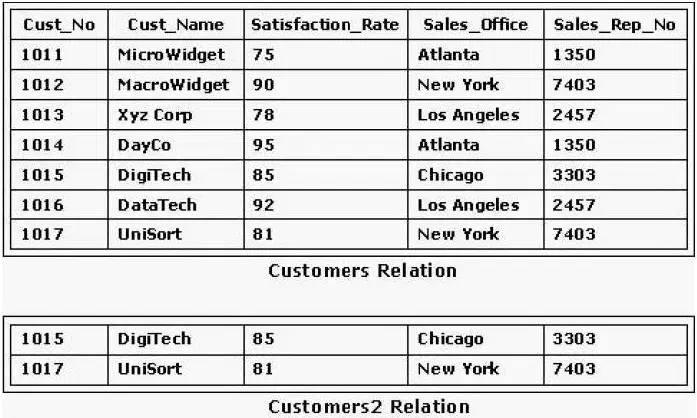
Consider the following relations shown in the exhibit. Which of the following SQL statements would return the Customers2 relation from the Customers relation?
SELECT * FROM Customers WHERE Satisfaction_Rate <= 80 OR Satisfaction_Rate >= 90;
SELECT * FROM Customers WHERE Satisfaction_Rate IN (80 AND 90);
SELECT *FROM Customers WHERE Satisfaction_Rate >= 80 AND Satisfaction_Rate <= 89;
SELECT * FROM Customers WHERE Satisfaction_Rate BETWEEN (80, 90);
Which statement is used to define a named group of related tables, views, domains and other database objects?
CREATE
CREATE TABLE
CREATE DOMAIN
CREATE SCHEMA
Which of the following best describes the ON DELETE NO ACTION referential integrity constraint?
If a parent key is deleted, any child keys referenced by the parent key are automatically deleted.
If a parent key is deleted, no test is made for referential integrity.
If any child key references a parent key, the record containing the parent key cannot be deleted.
If a parent key is deleted, all child keys are automatically set to a specified value. C

Consider the following relational algebraic expression: Which of the following SQL statements is equivalent to this relational algebraic expression?
SELECT * FROM Customers, Employees WHERE Sales_Rep_No = Cust_No;
SELECT Cust_No, Cust_Name, Emp_Name, Emp_Loc FROM Customers, Employees WHERE Customers.Sales_Rep_No = Employees.Sales_Rep_No;
SELECT * FROM Customers, Employees WHERE Customers.Sales_Rep_No = Employees.Sales_Rep_No;
What is a domain?
A normalized set of data applicable to a particular relation
A combination of attributes for a relation
A definition of permissible values for one or more attributes
A set of permissible values for one or more relations
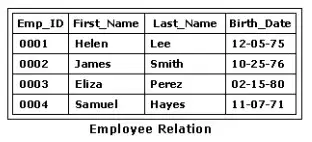
For the Employee relation shown in the exhibit, which set of column value holds the complete tuple for the employee named James Smith?
0002, James, Smith
0002, James, Smith, 10-25-76
First_Name, James, Last_Name, Smith
Emp_ID, 0002, First_Name, James, Last_Name, Smith
Which pair of relational algebraic operations requires union compatibility?
Union and join
Selection and projection
Intersection and difference
Cartesian product and intersection
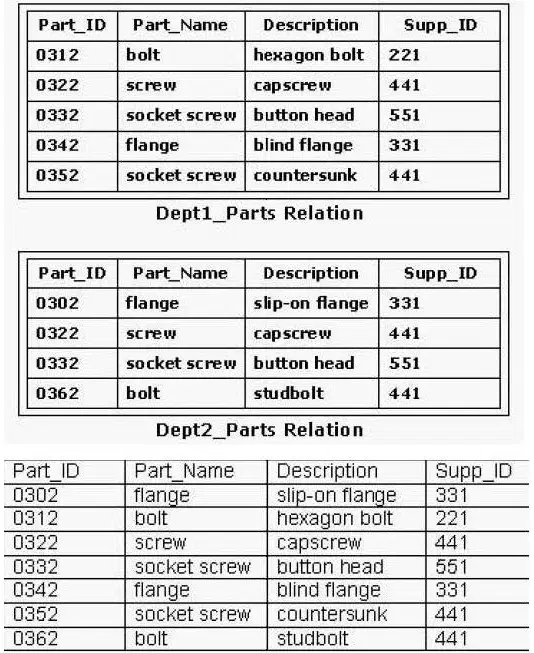
Consider the following table as well as the Dept1_Parts and Dept2_Parts relations shown in the exhibit: Which of the following relational algebraic expressions would result in the given table?
(a)
What is the most important service provided by a database management system?
Provides support for a data manipulation language
Allows users to store data in a distributed data repository
Provides support for data formatting language commands
Translates procedural commands into non-procedural commands
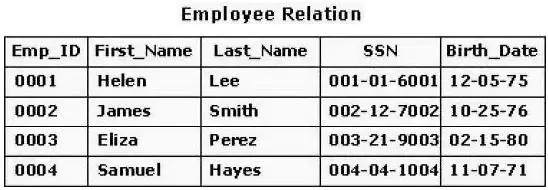
Consider the table for an employee database shown in the exhibit. What is the cardinality of the table?
6
20
4
25
What is a relational database domain?
A group of attributes
A set of permissible tuple values
A collection of related data items
A set of permissible attribute values D
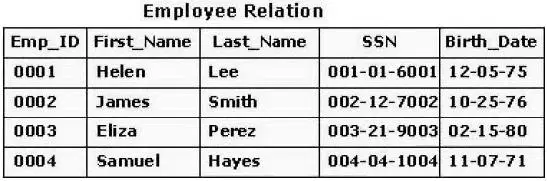
Consider the table for an employee database shown in the exhibit. What is the degree of the table?
25
5
4
20
What improvement can be made to file-based databases to overcome their limitations?
Implement a tabular structure.
Gather files in a distributed repository.
Use a hierarchical database file system.
Tightly couple database structure to database application programs.
NULL) Primary Key Class_Num -
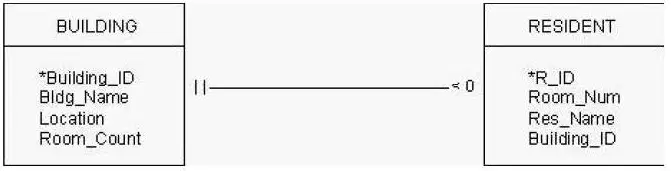
Consider the Information Engineering diagram shown in the exhibit. Which DBDL definition best describes this diagram?
BUILDING(Building_ID, Bldg_Name, Location, Room_Count) Primary Key Building_ID RESIDENT(R_ID, Room_Num, Res_Name, Building_ID) Primary Key R_ID
BUILDING(Building_ID, Bldg_Name, Location, Room_Count) Primary Key BUILDING RESIDENT(R_ID, Room_Num, Res_Name, Building_ID) Primary Key RESIDENT
BUILDING(Building_ID, Bldg_Name, Location, Room_Count) Primary Key BUILDING Foreign Key BUILDING(Building_ID) references RESIDENT (Building_ID) RESIDENT(R_ID, Room_Num, Res_Name, Building_ID) Primary Key RESIDENT
BUILDING(Building_ID, Bldg_Name, Location, Room_Count) Primary Key Building_ID RESIDENT(R_ID, Room_Num, Res_Name, Building_ID) Primary Key R_ID Foreign Key Building_ID references BUILDING(Building_ID)
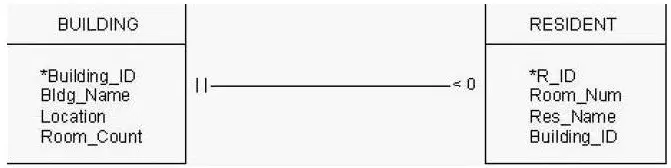
Consider the Information Engineering diagram in the exhibit showing the relations BUILDING and RESIDENT. What is the relationship between BUILDING and
RESIDENT?
1:1
1:N
N:1
M:N
You enterprise must decide whether to use a database management system. Which of the following lists four advantages of using a DBMS?
Management of data redundancy, increased data integrity, increased data dependence, and increased application program flexibility.
Consistency of data, adherence to standards, managed concurrency, and increased software complexity.
Increased data access, increased data backup and recovery, data sharing, and consistency of data.
Increased data security, increased data integrity, increased data independence, and decreased data separation.
Which of the following occurs in a relation when records are added or removed?
The number of domains changes.
The attributes in the domain change.
The cardinality of the relation is fixed but the degree varies.
The degree of the relation is fixed but the cardinality varies.

Your enterprise is creating a relation (shown in the exhibit) that tracks parts and suppliers. Which situation would occur if new supplier information were entered in the relation before any information about specific parts?
An update anomaly and an insertion anomaly would occur.
An insertion anomaly would occur.
A deletion anomaly would occur.
A deletion anomaly and an update anomaly would occur.
The creation of intermediate entities occurs during the logical database design phase for an enterprise. It is used to resolve which types of relationships?
One-to-many and recursive
Complex, recursive, and many-to-many
Redundant, recursive, and one-to-many
One-to-many and one-to-one
Your enterprise is developing a database system that will contain highly sensitive data. Security of the data will take priority over database processing speed.
Which database protection technique should be employed?
Backups
User views
Encryption
Integrity controls
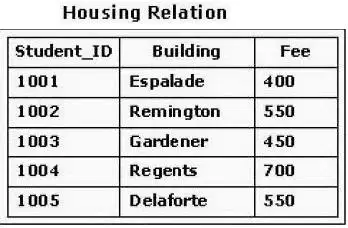
The exhibit shows a table called Housing Relation that relates a unique student identification number with a dormitory building and a room fee for that building.
Each building charges only one fee and a student can live in only one building. The key for the Housing Relation is Student_ID.
This table is in which normal form?
1NF
1NF and 2NF
1NF, 2NF and 3NF
1NF, 2NF, 3NF and BCNF
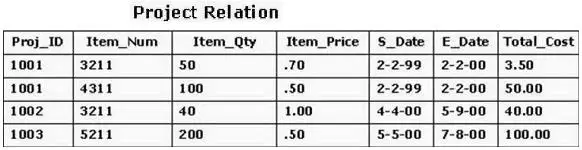
The exhibit shows a relation for a company projects. Which candidate key(s) would best serve as the primary key for this relation?
S_Date and E_Date
ProjJD
ltem_Num and E_Date
Proj_ID and Item_Num
Which of the following best describes a composite key?
A composite key is a primary key that consists of the first two attributes of a relation.
A composite key is a primary or foreign key defined by its parent keys.
A composite key is a foreign key that consists of the same attributes as the primary key from a related table.
A composite key is a primary or foreign key that consists of two or more attributes of a relation.
Consider the following database information:
domain s_id: integer domain grd: fixed length
character string length 1
STUDENT_GRADE(
Student_Number: s_id NOT NULL -
Grade: grd ) Primary Key -
Student_Number -
During which phase of the database design process would this information be developed?
Logical
Physical
Conceptual
Implementation
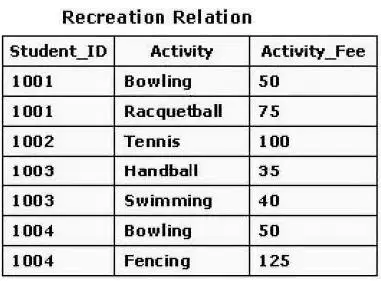
Consider the Recreation relation in the exhibit. A data operation that changes one of the tuples for Student_ID 1003 must be performed. It is necessary to change one of the activities from swimming to tennis. The Student_ID and Activity attributes make up the primary key for the Recreation relation. All related information must be altered, as well. Which SQL statement or statements would best accomplish this?
UPDATE Recreation SET Activity, Activity_Fee (Tennis,100) WHERE Student_ID = 1003;
UPDATE TABLE Recreation ALTER COLUMN ACTIVITY SET ACTIVITY = Tennis', Activity_Fee = 100 WHERE Student__ID = 1003 AND Activity = wimming?AND Activity = ?wimming?
UPDATE Recreation SET Activity = Tennis', Activity_Fee = 100 WHERE Student_ID = 1003 AND Activity = 'Swimming';
DELETE Activity FROM Recreation WHERE Student_ID = 1003; INSERT INTO Recreation VALUES (1003, Tennis', 100);
Which process is used to prevent the current database operation from reading or writing a data item while that data item is being accessed by another operation?
Lock
Deadlock
Time stamp
Transaction
Your company must choose which type of database to use for a new project. Which of the following lists three characteristics of file-based database systems?
Repetition of data, application program flexibility, and data centralization
Incompatibility of files, tabular data structures, and data dependence
Separation of data, repetition of data, and data independence
Application program inflexibility, data dependence, and separation of data
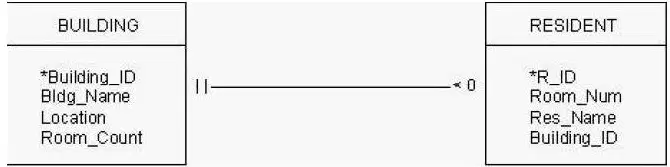
Consider the Information Engineering diagram shown in the exhibit. Building_ID, R_ID, Room_Count and Room_Num are integer numbers, whereas Bldg_Name and Res_Name are represented by variable-length strings with a maximum of 20 characters. Location can be up to 50 characters long, and no building has more than 600 rooms. Which SQL statement best implements the BUILDING relation shown in this diagram?
CREATE TABLE BUILDING ( Building_ID NOT NULL PRIMARY KEY, Bldg_Name, Location, Room_Count);
CREATE TABLE BUILDING ( Building_ID NOT NULL PRIMARY KEY, Bldg_Name, Location, Room_Count, FOREIGN KEY Building_ID REFERENCES BUILDING (Building_ID));
CREATE TABLE BUILDING (Building_ID INTEGER NOT NULL PRIMARY KEY, Bldg_Name VARCHAR (20), Location VARCHAR (50),
CREATE TABLE BUILDING (Building_ID INTEGER NOT NULL PRIMARY KEY, Bldg_Name VARCHAR (20), Location VARCHAR (50), Room_Count INTEGER CHECK (Room_Count > Room_Count INTEGER CHECK ( -1 And Room_Count < 601)); Room_Count > -1 Or Room_Count < 601));
Consider the following four database design activities:
1 - Design user views.
2 - Select a DBMS.
3 - Apply normalization.
4 - Determine entities.
Which choice shows the correct ordering of these activities, from first to last, by assigned numbers?
1,2,3,4
3,4,1,2
4,3,1,2
4,2,3,1
A large enterprise uses a two-tier database architecture and runs complex database applications.
Which term best describes the client in this system?
Fat client
Enterprise client
Thin client
Terminal client
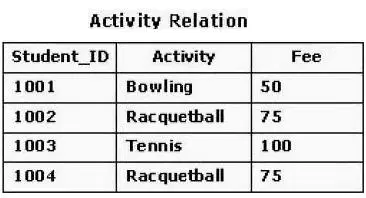
The exhibit shows a table called Activity Relation that relates a unique student identification number with a sports activity and a fee for participating in that activity.
A student can participate in only one activity. The key for the relation is Student_ID. What consequence would occur if the tuple for Student_ID 1001 were removed?
An update anomaly would occur.
An insertion anomaly would occur.
A deletion anomaly would occur.
Both an insertion anomaly and a deletion anomaly would occur.
Which of the following definitions best describes an entity?
A relation
Data about data
Data stored in a table column
An item about which information is stored
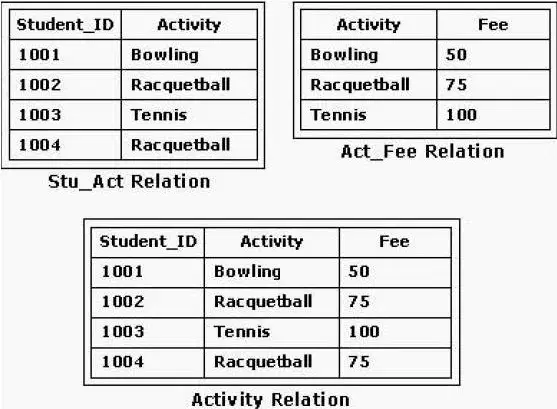
Several SQL operations are performed by User 1 to access the Fee information for Bowling in the Act_Fee relation (shown in the exhibit). The first access returns a fee of 50. An unrelated SQL operation by another user updates the Bowling fee to 60. The second access by User 1 returns a fee of 60. What problem has occurred?
Rollback
Deadlock
Dirty read
No problem has occurred.
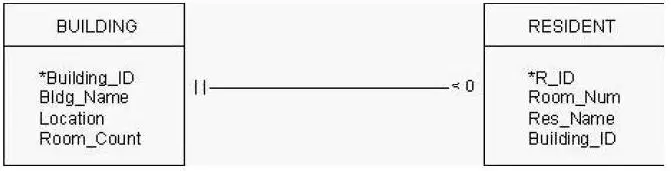
Consider the entity-relationship (ER) diagram shown in the exhibit. What do the characters at the ends of the connecting line indicate?
Degree of a relation
Cardinality of a relation
Primary key of a relation
Determinant of a relation
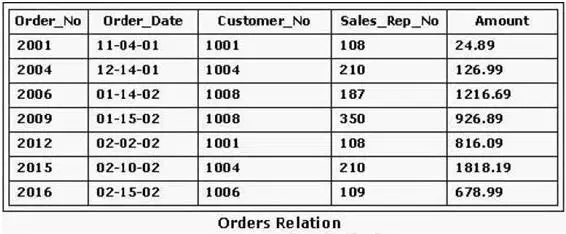
Consider the following SQL statement and the Orders relation shown in the exhibit:
What is the output of this SQL statement?
SELECT *
FROM Orders -
WHERE NOT (Amount < 1000 -
AND Sales_Rep_No = 210);
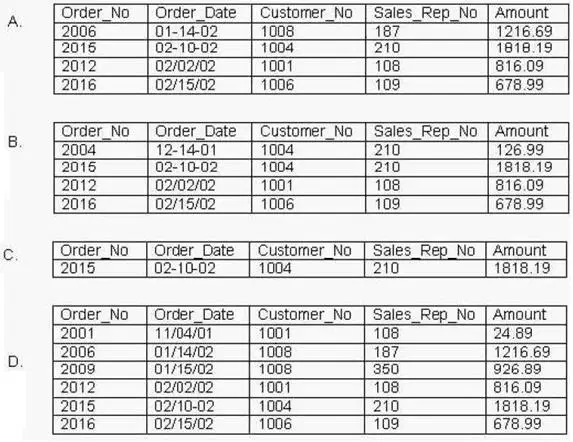
A
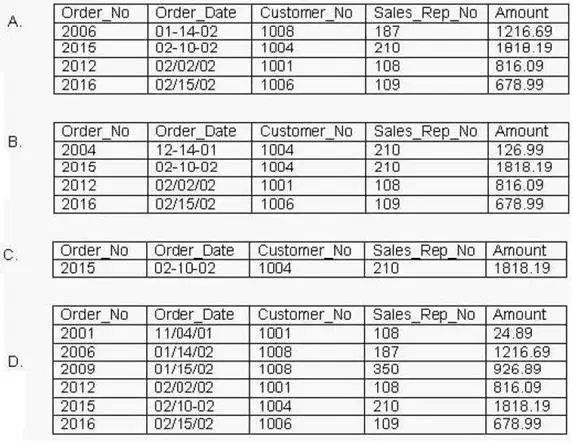
B
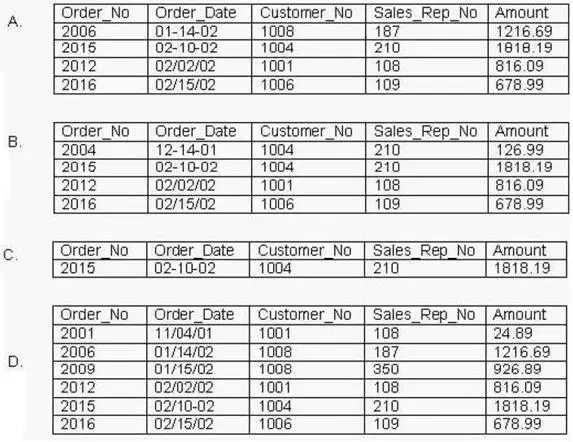
C
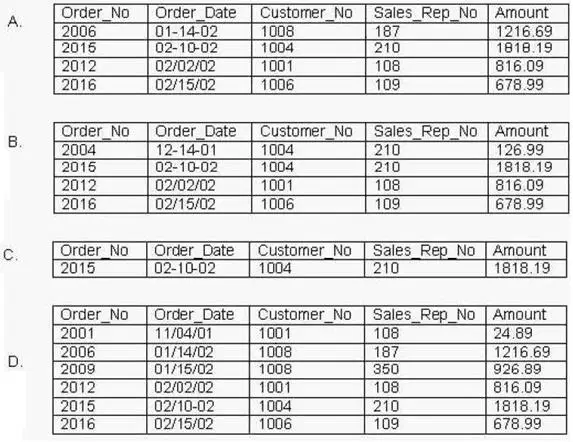
D
Consider the following DBDL description of an entity: Teachers (teach_num: variable length character string length 10 NOT NULL teach_name: variable length character string length 10 NOT NULL) Primary Key: teach_num which integrity constraint is satisfied?
Entity integrity
Necessary data
Referential integrity
Referential foreign integrity

FROM Registration WHERE -
Consider the following relational algebraic expression: Which of the following SQL Course_Code = 'A4343'; statements is equivalent to this relational algebraic expression?
SELECT Sales_Rep_No(108) FROM Orders;
INSERT INTO Orders VALUES(Sales_Rep_No = 108) WHERE Sales_Rep_No = NULL;
SELECT'FROM Orders WHERE Sales_Rep_No = 108;
SELECT'FROM Orders WHERE Sales_Rep_No = ?08?
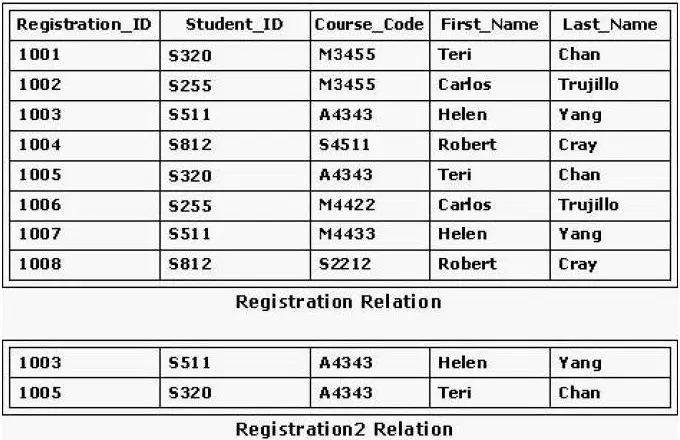
Consider the Registration relation shown in the exhibit. Which of the following SQL statements would return the Registration2 relation from the Registration relation?
SELECT Course_Code FROM Registration;
SELECT * FROM Registration WHERE Registration_ID = 1003 AND Registration_ID = 1005;
SELECT * FROM Registration WHERE Course_Code = A4343';
SELECT Registration_ID, Student_ID, First_Name, Last_Name
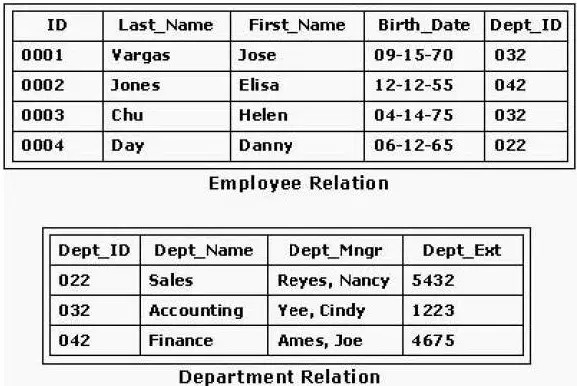
Consider the Employee relation shown in the exhibit. A database manager wants to set up a view called Emp_Dept that allows users to find employees and their department ID numbers. Which SQL statement will accomplish this?
CREATE VIEW Emp_Dept AS SELECT Last_Name, First_Name, Dept_ID FROM Employee;
UPDATE VIEW Emp_Dept AS SELECT * FROM Employee;
UPDATE VIEW Emp_Dept AS SELECT Last_Name, First_Name, Dept_ID FROM Employee;
CREATE VIEW Emp_Dept AS SELECT * FROM Employee WHERE ID = 0001 AND ID = 0002 AND ID = 0003 AND ID = 0004;
Which subset of Structured Query Language (SQL) is used to limit access to a database or its data?
Data Markup Language
Data Control Language
Data Formatting Language
Data Manipulation Language
Which type of relational integrity is violated if a primary key in a database has a null value?
Entity integrity
Domain integrity
Domain constraints
Referential integrity
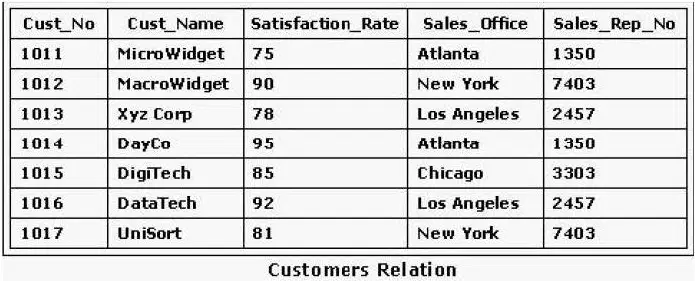
Consider the relation shown in the exhibit. Which of the following SQL statements would properly remove all tuples for New York customers?
DELETE * FROM Customers WHERE Sales_Office = New York;
DELETE FROM Customers WHERE Sales_Office = ew York?WHERE Sales_Office = ?ew York?
DELETE * FROM Customers WHERE Sales_Office = ew York?WHERE Sales_Office = ?ew York?
DELETE FROM Customers WHERE Sales_Office NOT LIKE ew York? WHERESales_Office NOT LIKE ?ew York?
What is a data dictionary?
A system catalog containing user data
An area of the database that is directly accessible by the user
Data that is stored in tables and is only accessible by the DBMS
Metadata that is stored in tables and is only accessible by the DBMS
Which statement best describes a procedural data manipulation language command?
It contains a query language for retrieving data.
It can be used only to manipulate data through a SQL interface.
The user is not required to know how the underlying data structures are implemented.
It requires that the user know how the underlying data structures are implemented.
Which area of database security involves maintaining access to enterprise data?
Theft
Privacy
Availability
Confidentiality
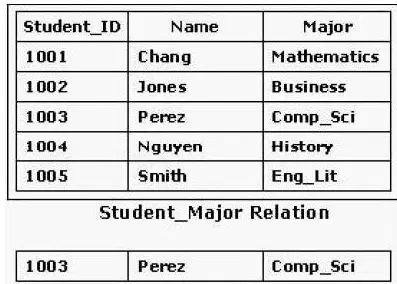
Consider the table shown in the exhibit. Which relational algebraic operation would return Row 3?
Union
Selection
Projection
Difference
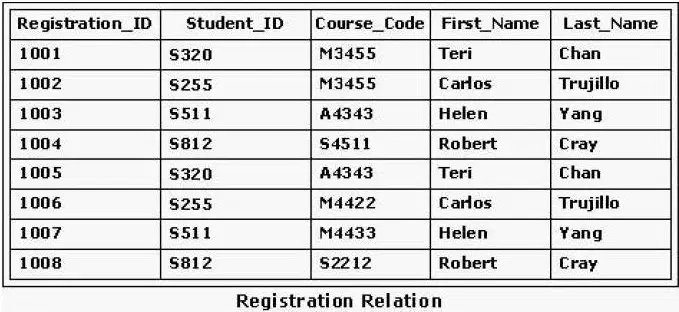
What is the highest normal form of the relation(s) shown in the exhibit?
Second normal form
First normal form
Boyce-Codd normal form
Third normal form
Your database administrator has disallowed a group of users from making alterations to the Employees table in your corporate database. The users, known as
Group_2, previously had full privileges with the Employees table. Which of the following SQL statements properly removes any alteration privileges from Group_2?
REVOKE INSERT, UPDATE, DELETE ON Employees FROM Group_2;
REVOKE UPDATE FOR Employees FROM Group_2;
REVOKE INSERT, UPDATE, DELETE ON Employees FOR Group_2;
REVOKE UPDATE, DELETE FOR Employees FROM Group_2;
Which type of dependency occurs when one attribute of a composite key is removed and the dependency still exists?
1:1
Transitive
Functional
Partial functional
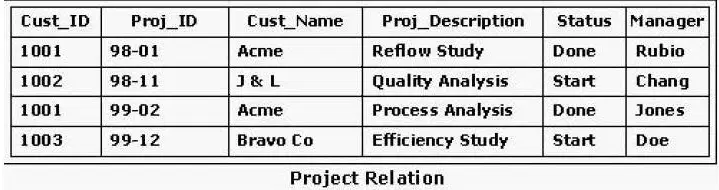
Consider the Project relation shown in the exhibit as well as the following SQL statement:
DELETE FROM Project -
WHERE Cust_Name = Acme;
Which of the following tables shows the Project relation after execution of this SQL statement?
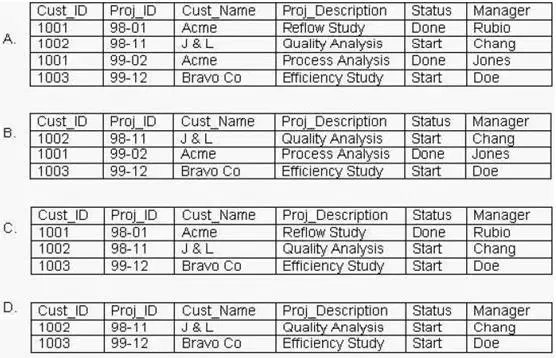
A
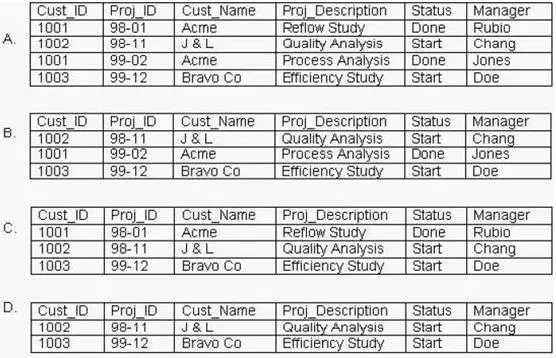
B
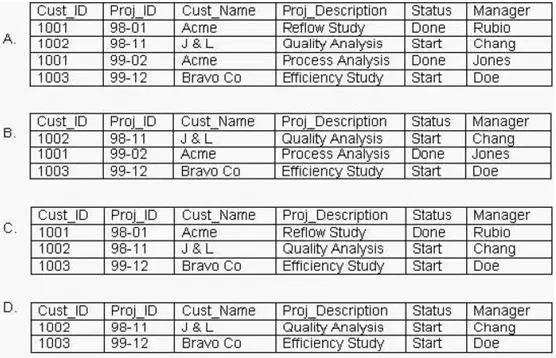
C
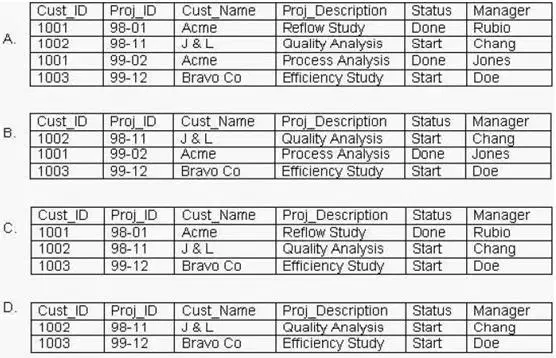
D
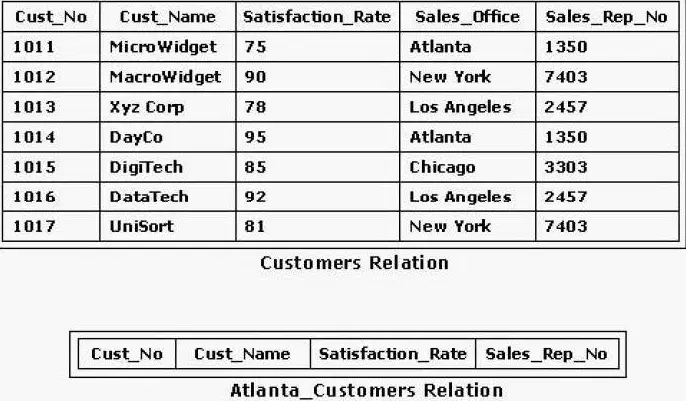
Consider the relations shown in the exhibit. Which of the following SQL statements would enter data from the Customers relation into the Atlanta_Customers relation?
INSERT INTO Atlanta_Customers VALUES( SELECT * FROM Customer s WHERE Sales_Office = Atlanta
INSERT INTO Atlanta_Customers SELECT * FROM Customers WHERE Sales_Office = Atlanta
INSERT INTO Atlanta_Customers SELECT Cust_No, Cust_Name, Satisfaction_Rate, Sales_Rep_No FROM Customers WHERE Sales_Office = Atlanta
INSERT INTO Atlanta_Customers SELECT Cust_No, Cust_Name, Sales_Office, Sales_Rep_No FROM Customers WHERE Sales_Office = Atlanta

Consider the Dept1_Parts and Dept2_Parts relations shown in the exhibit.Which of the following SQL statements would create a set difference of the two relations with the widest variety of Structured Query Language dialects?
SELECT * FROM
Dept1_Parts
EXCEPT(SELECT
PartJD FROM
Dept2_Parts);
SELECT * FROM Dept1_Parts MINUS
(SELECT Part_ID
FROM Dept2_Parts);
SELECT * FROM Dept1_Parts
DIFFERENCE
(SELECT Part_ID
FROM Dept2_Parts);
SELECT * FROM Dept1_Parts WHERE
Part_ID NOT IN
(SELECT Part_ID FROM
Dept2_Parts);
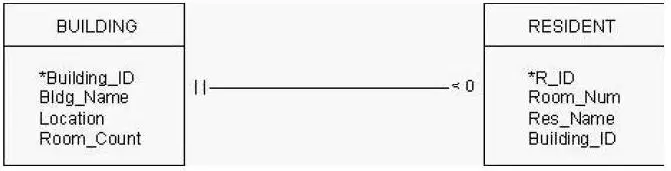
Consider the Information Engineering diagram shown in the exhibit. Building_ID, R_ID, Room_Count and Room_Num are integer numbers, whereas Bldg_Name, Location and Res_Name are all represented by variable-length strings with a maximum of 20 characters.
Which SQL statement best implements the RESIDENT relation shown in this diagram?
CREATE TABLE RESIDENT (
R_ID INTEGER NULL PRIMARY KEY,
Room_NumFLOAT,
Res_NameVARCHAR,
Building_IDINTEGER NULL,
FOREIGN KEY Building_ID REFERENCES BUILDING (Building_ID));
CREATE TABLE RESIDENT (
R_ID INTEGER NOT NULL PRIMARY KEY,
Room_NumBINARY,
Res_NameVARCHAR (20),
Building_IDINTEGER NOT NULL,
FOREIGN KEY Building_ID REFERENCES BUILDING (Building_ID));
CREATE TABLE RESIDENT (
R_ID INTEGER NOT NULL PRIMARY KEY,
Room_NumINTEGER,
Res_NameVARCHAR (20),
Building_IDINTEGER NOT NULL);
CREATE TABLE RESIDENT (
R_ID INTEGER NOT NULL PRIMARY KEY,
Room_NumINTEGER,
Res_NameVARCHAR (20),
Building_IDINTEGER NOT NULL,
FOREIGN KEY Building_ID REFERENCES BUILDING (Building_ID));
Which of the following best describes the two-tier database architecture?
The user accesses a database server using a terminal.
The user interface, data-processing logic, database access and data validation functions are performed on a mainframe server.
The user interface and data validation functions are performed by the client whereas the data- processing logic is performed on a server.
The user interface and data-processing logic are performed by the client whereas the server handles database access and data validation functions.
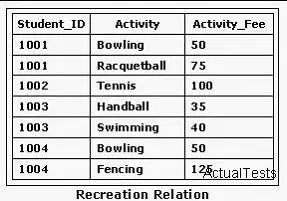
The exhibit shows a table called Recreation Relation that relates a unique student identification number and a sports activity with a fee for participating in that activity. The Student_ID and Activity columns in the table are used together as a composite key. Which statement about the relation is correct?
Activity_Fee is a determinant of Activity.
Activity_Fee is partially dependent on the key.
The table contains a transitive dependency.
Activity_Fee is a determinant of Activity and Student_ID.
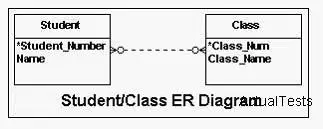
Consider the entity-relation (ER) diagram shown in the exhibit. When the logical database design phase is completed, which of the following is a valid DBDL description of the base relations for the ER diagram?
STUDENT(
Student_Number: integer NOT NULL
Name: variable length character string length 20 NOT NULL) Primary Key Student_Number
CLASS(
Class_Num: integer NOT NULL
Class_Name: integer NOT NULL)
Primary Key Class_Num
STUDENT(
Student_Number: integer NOT NULL
Name: variable length character string length 20 NOT NULL) Primary Key Student_Number
CLASS(
Class_Num: integer NOT NULL
Class_Name: integer NOT NULL)
Primary Key Class_Num
Foreign Key Class_Num References STUDENT
STUDENT(
Student_Number: integer NOT NULL
Name: variable length character string length 20 NOT NULL) Primary Key Student_Number
STU_CLASS(
Student_Number: integer NOT NULL
Class_Num: integer NOT NULL)
Primary Key Student_Number
CLASS(
Class_Num: integer NOT NULL
Class_Name: integer NOT NULL)
Primary Key Class_Num
STUDENT(
Student_Number: integer NOT NULL
Name: variable length character string length 20 NOT NULL) Primary Key Student_Number
STU_CLASS(
Student_Number: integer NOT NULL
Class_Num: integer NOT NULL)
Primary Key Student_Number, Class_Num
CLASS(
Class_Num: integer NOT NULL
Class_Name: integer NOT NULL)
Primary Key Class_Num
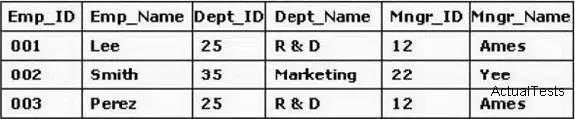
What is the highest normal form of the relation(s) shown in the exhibit?
Third normal form
Second normal form
No normal form
First normal form
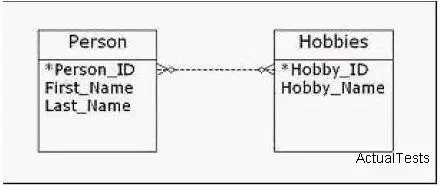
Consider the entity-relationship (ER) diagram shown in the exhibit. Which type of relationship between the two entities is shown?
A recursive relationship
A many-to-many relationship
A one-to-one relationship
A one-to-many relationship
Which of the following SQL statements would return all tuples that have course codes beginning with the letter M?
SELECT * FROM
Registration WHERE
Course_Code = #
SELECT * FROM
Registration WHERE
Course_Code LIKE _
SELECT* FROM
Registration WHERE
Course_Code LIKE %
SELECT * FROM
Registration WHERE
Course Code = %
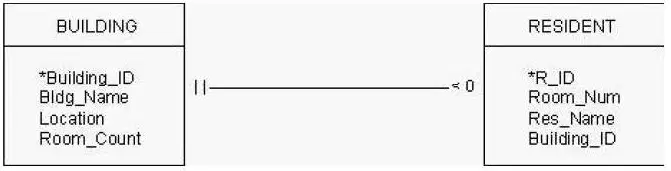
Consider the Information Engineering diagram shown in the exhibit for a building management company. Referential integrity must be maintained such that a building cannot be deleted when it has residents. Building_ID, R_ID, Room_Count and Room_Num are integer numbers, whereas Bldg_Name, Location and Res_Name are all represented by variable-length strings with a maximum of 20 characters. Which SQL statement best implements the relations shown in this diagram?
CREATE TABLE BUILDING (
Building_ID INTEGER NOT NULL PRIMARY KEY,
Bldg_Name VARCHAR (20),
Location VARCHAR (20),
Room_Count INTEGER );
CREATE TABLE RESIDENT (
R_ID NOT NULL PRIMARY KEY,
Room_Num INTEGER,
Res_Name VARCHAR (20),
Building_ID INTEGER NOT NULL,
FOREIGN KEY Building_ID REFERENCES RESIDENT (Building_ID) ON DELETE NO CHECK);
CREATE TABLE BUILDING (
Building_ID INTEGER NOT NULL PRIMARY KEY,
Bldg_Name VARCHAR (20),
Location VARCHAR (20),
Room_Count INTEGER );
CREATE TABLE RESIDENT (
R_ID NOT NULL PRIMARY KEY,
Room_Num INTEGER,
Res_Name VARCHAR (20),
Building_ID INTEGER NOT NULL,
FOREIGN KEY Building_ID REFERENCES BUILDING (Building_ID) ON DELETE NO CHECK
ON UPDATE CASCADE);
Which subset of Structured Query Language (SQL) is used to create and name database entities?
Data Query Language
Database Entity Language
Data Definition Language
Data Manipulation Language
Which statement best describes a candidate key?
It is the primary key for an entity.
It uniquely identifies every instance of an entity.
One or more keys are joined together to form a composite key.
One or more keys may be used to form a primary key.
Which of the following is a characteristic of the three-tier database architecture?
A Web browser is used as the application server.
The application logic is centralized on a dedicated server.
A thick client is used to perform business application logic functions locally.
Database application logic and database functionality are integrated and reside on a common server.
Which term describes an attribute or combination of attributes that uniquely identifies a row in a relation?
Entity
Domain
Primary key
Attribute group
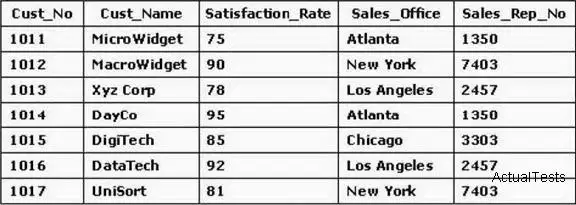
Consider the relation shown in the exhibit. Which of the following SQL statements would return a relation that excludes all customers with a Satisfaction_Rate of less than or equal to 80 unless the Sales_Office is located in Atlanta?
SELECT * FROM Customers
WHERE Satisfaction_Rate > 80
OR Sales_Office = Atlanta
SELECT * FROM Customers
WHERE Satisfaction_Rate <= 80
AND Sales_Office = Atlanta
SELECT * FROM Customers
WHERE Satisfaction_Rate >= 80;
SELECT * FROM Customers
WHERE Satisfaction_Rate >= 80
AND NOT Sales Office = Atlanta
Which mechanism provides database users with controlled access to the database through the use of virtual tables?
(a)
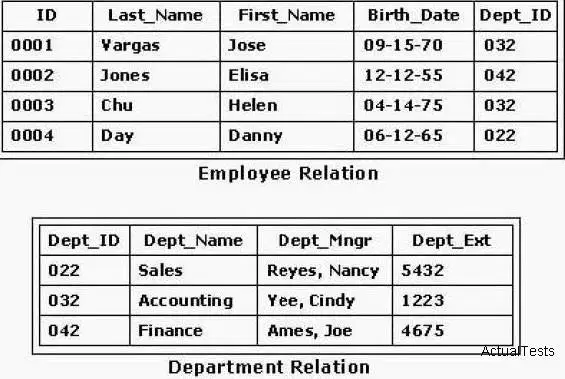
Consider the relational database shown in the exhibit. What is the foreign key in this database?
Employee.Dept_ID
Dept_Mngr
Dept_Name
Department.Dept_ID
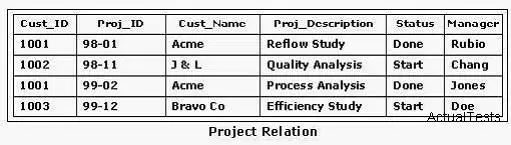
Consider the Project relation shown in the exhibit as well as the following SQL statement:
Which of the following tables shows the Project relation after execution of this SQL statement?
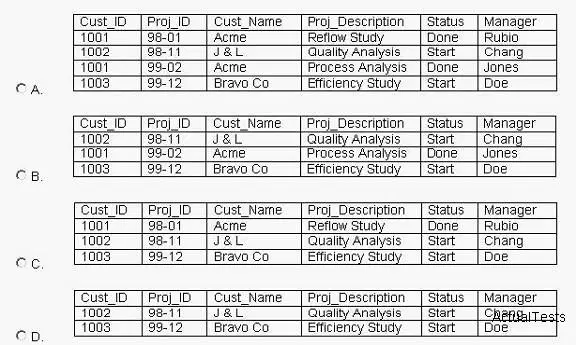
A
B
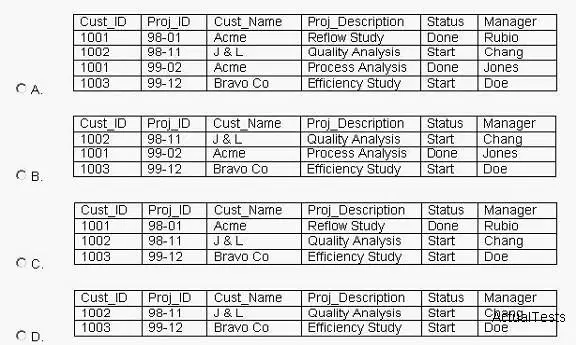
C
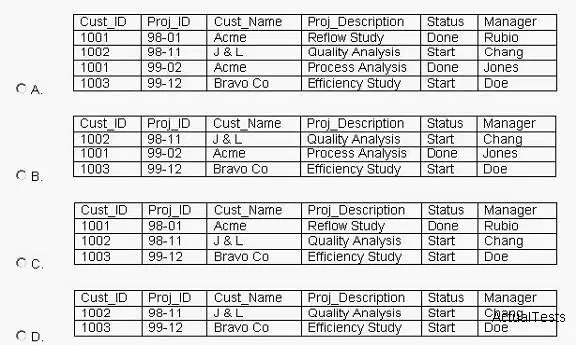
D
Which database architecture is best suited to implementation in the World Wide Web environment?
Two-tier using thin client
Three-tier using fat client
Three-tier using thin client
Centralized mainframe with terminal client
Your enterprise must decide whether to use a database management system. Which of the following best describes the functionality of a DBMS?
A DBMS provides the ability to control data access and limit the number of users at one time.
A DBMS provides the ability to maintain databases while providing increased security for the database.
A DBMS allows users to access the database while allowing the database administrator to define views particular to individual sets of users.
A DBMS provides the ability to define, create and maintain databases while providing controlled access to databases.
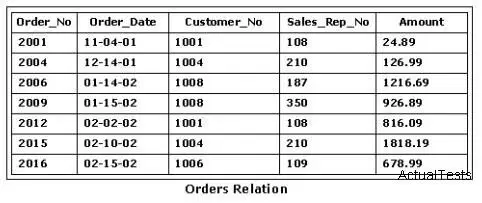
Consider the Orders relation shown in the exhibit. Which of the following SQL statements would return all complete tuples for order dates in 2002, arranged by amount from lowest to highest?
SELECT *
FROM Orders
WHERE Order_Date LIKE _02
ORDER BY Amount;
SELECT (Order_Date, Amount)
FROM Orders
WHERE Order_Date LIKE %02
ORDER BY Amount;
SELECT *
FROM Orders
WHERE Order_Date LIKE 02
ORDER BY OrderNo;
SELECT *
FROM Orders
WHERE Order_Date LIKE %02
ORDER BY Amount;
Which type of entity must reference another entity for its data to be meaningful?
(a)
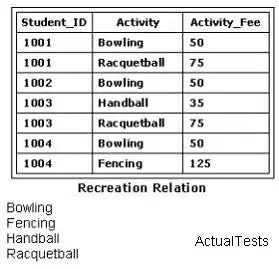
Consider the Recreation relation shown in the exhibit. You need to apply a SQL statement to the Recreation relation that will return the following data:
Which SQL statement applied to the Recreation relation will return this data?
SELECT Activity FROM Recreation;
SELECT DISTINCT Activity FROM Recreation;
SELECT Activity FROM Recreation
WHERE NOT LIKE Activity;
SELECT Activity FROM Recreation
WHERE DISTINCT Activity;
Which component in the three-tier database architecture handles the data-processing and business logic?
Thin client
Fat client
Database server
Application server
In a relational database, which term describes a single table consisting of rows and columns?
Entity
Matrix
Relation
Data dictionary
Which concurrency control method should be used only when conflicts between transactions rarely occur?
Locking
Time stamps
Optimistic
Serialization
Which characteristic is an advantage of a database management system?
Data files are owned and maintained by the users.
Database administration is simplified.
A standard method can be used to access the database.
Data is decentralized.
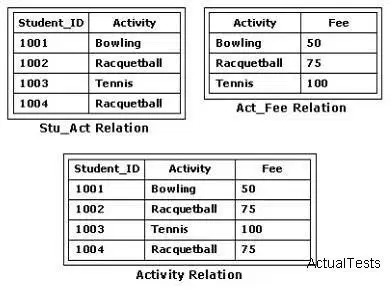
Consider the Stu_Act and Act_Fee tables shown in the exhibit.
Which relational algebraic operation would yield the Activity Relation table in the exhibit?
Union
Intersection
Natural join
Cartesian product
A foreign key maps to a:
prime key.
indirect key.
parent key.
composite key.
Which security technique limits access by unauthorized users to parts of an enterprise database?
(a)
Which of the following ACID properties requires that a transaction be executed in its entirety or not all?
Durability
Consistency
Isolation
Atomicity
To create a view, what are the minimal privileges that a user must have for the relations used to make the view?
(a)
Which database security technique prevents invalid data from being entered into the database?
File locking
User authorization
Parity checks
Integrity controls
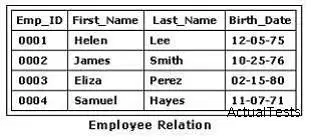
Consider the relation shown in the exhibit. Which of the following SQL statements would properly add information for a new employee?
INSERT INTO Employee VALUES(0005, Tim, Bogart, 03-15-77);
INSERT INTOEmployee(Emp_ID, First_Name, Last_Name, Birth_Date) VALUES(0004, Tim, Bogart, 03-15-77);
INSERT INTOEmployee(Emp_ID, First_Name, Last_Name, Birth_Date) VALUES(0005, Tim, Bogart, 03-05-77);
Which statement accurately describes a characteristic of attributes?
The ordering of attributes in a table is significant.
An attribute contains values from multiple domains.
An attribute name can be used only once per table.
An attribute name can be used only once in a relational database system with multiple tables.
Consider the following relation definition:
STUDENT(
Student_Number: integer NOT NULL
Name: variable length character string length 20 NOT NULL) Primary Key Student_Number
HOUSING(
Housing_ID: integer NOT NULL
Student_Number: integer NOT NULL
Building: variable length character string length 25 NOT NULL) Primary Key Housing_ID
Foreign Key Student_Number References
STUDENT(Student_Number)
ON DELETE NO CHECK
ON UPDATE
Which integrity constraint is violated in this relation definition?
Entity integrity
Domain constraint
Referential integrity
Enterprise constraint
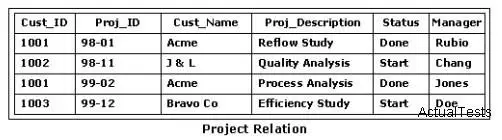
A relation for a construction company is shown in the exhibit. Which of the following best defines the relationship between Cust_ID and Cust_Name?
Cust_Name is the determinant.
Cust_Name is transitively dependent on Cust_ID.
Cust_ID is transitively dependent on Cust_Name.
Cust_Name is functionally dependent on Cust_ID.
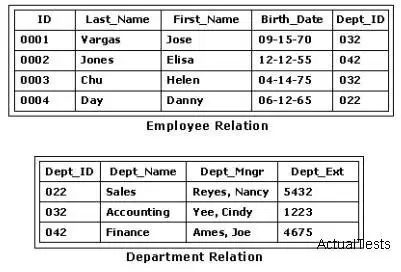
Consider the relations shown in the exhibit. Due to restructuring, the sales department has been eliminated and the employees working in that department have been dismissed. All ID information is stored as integers. Which SQL statement would be used to return a relation with all information for the employees who have been dismissed?
SELECT *
FROM Employee;
SELECT ID,Last_Name
FROM Employee;
WHERE ID = 0004;
SELECT *
FROM Employee
WHERE Dept_ID = 022;
Which term best defines a database system in which data records are stored in one or more files with no structured relationship?
Flat-file database
Relational database
Distributed database
Object-oriented database
Which of the following describes two desirable characteristics of a primary key?
A primary key should be a value that may be null and may change over time.
A primary key should be a value that is not null and will never change.
A primary key should consist of meaningful data and a value that can be changed if needed.
A primary key should not consist of meaningful data and a value that can be changed if needed.
Which relational algebraic operation is used to select specific columns (attributes) from a relation?
Union
Difference
Projection
Intersection
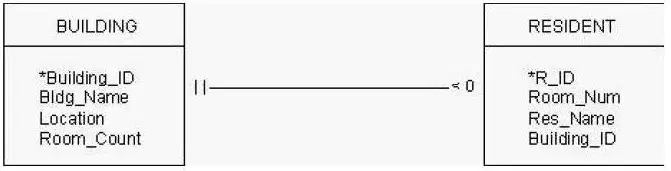
Consider the Information Engineering diagram in the exhibit showing a conceptual data model of the relations BUILDING and RESIDENT. What is the next step in refining the data model?
Create intermediate entities.
Create a logical data model.
Resolve many-to-many relationships.
Identify and resolve complex relationships.
Which of the following best describes the information contained in the data dictionary (or system catalog)?
(a)
Consider the following relation definitions:
STUDENT(
Student_Number: integer NOT NULL
Name: variable length character string length 20 )
Primary Key Student_Number
HOUSING(
Housing_ID: integer NOT NULL
Student_Number: integer NOT NULL
Building: variable length character string length 25 ) Primary Key Housing_ID
Foreign Key Student_Number References STUDENT(Student_Number) ON DELETE NO ACTION
ON UPDATE CASCADE
What are the referential constraints for the relations defined in these relation definitions?
There is no relationship between changes inSTUDENT(Student_Number) and HOUSING(Student_Number).
WhenSTUDENT(Student_Number) is changed or deleted, this modification or deletion will automatically be reflected in HOUSING (Student_Number).
Modifications toHOUSING(Student_Number) are automatically reflected in changes to STUDENT(Student_Number), but deletions are not permitted.
Modifications toSTUDENT(Student_Number) are automatically reflected in changes to HOUSING(Student_Number). For a deletion to occur from STUDENT(Student_Number), it must first occur in HOUSING(Student_Number).
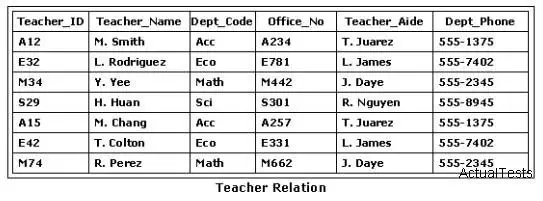
What is the highest normal form of the relation(s) shown in the exhibit?
Boyce-Codd normal form
First normal form
Second normal form
Third normal form

Consider the Dept1_Parts and Dept2_Parts relations shown in the exhibit. Which of the following SQL statements would create an intersection of the two relations with the widest variety of Structured Query Language dialects?
SELECT
FROM Dept1_Parts
AND
(SELECT
FROM Dept2_Parts);
SELECT
FROM Dept1_Parts
INTERSECTION
(SELECT
FROM Dept2_Parts);
SELECT *
FROM Dept1_Parts
WHERE Dept1_Parts.Part_ID = Dept2_Parts.Part_ID;
Your enterprise has created a database and database application. The testing phase for the project has started. Which of the following best describes white-box testing of the projects software?
The database designer tests the software because he or she is able to make necessary changes to the underlying code for the software.
A user who has no knowledge of thesoftwares underlying code tests the software.
Someone other than the database designer tests the software. This person has no access to the underlying code and attempts to use the software only in ways not considered by the software designers.
A person tests the software and submits suggestions to the software’s underlying code. This person is someone other than the database designer, but has access to thesoftwares underlying code.
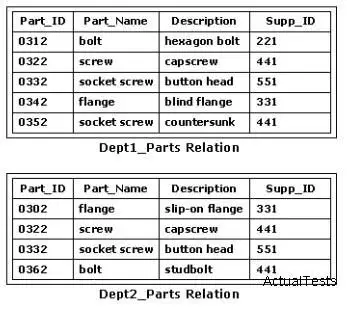
Consider the Dept1_Parts and Dept2_Parts relations shown in the exhibit. Which of the following SQL statements would create a set difference of the two relations with the widest variety of
Structured Query Language dialects?
SELECT *
FROM Dept1_Parts
EXCEPT
(SELECT Part_ID
FROM Dept2_Parts);
SELECT *
FROM Dept1_Parts
MINUS
(SELECT Part_ID
FROM Dept2_Parts);
SELECT *
FROM Dept1_Parts
DIFFERENCE
(SELECT Part_ID
FROM Dept2_Parts);
Which term describes the rejoining of relations that have been decomposed?
Normalization
Denormalization
Referential integrity
Domain constraints
Which subset of Structured Query Language (SQL) is used to perform operations such as data retrieval or deletion on the data contained in a database?
Data Control Language
Data Definition Language
Data Formatting Language
Data Manipulation Language
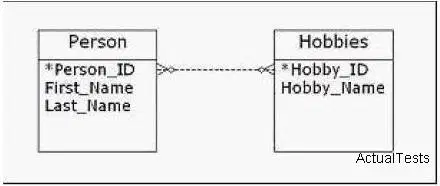
Consider the entity-relationship (ER) diagram shown in the exhibit. Which type of relationship between the two entities is shown?
m:m
m:n
1:1
1:n
Which of the following best describes the ON DELETE CASCADE referential integrity constraint?
If a parent key is deleted, any child keys referenced by the parent key are automatically deleted.
If any child key references a parent key, the record containing the parent key cannot be deleted.
If a parent key isdeleted, all child keys are automatically set to a specified value.
If a parent key is deleted, no test is made for referential integrity.
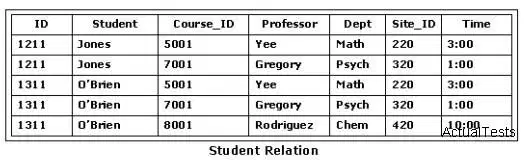
The exhibit shows a table called Student Relation that tracks all information related to a students courses, professors and sites. What would be the consequence of removing all records for a student with the ID 1311?
Only an update anomaly would occur.
An insertion anomaly would occur.
A deletion anomaly would occur.
An update anomaly and a deletion anomaly would occur.
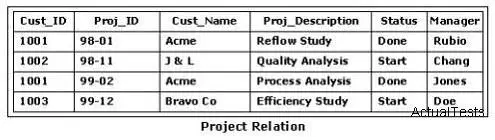
The database manager wants to give Rubio and Doe the ability to modify the Project Relation shown in the exhibit. A temporary employee named Temp needs to access the data in the database to generate reports. Which group of SQL statements will perform this task?
GRANT UPDATE ON Project TO Rubio, Doe;
GRANT SELECT ON Project TO Temp;
GRANT ALL PRIVILEGES ON Project TO Rubio, Doe;
GRANT UPDATE ON Project TO Temp;
GRANT SELECT ON Project
WHERE Manager = ‘Rubio’;
GRANT SELECT ON Project
WHERE Manager = ‘Doe’;
GRANT UPDATE ON Project
WHERE Manager = ‘Rubio’;
GRANT UPDATE ON Project
WHERE Manager = ‘Doe’;
GRANT SELECT ON Project TO Temp;
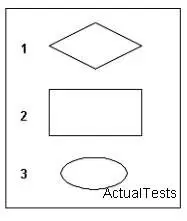
Consider the symbols shown in the exhibit. Which of the following correctly identifies these symbols when used in an entity-relationship (ER) diagram?
relationship
Dimande
Entity
Square
attribute
Circle
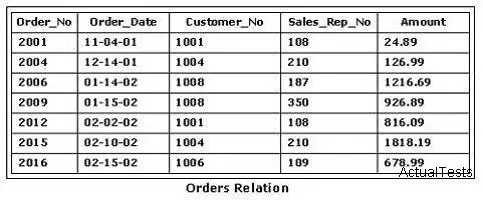
Consider the Orders relation shown in the exhibit. Which of the following SQL statements would replace the value in the Sales_Rep_No column with 110 everywhere that Sales_Rep_No 108 is listed?
UPDATESales_Rep_No
IN Orders
SET(Sales_Rep_No = 110
WHERE Sales_Rep_No = 108);
UPDATE Orders
SET Sales_Rep_No = 110
WHERE Sales_Rep_No = 108;
UPDATE Orders
SET Sales_Rep_No = 110;
UPDATE Orders
WHERE Sales_Rep_No = 108
SET Sales_Rep_No = 110;
A theta-join can be viewed as:
the intersection of two relations.
a Cartesian product of two relations.
a restricted Cartesian product of two relations.
the Cartesian product of two union-compatible relations.
In which situation would the DBMS use a serial schedule to execute the transactions?
Concurrent transactions read data from the same data structure.
Concurrent transactions write data to different data structures.
Concurrent transactions read or write the same data structure.
Concurrent transactions read or write from different data structures.
Which of the following definitions applies to all types of databases?
Data that is stored as tables
Software that manipulates data
Data that is stored in a structured manner
Data recordsthat are stored sequentially in a file
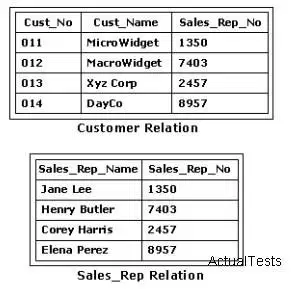
What is the highest normal form of the relation(s) shown in the exhibit?
No normal form
Second normal form
First normal form
Third normal form
Which term describes the management of simultaneous transactions to prevent conflicts?
Parallelism
Serialization
Database control
Concurrency control
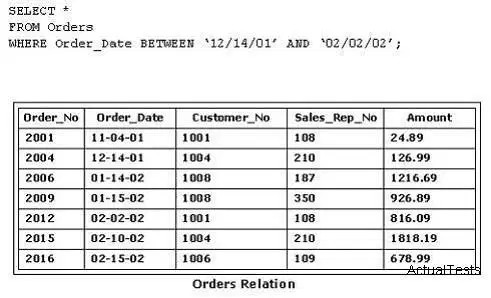
Consider the following SQL statement and the Orders relation shown in the exhibit:
How many records should be returned?
Two records
Three records
Four records
Five records

