wayground logo

Free Printable Worksheets

NEW

Font size

S
M
L
XL
Worksheets

8th Grade Unit 2 Review

Total questions: 75

Worksheet time: 17hrs 15mins
Name
Class
Date
1.
1. The Andromeda Galaxy is the nearest spiral galaxy to the Milky Way Galaxy. Which unit would BEST be used to represent the distance between the Milky Way Galaxy and the Andromeda Galaxy?
a)
astronomical unit
b)
kilometer
c)
light year
d)
mile
2.
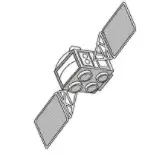
2. Satellites such as the one shown below are a very important technological advancement. Which of the following is NOT an example of the use of satellites in science?
a)
studying Earth's features
b)
collecting weather information
c)
wireless communications
d)
collecting samples on the other planets
3.
3. Sarah and her father used their telescope to look at Venus and various stars. The stars looked like tiny points of light while Venus looked much larger. Why?
a)
there are more stars than planets in our solar system
b)
stars are much smaller than planets
c)
Venus is much closer to Earth than are the stars
d)
stars reflect less light than planets
4.
4. The chart below shows the average distance in astronomical units (AU) between each planet and the Sun. Which planet would make the closest approach to Earth as the planet orbits the sun?
a)
Mars
b)
Mercury
c)
Jupiter
d)
Venus
5.
5. Rachel is learning about electromagnetic radiation that comes from the sun. What types of electromagnetic radiation does the sun emit?
a)
gamma rays and ultraviolet radiation
b)
ultraviolet radiation only
c)
infrared, visible, and ultraviolet radiation
d)
all types of electromagnetic radiation
6.
6. As part of his job at the U.S. Forestry Service, Scott uses satellite images to identify forest areas that have been cleared due to logging. The satellite images, which show forests appearing cooler and cleared areas appearing warmer, are produced using electromagnetic radiation. Which part of the electromagnetic spectrum does Scott’s technology MOST LIKELY use?
a)
infrared radiation
b)
gamma rays
c)
radio waves
d)
visible light
7.
7. Carla is learning about types of electromagnetic waves. What is the difference between a microwave and a gamma wave?
a)
Microwaves are common and gamma waves are rare.
b)
Microwaves are silent and gamma rays are audible (you can hear them).
c)
Microwaves were invented by humans and gamma waves were not.
d)
Microwaves and gamma waves have different wavelengths.
8.
8. Wavelength and frequency are related. Gamma rays, microwaves, visible light, and infrared rays all have different frequencies. Which of the following lists them in the correct order from longest wavelength to shortest wavelength?
a)
visible light, microwaves, infrared rays, gamma rays
b)
infrared rays, microwaves, visible light, gamma rays
c)
gamma rays, infrared rays, microwaves, visible light
d)
microwaves, infrared, visible light, gamma rays
9.
9. How is ultraviolet light different from the light emitted by a flashlight?
a)
Ultraviolet light is brighter than the light from a flashlight.
b)
Only light from a flashlight can travel through space.
c)
Ultraviolet light has a longer wavelength than the light from a flashlight.
d)
Ultraviolet light is invisible to the human eye.
10.
10. When NASA scientists communicate with the Mars rover, shown in the illustration, they use electromagnetic radiation with a long wavelength and low energy. Which type of radiation do they MOST LIKELY use?
a)
X-rays
b)
visible light
c)
radio waves
d)
infrared waves
11.
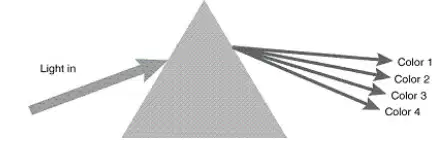
11. The illustration below shows what happens when white light is passed through a prism. How is white light different from the rest of the electromagnetic spectrum?
a)
White light has a spectrum of colors.
b)
White light has the same wavelength.
c)
White light is invisible.
d)
White light can travel through both empty space and matter.
12.
12. The sun's energy reaches Earth in waves of varying wavelengths. Which is the correct order from the shortest wavelength to the longest wavelength?
a)
ultraviolet- infrared - visible light
b)
infrared -ultraviolet- visible light
c)
ultraviolet - visible light - infrared
d)
infrared - visible light - ultraviolet
13.
13. Which of the following parts of the electromagnetic spectrum has the shortest wavelength?
a)
ultraviolet radiation
b)
infrared radiation
c)
radio waves
d)
microwaves
14.
14. Light can sometimes create an optical illusion. For example, you may see something underwater and reach into the water to pick it up. However, the object is not where you thought it would be. What property of light is responsible for this optical illusion?
a)
absorption
b)
reflection
c)
refraction
d)
transmission
15.
15. Aisha decided to demonstrate the reflection of light to her science class by using a ball. Which of the following activities should Aisha perform in her demonstration?
a)
bounce the ball at an angle off the floor
b)
throw the ball high into the air
c)
roll the ball on the floor
d)
pass the ball to a friend
16.
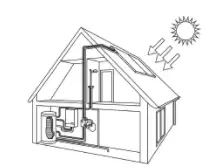
16. To save energy, some people install solar panels on their homes as shown in the illustration below. What interaction between solar panels and sunlight enables people to save on energy?
a)
The energy of the sunlight is reflected by the solar panels.
b)
The energy of the sunlight is refracted by the solar panels.
c)
The energy of the sunlight is absorbed by the solar panels.
d)
The energy of the sunlight is transmitted through the house.
17.
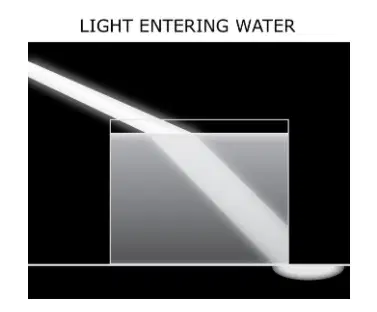
17. The image below shows light entering water. Which statement explains why light bends when it reaches the surface of the water?
a)
Light bends because water changes the amount of energy it carries.
b)
Light bends because water absorbs some of the light that reaches it.
c)
Light bends because the water reflects some of the light that reaches it.
d)
Light bends because water changes its speed when it moves from air into water.
18.
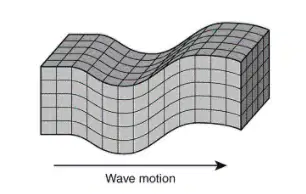
18. The drawing below illustrates a wave in motion. What is the name given to the substance through which a wave travels?
a)
a crest
b)
a frequency
c)
a medium
d)
a state
19.
19. Hypotheses based on observations are often the starting point in scientific investigations and explanations. Which statement BEST describes a hypothesis in science?
a)
A hypothesis is a description of a phenomenon in nature.
b)
A hypothesis is a tentative, testable explanation of a phenomenon in nature.
c)
A hypothesis is a speculative answer about the cause of a problem.
d)
A hypothesis is a fact supported by experiments conducted by many scientists.
20.
20. In the desert air, sound travels at 358 meters per second (m/s). In the polar air, sound travels at 330 meters per second (m/s). What can you conclude from this information?
a)
The speed of sound is constant.
b)
Sound waves travel fastest in space.
c)
The temperature and humidity of the air affect the speed of sound.
d)
Sound waves travel at the same speed everywhere on Earth.
21.
21. Sound waves travel the fastest through solids. What will slow the speed of a sound wave?
a)
a decrease in the distance the sound travels
b)
an increase in the distance the sound travels
c)
a decrease in the density of the material through which it is passing
d)
an increase in the density of the material through which it is passing
22.
22. Sam looks at the chart below of the electromagnetic spectrum. Sam describes what he notices as he looks from left to right at the diagram. Which of Sam’s descriptions is TRUE?
a)
The wavelength increases and the frequency increases.
b)
The wavelength decreases and the frequency increases.
c)
The wavelength decreases and the frequency decreases.
d)
The wavelength increases and the frequency decreases.
23.
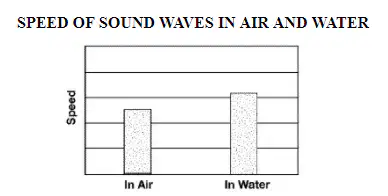
23. Look closely at the graph below of the speed of sound waves in air and water. What can you conclude from the data on this graph?
a)
The speed of sound waves is constant.
b)
Sound waves travel faster than light waves.
c)
Both air and water transmit sound waves at the same speed.
d)
The speed of sound waves depends on the medium through which they travel.
24.
24. Lillian decides to carry out a controlled experiment while on vacation. Which of the following projects fits the definition of a controlled experiment?
a)
Comparing sunscreens by applying three different brands to the same size area of skin on the arm, leaving one area bare. The arm is exposed to the Sun for the same amount of time and the areas compared.
b)
Determining the average number of starfish that wash onto the beach each day, tagging each starfish to avoid double-counting.
c)
Measuring the frequency of the tide at the same location for one week, using a stopwatch with precision of a hundredth of a second.
d)
Finding the number of unique organisms that inhabit a square meter of the beach, using a randomly selected square.
25.
25. The side of the Moon facing away from Earth is called the dark side of the moon. Which of the following would be MOST useful for studying features of the dark side of the Moon?
a)
a telescope on Earth's surface
b)
a telescope orbiting Earth
c)
a satellite orbiting the Moon
d)
a satellite orbiting Earth
26.
Cell phones and televisions use this type of EM wave.  It has the longest wavelength with the lowest frequency.
a)
radio wave
b)
tv wave
c)
Gamma wave
d)
ultra violet
27.
Which portion of the electromagnetic spectrum includes the range of light that can be detected by the human eye? 
a)
ultraviolet light
b)
visible light
c)
infrared light
d)
x-rays
28.
If the wavelength of an electromagnetic wave is longer, what is true about the energy? 
a)
Energy is higher.
b)
Energy is lower. 
c)
Energy is not dependent on wavelength. 
d)
energy is cancelled out
29.
A wave with a large wavelength will have a ______ frequency and _____ energy
a)
high, low
b)
high, high
c)
low, high
d)
low, low
30.
These are the waves that are used to penetrate solids and are used to create medical images.
a)
visible light
b)
gamma rays
c)
x rays
d)
microwaves
31.
The type of wave that DOES NOT need a medium to travel through
a)
mechanical
b)
electromagnetic
32.
The type of wave with the shortest wavelength and highest frequency.  This type of wave is extremely harmful.
a)
radio
b)
infrared
c)
gamma
d)
x ray
33.
The type of EM wave that is used to cook food.  It has a higher frequency than radio waves.
a)
radio
b)
microwave
c)
gamma
d)
visible light
34.
This type of EM wave has the 3rd longest wavelength. 
a)
Radio
b)
microwave
c)
x rays
d)
infrared
35.
This color has the shortest wavelength
a)
Indigo
b)
red
c)
Yellow
d)
violet
36.
Which of the following types of radiation has the shortest wavelength and the highest frequency?
a)
Radio Waves
b)
Infrared
c)
Visible
d)
X-Rays
37.

What kind of wave is used with night goggles?

a)

Radio waves

b)

Infrared

c)

Ultraviolet

d)

X-Rays

38.

Which of the following is true?

a)

A long wavelength means a low frequency

b)

A long wavelength means a high frequency

c)

All of the electromagnetic spectrum has the same wavelength

d)

A long wavelength means high energy

39.

Which electromagnetic waves carry more energy?

a)

If it has a long wavelength

b)

If it has a short wavelength

c)

If it has a low frequency

d)

They all carry the same amount of energy

40.

The full range of frequencies of electromagnetic radiation is called

a)

visible light.

b)

radio waves.

c)

the electromagnetic spectrum.

d)

invisible radiation.

41.

The visible light spectrum ranges between

a)

radar waves and X-rays.

b)

television waves and infrared rays.

c)

infrared rays and ultraviolet rays.

d)

ultraviolet rays and gamma rays.

42.
This wave has the second highest frequency on the spectrum. 
a)
microwaves
b)
visible light
c)
x-rays
d)
gamma ray
43.

When frequency increases, __________ increases.

a)

energy

b)

wavelength

c)

strength

d)

color

44.
Which type of electromagnetic wave is observed in the remote control that we use to change the station on our televisions?
a)
Radio waves
b)
Infrared waves
c)
X-rays
d)
Micro Waves
45.
Where is radio waves located?
a)
2
b)
3
c)
1
d)
8
46.
Where is gamma on the EM spectrum?
a)
3
b)
5
c)
7
d)
1
47.
Where is Ultraviolet (UV)  on the EM spectrum?
a)
2
b)
6
c)
4
d)
5
48.
What is represented by the #2?
a)
Radio
b)
X-Ray
c)
Mircowave
d)
Visible Light
49.
Put the EM waves in increasing order 
a)
visible light, microwave, gamma
b)
infrared, microwave, radio
c)
ultraviolet, radio, x-ray
d)
radio, visible light, ultraviolet
50.

What type of radiation would your cellphone have?

a)

ultraviolet

b)

Microwave

c)

Infrared

d)

Gamma

51.
What is NOT part of the electromagnetic spectrum?
a)
Visible light 
b)
X rays 
c)
Gamma Rays
d)
Magnetic Rays
52.

What type of energy does a sound wave have?

a)

Mechanical

b)

Radiant

c)

Electrical

d)

Sound

53.

Sound is produced by -----

a)

Heat energy

b)

Low temperatures

c)

Vibrations

d)

Friction

54.

True or False: Sound needs a medium.

a)

True

b)

False

55.

Sound waves are also known as ----- waves.

a)

Compression

b)

Longitudinal

c)

Neither

d)

Both longitudinal and compression

56.

True or False: Sound waves are faster than light.

a)

False

b)

True

57.

Areas of increased pressure on a sound wave are known as a ----

a)

Rarefaction

b)

Compression

c)

Frequency

d)

Amplitude

58.

The distance from the beginning of one compression to the beginning of the next compression is called a -----

a)

Rarefaction

b)

Frequency

c)

Wavelength

d)

Compression

59.

Spread out areas or areas of decreased pressure on a sound wave are known as a ---

a)

Rarefaction

b)

Amplitude

c)

Compression

d)

Hertz

60.

The number of wavelengths that pass a fixed point each second is known as ----

a)

Hertz

b)

Amplitude

c)

Frequency

61.

The unit for measuring frequency is the ---

a)

Joule

b)

Hertz

c)

Gram

d)

Newton

62.

The measure of the amount of energy in a wave is ----

a)

Wavelength

b)

Hertz

c)

Frequency

d)

Amplitude

63.

The speed of sound depends on these two things:

a)

The type of medium and the temperature of the medium

b)

Speed of the medium and temperature of the medium

c)

Temperature of the medium and sound of the medium

d)

None of the above

64.

Sound waves travel the fastest through ---

a)

Liquids

b)

Gases

c)

Solids

65.

Sound waves that are beyond the range of human ear are known as ----

a)

Infrasonic waves

b)

Ultrasonic waves

66.

Sonar and echolocation use ----- to detect objects under water.

a)

Refraction

b)

Reflection

67.

Scientists use spacecraft like satellites, probes and rovers to study a variety of objects in space. What benefits do unmanned spacecraft provide to space scientists?

a)

instruments never commit errors

b)

instruments can be sent places humans cannot go

c)

instruments require more control over the environment than human spaceflight does

d)

instruments can replace analysis by human scientists

68.
I orbit above Earth sending back detailed pictures of objects in the solar system. My images are more detailed than all others. 
a)
optical telescope
b)
space probes
c)
Hubble telescope
d)
space shuttle
69.
What space technology is this?
a)
space station
b)
space probes
c)
satellite
d)
radio telescope
70.

The Hubble Space Telescope produces images that show red, yellow and blue wavelengths. What part of the electromagnetic spectrum does the Hubble Space Telescope use to produce these images

a)

infrared

b)

x-ray

c)

visible light

d)

radio waves

71.
Orbits around Earth and provides a living area for astronauts to conduct tests and exploration.  
a)
space shuttle
b)
space station
c)
space satellites 
d)
optical telescope
72.
Which of the following does NOT belong in the electromagnetic spectrum:
a)
X-ray
b)
sound wave
c)
ultra violet rays
d)
microwaves
73.

The Earth’s atmosphere protects us from the Sun’s radiation. Which of the following types of the Sun's radiation could cause the greatest damage to us on Earth?

a)

Visible Light

b)

Ultraviolet

c)

Microwaves

d)

Infrared

74.

Different types of telescopes, such as the Chandra X-ray and Spitzer Infrared telescopes, are used in space science. What is the reason for this?

a)

Different types of telescopes are needed to observe the same part of the electromagnetic spectrum

b)

Different types of telescopes are needed to detect visible light

c)

Different types of telescopes are needed to measure the wavelengths of radiation

d)

Different types of telescopes are needed to collect data from different ranges of radiation

75.
Sends, receives or bounce back information sent to different areas of Earth from space. Allows us to see our favorite tv shows.  
a)
Satellite
b)
Probes
c)
radio telescope
d)
Hubble telescope