wayground logo

Free Printable Worksheets

Font size

S
M
L
XL
Worksheets

Unit 5 Review

Total questions: 171

Worksheet time: 5hrs 7mins

Name
Class
Date
1.

A pilot experiences centripetal acceleration of 2g's (2 x 9.8 m/s2) while maneuvering a loop at a speed of 400 m/s. What is the radius of the loop?

a)

203 m

b)

8163 m

c)

80,003 m

d)

23 m

2.
What happens to the centripetal force exerted on an object if you triple the velocity?
a)
it increases to 3X
b)
it decreases to 6X
c)
it increases to 6X
d)
it increases to 9X
3.
Calculate the velocity of an object moved around a circle with a radius of 1.65 m and an acceleration of 3.5 m/s2.
a)
2.4 m/s
b)
3.6 m/s
c)
3.9 m/s
d)
4.2 m/s
4.
Calculate the centripetal force required to make a 5 kg ball move 4 m/s in a circle with a radius of 2 m.
a)
10 N
b)
20 N
c)
30 N
d)
40  N
5.

Centripetal force is...

a)

the inward force acting on a body moving at constant speed in a circle

b)

the outwards force acting on a body moving at constant speed in a circle

6.
Centripetal acceleration acts towards the ___________ of the circular motion
a)
centre
b)
circumference
7.

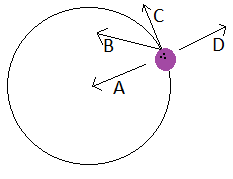
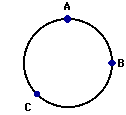
A ball is moving at constant speed around the circle. Which letter represents the acceleration of the ball?

a)

A

b)

B

c)

C

d)

D

e)

Nonsense. The ball can't be accelerating while moving at a constant speed.

8.
Calculate the mass of an object if it took 20 N to rotate it in a circle with a radius of 2 meters with a velocity of 4 m/s
a)
4.1 kg
b)
3.6 kg
c)
2.5 kg
d)
1.8 kg
9.

Why do objects experience centripetal acceleration even though they can have a constant speed?

a)

Because they are speeding up as they move in a circle

b)

Because they are constantly changing direction and hence, velocity changes, and that net change is directed inward.

c)

Because they are constantly changing both speed and direction

d)

Because when you have 100 people pedaling, you can speed up more easily.

10.
A test car moves at a constant speed around a circular track.  If the car is 48.2 m from the track's center and has a centripetal acceleration of 8.05 m/s2, what is the car's tangential speed?
a)
19.7 m/s
b)
5.99 m/s
c)
0.17 m/s
d)
388.01 m/s
11.

The linear velocity is always _____ to the line of a circle.

a)

outwards

b)

towards the center

c)

tangent

d)

faster

12.

moving or tending to move toward a center...

a)

centripetal force

b)

centrifugal force

c)

Tangent

d)

Curvature

13.
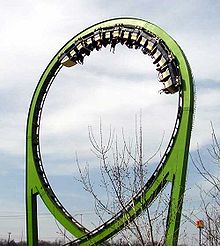
Where is the net force when the rollercoaster is at the top of the loop?
a)
Towards the sky
b)
Towards the Right
c)
Towards the left
d)
Towards the ground
14.
The velocity is always _____ to the line of a circle. 
a)
outwards
b)
towards the center
c)
tangent
d)
faster
15.
Which represents the acceleration of the ball?
a)
A
b)
B
c)
C
d)
D
16.
Which of the following depict the speed of the blowing ball?
a)
A
b)
B
c)
C
d)
D
17.

moving or tending to move toward a center...

a)

centripetal force

b)

centrifugal force

c)

Tangent

d)

Curvature

18.

the process or act of turning or circling around something

a)

Curvature

b)

Rotation

c)

Radius

d)

Orbit

19.
Where is the net force when the rollercoaster is at the top of the loop?
a)
Towards the sky
b)
Towards the Right
c)
Towards the left
d)
Towards the ground
20.
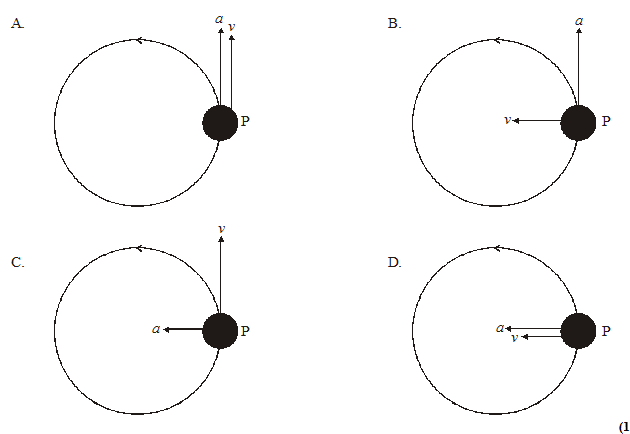
A particle P is moving in a circle with uniform speed. Which one of the following diagrams correctly shows the direction of the acceleration a and velocity v of the particle at one instant of time?
a)
A
b)
B
c)
C
d)
D
21.
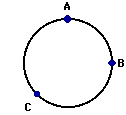
What is the direction of the velocity at point B, if the ball is revolving clockwise?
a)
up
b)
right
c)
down
d)
left
22.
What is the direction of the acceleration at point A, if the ball is revolving clockwise?
a)
up
b)
right
c)
down
d)
left
23.
What is the direction of the acceleration at point B, if the ball is revolving clockwise?
a)
up
b)
right
c)
down
d)
left
24.
The velocity is always _____ to the line of a circle. 
a)
outwards
b)
towards the center
c)
tangent
d)
faster
25.
Which statement is true about an object that is traveling in uniform circular motion?
a)
The speed of the object varies.
b)
The net force on the object is directed toward the center of the circular path.
c)
The direction of the object's velocity is constant.
d)
The net force on the object is directed away from the center of the circular path.
26.
Centripetal acceleration always points
a)
in the direction of the object's motion
b)
in the opposite direction of the object's motion
c)
towards the center of the circle
d)
towards the outside of the circle
27.
What is the direction of the velocity at point A, if the ball is revolving clockwise?
a)
up
b)
right
c)
down
d)
left
28.
What is the SI unit for circumference?
a)
meter
b)
pi
c)
inches
d)
kilometer
29.

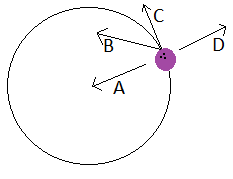
A ball is moving at constant speed around the circle. Which letter represents the acceleration of the ball?

a)

A

b)

B

c)

C

d)

D

e)

Nonsense. The ball can't be accelerating while moving at a constant speed.

30.
Which of the following depict the speed of the blowing ball?
a)
A
b)
B
c)
C
d)
D
31.
If the radius of the string is .3 meters long and the stopper makes 5 revolutions per second, what is the speed of the stopper? (Hint: C=2πr)
a)
9.4 m/s
b)
6.8 m/s
c)
11.7 m/s
d)
3.5 m/s
32.
Centripetal acceleration is ...
a)
Acceleration toward the center of a curved or circular path
b)
Acceleration toward the outside of a circle
c)
Vertical motion instead of horizontal motion
33.

A 10kg car travels at a constant speed of 20.0 m/s around a horizontal circular track. Which diagram correctly represent the direction of the car's velocity (v) and the direction of the centripetal force (Fc) acting on the car at a particular moment?

a)
b)
c)
d)
34.
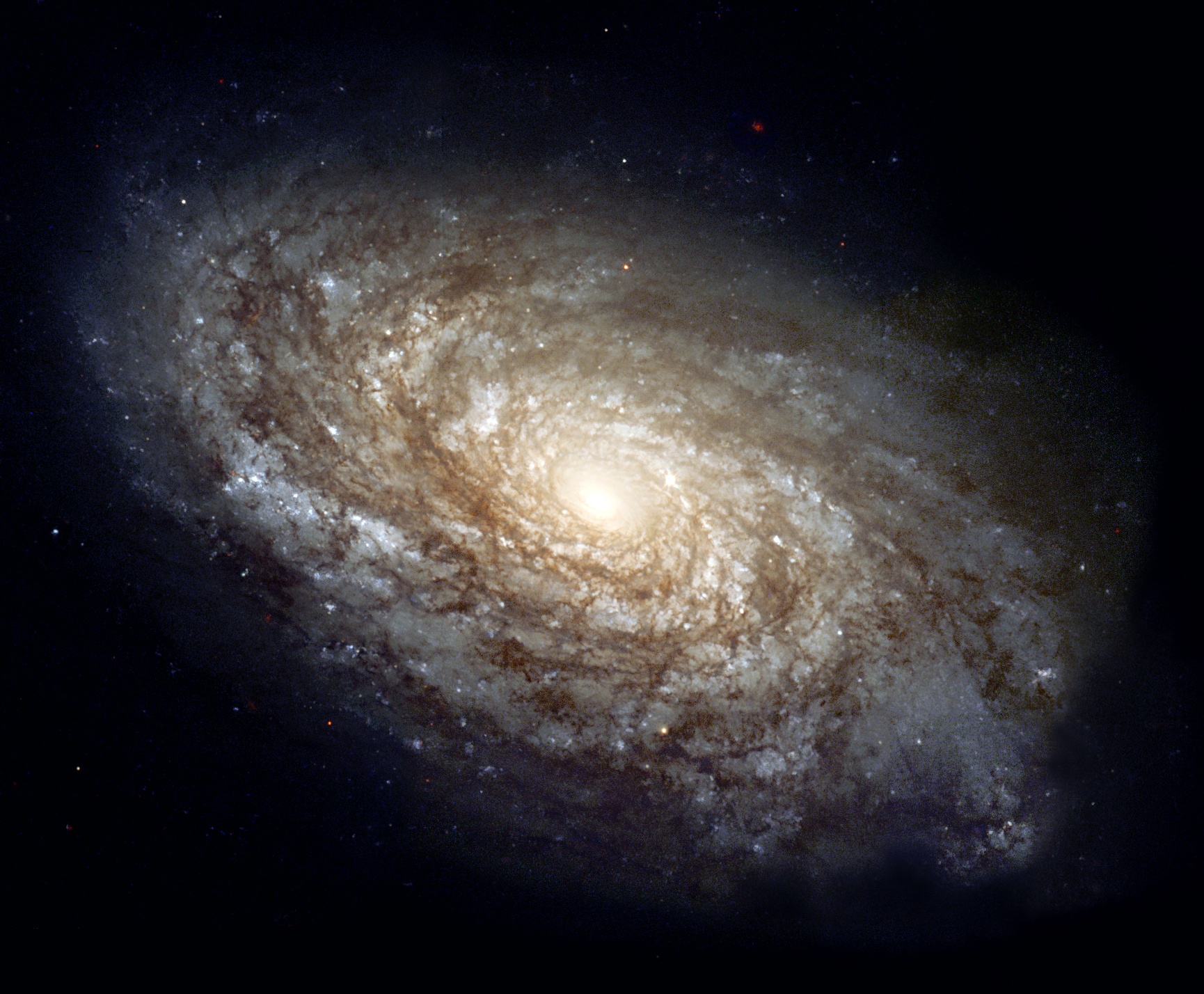
Assuming Andromeda rotates at a uniform rate, which stars are moving the fastest?
a)
Stars closest to center
b)
Stars furthest from the center
c)
Stars with the hottest temperature
d)
Stars with the coldest temperature
35.
Which of the following is Newton's Law on Gravitation?
a)
F=Gm1m2/r
b)
F = Gm1m2/r2
c)
F = Gm1m2/2r
d)
F = m1m2/2r
36.
Two factors effecting the magnitude of the force of gravity between 2 objects are...
a)
mass and distance 
b)
mass and matter
c)
distance and weight 
d)
weight and mass
37.

Centripetal force, created by swinging something in a circle, acts in a direction--

a)

along the path of motion

b)

away from the center of the circle

c)

toward the center of the circle

d)

tangent to the circle

38.

Two masses 8000 kg and 1500 kg are 1.5 m apart. Find their gravitational pull.

a)

3 N

b)

0.0003 N

c)

3000 N

d)

30 N

39.

Calculate the gravitational force between two objects when they are 0.750m apart. Each object has a mass of 5.00kg.

a)

2.96x10⁻⁷N

b)

3.00x10⁻⁶N

c)

2.22x10⁻⁹N

d)

2.23x10⁻⁸N

40.
Calculate the velocity of an object moved around a circle with a radius of 1.65 m and an acceleration of 3.5 m/s2.
a)
2.4 m/s
b)
3.6 m/s
c)
3.9 m/s
d)
4.2 m/s
41.
Calculate the centripetal force required to make a 5 kg ball move 4 m/s in a circle with a radius of 2 m.
a)
10 N
b)
20 N
c)
30 N
d)
40  N
42.
Calculate the velocity of an object moved around a circle with a radius of 1.65 m and an acceleration of 3.5 m/s2.
a)
2.4 m/s
b)
3.6 m/s
c)
3.9 m/s
d)
4.2 m/s
43.
A test car moves at a constant speed around a circular track.  If the car is 48.2 m from the track's center and has a centripetal acceleration of 8.05 m/s2, what is the car's tangential speed?
a)
19.7 m/s
b)
5.99 m/s
c)
0.17 m/s
d)
388.01 m/s
44.

What did Newton say about the gravitational force between distant objects?

a)

It is independent of distance

b)

It is inversely related to distance squared

c)

It is proportional to distance squared

d)

It is inversely related to mass squared

e)

It is zero, unless the objects are touching

45.

Earth pulls satellite, and satellite pulls Earth. Which of the forces is stronger?

a)

Earth pulling satellite

b)

Satellite pulling Earth

c)

Both the same

d)

Not enough information to determine

46.
Force of gravity is directly proportional to
a)
Mass
b)
Weight
c)
Distance
d)
Time
47.
If I double the distance between two objects, what happens to their gravitational Force?
a)
4x bigger
b)
4x smaller
c)
2x bigger
d)
2x smaller
48.
What happens to Gravitational force if I double both of the masses but don't change their distance?
a)
doubles
b)
half as big
c)
4x bigger
d)
4x smaller
49.

Observers using different ___________________ may measure different velocities for an object in motion

a)

frame of reference

b)

relatives of motion

c)

projectile motions

d)

constant velocity

50.

What is the train's speed with respect to the stationary observer?

a)

40 mph

b)

50 mph

c)

10 mph

d)

30 mph

51.

What is the walker's speed from the observer's perspective?

a)

10 mph

b)

40 mph

c)

50 mph

d)

30 mph

52.

What is the walker's speed with respect to the train?

a)

30 mph

b)

10 mph

c)

40 mph

d)

50 mph

53.
What is the direction of the acceleration at point A, if the ball is revolving clockwise?
a)
up
b)
right
c)
down
d)
left
54.
The velocity is always _____ to the line of a circle. 
a)
outwards
b)
towards the center
c)
tangent
d)
faster
55.
The momentum of an object depends upon the object's ___________&_____________.  
a)
size and shape
b)
mass and speed
c)
mass and veloctiy
d)
mass and energy
56.

The equation to calculate momentum is

a)

p = m x v

b)

p = 1/2 m x v2

c)

p = m x g x h

d)

p = m x g

57.
Determine the momentum of 1000-kg car moving southward at 20 m/s......... 
a)
20000 N
b)
20000 Joules
c)
20000 Kg * m/s south
d)
10000 kg * m/s south
58.

What is the unit for momentum?

a)

m/sec

b)

kg/sec

c)

kg/m

d)

kg x m/sec

59.

What is the unit for velocity?

a)

m/sec

b)

kg/sec

c)

kg/m

d)

kg x m/sec

60.
What is the unit for mass?
a)
m/sec
b)
kg/sec
c)
kg
d)
kg m/sec
61.
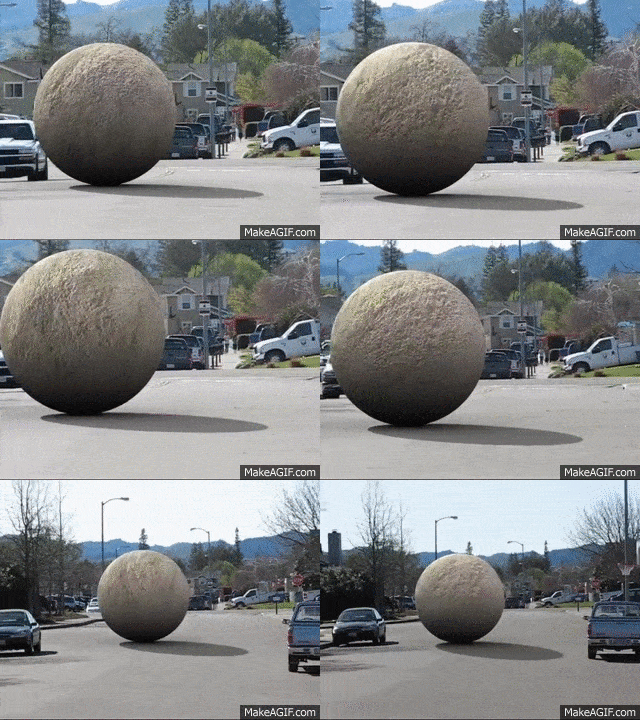
A 50 kg ball rolls down the street at 5 m/s. Calculate the momentum of the ball. 
a)
55 kg*m/s
b)
100 kg*m/s
c)
250 kg*m/s
d)
500 kg*m/s
62.

Which of the following has the MOST momentum? (they are all rolling at the same velocity)

a)

rolling ping-pong ball

b)

rolling bowling ball

c)

rolling soccer ball

d)

rolling basketball

63.

If an object has a momentum of 40 kg x m/s and a mass of 60 kg, what is it's velocity?

a)

2400 m/s

b)

1.5 m/s

c)

240 m/s

d)

.67 m/s

64.

In order for an object to have momentum it must be ________

a)

moving

b)

motionless

c)

alive

d)

asleep

65.
The equation to calculate momentum is
a)
p=mv
b)
p=1/2mv2
c)
p=mgh
d)
p=mg
66.

The momentum of an object depends upon the object's ___________&_____________.

a)

size and shape

b)

mass and speed

c)

mass and veloctiy

d)

mass and energy

67.
Momentum is a ____________________ quantity
a)
science
b)
scalar
c)
vector
d)
energy
68.
Which of the following has more momentum? 
a)
a moving SUV
b)
a moving semi-truck
c)
more information is needed
69.
In a perfectly inelastic collision, ______ is conserved. 
a)
Momentum only
b)
Kinetic Energy only
c)
Both momentum and kinetic energy
70.
A 50 kg ball rolls down the street at 5 m/s. Calculate the momentum of the ball. 
a)
55 kg*m/s
b)
100 kg*m/s
c)
250 kg*m/s
d)
500 kg*m/s
71.

Two skaters begin at rest. Skater 1 has a smaller mass than Skater 2. After they push off each other,...

a)

Skater 1 experiences a greater change in momentum

b)

Skater 2 experiences a greater change in momentum

c)

Skater 1 has a greater speed than Skater 2

d)

Skater 1 experiences a greater force

72.
The momentum of an object depends upon the object's ___________&_____________.  
a)
size and shape
b)
mass and speed
c)
mass and veloctiy
d)
mass and energy
73.
Determine the momentum of 1000-kg car moving northward at 20 m/s......... 
a)
20000 N
b)
20000 Joules
c)
20000 Kg * m/s
d)
20000 kg * m/s north
74.
A runner has a momentum of 720 kg m/s and is traveling at a velocity of 5 m/s. What is his mass?
a)
14.4 kg
b)
1400 kg
c)
144 kg
d)
360 kg
75.
Determine the momentum of 1000-kg car moving northward at 20 m/s......... 
a)
20000 N
b)
20000 Joules
c)
20000 Kg * m/s
d)
20000 kg * m/s north
76.

In an elastic collision, ______ is conserved.

a)

Momentum only

b)

Kinetic Energy only

c)

Both momentum and energy

77.
When the speed of an object is doubled, its momentum
a)
remains unchanged in accord with the conservation of momentum.
b)
doubles
c)
quadruples
d)
decreases
78.
A 2 kg cart has a momentum of 16 kg m/s. What is its velocity?
a)
8 m/s
b)
32 m/s
c)
0.125 m/s
d)
18 m/s
79.
In any collision (crash) the ______ is ALWAYS constant
a)
Total Momentum
b)
total speed
c)
total Velocity
d)
Energy
80.
The total momentum before a collision is _________ the total momentum after a collision.
a)
equal to 
b)
less than 
c)
more than
d)
It depends on the type of collision
81.
Which of the following has the least amount of momentum?
a)
An ant walking along the ground
b)
An ant at rest
c)
An elephant walking
d)
An elephant running
82.
If two objects have the same mass, then the faster moving object has ____________ momentum.
a)
more 
b)
less
c)
the same
83.
The momentum of an object depends upon the object's ___________&_____________.  
a)
size and shape
b)
mass and speed
c)
mass and veloctiy
d)
mass and energy
84.
The equation to calculate momentum is
a)
p=mv
b)
p=1/2mv2
c)
p=mgh
d)
p=mg
85.
Which has more momentum: a car stopped at a red light or a bike moving at 15 mph?
a)
car
b)
bike
c)
they are equal
d)
cannot determine using the info provided
86.
Determine the momentum of 1000-kg car moving southward at 20 m/s......... 
a)
20000 N
b)
20000 Joules
c)
20000 Kg * m/s south
d)
10000 kg * m/s south
87.
A 2.5 kg ball moving at 5 m/s collides with a 2.5 kg stationary ball in a perfectly elastic collision.  What is the velocity of the second ball after the collision? 
a)
5 m/s
b)
2.5 m/s
c)
10 m/s
d)
7.5 m/s
88.
A 9300 kg railroad car traveling at a velocity of 5 m/s strikes a second boxcar that weighs 5000 kg at rest. At what speed will the second boxcar move?
a)
18.6 m/s
b)
9.3 m/s
c)
7.5 m/s
d)
1.86 m/s
89.
Momentum is a ____________________ quantity
a)
science
b)
scalar
c)
vector
d)
energy
90.
A boy kicks a football with a force of 20 N, the time the force acts for is 0.3 s.
Calculate the impulse on the ball.
a)
1 N*s
b)
6 N*s
c)
33.3 N*s 
d)
None of these
91.
The impulse is ______ the change in momentum
a)
Greater than
b)
Equal to
c)
less than
d)
always double
92.
In any collision (crash) the ______ is ALWAYS constant
a)
Total Momentum
b)
total speed
c)
total Velocity
d)
Energy
93.
When two objects collide, the Pbefore is ____________ the Pafter.
a)
more than 
b)
less than 
c)
equal to
d)
unrelated to
94.
Which of the following has the greatest momentum? 
a)
a scurrying cockroach
b)
a parked semi-truck
c)
more information is needed
95.
When the speed of an object is doubled, its momentum
a)
remains unchanged in accord with the conservation of momentum.
b)
doubles
c)
quadruples
d)
decreases
96.
Which object listed below has the greatest momentum?
a)
A 0.05 kg object rolling at 0.2 m/s.
b)
A 0.15 kg object rolling at 2 m/s.
c)
A 0.15 kg object rolling at 1 m/s
d)
A 0.4 kg object rolling at 2 m/s.
97.
Which of the following has the least amount of momentum?
a)
An ant walking along the ground
b)
An ant at rest
c)
An elephant walking
d)
An elephant running
98.
What is the unit for momentum?
a)
m/sec
b)
kg/sec
c)
kg/m
d)
kg m/sec
99.
What is the unit for velocity?
a)
m/sec
b)
kg/sec
c)
kg/m
d)
kg m/sec
100.
What is the unit for mass?
a)
m/sec
b)
kg/sec
c)
kg
d)
kg m/sec
101.
A 0.250 kg cart moving at 0.400 m/s has how much momentum?
a)
0.1 kg-m/s
b)
1 kg-m/s
c)
10 kg-m/s
d)
100 kg-m/s
102.
Determine the momentum of 1000-kg car moving northward at 20 m/s......... 
a)
20000 N
b)
20000 Joules
c)
20000 Kg * m/s
d)
20000 kg * m/s north
103.
In any collision (crash) the ______ is ALWAYS constant
a)
Total Momentum
b)
total speed
c)
total Velocity
d)
Energy
104.
A big fish swims upon and swallows a small fish at rest. After lunch, the big fish has less
a)
momentum
b)
velocity
c)
mass
105.
When two objects collide, the Pbefore is ____________ the Pafter.
a)
more than 
b)
less than 
c)
equal to
d)
unrelated to
106.

A 9300 kg railroad car traveling at a velocity of 5 m/s strikes a second boxcar that weighs 5000 kg at rest. If the first boxcar is at rest after the collision, what speed will the second boxcar move?

a)
18.6 m/s
b)
9.3 m/s
c)
7.5 m/s
d)
1.86 m/s
107.
A 9 kg blob moving at 5 m/s collides and sticks to a second blob with a mass of 5 kg. If the two bobs stick together, what will the velocity of the two blobs move at?
a)
3.57 m/s
b)
3.2 m/s
c)
10.0  m/s
d)
9.0  m/s
108.
A person on a stationary skateboard throws a bowling ball with a velocity of 5.0 m/s. What is a possible speed of the person after the throw? 
a)
0 m/s
b)
1.5 m/s
c)
5.0  m/s
d)
7.5 m/s
109.
Two skaters begin at rest. Skater 1 has a smaller mass than Skater 2. After they push off each other,...
a)
Skater 1 experiences a greater change in momentum
b)
Skater 2 experiences a greater change in momentum
c)
Skater 1 has a greater velocity than Skater 2
d)
Skater 1 experiences a greater force
110.

The Law of Conservation of Momentum states:

a)

The total momentum before a collision is equal to the total momentum after a collision.

b)

The total momentum before a collision is greater than the total momentum after a collision.

c)

The total momentum before a collision is less than the total momentum after a collision.

d)

The total momentum before a collision is not related to the total momentum after a collision.

111.

What is the symbol for momentum?

a)

p

b)

m

c)

M

d)

mo

112.

According to the Law of Conservation of Momentum, when two objects collide:

a)

both objects lose momentum.

b)

both objects gain momentum

c)

momentum is neither lost nor gained.

d)

momentum is always lost or gainer.

113.

Given the following data, compute for the momentum.

Object: Bird

Mass: 0.03 kg

Velocity: 18 m/s

Momentum=?

a)

0.54 kg*m/s

b)

0.64 kg*m/s

c)

0.74 kg*m/s

114.

Given the following data, compute for the momentum.

Object: Basket player

Mass: 75 kg

Velocity: 5 m/s

Momentum=?

a)

365 kg*m/s

b)

375 kg*m/s

c)

385 kg*m/s

115.

Given the following data, compute for the momentum.

Object: Bullet

Mass: 0.004 kg

Velocity: 600 m/s

Momentum=?

a)

0.4 kg*m/s

b)

1.4 kg*m/s

c)

2.4 kg*m/s

116.

Given the following data, compute for the momentum.

Object: Baseball

Mass: 0.14 kg

Velocity: 30 m/s

Momentum=?

a)

4.2 kg*m/s

b)

3.2 kg*m/s

c)

2.2 kg*m/s

117.

Given the following data, compute for the momentum.

Object: Frog

Mass: 0.9kg

Velocity: 12 m/s

Momentum=?

a)

9.8 kg*m/s

b)

10.8 kg*m/s

c)

11.8 kg*m/s

118.

The equation to calculate momentum is

a)

p = m x v

b)

p = 1/2 m x v2

c)

p = m x g x h

d)

p = m x g

119.

What is the unit for momentum?

a)

m/sec

b)

kg/sec

c)

kg/m

d)

kg x m/sec

120.

What is the unit for velocity?

a)

m/sec

b)

kg/sec

c)

kg/m

d)

kg x m/sec

121.
What is the unit for mass?
a)
m/sec
b)
kg/sec
c)
kg
d)
kg m/sec
122.
A 50 kg ball rolls down the street at 5 m/s. Calculate the momentum of the ball. 
a)
55 kg*m/s
b)
100 kg*m/s
c)
250 kg*m/s
d)
500 kg*m/s
123.

Which of the following has the MOST momentum? (they are all rolling at the same velocity)

a)

rolling ping-pong ball

b)

rolling bowling ball

c)

rolling soccer ball

d)

rolling basketball

124.

If an object has a momentum of 40 kg x m/s and a mass of 60 kg, what is it's velocity?

a)

2400 m/s

b)

1.5 m/s

c)

240 m/s

d)

.67 m/s

125.

In order for an object to have momentum it must be ________

a)

moving

b)

motionless

c)

alive

d)

asleep

126.
A runner has a momentum of 720 kg m/s and is traveling at a velocity of 5 m/s. What is his mass?
a)
14.4 kg
b)
1400 kg
c)
144 kg
d)
360 kg
127.
Which has more momentum: a car stopped at a red light or a bike moving at 15 mph?
a)
car
b)
bike
c)
they are equal
d)
cannot determine using the info provided
128.
Which of the following has the least amount of momentum?
a)
An ant walking along the ground
b)
An ant at rest
c)
An elephant walking
d)
An elephant running
129.
A 0.250 kg cart moving at 0.400 m/s has how much momentum?
a)
0.1 kg-m/s
b)
1 kg-m/s
c)
10 kg-m/s
d)
100 kg-m/s
130.
A biker with a mass of 75 kg moves along the path with a constant velocity of 5 m/s. What is the biker's momentum?
a)
25 m/s
b)
375 m/s
c)
25 kg m/s
d)
375 kg m/s
131.

The momentum of an object depends on

a)

Its mass only

b)

Its velocity only

c)

Its mass and velocity

d)

none of the answers

132.

1) Momentum is the measurement of _____ in motion?

a)

Time

b)

Mass

c)

Work

d)

Power

e)

Energy

133.

2) What letter is typically used to represent momentum in physic equations?

a)

m

b)

w

c)

v

d)

b

e)

p

134.

Finish the formula: Momentum = Mass * _________

a)

Velocity

b)

Acceleration

c)

Voltage

d)

Power

e)

Work

135.

Which of the following is a unit of measurement for momentum?

a)

N

b)

N m/s

c)

J

d)

kg m/s

e)

J/s

136.

Because momentum is a vector measurement, it has both a magnitude and a _______.

a)

Direction

b)

Velocity

c)

Temperature

d)

Speed

e)

Volume

137.

Which of the following is true about collisions according to the Law of Momentum Conservation?

a)

The total momentum of the objects must remain the same

b)

The momentum of each object must stay the same

c)

Some momentum will be lost

d)

None of the Above

138.

If a 70kg man and a 40k boy are both running at the same velocity, who has more momentum?

a)

The boy

b)

The man

c)

They both have the same momentum

139.

What is the momentum of a 3 kg ball moving at the velocity of 5 m/s east?

a)

3 kg m/s east

b)

5 kg m/s west

c)

15 kg m/s west

d)

15 kg m/s east

e)

0 kg m/s

140.

What do we call it when two or more moving objects exert forces on each other for a short period of time?

a)

Momentum

b)

Work

c)

Collisions

d)

Friction

e)

Energy

141.

If a ball is moving at the velocity of 10 m/s east with a momentum of 50 kg m/s east, what is its mass?1 kg

a)

1 kg

b)

2.5 kg

c)

5 kg

d)

25 kg

e)

500 kg

142.

Which has more momentum?

a)

A parked semi truck

b)

A moving car

c)

they have the same amount of momentum

143.

Which has more momentum?

a)

A hummingbird zipping down the street (v = 1 m/s)

b)

A bus stopped at a stop sign

c)

A bus barreling down the road (v = 10 m/s)

d)

A hummingbird hovering at a feeder

144.

A bicycle has a momentum of 24 kg•m/s. What momentum would the bicycle have if it had twice the mass and was moving at the same speed?

a)

twice the momentum; 48 kg*m/s

b)

1/2 the momentum; 12 kg*m/s

c)

4x the momentum; 96 kg*m/s

d)

1/4 the momentum; 6 kg*m/s

145.

A bicycle has a momentum of 24 kg•m/s. What momentum would the bicycle have if it had the same mass and was moving with one-half the speed?

a)

twice the momentum; 48 kg*m/s

b)

1/2 the momentum; 12 kg*m/s

c)

4x the momentum; 96 kg*m/s

d)

1/4 the momentum; 6 kg*m/s

146.

A bicycle has a momentum of 24 kg•m/s. What momentum would the bicycle have if it had the twice the mass and was moving with twice the speed?

a)

twice the momentum; 48 kg*m/s

b)

1/2 the momentum; 12 kg*m/s

c)

4x the momentum; 96 kg*m/s

d)

1/4 the momentum; 6 kg*m/s

147.

The momentum of an object depends upon the object's ___________&_____________.

a)

size and shape

b)

mass and speed

c)

mass and veloctiy

d)

mass and energy

148.

A 2 kg cart has a momentum of 16 kg m/s. What is its velocity?

a)

8 m/s

b)

32 m/s

c)

0.125 m/s

d)

18 m/s

149.

What is the momentum if the mass is of an object is 50 kg and it has a velocity of 25 m/s?

a)

2 kg*m/s

b)

125 kg*m/s

c)

10 kg*m/s

d)

1250 kg*m/s

150.

A 3 kg cart has a momentum of 18 kg m/s. What is its velocity?

a)

6 m/s

b)

54 m/s

c)

0.17 m/s

d)

15 m/s

151.

What is the momentum if the mass is of an object is 35 kg and it has a velocity of 10 m/s?

a)

3.5 kg*m/s

b)

35 kg*m/s

c)

0.3 kg*m/s

d)

350 kg*m/s

152.

Cart A is pulled with a 2 Newton force for 2 seconds, and Cart B is pulled with a 1 Newton force for 3 seconds. Which cart experiences the greatest impulse?

a)

Cart B

b)

Cart A

c)

they are the same

153.
The purpose of crumble zones on a car is to
a)
decrease time of impact.
b)
increase force of impact.
c)
increase the time of impact.
d)
decrease the impulse during impact.
154.

A 5 N force is applied to a 3 kg ball to change its velocity from +9 m/s to +3 m/s. The impulse on the ball is ______.

a)

2.5 N s

b)

10 N s

c)

-18 N s

d)

-45 N s

155.
An egg is thrown at a wall and at a bed sheet. The force of impact will be
a)
Greater against the wall
b)
Greater against the sheet
c)
Force is equal
156.

An egg is thrown at a wall and at a bed sheet. The egg's impulse will be

a)

Greater for the wall collision

b)

Greater for the sheet collision

c)

impulse is equal

157.
In this type of collision, objects tend to "stick" together.
a)
elastic
b)
inelastic 
c)
recoil
158.
When the speed of an object is doubled, its momentum
a)
remains unchanged in accord with the conservation of momentum.
b)
doubles
c)
quadruples
d)
decreases
159.
The law of conservation of momentum states that, 
a)
p before is less than the p after
b)
p before is the same as the p after
c)
p before is more than the p after
160.
The units for Impulse are
a)
N/s
b)
N-s
c)
N
d)
m/s
161.
A bug flies into the windshield of a car going the opposite way. Which of the following are true.
a)
the force of impact is the same for both
b)
the impulse is the same for both
c)
the acceleration of the bug is larger than the truck
d)
A, B, and C are all true
162.
Momentum is a ____________________ quantity
a)
science
b)
scalar
c)
vector
d)
energy
163.
T/F:  A big truck will always have more momentum than a small car.
a)
True
b)
False
164.
The purpose of crumble zones on a car is to
a)
decrease time of impact.
b)
increase force of impact.
c)
increase the time of impact.
d)
decrease the impulse during impact.
165.
A(n) _________________ causes and is equal to a change in momentum
a)
impulse
b)
force
c)
joule
d)
watt
166.
An egg is thrown at a wall and at a bed sheet. The force of impact will be
a)
Greater against the wall
b)
Greater against the sheet
c)
Force is equal
167.
An egg is thrown at a wall and at a bed sheet. The egg's change in velocity will be
a)
Greater for the wall collision
b)
Greater for the sheet collision
c)
Change in velocity is equal
168.
The equation to calculate momentum is
a)
p=mv
b)
p=1/2mv2
c)
p=mgh
d)
p=mg
169.
Which of the following has the smallest amount of momentum?
a)
A semi-truck traveling at highway speeds
b)
A college track athlete running a race
c)
A baby crawling on the floor
d)
A student sitting at a desk
170.
Which of the following has the largest amount of momentum?
a)
A semi-truck traveling at highway speeds
b)
A college track athlete running a race
c)
A baby crawling on the floor
d)
A student sitting at a desk
171.
The purpose of air bags on a car is to
a)
decrease time of impact.
b)
increase force of impact.
c)
increase the time of impact.
d)
decrease the impulse during impact.