
 Worksheets
M1:U1-3 IT Fund Prac
Total questions: 150
Worksheet time: 2hrs 46mins
What does IT stand for?
Information Technology
Internet Technology
Intelligent Technology
Industrial Technology
What is the role of a command in a computer system?
To manage applications
To input data
To control the CPU
To perform a specific operation
What does the term 'binary' refer to in computing?
A type of input device
A system for representing numbers
A type of software application
A method of storing data
Binary data is typically represented by which two digits?
0 and 1
1 and 2
2 and 3
3 and 4
Person
Human
Geek
A small computer dedicated to playing content from the internet
Video media
Streaming service
Stick
What are the three elements required for a computer to perform useful tasks?
Hardware, software, and user
Input, processing, and output
Storage, networking, and peripherals
CPU, RAM, and motherboard
Why don't laptops make good servers?
Laptops are not powerful enough
Laptops are not reliable
Laptops are not portable
Laptops cannot handle multiple users
What does Ctrl + X do?
Cut the selected item
Copy the selected item
Paste the selected item
Undo an action
What does Ctrl + C (or Ctrl + Insert) do?
Cut the selected item
Copy the selected item
Paste the selected item
Undo an action
What does Ctrl + V (or Shift + Insert) do?
Cut the selected item
Copy the selected item
Paste the selected item
Undo an action
What does Ctrl + Z do?
Cut the selected item
Copy the selected item
Paste the selected item
Undo an action
What does Alt + Tab do?
Switch between open apps
Close the active item, or exit the active app
Lock your PC
Display and hide the desktop
What does Alt + F4 do?
Switch between open apps
Close the active item, or exit the active app
Lock your PC
Display and hide the desktop
What does Windows logo key + L do?
Switch between open apps
Close the active item, or exit the active app
Lock your PC
Display and hide the desktop
What does Windows logo key + D do?
Switch between open apps
Close the active item, or exit the active app
Lock your PC
Display and hide the desktop
What does F2 do?
Rename the selected item
Search for a file or folder in File Explorer
Display the address bar list in File Explorer
Refresh the active window
What does F3 do?
Rename the selected item
Search for a file or folder in File Explorer
Display the address bar list in File Explorer
Refresh the active window
What does F4 do?
Rename the selected item
Search for a file or folder in File Explorer
Display the address bar list in File Explorer
Refresh the active window
What does F5 do?
Rename the selected item
Search for a file or folder in File Explorer
Display the address bar list in File Explorer
Refresh the active window
What does F6 do?
Cycle through screen elements in a window or on the desktop
Activate the Menu bar in the active app
Show your password on the sign-in screen
Cycle through items in the order in which they were opened
What does F10 do?
Cycle through screen elements in a window or on the desktop
Activate the Menu bar in the active app
Show your password on the sign-in screen
Cycle through items in the order in which they were opened
What does Alt + F8 do?
Cycle through screen elements in a window or on the desktop
Activate the Menu bar in the active app
Show your password on the sign-in screen
Cycle through items in the order in which they were opened
What does F7 do?
Rename the selected item
Search for a file or folder in File Explorer
Display the address bar list in File Explorer
Refresh the active window
What does Ctrl + S do?
Cut the selected item
Copy the selected item
Save the current document or file
Undo an action
What does Alt + F9 do?
Switch between open apps
Close the active item, or exit the active app
Minimize the active window
Display and hide the desktop
What does Ctrl + P do?
Print the current document or file
Copy the selected item
Paste the selected item
Undo an action
What does Shift + Delete do?
Rename the selected item
Search for a file or folder in File Explorer
Permanently delete the selected item without moving it to the Recycle Bin
Refresh the active window
Click the hotspots to perform the keyboard shortcut for:
Refreshing a page
Click the hotspots to perform the keyboard shortcut for:
Taking a screenshot
Click the hotspots to perform the keyboard shortcut for:
maximizing a window
Click the hotspots to perform the keyboard shortcut for:
showing the desktop
Click the hotspots to perform the keyboard shortcut for:
deleting a word
Click the hotspots to perform the keyboard shortcut for:
closing a window or application

What is this?
Home Screen
Linux
Windows 10
Windows 11

What is this?
Windows 11
Windows 10
Steam OS
Home Screen

What is this?
Desktop
Start Menu
Windows 10
Windows 11

What is this?
Windows 11
Home Screen
Start Menu
Start Screen

What is this?
Time Settings
Agenda
Calendar
Date & Time

What is this?
Sound Settings
Speakers
Volume
Audio Settings

What is this?
Power Cable
Power Mode
Battery Status
Power Options

What is this?
Internet Access
Internet Options
Network Settings
WiFi Settings

What is this?
Bluetooth Settings
Bluetooth
Dudetooth
NFC

What is this?
Dark Mode
Locations Settings
Cellular
Notifications

What is this?
Acton Center
Cellular
Quick Settings
Location Settings

What is this?
This PC
My PC
Files
File Explorer

What is this?
Control Panel
Computer Settings
Settings
Control Pane

What is this?
Windows Ink Workspace
Mac Ink Workspace
Snipping
Whiteboard

What is this?
System Settings
Mr. Dave's Surface
Settings
Windows Settings
Select the following:
System
Apps
Accounts
Select the following:
Network
Phone
Language
Select the following:
Personalize
Devices
Updates
Label the following
Shortcut
Taskbar
Desktop
Volume Bar
Label the parts
Search Bar
Action Center
Noticiations
Label the following...
Time
Calendar
Agenda
Shortcuts
Which type of user interface is primarily used by IT and other tech professionals?
Graphical user interface (GUI)
Command line interface
Touchscreen interface
Keyboard interface
What is the purpose of an operating system in relation to hardware and application software?
To interpret raw physical signals from hardware and pass them to software
To provide a user interface for hardware and software to interact
To manage disk storage and file organization
To ensure security and prevent malicious files from accessing the computer
Which operating system is commonly used for gaming consoles, televisions, and smart cars?
Android
iOS
Windows
Firmware
What is the purpose of disk management software in an operating system?
To create, delete, open, or rename files and folders
To keep storage devices well organized and maintained
To manage processes and memory allocation
To configure access control and protection settings
Which type of user account in an operating system has TOP LEVEL rights and privileges?
Standard user account
Guest user account
Power user account
Administrative user account
Which operating system type is designed to interface with multiple computer systems and provide services?
Workstation
Server
Mobile device
Embedded system
What is the purpose of device management in an operating system?
To provide an interface between applications and hardware
To manage disk storage and file organization
To interpret instructions from connected hardware
To control access and protect sensitive information
Which operating system type is commonly used for laptops, desktops, and all-in-one computers?
Workstation
Server
Mobile device
Embedded system
What is the purpose of file management in an operating system?
To provide an interface between the computer and the user
To manage applications installed on a system
To keep storage devices well organized and maintained
To create, delete, open, or rename files and folders
Which operating system type is commonly used for hand-held devices such as smartphones and tablets?
Workstation
Server
Mobile device
Embedded system
What is the purpose of access control and protection in an operating system?
To provide an interface between the computer and the user
To manage applications installed on a system
To restrict access and preserve sensitive information
To interpret instructions from connected hardware
What is the purpose of process and memory management in an operating system?
To provide an interface between the computer and the user
To manage applications installed on a system
To run processes in an orderly way and prevent resource clogs
To keep storage devices well organized and maintained

Which part of the OS would this MOST likely represent?
GUI
CLI
DiskUI
KLI

Which part of the OS would the MOST likely represent?
Disk Management
File Management
Application Management
Process/Memory Management
Service Management

Which part of the OS would the MOST likely represent?
Disk Management
File Management
Application Management
Process/Memory Management
Service Management
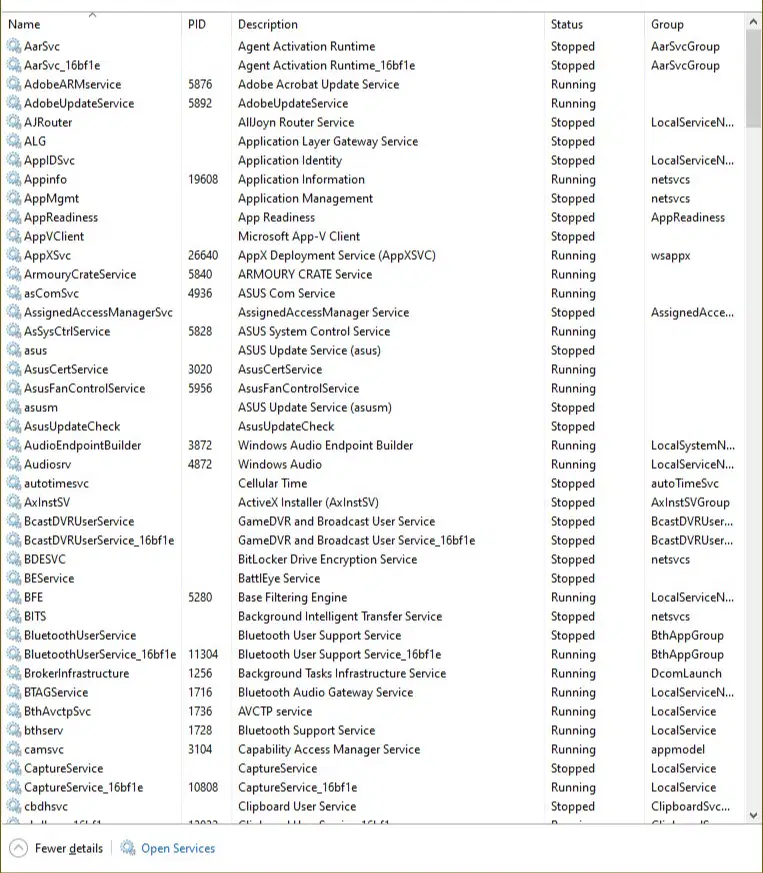
Which part of the OS would the MOST likely represent?
Disk Management
File Management
Application Management
Process/Memory Management
Service Management
Organize these options into the right categories according to OPERATING SYSTEM TYPES
runs on a laptop
includes additional roles
handheld use
has various classifications
interface with many computers
useful for on the go computing
Windows 10/MacOS/Linux
more resources, like storage/RAM
KaiOS/Android/iOS

This picture BEST represents what OS?
Workstation
Server
Mobile

This picture BEST represents what OS?
Workstation
Server
Mobile

This picture BEST represents what OS?
Workstation
Server
Mobile

This picture BEST represents what OS?
Workstation
Server
Mobile
One of these most important principles in (a) security is the principle of (b) privilege.
In computing, a SHELL is what?
An outer layer that protects a yolk.
A program that provides an virtualized environment for the user..
Specific programming for the user to interact with the network users.
You see icons, shortcuts and pictures, what shell are you using?
You see only text, what shell are you using?
Hardware requires WHAT type of software to function?
What are the 'sizes' of CPU instructions?
32/64
32/86
86/32
64/16
Can a 64-bit application run on a 64-bit CPU?
Y
N
Can a 64-bit application run on a 32-bit CPU?
Y
N
Can a 32-bit application run on a 32-bit CPU?
Y
N
Can a 32-bit application run on a 64-bit CPU?
Y
N
Monitoring system health is important. What type of software is used to monitor?
Productive
Utility
Operating
Performance
Both OS and software applications are made up of two specific files. Name one.
executable
excusable
executive
excellently
Both OS and software applications are made up of two specific files. Name one.
configuration
conflated
confined
confederate
In an OS, a folder is also known as WHAT?
What is a directory structure in an OS?
All of these are WORKSTATION OPERATING SYSTEMS except...
Enterprise (pro)
NOS
Home
Lite
An OS designed for handheld devices is known as?
This OS includes packages or roles to run network services.
Enterprise
Server
Home
Pro
Linux
freely code available
can make changes to code
cost effective
Windows
code behind paywall
code cannot be changed
cost prohibitive
Embedded OS are considered what kind of environment?
Static
Dynamic
Unchanging
Changing
Which scenario MOST represents an embedded operating system?
Mom using a tablet.
Mom paying for gas at the pump.
Mom using her PC to order from Amazon.
Mom talking to Siri.
A kernel system that is required to be stable due to its specific function closely represents what type of OS?
Embedded
Workstation
Server
Pro
How often should firmware be updated?
Infrequently
An example of firmware is
BIOS
Win10
OS
UFI
Which PC firmware more closely represents a GUI?
UEFI
BIOS
Win10
Linux
What is virtualization?
This means that multiple operating systems can be installed on a single computer.
Virtualization
Virtual Options
VirtualBox
Hyper-V
Which modern day gaming service provides a type of virtualization?
Xbox Discs
Amazon Luna
Sony Sync
Nintendo VR
Which is NOT a component for a virtual platform?
Physical Machine
Hypervisor
Virtual Machine
Virtual OS
Which Hypervisor is installed directly on the computer?
Type I
Type II
Type III
Type IV
Which Hypervisor runs as a software application within a host OS?
Type I
Type II
Type III
Type IV
Virtualization Options
Labs
Legacy Software Apps
Dev envrionment
Training
Video Conferencing
Store Apps
Open Source Apps
Production PC
According to the book, Windows is installed on what percentage of PCs?
100
90
80
70
Windows Updates
Designated by numbers
Hotfixes
Bigger OS changes
Smaller, sometimes daily updates
Takes months to develop
Does not make radical changes
When Windows 10 was released, it was Microsoft's intention to never...
Release another Windows version
Release another Windows update
Release another Windows edition
Release another Windows App
Windows OS vs Not
7
8
8.1
XP
6
9
XM
Wista
Why are Editions created with Windows?
Windows Editions v. Not
Home
Pro
Enterprise
Education
Client
Support
Business
Non-Profit
Which hardware device is MOST likely associated with 32/64-bit?
Which mobile device has not survived the current market?
Windows
iOS
Android
Samsung
Mac OS is different than other operating systems because
Which OS was designed by Linus Torvalds?
Different Linux versions are known as
Linux is mostly used with WHAT shell?
CLI
GUI
Chrome OS was primarily developed to use what?
Android was developed by what alliance?
Linux Alliance
Microsoft Alliance
Apple Alliance
The file management interface for Windows is called?
The shortcut key combo for File Explorer is what?

What is this icon?
This PC
Network
Control Panel
File Explorer

What is this icon?
This PC
Network
Control Panel
File Explorer

What is this icon?
This PC
Network
Control Panel
File Explorer

What is this icon?
This PC
Network
Control Panel
File Explorer
How is Windows Settings different from Control Panel?
ALL of Windows 10 configuration settings are available in Windows Settings.
True
False
You can find APPLETS within this Windows 10 feature.
What is Control Panel in Windows?
All of these tools are part of Ease of Access EXCEPT...
Touchscreen
Voice Control
Swiping
Magnifier
What is Ease of Access on Windows 10?
The shortcut to access the advanced management utilities is what?
Start-X
Start-U
Start-A
Start-E
All of these are example of management utilities EXCEPT...
Device Manager
Computer Management
Network Management
Command Prompt
One of the most important reasons for owning a computer is to
Email friends
Access the Internet
Watch Netflix
Play Online Games
Websites are hosted on what?
browser or not
Internet Explorer
Edge
Chrome
FireFox
Safari
OpenWeb
Chrombox
FireTail
Internet Browser
Apple
URL stands for
All of these are URLs except...
comptia.org
mercycte.org
https://www.citizensbanks.com
c:/Windows/Users/Website
What is a hyperlink?
A hyperlink is a reference or a link to a web page.
A hyperlink is a reference of font style.
A hyperlink is a link to some of an image file.
What is it called when a browser stores pieces of information on your PC?
The default page that opens when you launch a web browser is called what?

In web browsing, what does this do?
Refresh
Stop
Go Forward

In web browsing, what does this do?
Refresh
Stop
Go Forward

In web browsing, what does this do?
Refresh
Stop
Go Forward

