
 Worksheets
Communication and Language Development
Total questions: 17
Worksheet time: 16mins

Language is defined as...
The manipulation of vocal cords to produce sounds.
A system that enables individuals to express ideas and communicate to others who use the same code.
The exclusive use of words to convey ideas and emotions.
A set of unchanging rules governing communication.
Speech is defined as the (a) of language, the (b) to communicate (c) ; speech depends on (d) ; the ability to produce sounds (e) and correctly.
(Allen et al., 2020)

Communication is defined as the (a) of thoughts and (b) , feelings and (c) likes and (d) .
(Allen et al., 2020)

Communication includes more than just expressive language, it also includes
Gestures and body language.
Music, dance, painting, sculpting, theatre.
Printed word-letters, magazines, texts, memes.
Transmitting information through telepathic means.

A speech impairment is...
Limited vocabulary and grammar skills.
characterized by difficulty in the articulation of words.
Inability to comprehend text.
Difficulty in understanding spoken language.
Articulation refers to...
The sounds, syllables, and phonology produced by the individual.
The speed at which one speaks.
The volume and pitch of one's voice.
The ability to comprehend complex thoughts.spesepasdsdf

Voice refers to...
the ability to speak loudly and effectively
the speed and intensity at which one speaks.
emotional tone conveyed in speech.
the characteristics of sounds produced-pitch, quality and intensity of sound.
What does the term "fluency" refer to?
The complexity of vocabulary used.
the characteristics of rhythm, rate and emphasis of sound produced.
The clarity of pronounciation.
The speed and intensity at which one speaks.
A language impairment is an impairment in (a) and (b) thoughts and ideas. It involves the (c) of (d) information.
(Allen et al., 2020)
Language impairment might include the form of language, including (a) , (b) and morphology. It can also include (c) and (d)
(Allen et al., 2020)
What are the five signs of speech delay that were identified in the video?
B.F. Sinner explained that a child learns to talk by (a) words and then receiving (b) or (c) .
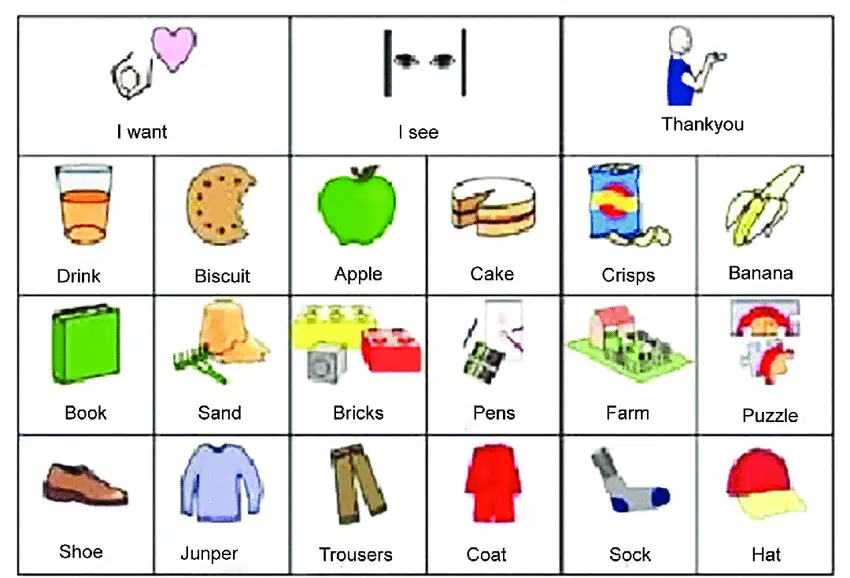
This is an example of:
A method of vocabulary development for children with cognitive impairment.
Technique for prompting vocal projection.
A system of communication for those with hearing impairments
picture exchange communication system to assist children with speech delays.
The Reggio Emilia Approach cites the "Hundred Languages of Children". This refers to:
Children being capable and knowledgeable and can construct their own learning in creative ways.
Children learn languages quickly.
Children are vessels to be filled by educators.
No child develops speech in the same way at the same rate.
A child who has difficulty saying what they want to say correctly and consistently in the right sequence is called:
aphasia
dysarthria
stuttering
apraxia
An anxiety disorder that affects children's ability to speak to people is called:
stuttering
aphasia
selective mutism
speech apraxia
Stuttering is a speech problem that can cause:
children to avoid speaking some words
an attempt to speak with no sound coming out
repetition of whole or parts of words
A, B and C.

