
 Worksheets
Legislative Branch Test
Total questions: 52
Worksheet time: 17mins
What distinguishes an implied power from an express power?
Implied powers are always judicial powers, while express powers are not.
Implied powers are not explicitly enumerated in the Constitution.
Implied powers must undergo legislative review.
Express powers are granted by the Legislative Branch.
What is the main difference between an authorization bill and an appropriations bill in the context of government spending?
The first refers to state spending, while the second refers to federal spending.
The first is approved by the House of Representatives, while the second is approved by the Senate.
The first refers to external spending, while the second refers to internal spending.
The first provides legal authority to spend, while the second actually provides the funds.
Why is the power of legislative oversight important in the system of checks and balances?
It allows Congress to ensure that the Executive Branch is implementing the laws as intended.
It gives Congress the ability to declare laws unconstitutional.
It forces Congress to relinquish its power of judicial review.
It allows Congress to decide whether the power is explicit or implicit.
How did the Supreme Court case of McCulloch v. Maryland impact the interpretation of the 'Necessary and Proper Clause'?
It restricted the interpretation of the clause.
It provided a very broad interpretation of the clause and supported implied powers.
It declared the clause unconstitutional.
It did not have a significant impact on the interpretation of the clause.
Which of the following is NOT a source of tension between Congress and the President?
They have the same term limits.
The system of checks and balances.
Congress and the Presidency are controlled by different political parties.
They serve different electorates.
What is the main purpose of redistricting?
Redraw district lines after redistricting.
Redraw district lines to gain a political advantage.
Change how House membership is distributed among states.
Provide an accurate count of the population in the United States.
The Supreme Court ruled that the Line Item Veto is unconstitutional because:
It is the job of Congress to edit legislation, not the President.
It does not allow for adequate voter participation.
It gives Congress too much power over the Executive Branch.
The Senate is the only government body that can veto a bill.
Which committee has the most influence over the scheduling of bills in the House of Representatives?
Conference Committee
Standing Committee
Rules Committee
Joint Committee
What is the key difference between an open rule and a closed rule during action on the floor?
An open rule allows unlimited debate time.
A closed rule requires a quorum to vote.
An open rule allows amendments to the bill.
A closed rule restricts who can participate in the debate.
Which of the following correctly describes the eligibility requirements for the Senate?
Must be 25 years old and a U.S. citizen for 7 years.
Must be 30 years old and a U.S. citizen for 9 years.
Must be 35 years old and a natural-born citizen.
Must be 20 years old and a natural-born citizen.
What is the main function of a Joint Committee in Congress?
A Joint Committee is a temporary committee that studies a specific topic of national importance.
A Joint Committee is a permanent committee that handles matters related to its subject area.
A Joint Committee is a temporary committee composed of members of the House and the Senate.
A Joint Committee is a permanent committee composed of members of the House and the Senate that investigates different topics and reports their findings.
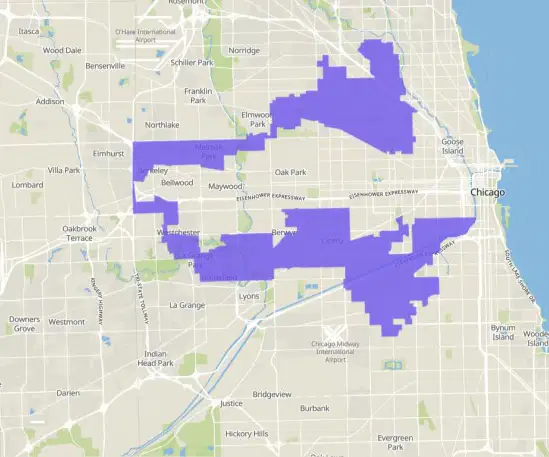
Which of the following statements best explains the motivation behind how the district has been drawn?
It has been drawn by a political party to group moderate voters.
It has been drawn cooperatively by both political parties to ensure a fair election.
It has been drawn to group diverse voters and foster highly competitive elections.
It has been drawn to give an advantage to one party in the election. This could be done by grouping or dividing.
What is the minimum number of senators needed to invoke cloture and end a filibuster?
51
60
75
100
Where is a filibuster most likely to occur to prevent a bill from being voted on?
Primarily in the House, with rare occurrences in the Senate.
Primarily in the Senate, with rare occurrences in the House.
Only in the House, as it has fewer restrictions.
Only in the Senate, as it has fewer restrictions.
How many members are there in the United States Senate?
How many members are there in the House of Representatives in total?
How many senators does each state have?
How many Representatives and Senators are there in total?
What is the role of the Speaker of the House in the legislative process?
The Speaker of the House has no role in the legislative process.
The Speaker of the House can propose legislation but cannot vote on it.
The Speaker of the House controls the legislative agenda and presides over debates.
The Speaker of the House only votes in case of a tie.
What is the meaning of the Elastic Clause in the U.S. Constitution?
It allows for the expansion of federal power to meet the needs of the nation.
It provides flexibility in the interpretation of the Constitution.
It allows for the addition of new amendments to the Constitution.
It limits the power of the federal government by reserving certain powers to the states.
What is the role of the Senate Majority Leader in the legislative process?
The Senate Majority Leader has no role in the legislative process.
The Senate Majority Leader can propose legislation but cannot vote on it.
The Senate Majority Leader controls the legislative agenda and presides over debates.
The Senate Majority Leader only votes in case of a tie.
What is the main function of a Select Committee in Congress?
A Select Committee is a temporary committee that studies a specific issue of national importance.
A Select Committee is a permanent committee that handles matters related to its subject area.
A Select Committee is a temporary committee composed of members of both the House and the Senate.
A Select Committee is a permanent committee that exists to resolve differences between House and Senate bills.
What is the main function of a Conference Committee in Congress?
A Conference Committee is a temporary committee that studies a specific topic of national importance.
A Conference Committee is a permanent committee that handles matters related to its subject area.
A Conference Committee is a temporary committee composed of members of the House and the Senate.
A Conference Committee is a permanent committee that exists to resolve differences between House and Senate bills.
What are two exclusive powers/duties of the House of Representatives?
electoral and judge the impeachment
present impeachment charges and initiate all revenue bills
choose the Vice President if there is no majority in the electoral college and judge the President's impeachment
choose the President if there is no majority in the electoral college and approve presidential appointments
The official who presides over the Senate is the
President Pro Tempore
Vice President
President
Senate Majority Leader
All of the following are constitutional requirements for a person wishing to run for the House of Representatives, except:
natural born citizen
25 years of age
citizen for 7 years
reside in the district he/she represents
All of the following are qualifications for a person who wants to become a Senator, except:
must have served in the House for at least 4 years
30 years of age
9 years as a U.S. citizen
live within the state they represent
What is the importance of the Census in relation to the House of Representatives?
The Constitution provides for a census every ten years to redistribute seats fairly.
The Constitution provides for a census every 20 years to obtain an accurate count of the population.
The Constitution uses the Census to determine the number of senators each state should have.
The Constitution establishes a Census to distribute seats in the House of Representatives.
The main job of the legislative branch
determine if laws are unconstitutional
veto laws
make laws
approve laws made by the President
When a bill passes through the House, where does it go next?
Senate
Supreme Court
President
Library of Congress
What happens to a bill if the President signs it?
It becomes law
It is rejected
If the House and the Senate pass different versions of the same bill, where does it go next?
conference committee
joint committee
resolution committee
President
Congress can override a presidential veto with a
½ vote of both houses
⅔ vote of both houses
¾ vote of both houses
unanimous vote of both houses

This image shows the political concept of drawing districts for the advantage of a particular political party. What is this concept called?
Salamandering
Gerrymandering
Gerry Curling
Elbridge Gerrying
Who receives a bill first?
The House
The Senate
The House or the Senate
The President
Where can an idea for a bill come from?
the President
the American public
members of Congress
All of the above
A bill must be debated and examined in a _____________ before it can be voted on by the entire House or Senate.
panel of judges
committee
President
Supreme Court
If there is a 50/50 tie in the Senate, the _______________ or the official presiding over the Senate can vote to break the tie.
Vice President
Speaker of the House
President
Chief Justice
If the President retains a bill for 10 days without signing it and Congress is still in session, the bill
dies
returns to Congress
becomes law
returns to a committee for review
What is an attempt to delay the approval of a bill called?
Paralysis
Filibuster
Pocket Veto
Congressional Override
A veto of a bill caused by the president's failure to sign it within ten days of Congress adjourning is called what?
Filibuster
Stalemate
Pocket Veto
Rider
The powers granted to Congress by the Constitution are known as
implied powers
expressed powers
separation of powers
powers of Congress
These are permanent committees that exist in the House and the Senate.
Conference committees
Select committees
Joint committees
Standing committees
The necessary and proper clause is also known as the elastic clause.
True
False
What happens to a bill in committee?
research, hearings, debate, committee votes
debate, full chamber vote, veto
signed, veto, pocket veto
cloture, debate, filibuster
What is the difference between public bills and private bills?
Public bills impact everyone.
Public bills impact a small group of people.
There are no differences between the two.
One starts in the House and the other in the Senate.
What is the main purpose of political action committees (PACs)?
To lobby government officials
To spread propaganda
To raise money for candidates running for public office
To raise money for interest groups
Groups that seek to influence public policy or government.
Lobbyists
Interest groups
Political Action Committees (PACs)
Investigative journalists
What is a lobbyist?
A lobbyist is a person who works in the lobby of a hotel.
A lobbyist is a person hired to persuade legislators to support specific interests or causes.
A lobbyist is a type of sandwich.
A lobbyist is a type of bird.
What is lobbying?
Lobbying is the act of conducting scientific research.
Lobbying is the act of attempting to influence decisions made by government officials.
Lobbying is the act of promoting products in the market.
Lobbying is the act of organizing protests against the government.
What's an interest group?
What is the primary difference between an interest group and a political party?
Interest groups are not involved in the political process
Political parties aim to influence public policy, while interest groups do not
Interest groups focus on specific issues or interests, while political parties aim to win elections and govern
Political parties are illegal in many countries

