
 Worksheets
Understanding Our Politics Practice Exam
Total questions: 40
Worksheet time: 20mins

According to the bar graph, what percentage of children remain Independent/Non-partisan if their parents do not have a consistent orientation toward either party?
50%
30%
20%
100%

According to the bar graph, which of the following statements is true about the influence of parents on the political orientation of their children?
About 50% of children whose parents are both Democrats will become Independent/Non-partisan.
When both parents are Democrat, their child is likely to become Independent/Non-partisan.
About 25% of children whose parents are both Republican will become Independent/Non-partisan.
When both parents are Republican, their child will not become a Democrat.

Based on the data in the bar graph and your knowledge of the course, which of the following is an accurate statement that can be made about political socialization?
Young people are closer to and tend to rely more on their peers than their parents for political information.
The political orientation of parents has a great influence on how their child will view politics.
Family, schools, peers, and social environments, including civic and religious organizations, all have an equal role in the political socialization of young people.
The impact of globalization on political culture and an expansive social media network has the greatest influence on children’s political socialization.
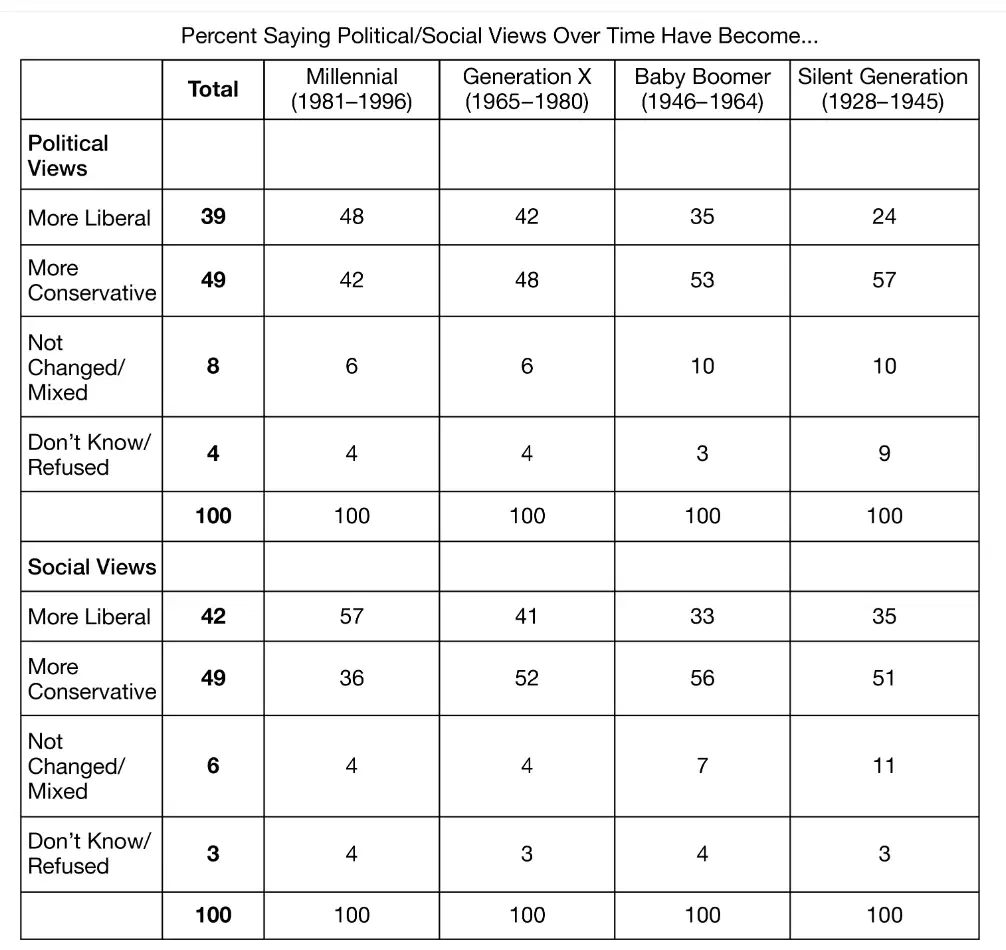
Which of the following statements are illustrated by the data in table?
The Silent Generation is more likely to say they have become more liberal over time politically than Millennials.
Millennials are more likely to say they have become more liberal politically over time than Baby Boomers.
Generation X is more likely to say their political views have not changed or been mixed over time compared to the Silent Generation.
Baby Boomers are more likely to say they have become more conservative politically over time than the Silent Generation.
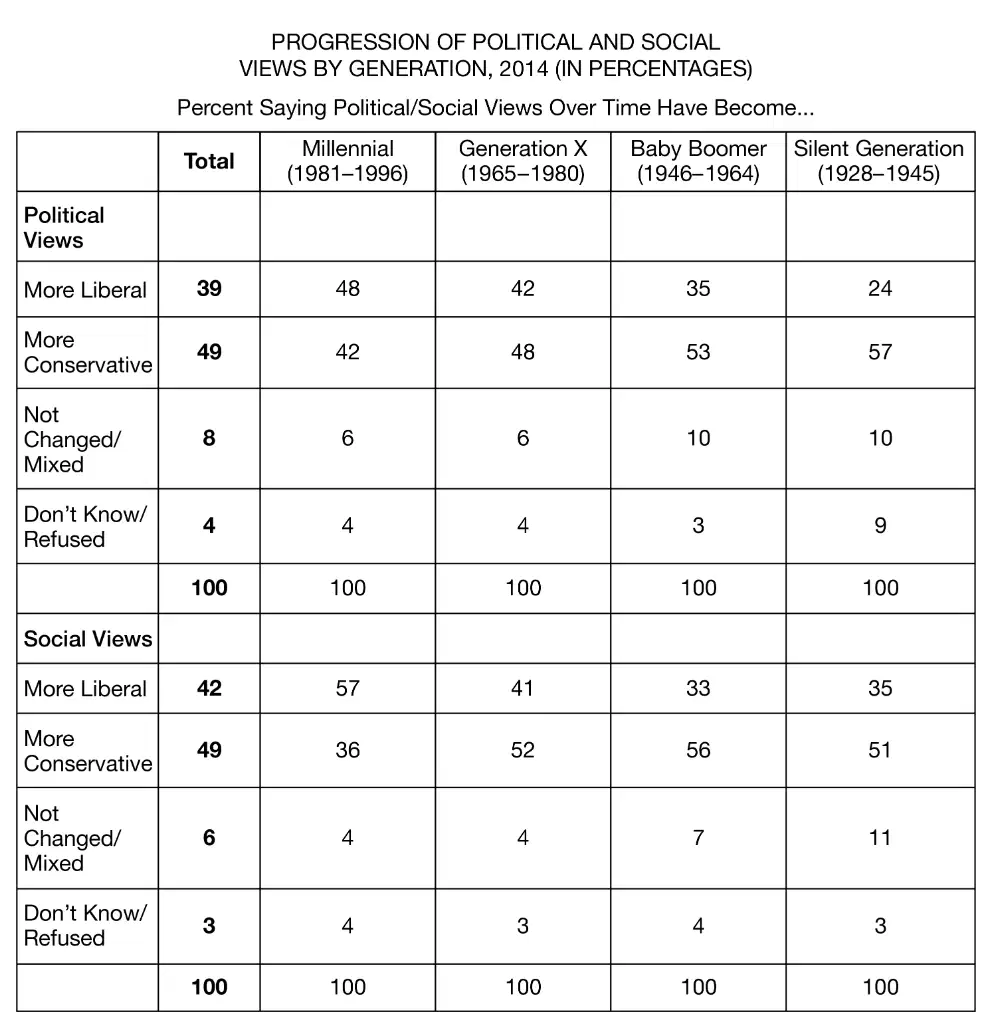
Which of the following are supported by the data in the table?
Very few people change their views on social or political issues over time.
Younger people are more apt to identify as politically liberal rather than socially liberal.
As people get older, they tend to become more liberal on social issues but not on political issues.
More people become more socially conservative over time than more socially liberal.
A large national survey of young Americans recently released by CIRCLE shows young Obama and Romney voters had strikingly similar levels of political knowledge. The survey also shows a clear relationship between respondents’ high school civics education experiences and their knowledge of campaign issues and political participation in the 2012 presidential election. However, taking high school civics had little or no relationship with young adults’ choice between Barack Obama and Mitt Romney.
“Young people who recalled experiencing more high-quality civic education practices in schools were more likely to vote, to form political opinions, to know campaign issues, and to know general facts about the US political system,” said Peter Levine, director of CIRCLE. “Civics education was not related to partisanship or choice of candidate. These results should allay political concerns about civic education being taught in schools.” Which of the following concepts is most closely related to the passage?
Public opinion polling
Partisanship
Political socialization
Ideology
A large national survey of young Americans recently released by CIRCLE shows young Obama and Romney voters had strikingly similar levels of political knowledge. The survey also shows a clear relationship between respondents’ high school civics education experiences and their knowledge of campaign issues and political participation in the 2012 presidential election. However, taking high school civics had little or no relationship with young adults’ choice between Barack Obama and Mitt Romney.
“Young people who recalled experiencing more high-quality civic education practices in schools were more likely to vote, to form political opinions, to know campaign issues, and to know general facts about the US political system,” said Peter Levine, director of CIRCLE. “Civics education was not related to partisanship or choice of candidate. These results should allay political concerns about civic education being taught in schools.” Which of the following explains how the scenario described in the passage relates to political behavior?
Globalization has influenced how individuals participate in politics.
Taking part in civic education affects whether or not an individual participates politically.
Generational differences account for major differences in political participation rates.
Individuals are likely to form opinions about politics that correspond to their parents’ views.
A large national survey of young Americans recently released by CIRCLE shows young Obama and Romney voters had strikingly similar levels of political knowledge. The survey also shows a clear relationship between respondents’ high school civics education experiences and their knowledge of campaign issues and political participation in the 2012 presidential election. However, taking high school civics had little or no relationship with young adults’ choice between Barack Obama and Mitt Romney.
“Young people who recalled experiencing more high-quality civic education practices in schools were more likely to vote, to form political opinions, to know campaign issues, and to know general facts about the US political system,” said Peter Levine, director of CIRCLE. “Civics education was not related to partisanship or choice of candidate. These results should allay political concerns about civic education being taught in schools.” The students mentioned in the passage did not have a strong preference in candidates or increased levels of partisanship, despite their exposure to civics education. Which of the following explains this type of political socialization?
Political socialization does not include the formation of political beliefs but rather refers only to the likelihood of participation.
Younger people are less likely to understand politics; therefore, the civics courses were unlikely to lead to strong preferences regarding partisanship or candidates.
Public schools are prohibited by law from discussing political issues and current events, which limits the effect of political socialization.
Some life experiences that socialize individuals into politics affect specific behaviors but not partisanship or ideology.
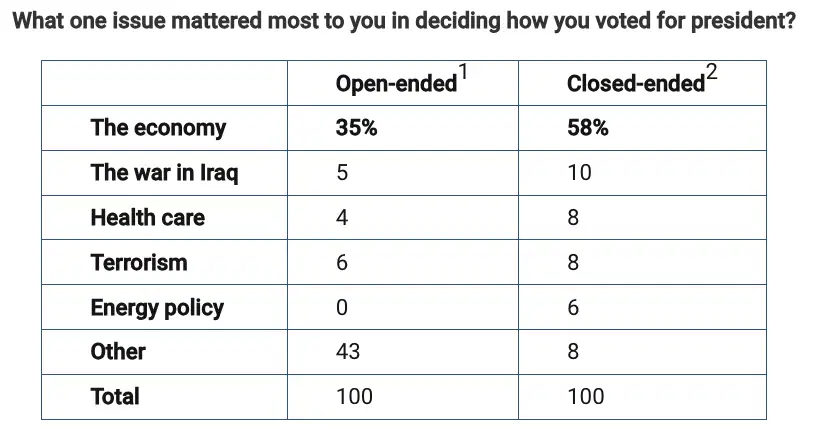
Which of the following elements of polling likely created the difference in the poll results?
The difference was likely a result of the margin of error.
One poll is a tracking poll, and the other is a benchmark poll.
The formats of the survey questions are different.
The questions are worded differently.
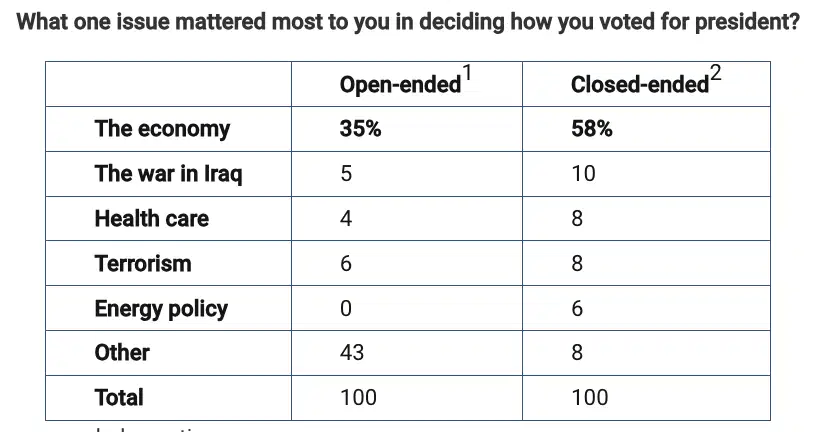
Which of the following best explains how the format affected the polls?
The closed-ended format limited respondents to fewer options, which forced respondents to focus on the most important issue of those options.
The closed-ended format decreased participation because it was more difficult for respondents to think of a response.
The open-ended format increased the number of respondents who mentioned energy policy because the poll reminded them of the issue.
The open-ended format limited the number of potential responses, which affected the accuracy of the poll.
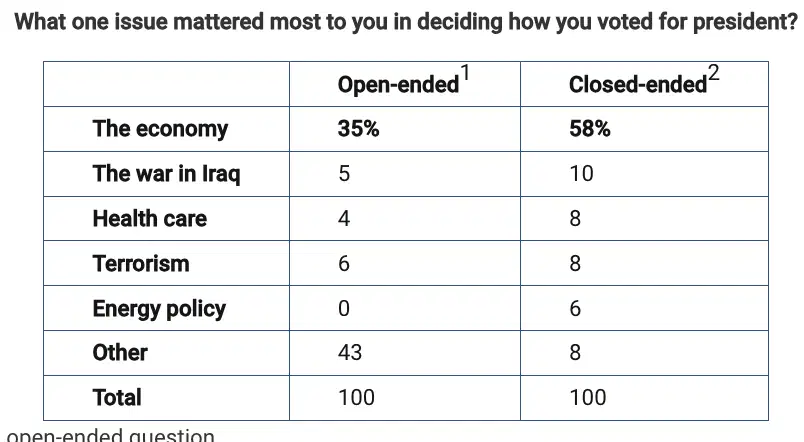
The data from the two polls, which ask the same question, illustrate which of the following?
Public opinion can influence policy debates and election results.
Polls that do not use scientific methods will not be replicable in another setting.
Those making inferences from polling results should understand the methods used by pollsters.
Scientific polling is not an appropriate way to measure public opinion.
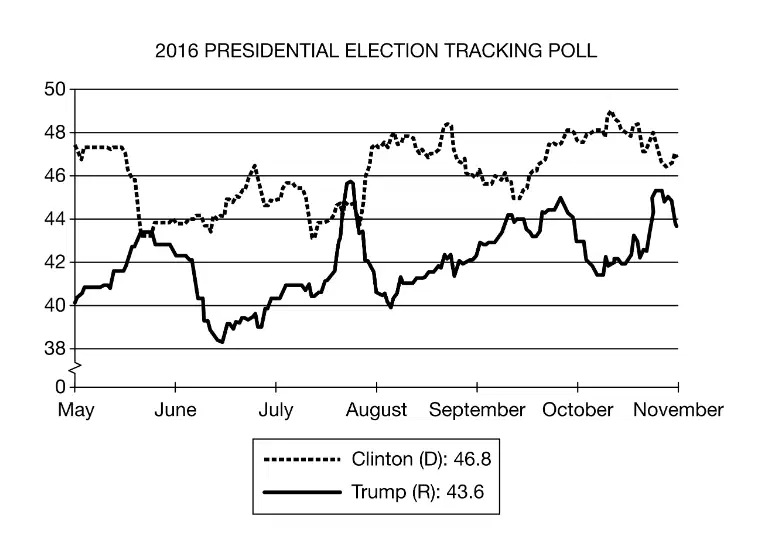
In the 2016 election, Donald Trump won the election despite losing the popular vote by about two percent. The line graph illustrates which of the following about presidential election polling?
The trend appears to indicate that Clinton is more likely to win, but factors such as margin of error and the electoral system also need to be taken into account.
Most polling used by the media is biased and lacks scientific rigor, leading to incorrect assumptions about who will win elections.
Even though polls reach many people, it is not useful to make inferences about the general population because most people are not being polled.
Polling groups of people over a long period of time leads to incorrect polling results.
The trend in late October and early November showing Clinton ahead but an increase in support for Trump most likely would be
used by Clinton to assure her supporters of a likely victory
described as momentum by the trailing Trump campaign to encourage supporters to vote
the result of the margin of error, which might lead one to believe Trump was possibly ahead
a result of unscientific polling practices by polling organizations
The polling in the summer of 2016 shows a sharp increase in popular support for Clinton, followed by a sharp increase in popular support for Trump. Which of the following factors most likely accounts for these increases in popular support?
A change in the use of sampling techniques employed by polling organizations
The timing of political events covered by the news which temporarily influenced preferences
The effect of political socialization on individuals responding to poll questions
Sampling errors that affected polling results

Using both maps, which of the following best explains how states without capital punishment voted in the 2016 presidential election?
States without capital punishment were more likely to vote for the Republican in the 2016 election.
Support for or opposition to capital punishment had no correlation to how a state voted in 2016.
States without capital punishment were more likely to cast their ballots for the Democrat in the 2016 election.
States without capital punishment were just as likely to vote for Hillary Clinton as they were to vote for Republican.
Using both maps, which of the following explains how states with capital punishment voted in the 2016 election?
The maps show that states with capital punishment were more likely to vote for the Republican in the 2016 election.
The maps show that support for or opposition to capital punishment had no correlation to how a state voted in the 2016 election.
The maps show that states with capital punishment were more likely to cast their ballots for the Democrat in the 2016 election.
The maps show that states with capital punishment were just as likely to vote for the Democrat as they were to vote for the Republican.
Which of the following amendments is most closely related to the information on the maps?
First Amendment
Eighth Amendment
Fifth Amendment
Fourth Amendment
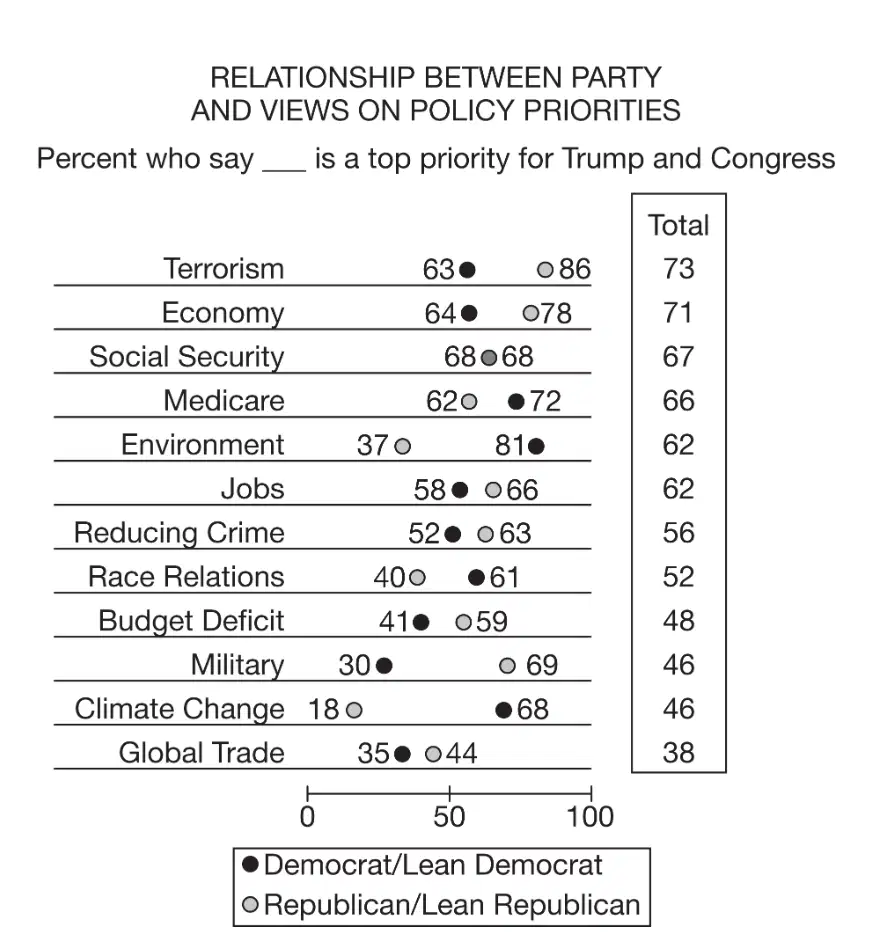
Which of the following is a possible limitation depicted by the data presented in the chart?
The chart does not show many differences between the parties on public policy issues.
The chart does not account for the segments of the population that identify as Independents.
The chart does not take into account those who are not registered to vote.
The chart surveyed respondents during January 5–9, 2018.
The data in the chart is too limited to support which of the following generalizations?
Democrats believe the environment is a more important policy priority than terrorism.
Republicans believe the economy is a priority for state governments rather than the federal government.
Most Democrats believe the federal government needs to take action to reduce crime.
There is a relatively wide partisan gap on whether the military should be a top priority.
Which of the following statements are least supported by information on the chart?
Most Democrats and Republicans surveyed believe that an increase in social security taxes is needed to address social security deficits.
Most Democrats and Republicans surveyed think that terrorism is a priority.
Both Democrats and Republicans surveyed believe the military is a less important priority than the economy.
A majority of respondents surveyed do not believe that reducing crime is a more important priority than reducing the budget deficit.
“Finally, there are the legal and moral arguments. Health care is considered a human right in every other developed nation. By not providing Medicare to all Americans, the government is not providing equal protection under the law: those with Medicare have more protection against the devastating effects of illness and injury, get more help overcoming or living with disabilities, and are protected against financial ruin.
People say that single-payer would cost too much. Not true.
We could provide health care for all our citizens for no more than we are currently spending on our very dysfunctional, fragmented and unfair system.
How is this possible? Currently almost half of every health care dollar is spent on something other than health care: profit for insurance companies; multi-million-dollar salaries of their CEOs; money spent on advertising, processing (and rejecting) claims; and creating mountains of paperwork and endless hassles for doctors and patients.” Which of the following statements reflect the author’s viewpoint as shown in the passage?
The passage could influence Congress to pass legislation that increases the regulation of health insurance companies.
The passage could convince more members of Congress to support Medicare for all.
The passage could influence state legislators to limit the types of health care plans offered in their states.
The passage could influence citizens in deciding whether or not they should purchase health care plans.
“Finally, there are the legal and moral arguments. Health care is considered a human right in every other developed nation. By not providing Medicare to all Americans, the government is not providing equal protection under the law: those with Medicare have more protection against the devastating effects of illness and injury, get more help overcoming or living with disabilities, and are protected against financial ruin.
People say that single-payer would cost too much. Not true.
We could provide health care for all our citizens for no more than we are currently spending on our very dysfunctional, fragmented and unfair system.
How is this possible? Currently almost half of every health care dollar is spent on something other than health care: profit for insurance companies; multi-million-dollar salaries of their CEOs; money spent on advertising, processing (and rejecting) claims; and creating mountains of paperwork and endless hassles for doctors and patients.”
Question
Which of the following explains how the role of government in health care policy would be influenced if the policy proposal in the passage were to be implemented?
Because it is a single-payer system, the federal government would be able to cut taxes and still fund health care for everyone in the country.
Due to the nature of the single-payer system, the federal government would provide health care plans only to people who were unable to afford their own plans.
Because it is a single-payer system, the federal government would let private insurance companies take over administering health care plans.
Due to the nature of single-payer health care systems, the federal government would be responsible for funding and administering a public health care system for all citizens.
“Finally, there are the legal and moral arguments. Health care is considered a human right in every other developed nation. By not providing Medicare to all Americans, the government is not providing equal protection under the law: those with Medicare have more protection against the devastating effects of illness and injury, get more help overcoming or living with disabilities, and are protected against financial ruin.
People say that single-payer would cost too much. Not true.
We could provide health care for all our citizens for no more than we are currently spending on our very dysfunctional, fragmented and unfair system.
How is this possible? Currently almost half of every health care dollar is spent on something other than health care: profit for insurance companies; multi-million-dollar salaries of their CEOs; money spent on advertising, processing (and rejecting) claims; and creating mountains of paperwork and endless hassles for doctors and patients.”
Question
Which of the following most likely explains how the views of a moderate, someone who does not subscribe to the views of a single political party, might be affected by this passage?
The passage might convince a moderate to support a single-payer public health care system and the passage of a constitutional amendment that requires Congress to create such a system.
The passage might convince a moderate to support a single-payer public health care system and contact their representatives in Congress to indicate their support.
The passage might convince a moderate to support a single-payer public health care system and vote for a member of Congress who supports defunding Medicare entirely.
The passage might convince a moderate to support a single-payer public health care system and a proposal that would double income taxes to pay for it.
A member of Congress is arrested and convicted of failing to pay the proper amount of income tax. Which of the following core American values is most relevant to this case?
Limited government
Equality of opportunity
Free enterprise
The rule of law
The idea of having a constitution, which establishes the powers of the government to enact and enforce legislation, is most closely aligned with which of the following core American values?
Equality of opportunity
Free enterprise
The rule of law
Individualism
Which of the following examples describes the core value of equality of opportunity?
A student gains admittance to a university without the hindrance of racial discrimination.
A person is hired at a workplace because the hiring manager prefers younger employees.
A business owner receives a loan from a bank as a result of growing up with the bank manager.
A citizen is appointed to a school board through political connections with the mayor.
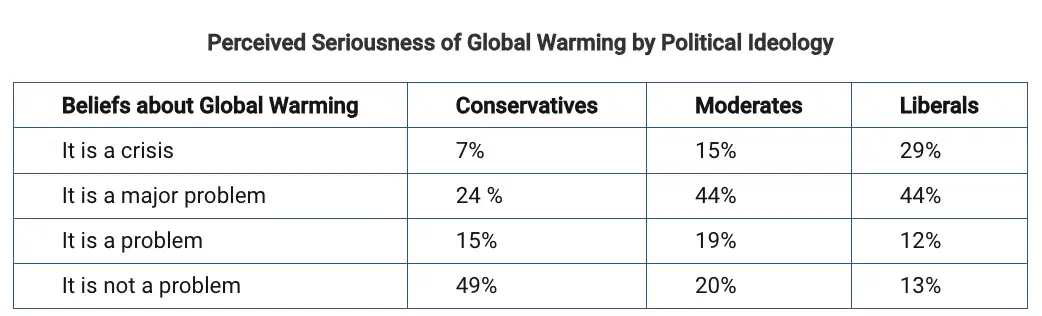
Which of the following statements are supported by the data in the table?
Conservatives are more likely than liberals to believe that global warming is a crisis.
Moderates are more likely than conservatives to agree that global warming is not a problem.
Liberals are more likely than moderates to agree that global warming is a crisis.
Conservatives are more likely than moderates to say that global warming is a major problem.
Which of the following public policies would Democrats be most likely to support?
Reducing taxes on American businesses and corporations
Increasing the age of eligibility for social security benefits
Reducing the size of the federal government by eliminating an executive department
Increasing taxes on the wealthiest Americans
Which of the following public policies would Republicans be most likely to support?
Placing more regulations on businesses
Increasing national government involvement in the public health care system
Creating a less restrictive marketplace environment
Creating additional education policies at the national level rather than at the state level.
Which of the following parties would be most likely to support little to no national or state involvement in policymaking?
The Democratic Party
The Libertarian Party
The Green Party
The Republican Party
American political culture is characterized by strong popular support for all of the following EXCEPT
the rule of law
limited government
individual liberty
economic equality
Which of the following explains why any attempt to reduce Social Security benefits is difficult?
The Supreme Court has ruled that benefits are constitutionally required.
Interest groups concerned with Social Security are ineffective.
There are many voters who support Social Security.
Government cannot predict the number of new retirees each year.
Just beyond the horizon of current events lie two possible political futures—both bleak, neither democratic. The first is a retribalization of large swaths of humankind by war and bloodshed: a threatened Lebanonization of national states in which culture is pitted against culture, people against people, tribe against tribe—a Jihad in the name of a hundred narrowly conceived faiths against every kind of interdependence, every kind of artificial social cooperation and civic mutuality. The second is being borne in on us by the onrush of economic and ecological forces that demand integration and uniformity and that mesmerize the world with fast music, fast computers, and fast food—with MTV, Macintosh, and McDonald’s, pressing nations into one commercially homogeneous global network: one McWorld tied together by technology, ecology, communications, and commerce. The planet is falling precipitantly apart and coming reluctantly together at the very same moment.
Question
Based on your knowledge of United States government and politics, with which of the following statements would the author most likely agree?
Free market principles influence American political culture as well as the cultures of other countries.
The United States is moving toward a single religion while other countries become more religiously fragmented.
Capitalism has little influence beyond the borders of the United States because of retribalization in other countries.
Citizens in the United States have witnessed a decline in civil liberties because of the similarities between the two major parties.
A state government places security cameras facing a popular site of protest in a public square in front of its statehouse. This scenario illustrates
how political attitudes quickly shift in the United States
the balance of promoting stability and ensuring civil liberties
the free-rider problem of organizing a civil rights protests
the impact of globalization on individual political attitudes
Candidates for political office use public opinion polls for all of the following purposes EXCEPT to
assess recognition of the candidate’s name
measure voters’ support for the candidate’s issues
bring the opposition’s opinions into alignment with those of the candidate
identify key issues among the voters
One of the principal effects of 9/11 was instilling in Americans a fear that their personal security was at greater risk than ever before. Many aspects of the post-9/11 world are indeed new, but the fear it evokes echoes that felt by prior generations. At times the country has met those fears while still holding fast to its core democratic principles. Other times, fear has overruled American principles, especially the protection of individual freedoms. The most important legacy of the American experience following 9/11 will not be the novelty of fear, but rather how well the country copes with that fear while adhering to its constitutional framework.
Given how searing the 9/11 experience was, it is sometimes hard to remember that prior generations of Americans didn’t always sleep soundly either. Pearl Harbor is an often-cited example, but it joins many other moments of intense fear in U.S. history. During the 40-plus years of the Cold War, American school children practiced “duck and cover” drills the way today’s kids might practice school lock-downs. As a teenage in the 1980s, I joined Sting in hoping we could avert a nuclear holocaust if “the Russians love their children, too.”
With the collapse of the Soviet Union, other threats in the United States soon appeared: the 1993 World Trade Center bombing, the 1995 Oklahoma City bombing, and the 1996 Atlanta Olympic Park bombing, to name just a few. During the 1990s, some in the military liked to refer to the United States as a “homeland sanctuary;” after 9/11, many talk about the end of that sanctuary.
True, the country has experienced fewer external threats to its population than have most other nations. But it’s a misconception to think that the American sense of external threat is new.
Question
The experience of those who lived through 9/11 needs to create which of the following outcomes, according to the author of the passage?
Citizens should not let their fear of another terror attack override the country’s ability to adhere to the civil liberties protections outlined in the Constitution.
Citizens need to acknowledge that the 9/11 attack was a unique event and work to develop a new strategy to combat future terror attacks.
Citizens have to be willing to sacrifice some civil liberties in order to protect the country from future terroristic attacks.
Citizens can rely on the government to develop plans to protect them in the event of a future attack on the United States.
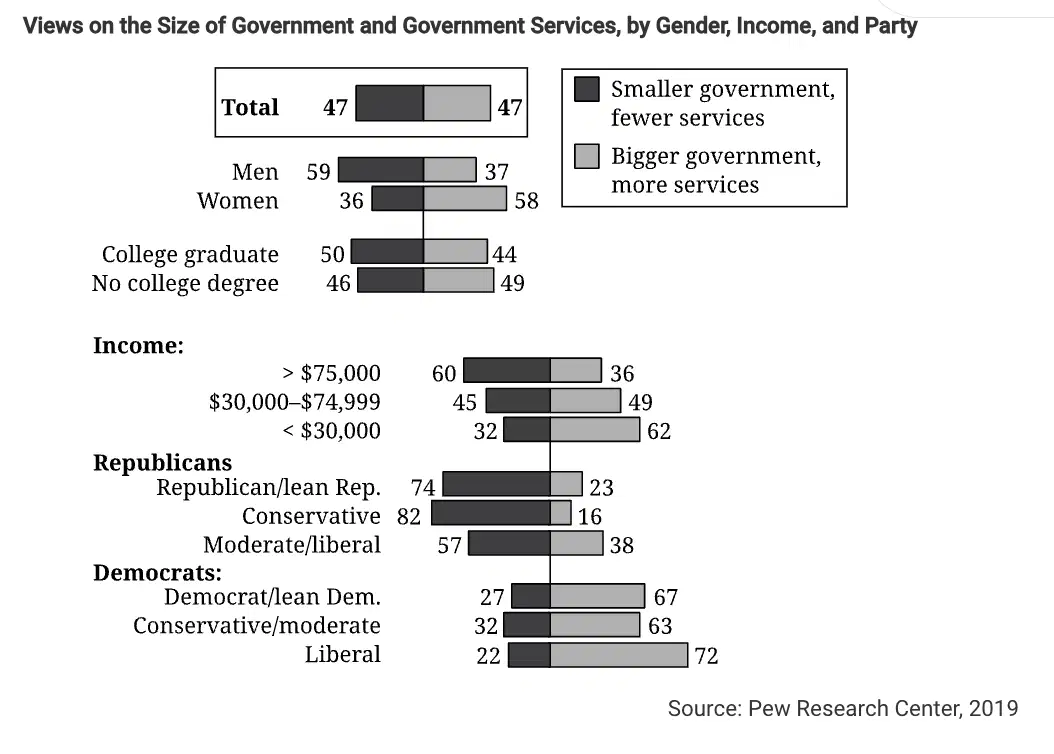
Which of the following statements is consistent with data shown in the bar graph?
Men are more likely than women to believe that there should be an increase in government spending to provide social services for the elderly.
Conservatives are more likely than liberals to believe that spending on public transportation should be increased to connect citizens to employment opportunities.
Republicans are more likely than Democrats to believe that there should be fewer regulations on businesses to promote economic growth and increase wages.
Those with higher incomes are more likely than those with lower incomes to believe that education spending should be a federal responsibility to guarantee that each citizen has an equal chance at success.
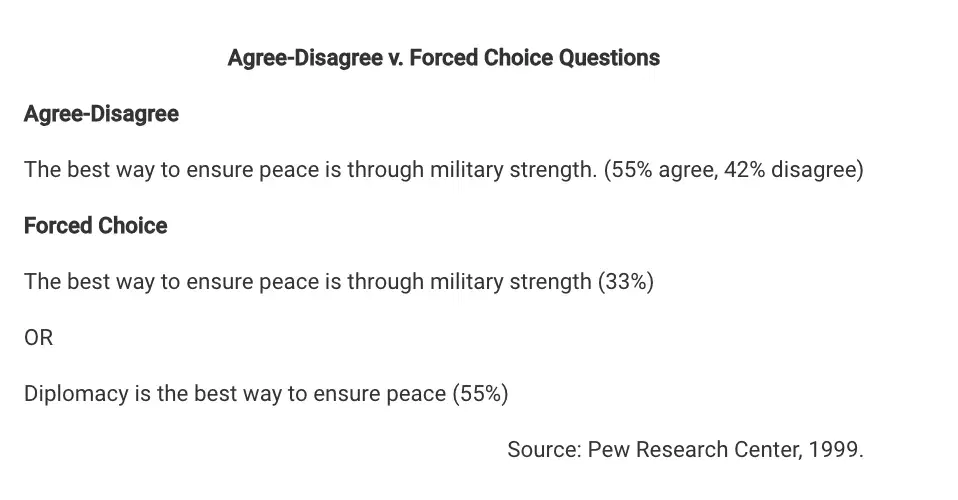
Which of the following is the best conclusion a polling group might draw from the results of the two polls?
Including loaded phrases such as “military strength” in questions skews the results of the poll.
Asking the same question twice biases respondents, encouraging them to change their position.
Using an agree-or-disagree format encourages respondents to agree with the position.
A majority of Americans support using military force to ensure peace.
Which of the following best matches a political ideology with that ideology’s position on the proper role of government in regulating the economy?
Communitarian—The government should regulate monetary policy but not fiscal policy.
Libertarian—Government regulation should increase when the economy is in decline.
Conservative—The government should strictly limit its regulation of the marketplace.
Liberal—The government should not intervene in economic decision-making.
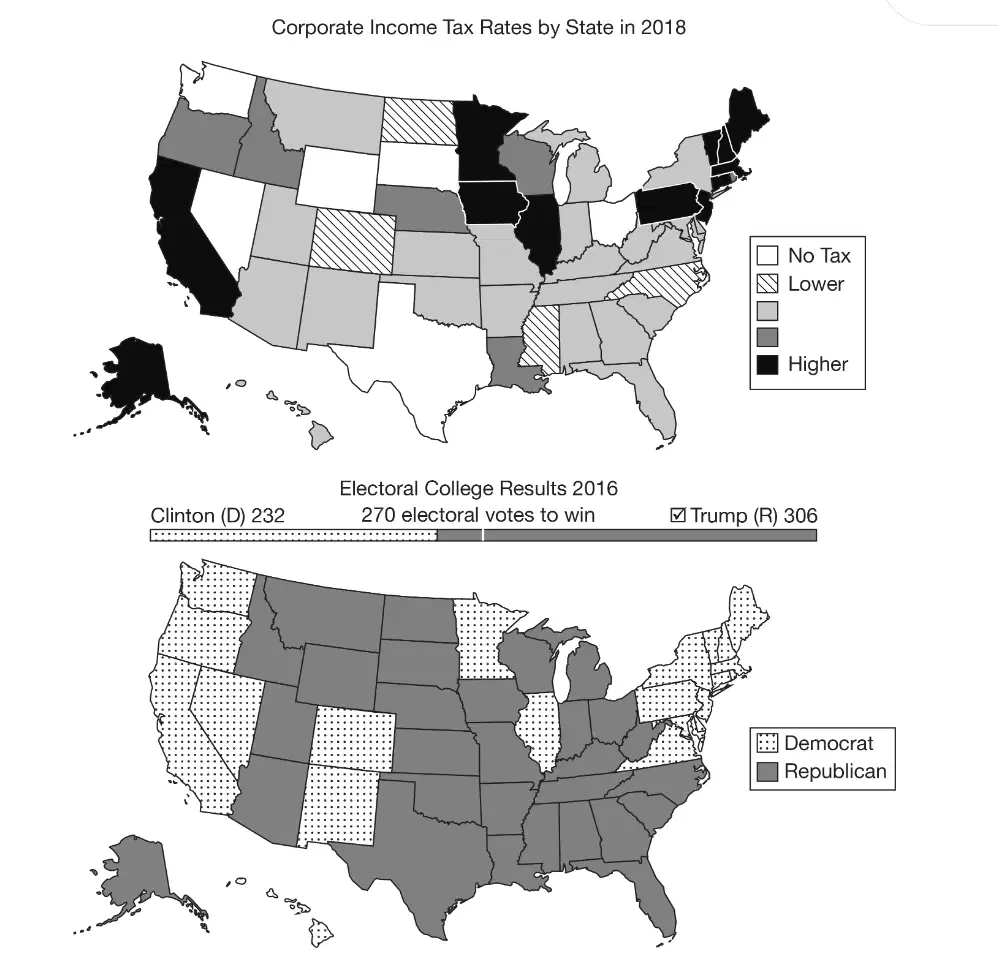
Using both of the maps, which of the following best explains the role that ideology has played in the shaping of corporate tax rates?
The maps indicate that there is no correlation between corporate tax rates and a state’s ideology.
The maps indicate that states that have high corporate tax rates are more likely to enact liberal policies.
The maps indicate that states with high corporate tax rates are more likely to hold libertarian positions.
The maps indicate that states with high corporate tax rates do not have an ideological preference.

