
 Worksheets
Module 3 Review - Computer Discovery
Total questions: 36
Worksheet time: 36mins
How to add a sprite?


What happens when we click this?
Change the Sprite
Program Starts
Program Stops
A series of instructions or steps that repeats.
Frame Rate
Loop
User Interface
Finding and fixing errors in a program.
Debugging
Bug
Initialization
A series of instructions that follow one another in order.
Sequence
Parallelism
Navigator
Part of a program that does not work correctly.
Ant
Bug
Spider
A list of steps to finish a task.
Event
Bug
Algorithm
Which of these is NOT an algorithm?
Following recipe instructions
Working out how an engine works
Tying your shoelaces
Making a cup of coffee

What is being created in the Scratch code shown here?
A loop
A function
A costume
An IF statement

Leo is writing a "Digital Pet" program in Scratch. What is Leo using here to store how thirsty his pet is?
A costume
A sprite
A function
A variable
In which of the following technology, user made tools (animated pictures, effect, shadow, filters etc)) is mixed with real environment?
Augmented Reality
Virtual Reality

what is this?
AR (Augmented Reality
VR (Virtual Reality)
MR (Mixed Reality)
AI (Artificial Intelligence)
In the future, VR will have an impact on the areas such as: military applications, education, fashion, sport and media.
Yes
No
AR users do not need to wear a headset or a head-mounted display.
YES
NO
what is AR used for?
education
entertainment
Advertising
All of the Above
A set of steps used to complete a specific task is called a (a) .
Binary uses a system of _____'s and ______'s.
One
Numbers
Sequences
Zero
Bits and Bytes are units of _____________.
Binary
Code
Storage
Memory
Selections, ask a (a) in order to figure out which path to take next.
Loops allow programmers to efficiently code __________ tasks instead of having to write the same actions over and over again.
repetitive
compulsory
fundamental
routine
Code
a step-by-step procedure for solving a problem
Part of a program that does not work correctly.
to write instructions for a computer.
The art of creating a program.
Event
Part of a program that does not work correctly.
The art of creating a program.
An action that causes something to happen.
Putting commands in correct order so computers can read the commands.
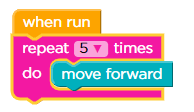
What does this code do?
Moves forward 1 time
Moves forward forever
Moves forward 5 times
Moves left


What is this relational operator: >
Less than
Greater than
Equal to
Not equal to
What is this relational operator: <
Less than
Greater than
Equal to
Not equal to
What is this relational operator: <=
Less than or equal to
Greater than or equal to
Equal to
Not equal to
What is this relational operator: >=
Less than or equal to
Greater than or equal to
Equal to
Not equal to
What is a piece of code that could be used over and over again.
Rerun
Test
Function
Bugger

