
 Worksheets
Particle model Y9
Total questions: 46
Worksheet time: 33mins
Which state of matter has the particles most closely packed?
Solid
Liquid
Gas
Which state of matter has the weakest force between particles?
Solid
Liquid
Gas
Which state of matter has the fastest moving particles?
Solid
Liquid
Gas
Which state of matter has particles that are regularly arranged?
Solid
Liquid
Gas
Which state of matter has strong forces between particles?
Solid
Liquid
Gas
Tick the states of matter where the particles are in an irregular arrangement.
Solid
Liquid
Gas
Which state of matter do the particles vibrate on the spot
Solid
Liquid
Gas
The total kinetic and potential energy of all the particles added up is called the (a) energy
The energy needed to change the state of 1 kg of a substance is called
latent heat
specific heat capacity
The energy needed to heat 1 kg of a substance up by 1oC is called
latent heat
specific heat capacity
Change of state from liquid to solid is called
Freezing
Melting
Boiling
Condensing
Sublimation
Change of state from solid to liquid is called
Freezing
Melting
Boiling
Condensing
Sublimation
Change of state from liquid to gas is called
Freezing
Melting
Boiling
Condensing
Sublimation
Change of state from gas to liquid is called
Freezing
Melting
Boiling
Condensing
Sublimation
Change of state from solid to gas is called
Freezing
Melting
Boiling
Condensing
Sublimation

What state is A-B
Solid
Liquid
Gas

What state is C-D?
Solid
Liquid
Gas
What state is E-F?
Solid
Liquid
Gas
What change of state is B-C?
Melting/freezing
Boiling/Condensing
What change of state is D-E?
Melting/freezing
Boiling/Condensing
Gold is a dense solid. What does this mean?
It is hard
It is heavy
It is heavier than other things of the same size
It is malleable
What is the equation for density?
Density = mass x volume
Density = weight x volume
Density = volume / mass
Density = mass / volume

Which of these is false about solids
Particles move about fixed positions
Solids can easily change shape
Solids have fixed volumes
Solids cannot flow

The internal energy of a substance is...
the movement of particles
the average kinetic energy of the particles
the average kinetic and potential energy of the particles
the average potential energy of the particles
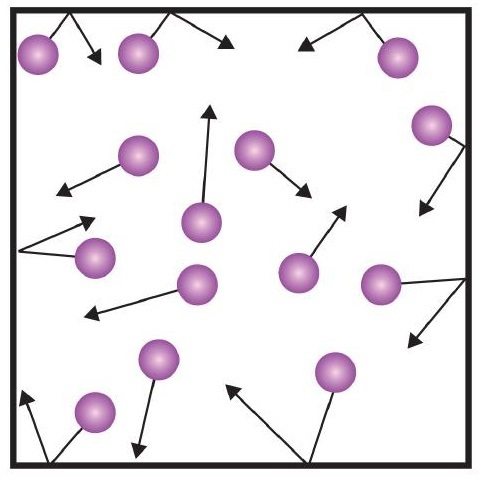
What causes gas pressure?
The gas particles condensing on the surface of a container
The gas particles colliding with each other
The gas particles colliding with the surface of the container
Assuming temperature remains constant, what will happen to the pressure of a gas if the volume is decreased?
the pressure will increase
the pressure will decrease
the pressure will not change.

Latent Heat of Fusion: The amount of energy required to change the state of 1kg a substance from solid to liquid at fixed _____________
Quantity
Heat Energy
Temperature
Pressure
A cube of metal has side 2 cm. It weighs 10g. Find its density.
5 g / cm3
20 g / cm3
0.2 g / cm3
1.25 g / cm3

It's the SI unit for Heat
Watts
Celsius
Joules
Nm

Increasing the temperature of a gas increases the store of which energy type of the particles?
Potential Energy
Chemical Energy
Kinetic Energy
Pressure

Find the energy required to boil 0.250 kg of water away at 100ºC. The Latent Heat of Vapourisation of water is 2260 KJ/kg.
Lv of water = 2260 kJ per kg
565 000 J
565 J
9040 J
9.040 J

What is the graph called?
Melting and Boiling graph
Temperature Graph
Heating Curve of a substance
Graph of Temperature and heating up

At which point does the substance finish boiling
B
C
E
F
D
The internal energy of a substance is made up of these two parts:
elastic energy and potential energy
internal energy and vibration energy
potential energy and kinetic energy
kinetic energy and elastic energy
The thermal energy of a substance is called the........
Maternal energy
External energy
Paternal energy
Internal energy
When we increase the kinetic energy of particles we also increase their .............?
mass
temperature
size
area

Between which two points is iron a solid?
A to B
B to C
C to D
D to E
E to F

During which two sections of the graph does the temperature stay constant? (You must choose two answers)
A to B
B to C
C to D
D to E
E to F

At what point do the particles have the most kinetic energy?
A
C
D
F

What is the melting point of iron?
0 oC
1500 oC
2800 oC
3300 oC

What is happening at point D?
The iron has disappeared
The iron has stopped melting
The iron is getting colder
The iron is starting to boil
When an ice cube melts, what happens to the total mass of water?
It stays the same
It decreases
It increases

