
 Worksheets
NCTest EOC Check in 3 Review
Total questions: 158
Worksheet time: 3hrs 41mins

A nucleotide is composed of
A phosphate, sugar and nitrogenous base
A protein, sulfur and Guanine
A phosphate, something and a base
A protein, sugar and nitrogenous base

The weak bonds between base pairs is a ___
Covalent Bond
Polar Bond
Non Polar Bond
Hydrogen

What would the other side of this strand of DNA be: AATCATGGA
AGGTACTAA
What is true of RNA? (select all that apply)
Single Strand
Contains uracil
Ribose Sugar
Deoxyribose Sugar
What is true of DNA?
Double Helix
Contains Thymine
Deoxyribose Sugar
Ribose Sugar
Which amino acid will be added to a protein chain if the codon is UAA?
Ser
Lys
Ala
STOP
Which of the following are differences in the structure between RNA and DNA
DNA uses deoxyribose sugar, RNA uses sugar ribose
DNA pairs Adenine with Uracil, RNA pairs Adenine with Thymine
DNA is a double helix, RNA is a single helix
DNA pairs Adenine with Thymine, RNA pairs Adenine with Uracil
During transcription, this type of ribonucleic acid is responsible for copying the DNA and brining it out of the nucleus.
tRNA
mRNA
rRNA
dRNA
There are a total of ____ different amino acids
20
1
4
unlimited
How many amino acids are found on one tRNA?
20
4
1
3


Which organelle is the location where protein is made?
Ribosome
Nucleus
Cytoplasm
Nucleotide
Which of the following is the complementary mRNA sequence to this DNA strand: AACTGAA
UUGACUU
TTGACTT
AACTGAA
AACUGAA

What brings the amino acids to the ribosome to assemble a protein?
DNA


An enzyme that cut DNA molecules at a specific “recognition site” is called
Restriction enzyme
DNA polymerase
RNA polymerase
Taq polymerase
Millions of Individuals have identical DNA profiles
True
False
A hospital had three babies born on the same day. Unfortunately, they had a mixup during bathing the babies and the identification bracelets were lost. Determine which Baby belongs to which family
To make a DNA Fingerprint, you use (a) (a) to cut a DNA sample into fragments, and then use (b) (b) _ to separate the fragments by size


DNA fingerprinting may be used to do which of the following?
Identify gender
Identify criminals
Identify parents and offspring
Identify genetic disorders
Gel electrophoresis separates fragments of DNA by:
Size/weight
Genes
Base pairs
Electromagnetic charge

In a DNA fingerprint, lighter-weight fragments can be found at the:
Top
Bottom
Middle
Front
Cloning
Making an exact copy of an organism
Gene Therapy
Replacing faulty genes
Transgenic Organisms
Inserting genes from one organism into another's genome
DNA Fingerprints
Using DNA fragments for identification
Restriction Enzymes
Used to cut DNA into pieces
Cut out gene you want
Put into bacterial plasmid
Put plasmid into bacteria
Bacteria will make the protein
Restriction Enzyme
Made of Protein
Plasmid
Made of DNA (found in prokaryotes not eukaryotes)
Prokaryotes
Cells with plasmids
Transformed Bacteria
Bacteria with new gene
Which of the following represents a transgenic organism? Choose ALL that apply.
Mule
Corn with genes from bacteria
Breeding two varieties of apples together
GMOS (Genetically Modified Organisms)
A pig with a human gene added to it.
A type of transformation that results in an organism that that contains genes from different species.
Hybridization
Recombinant DNA
Transgenic
A project that analyzes the order of bases for all the genes in the human DNA.
Human Genome Project
Gene Therapy
Cloning
The process of making changes in an organism's DNA is known as?
Genetic Engineering
Hybridization
DNA Recombination
DNA
Fingerprinting


Which of the following best describes bacterial transformation?
Changing bacterial DNA by adding genes to it
Any organism that has DNA from a different species
Any organism that has DNA from the same species
A tool used by scientists to separate chunks of DNA
Clones have the exact same:
Personalities
Physical appearances
Intelligence levels
Genetic material
Which of the following are ways that Biotechnology can be used?
Diagnosis of disease
Gene therapy
Production of pharmaceuticals (medicine)
DNA profiling
Agriculture - creating GMOS (Genetically modified organisms)
The fossils found closer to the surface of the ground are generally -
(a)
A human arm and a whale fin have similar bone structure but the whale fin is used for swimming and the arm is used for reaching and grabbing. What type of structures are these?
Homologous structures
Analogous structures
Vestigial structures
Fossil structures
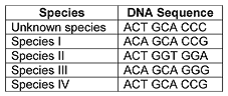
When comparing the DNA of two different organisms, the more differences in the DNA base pairs the more-
Closely related they are.
Distantly related they are.
It doesn't prove anything.
They look alike.

Which of the pictures above would be examples of homologous structures? (pick 2)
1
2
3

The similarities of bone structure in the diagram provide evidence of what?
The organisms probably use there forelimbs for the same thing.
The organisms evolved from a common ancestor.
The organisms have the same DNA.
All vertebrate species have identical forelimbs.
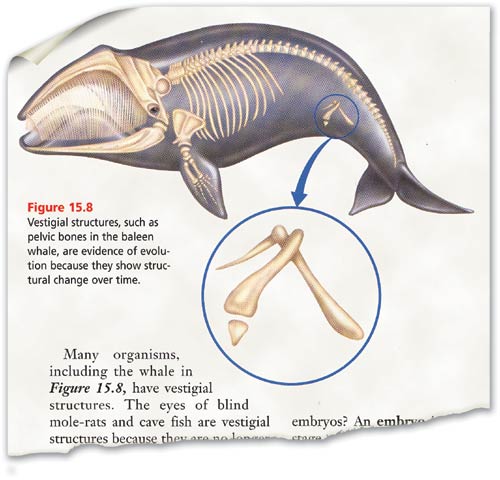
The appendix, which is not needed to survive, is conisdered to be a
Homologous Structure
Analagous Structure
Vestigial Structure
Homology

Why are similar fossils found all over the world?
The animals swam to new parts of the world before going extinct
The land masses were once connected
The organisms were transported to different areas of the world
They are not similar fossils.
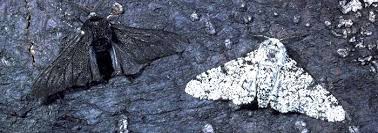

What is an adaptation of the snowshoe hare that allows it to remain unseen by predators in the winter time?
heavy fur on feet to stay warm
small ears to prevent heat loss
turns white in winter to match snow
sense of smell to detect food
Natural selection occurs during the lifetime of a single organism.
True
False
TRUE or FALSE: Natural selection will still occur if individuals are exactly the same.
TRUE
FALSE
How do you "win" at natural selection?
survive
go extinct
survive & reproduce

Due to pollution, a pond becomes darker over time. Which trait variation became more common?
light fish
dark fish
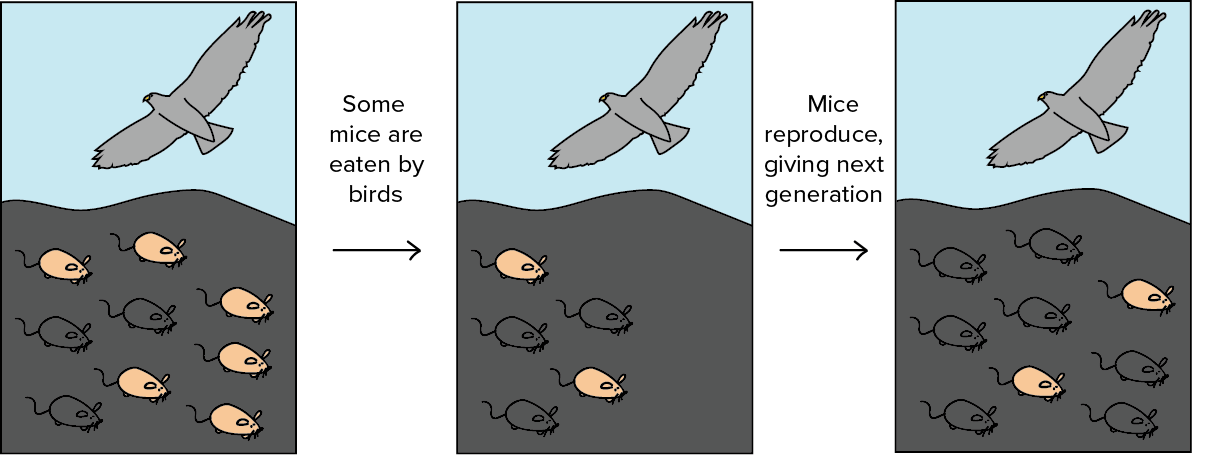

Many different groups of organisms have wings, even though they do not share a recent common ancestor. This is because they evolved in environments with similar selective pressures. Wings are an example of a(n) ______________ structure.
vestigial
analogous
homologous

Why is it important to finish ALL of an antibiotic, even if you feel better?
If all of the infectious bacteria are not killed, the bacteria may continue to multiply. Some of these bacteria may have a mutation that makes them resistant to the antibiotic. This could cause resistant bacteria to spread.
If all of the antibiotic is not used, the surviving bacteria may learn how to fight off the antibiotic, causing the sickness to get even worse.
If all of the antibiotic is not used, the bacteria may begin ingesting your skin cells, causing a new sickness to arise.
If all of the antibiotic is not used, the surviving bacteria may cooperate with other infectious bacteria, resulting in two separate infections at the same time.
In classifying organisms, orders are grouped directly together into larger
classes
phyla
families
genera (genus)
The most specific taxon is the
family
order
species
class
Which taxon that has the most variety of organisms?
kingdom
phylum
genus
class
The science of classifying living things is called___.
identication
classification
taxonomy
speciation
Scientific names are written in what language?
English
Greek
Arabic
Latin


A
B
C
D
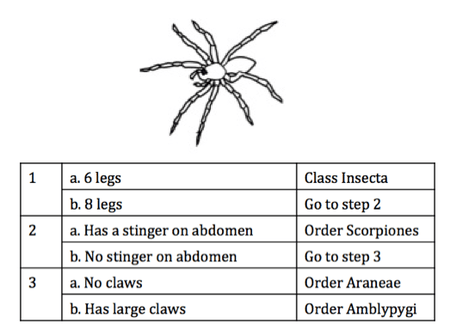

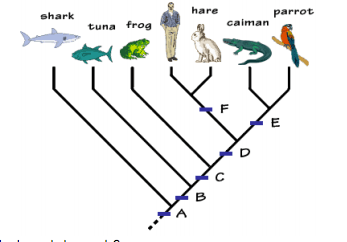
On the cladogram, which organism is the closest relative of the parrot?
Frog
Hare
Caiman
Parrot
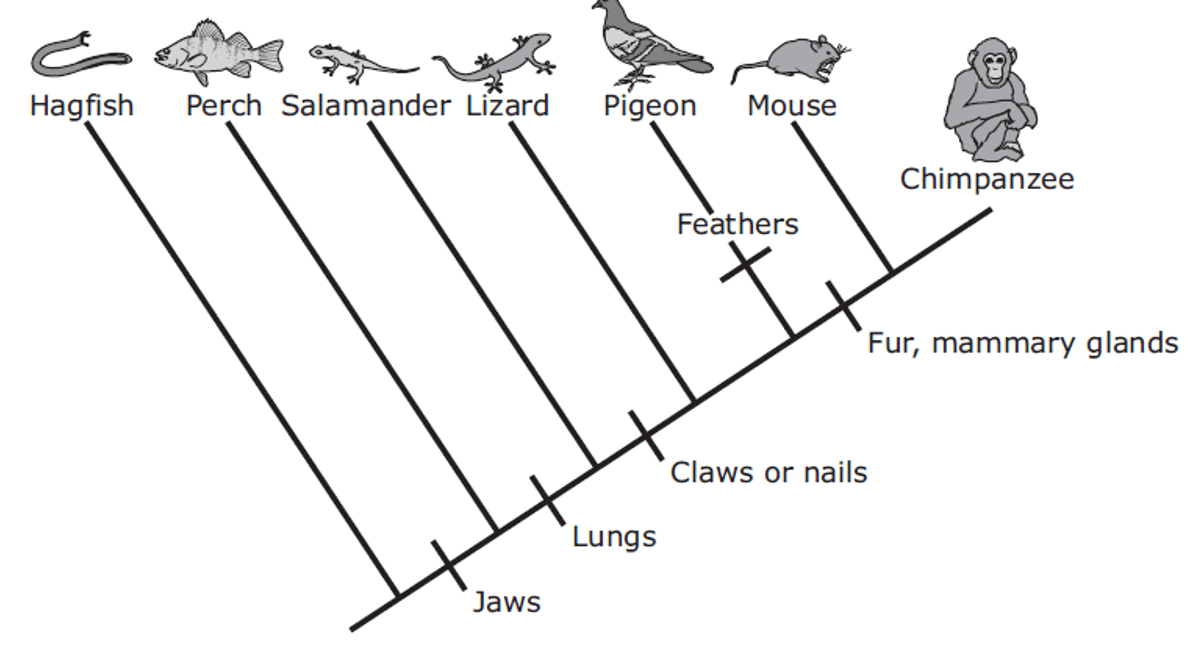
All the animals to the right of the salamander would have the common characteristic of...
Fur
Claws or nails
Lungs
Jaws

In a phylogenetic tree, the branching points represent common ancestors.
Yes
NO

What is the common ancestor of Letters A, B, C, D, E?
1
2
3

Which group of animals on this tree are most closely related to birds?
Saurischian dinosaurs
Ornithischian dinosaurs
Crocodiles
None of these are related to birds
______ and ________ are organelles that arose from the endosymbiotic theory
flagellum and chloroplast
mitochondria and chloroplasts
Smooth and Rough ER
mitochrondria and cell wall
The Theory of Endosymbiosis explains:
how bacteria live
the origin of Eukaryotes
Why cells rely on one another
how species develop
Which of the following is evidence to support the endosymbiotic theory?
Mitochondria and chloroplasts have their own DNA, which is similar to prokaryotic DNA.
Fossil evidence shows that the first forms of life were prokaryotic cells.
All eukaryotic cells have a double-layered membrane composed of phosplipids and proteins.
Prokaryotes have the same number and types of enzymes as eukaryotes.

Two students are reading an article about the evidence of the endosymbiotic theory. As they are reading, they have drawn images of what they believe to be occurring on index cards. The two students are engaging in a discussion on how the index cards should be ordered to accurately show the evolution of eukaryotic cells.
Student A claims the order should be B, E, D, A, C. Their reasoning is that since the small circles without lines in the index cards represent chloroplasts, photosynthesizing organisms evolved before aerobic organisms.
Student B claims the order should be B, A, C, E, D. Their reasoning is that since the small ovals with lines in the index cards represent mitochondria, respiratory organisms evolved before photosynthesizing organisms
Use the diagram to answer the question. Which statement below is accurate about the discussion above?
student A has a correct ordering of index cards but incorrect reasoning.
student B has a correct ordering of index cards and correct reasoning.
Student A has a correct ordering of index cards and correct reasoning.
Student B has a correct ordering of index cards but incorrect reasoning.
Which evidence supports the endosymbiotic theory?
Presence of circular DNA in mitochondria and chloroplasts
Ability of mitochondria and chloroplasts to divide independently
Double membranes of mitochondria and chloroplasts
All of the above

What type of dominance is shown in the picture?
Complete dominance
Incomplete dominance
Codominance
The physical appearance of a trait is known as the-
genotype
phenotype
Homozygous
intelligence

In the punnett square, what is the probability for white fur?


A black male and white female produced this grey offspring:
Incomplete dominance
Codominance
Complete dominance


A calico cat shows both the traits for orange fur and black fur. What kind of allele expression is this?
Incomplete Dominance
Codominance
Independent assortment
Recessive inheritance


This type of inheritance pattern shows BOTH traits in possible offspring
complete dominance
incomplete dominance
codominance
dominant pattern
The physical appearance of a trait is known as the-
genotype
phenotype
Homozygous
intelligence
Gretford is heterozygous for his head shape. If (R) is for a Round head, and (r) is for an Egg head, what is Gretford's genotype?
RR
Rr
rr
rR

What is the probability of heterozygous offspring?
25%
50%
0%
100%
X and Y are (a) chromosomes. Females are (b) and males are (c) .
In fruit flies, eye color is a sex-linked trait. Red (R) is dominant to white (r).
Which genotype shows a female fly with white eyes?
XRXr
XRXR
XrXr
Which genotype shows a male with white eyes?
R = Red, r= white
XrY
XRY
Match the following. H= no hemophilia, h = hemophilia
Male without hemophilia
XHY
Female with hemophilia
XhXh
Female Carrier
XH Xh
Male with hemophilia
XhY
Female who is NOT a carrier
XHXH

XBXb
XbXb
XbY
XBY

The following punnett square depicts the x-linked cross of a female who carries hemophilia with a man showing no symptoms. Fill in the genootype represented by the blank box in the punnett square.
XH XH
Xh XH
XH Y
Xh Y

What is the likelihood of this cross have a child that is colorblind?
100%
75%
50%
25%

What is the chance that a daughter will be colorblind?
100%
50%
25%
0%

What chance will a boy will be colorblind?
100%
50%
25%
0%
Who is more likely to have an X-linked trait?
Males
Females
Both males and females


In the image above, what is the percentage of the offspring has the possibility of inheriting blood type O?
0%
25%
50%
100%
Which of the following are genotypes for blood type B?
IA IA and IA IB
IB IB and ii
IB IB and IB i
IA IB and IA IB


What is the Genotype for Type A that had a type O parent
IᴬIᴮ
Iᴬi
IᴬIᴬ
ii
Punnett Square: A man is homozygous for the B allele, and a woman is type O. What are ALL the possible blood types of their baby?
IᴮIᴮ
ii
IᴬIᴬ
Iᴮi

The karyotype diagram below represents a human female with the genetic disorder known as Turner syndrome. Chromosomal analysis of this karyotype reveals the mutation is a result of
a missing X chromosome
a missing Y chromosome
an extra 21 chromosome
missing chromosome #9

The karyotype diagram below represents a human male. Chromosomal analysis of this karyotype reveals the abnormality in this karyotype is:
a missing X chromosome
a missing Y chromosome
an extra 21 chromosome
missing chromosome #9

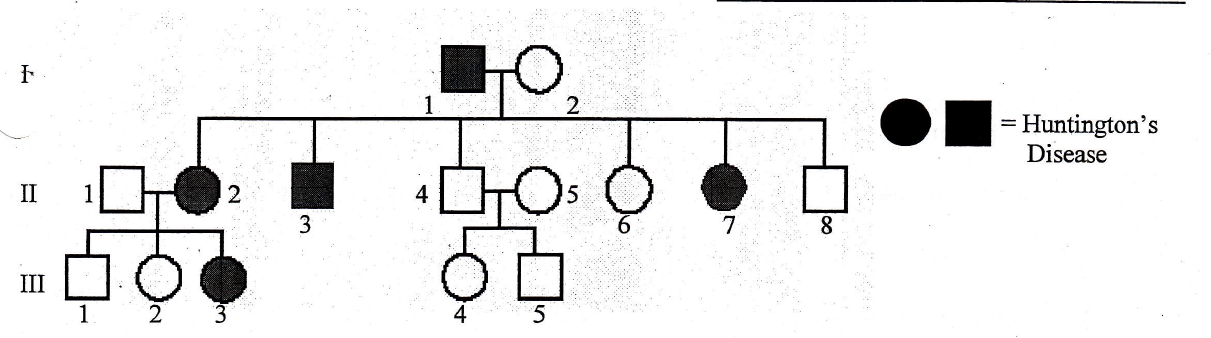
The trait this pedigree traces is recessive because it skips a generation and individuals can be carriers. What is the most likely genotype for person III-3?
GG
Gg
gg


If this pedigree shows a recessive disorder, what MUST the genotype of individual 4 be?
HH
Hh
hh
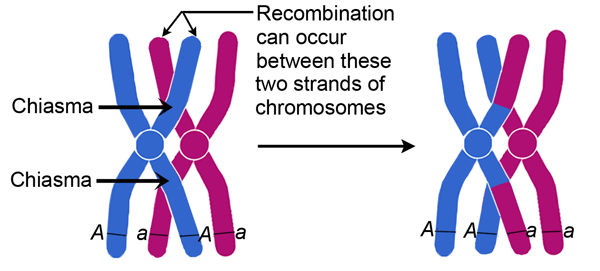
segregation of sister chromatids
condensation and segregation of alleles
mutationin which the DNA content of the gene is altered
crossing - over in which genes are exchanged
A chromosome is composed of two identical sister
centromeres
chromatids
autosomes
somatic cells
A pair of homologous chromosomes (a tetrad) is composed of (a) matching chromosomes, and (b) sister chromatids.
In which type of cell division does crossing over occur?
mitosis
meiosis
During meiosis, if an organism has 10 chromosomes, how many will the new daughter cells have?
10
8
5
2
Which event is an important factor in increasing variety among sexually reproducing organisms?
crossing over
gene linkage
testcross
mitosis
Select the image that represents meiosis:



