
NEW
Font size
 Worksheets
Muscular System Practice
Total questions: 17
Worksheet time: 6mins
What are the three types of muscles?
skeletal muscles, smooth muscles, and cardiac muscles
biceps muscles, triceps muscles, and quadriceps muscles
voluntary muscles, involuntary muscles, and respiratory muscles
flexor muscles, extensor muscles, and oblique muscles
Which type of muscle is responsible for voluntary movements?
Smooth muscles
Skeletal muscles
Adipose tissues
Cardiac muscles
Which type of muscle is found in the walls of hollow organs?
striated muscle
smooth muscle
skeletal muscle
cardiac muscle
What are the main functions of muscles?
The main functions of muscles are producing sound, vision, and taste.
The main functions of muscles are thinking, feeling, and sensing.
The main functions of muscles are movement, stability, and posture.
The main functions of muscles are digestion, respiration, and circulation.
Which muscle type is striated and multinucleated?
skeletal muscle
cardiac muscle
adipose tissue
smooth muscle
What is the basic unit of muscle structure?
Nucleus
Mitochondria
Golgi Apparatus
Sarcomere
What is the process called when a muscle shortens and generates force?
muscle contraction
muscle extension
muscle expansion
muscle relaxation
Which protein is responsible for muscle contraction?
keratin and collagen
hemoglobin and myoglobin
insulin and glucagon
actin and myosin
What is the role of calcium ions in muscle contraction?
Calcium ions inhibit the binding of troponin to actin, preventing muscle contraction.
Calcium ions bind to troponin, causing a conformational change that moves tropomyosin away from the myosin-binding sites on actin.
Calcium ions directly bind to myosin, causing muscle contraction.
Calcium ions have no role in muscle contraction.
What is the name of the neurotransmitter that stimulates muscle contraction?
Acetylcholine
Serotonin
Dopamine
GABA

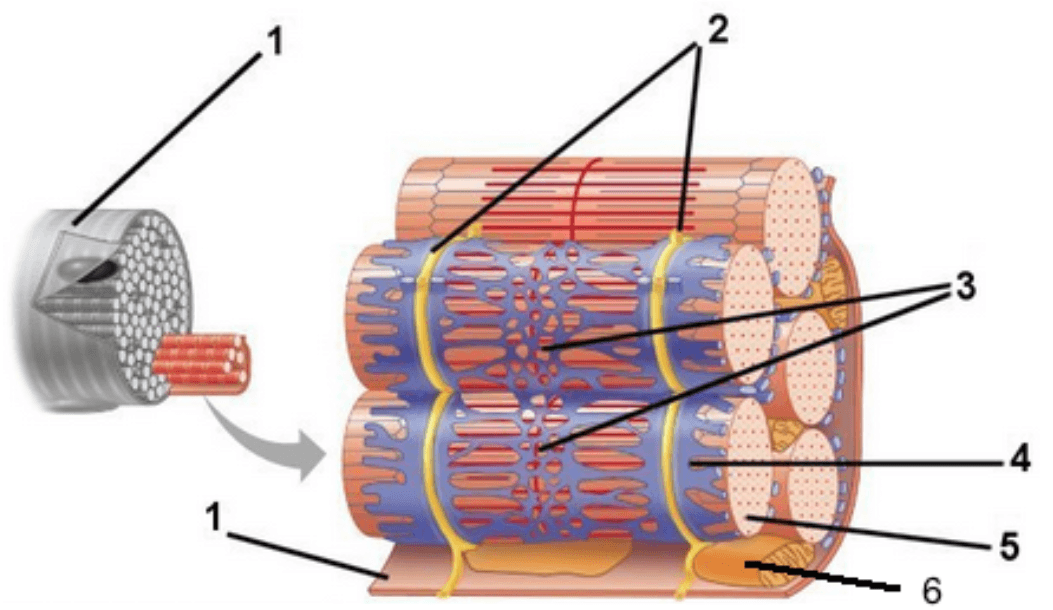
What is shown in the colored part of this diagram?
a whole muscle
five muscle fibers
five muscle fascicles
five myofibrils
What is labeled "4" (the blue/purple part) in the diagram?
sarcolemma
sarcoplasmic reticulum
transverse tubules
myofibril
Name the following in order from largest to smallest:
muscle, muscle fascicle, muscle cell, myofibril, filaments
muscle, muscle fascicle, muscle cell, filaments, myofibril
muscle, muscle cell, muscle fascicle, myofibril, filaments
muscle, muscle cell, muscle fascicle, filaments, myofibril
What is the length between Z-lines of an actin molecule called?
fascicle
sarcomere
myosin binding site
sarcoplasmic length
____________ attaches to actin to form the cross bridge.
Troponin
Tropomyosin
Myosin
Calcium

