
 Worksheets
Fossil Record
Total questions: 35
Worksheet time: 28mins
If you know the age of a fossil, you know the relative age of the ________________ it was found inside.
sticky tar
rock
amber
ice
If you know the age of a rock, you know the relative age of the _________________ that was found inside.
sticky tar
fossil
amber
ice
Geologists use radioactive dating to..
determine the relative ages of rock layers.
tell the difference between molds and casts.
tell where one soil horizon ends and the next one begins.
determine the absolute ages of rocks.

What are the oldest fossils and why?
B, C- because they are closest to the top
A, B- because they are closest to the bottom
They are all the same age- because they are all found on layer 2
A, B- because they are found closest to the top


In which kind of rock do we usually find a fossil?
sedimentary rock
metamorphic rock
igneous rock
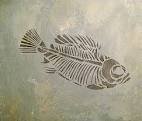
If scientists found this fossil, what could they infer?
what fish are like today
that this fish lacked oxygen
that water once covered the area where this fossil was found
Fossils of fish are found under land where cows now live. What does this tell you?
the fish were dropped their by flying birds
this land was once under the ocean
fish used to live on land
Fossils are proof of ___________.
Evolution
A Higher Power
Physics
Newtons 2nd Law

The mineralized remains of organisms, showing how long-dead organisms lived and how their bodies were structured
Diversity
Endangered
Fossils
Crude Oil
Why do you think there are not fossil for every organism that has every lived?
Many organisms decompose too quickly to become fossils
They do, the fossils are just destroyed
Some plants and animals do not have carbon in them
Many organisms are too large to form fossils

Layers of rock that are successively deposited on top of one another and are distinguishable from one another based on their mineral contents
Extinction
Petrification
Glacial Period
Sedimentary Layers

The formation of fossils as stone replaces decaying tissues
Extinction
Petrification
Glacial Period
Sedimentary Layers

Scientific law that states fossils located in deeper sediment layers are older than ones deposited in layers closer to the surface
Fossil Record
Law of Superposition
Fossil Fuels
Divergence
The mineralized remains of organisms, showing how long-dead organisms lived and how their bodies were structured
Diversity
Endangered
Fossils
Crude Oil

The mineralized remains of organisms and the rock layers in which they are found that shows when and where long-dead organisms lived and how their bodies were structured
Fossil Record
Law of Superposition
Fossil Fuels
Fossils
Which of the following can be learned by using the fossil record?
When organisms changed or evolved
when organisms appeared on Earth
when organisms became extinct
All the above

When did fossil A become extinct?
Layer 1
Layer 2
Layer 3
Layer 4

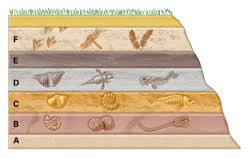
Organisms D and C clearly lived in an aquatic (water) environment. Organism A does not look like it lived in the water. What is the most likely explanation for this?
The fossil in layer A died on land and was carried to the water
The fossils in layer C and D did not live in the same location as the fossil in layer A
The environment changed over a long period of time. It used to be under water, but is not anymore
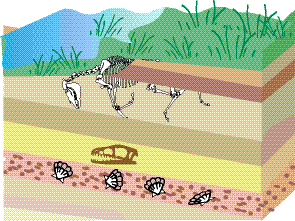

Which of the follow is INCORRECT about an index fossil?
The fossil must have lived only during a short part of the Earth's history.
Many fossils of the organism must be found in the rock layers.
The fossil must be found over a wide area of the Earth and be unique.
The fossil must only be found in one area.

Which layer contains the oldest fossil?
Layer 1
Layer 2
Layer 3
Layer 4

Starting at layer H (at the bottom) what pattern do you notice as you move up towards layer B
organisms become more complex
random arrangement of organisms
organisms go from water only to land only
organisms become more simple

