
 Worksheets
Grade 7 Social Studies Quiz
Total questions: 83
Worksheet time: 58mins
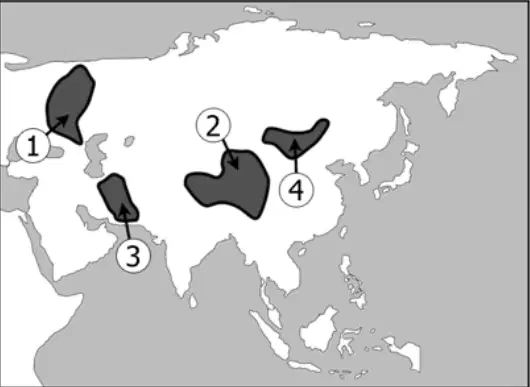
This is a map of Asia. Which number correctly identifies the Gobi Desert?
1
2
3
4

This chart lists several achievements of the Byzantine Empire under the leadership of Justinian. Based on this chart, which statement is true about the leadership of Justinian?
It left the Byzantine Empire vulnerable to invasion.
It caused an economic collapse throughout all of Europe.
It increased the influence of Islam throughout the world.
It established the Byzantine Empire as a major civilization in Europe.
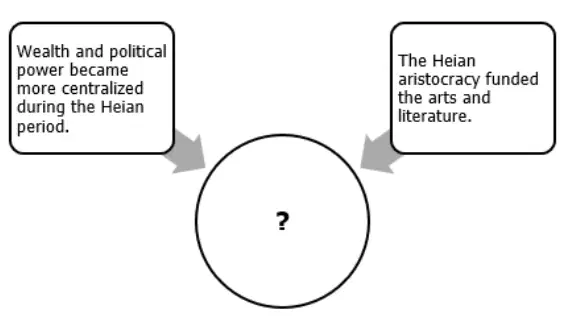
This chart shows the impact of two events in Japanese history. Which impact completes this chart?
Japan worked to westernize its economy.
Japan took political control of the Korean Peninsula.
Japan developed a distinct cultural identity.
Japan abandoned all cultural ties to China.
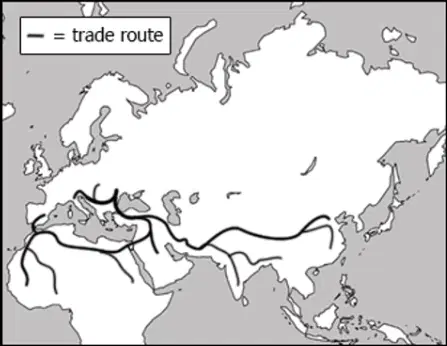
This is a map of trade routes in the 1500s. Based on this map, which statement is true?
Trade routes prevented the movement of goods.
Trade routes limited cultural diffusion.
Trade routes isolated Asia from other continents.
Trade routes connected Africa to Asia and Europe.
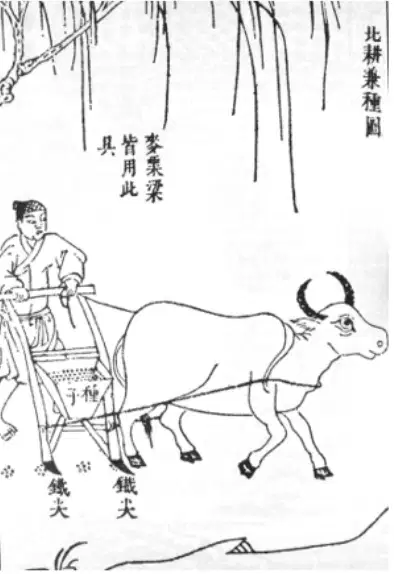
This is a drawing of a man using a seed drill during the Song Dynasty. Based on this drawing, the Song Dynasty made advancements in which fields? Select two that apply.
medicine
technology
mathematics
agriculture
warfare
How did the geographical location of Constantinople impact the Byzantine Empire?
It prevented the Byzantine Empire from expanding outside of Eastern Europe.
It allowed the Byzantine Empire to increase its influence on Indian civilizations.
It made it easier for the Byzantine Empire to establish new cities throughout Asia.
It gave the Byzantine Empire access to major trade routes.
How did the expansion of the Byzantine Empire impact the cultures of Eastern Europe?
The practice of Islam increased.
The practice of Christianity decreased.
The importance of trade with Africa and Asia decreased.
The use of Greek and Latin languages increased.
How did the spread of Muslim culture impact literature in Africa?
Poems and stories about nature gods became more popular throughout Africa.
Many Islamic poems and stories were translated into African languages.
Many traditional African stories were added to the Qur’an.
Stories about polytheism became more popular throughout Africa.
"Shinto is a system of [ceremonies] for the [reverence] of the [deceased] personalities closely connected with our existence and our national history—in other words, a systematized and complicated form of [honoring] emblems of our ancestors and our national heroes."
According to this excerpt, which is a core belief of Shintoism?
ancestor worship
church attendance
isolationism
reincarnation
"To establish oneself in the world and practice the Way; to uphold one’s good name for posterity and give glory to one’s father and mother—this is the completion of filial duty. Thus filiality begins with service to parents, continues in service to the ruler, and ends with establishing oneself in the world [and becoming an ideal person]."
Based on this excerpt, what role did Confucianism play in the culture of the Song Dynasty?
It created systems of taxation on trade.
It promoted individualism and selfishness.
It promoted isolationism.
It created social rules that made a stable society.
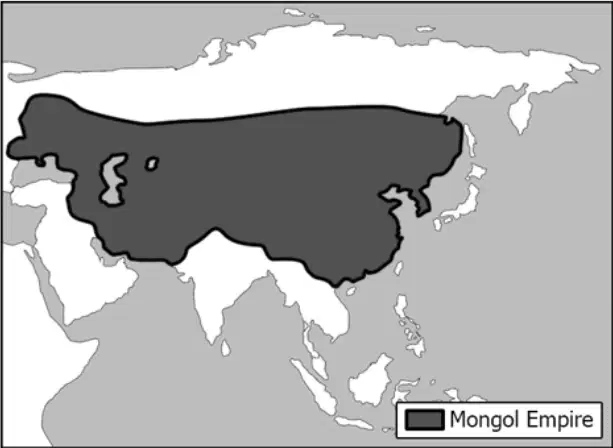
Based on this map, which statement is true?
The Mongol Empire conquered parts of Northern Africa.
The Mongol Empire was unable to conquer India.
The Mongol Empire was unable to conquer parts of China.
The Mongol Empire conquered all of Asia.
What role did shogun play in Japanese society?
They were imperial scholars.
They were religious leaders.
They were wealthy landowners.
They were military commanders.
"Marriage with certain classes of persons is forbidden....
[The amount of money] awarded [to a victim] of an injury...rises and falls in amount according to the class and character of the [victim].
The penalty [for robbery] is three times the value of the property, and this whether the robber be caught in the act or not."
Based on these excerpts, which statement is true about the Byzantine Empire under the leadership of Justinian?
It codified many of its laws.
It banned monetary fines.
It developed a classless society.
It prevented all citizens from marrying.
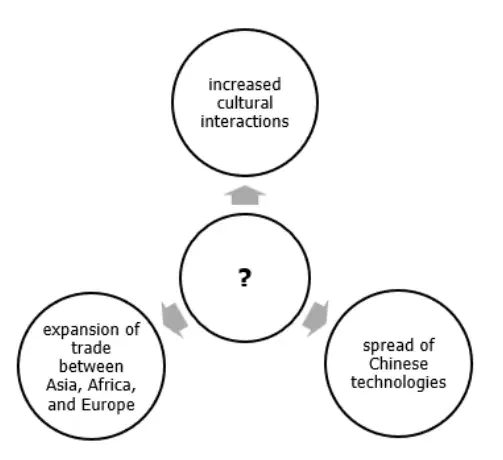
Which historical event completes this chart?
The Great Wall was completed.
Japan developed a feudal system.
The Mongol Empire took control of the Silk Road.
China was unified under the Tang Dynasty.
How did the Song Dynasty improve trade in China?
It banned products made outside of China.
It ended all taxes on goods produced in China.
It introduced paper money.
It reverted to a barter system.
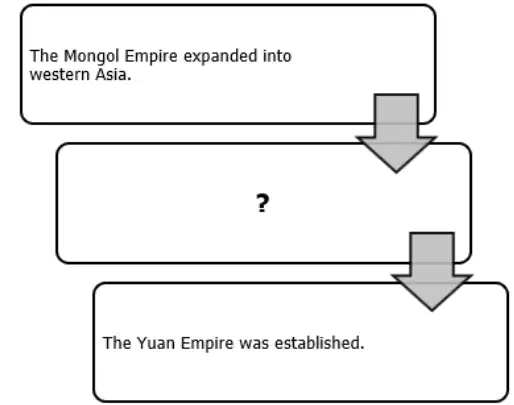
Which event completes this timeline?
Kublai Khan led the Mongol conquest of China.
Genghis Khan completed construction of the Great Wall.
Genghis Khan retreated from Japan.
Kublai Khan blocked all trade along the Silk Road.
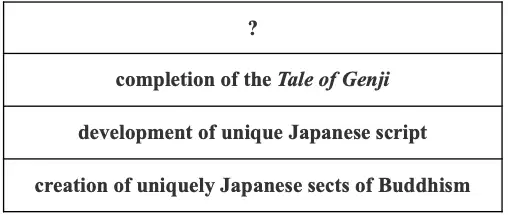
Which era of Asian history completes this chart?
Song Dynasty
Mongol period
Heian period
Yuan Dynasty
How did China influence Ancient Japanese culture?
The feudal system was developed.
Chinese writing systems were adopted.
The samurai warrior class developed.
Chinese currencies were used.
Which factor most contributed to the rise of the Mongol Empire?
the unification of nomadic tribes under Genghis Khan
the establishment of a powerful navy under Zheng He
the development of advanced technologies like gunpowder
the development of a strong centralized government
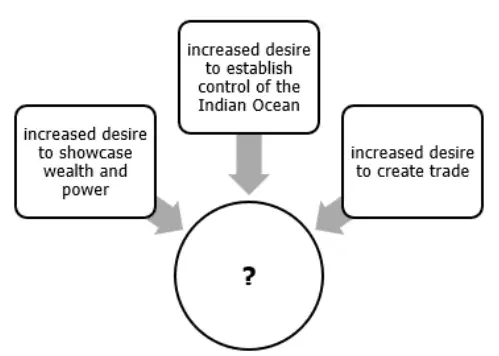
Which historical event completes this chart?
reconstruction of the Great Wall
development of isolationist policies
voyages of Zheng He
implementation of filial piety
How did the fall of Constantinople have a lasting impact on European culture?
It pushed Muslim influence out of Spain and Portugal.
It forced the Byzantine Empire to adopt Judaism as its central religion.
It established the Ottoman Empire as a Muslim influence in southeastern Europe.
It prevented the practice of Judaism throughout Central Europe.
Which religion spread into Eastern Europe through the establishment of the Byzantine Empire?
Christianity
Islam
Shintoism
Buddhism
How did the reunification of China prior to the Tang Dynasty increase the spread of Buddhism in China?
Reunification led to the creation of the Great Wall, which increased tensions with neighboring cultures.
Reunification led to the Warring States period, which prevented interactions with other cultures.
Reunification led to the creation of trade routes that allowed for the exchange of goods and ideas.
Reunification led to the isolationist policies that allowed for the creation of unique cultural practices.
How did regional geography impact the Byzantine Empire?
It isolated the Byzantine Empire from regional trade and cultural exchanges with other civilizations.
It prevented the Byzantine Empire from spreading new ideas and technologies into Eastern Europe.
It acted as a natural barrier that helped the Byzantine Empire preserve European cultural traditions.
It provided the Byzantine Empire with natural resources that allowed it to become the wealthiest civilization in the world.
Which bodies of water are located in Southwest Asia? Select three that apply.
Arabian Sea
Persian Gulf
Red Sea
Bay of Bengal
Sea of Japan
Which geographical feature acts as a natural barrier between East Asia and the Indian subcontinent?
Korean Peninsula
Himalayan Mountains
Gobi Desert
Yellow River
Which was an architectural achievement of the Byzantine Empire under the leadership of Justinian?
construction of the Hagia Sophia
construction of Europe’s first aqueduct
construction of the Great Wall
construction of Europe’s first paved road
How did Islam spread into the regions of modern-day Turkey during the 600s CE?
The leaders of Islamic groups asked priests to lead colonies in these regions.
Militaries organized by Muslim leaders conquered these regions.
The leaders of Islamic groups built religious schools in these regions.
Trading posts established by Muslim leaders weakened the economies of these regions.
Which geographical feature is located in East Asia?
Arabian Peninsula
Atlantic Ocean
Niger River
Gobi Desert
How did the reunification of China prior to the Tang Dynasty help spread Buddhist beliefs?
Through cultural exchanges
Through trade routes
Through diplomatic alliances
Through military conquests
What were the agricultural, commercial, and technological developments during the Song Dynasties?
Irrigation systems, paper money, and compass
Terrace farming, silk production, and gunpowder
Animal domestication, pottery making, and iron smelting
Crop rotation, maritime trade, and printing press
Who was responsible for the conquests of the Mongol Empire?
Charlemagne
Mansa Musa
Kublai Khan
Genghis Khan
How did Kublai Khan maintain control of the Yuan Empire?
Through religious tolerance
Through political alliances
Through military force
Through economic reforms
What were the effects of the Mongolian empires on the Silk Roads?
Isolation of China from the rest of the world
Increased trade and cultural exchange
Decreased trade and cultural exchange
Collapse of the Silk Roads
What were the achievements of the Ming Dynasty?
Development of a Japanese national culture
Spread of Buddhism and Confucianism
Reconstruction of the Great Wall and building projects
Construction of the Forbidden City and Zheng He's sea voyages
What are the central features of Shintoism?
Belief in karma and reincarnation
Ancestor worship and animism
Monotheism and Five Pillars
Worship of multiple gods and goddesses
How did Japanese culture change through Chinese and Korean influences?
Establishment of the Ottoman Empire and growth of trade routes
Spread of Islam and development of a military society
Preservation of knowledge and spread of the Catholic Church
Adoption of the Chinese writing system and spread of Buddhism
What was the role of the shogun and samurai in Japanese society?
Shogun was the religious leader and samurai were the warriors
Shogun was the merchant and samurai were the artisans
Shogun was the emperor and samurai were the peasants
Shogun was the military leader and samurai were the warriors
What were the significant contributions of the Song Dynasty to Chinese culture?
Development of the civil service examination system
Construction of the Great Wall
Introduction of Buddhism
Establishment of the Silk Road
How did the geography of Japan influence its isolation?
Mountainous terrain made it difficult to travel
Surrounded by deserts, making it inaccessible
Located on an island, separated from the mainland
Extreme cold climate deterred outsiders
What was the role of trade in the spread of Islam?
Trade had no significant role in the spread of Islam.
Trade routes facilitated the spread of Islam by connecting different regions.
Trade hindered the spread of Islam by creating cultural barriers.
Trade routes isolated Islamic regions, preventing the spread of Islam.
How did the Islamic Golden Age contribute to the spread of Islam?
The Islamic Golden Age led to a decline in the spread of Islam.
The Islamic Golden Age had no impact on the spread of Islam.
The Islamic Golden Age, marked by advancements in various fields, attracted many to Islam.
The Islamic Golden Age isolated the Islamic world, preventing the spread of Islam.
What is the significance of the Five Pillars of Islam?
They are the five most important cities in the Islamic world.
They are the five main religious texts in Islam.
They are the five basic acts of worship that are central to a Muslim's faith and practice.
They are the five prophets who are most revered in Islam.
Who was the founder of Islam?
Abraham
Muhammad
Jesus
Buddha
What is the holy book of Islam?
The Bible
The Torah
The Qur'an
The Vedas

What area(s) did the Ottoman Empire not control or have pieces of?
North Africa
What was the role of monasteries in medieval Europe?
Preserving knowledge and spreading the Catholic Church
Promoting trade and commerce
Building castles and fortifications
Developing new agricultural techniques
How did Charlemagne shape medieval Europe?
By impacting feudalism and establishing Christianity as the religion of the Empire
By leading the Crusades and conquering new territories
By introducing the Magna Carta and limiting the power of the monarch
By promoting the growth of towns and the development of a merchant class
What were the key features of feudalism and manorialism in medieval Europe?
Feudalism: Centralized government with a monarch; Manorialism: Trade and commerce in towns
Feudalism: Social hierarchy based on land ownership; Manorialism: Economic system centered around self-sufficient manors
Feudalism: Democratic governance with elected officials; Manorialism: Growth of banking and commerce
Feudalism: Religious institutions controlling the economy; Manorialism: Agricultural improvements and technological advancements
What was the long-term impact of William the Conqueror on England and Northern France?
He promoted the spread of Christianity and established the Holy Roman Empire
He established Norman rule in England and introduced feudalism
He led the Reconquista and united the Iberian Peninsula
He signed the Magna Carta and limited the power of the monarch
What was the significance of the Magna Carta in medieval Europe?
It shaped English culture and language, and promoted a peaceful end to the Hundred Years War
It limited the power of the monarch, established the rule of law, and ensured the right to trial by jury
It led to the development of feudalism and manorialism
It promoted the spread of Christianity and the establishment of the Holy Roman Empire
What was the impact of the Crusades on medieval Europe?
They led to the spread of Christianity and the establishment of the Holy Roman Empire
They promoted the growth of towns and the development of a merchant class
They led to cultural exchange and the spread of knowledge from the East
They introduced the Magna Carta and limited the power of the monarch
How did the Black Death affect medieval Europe?
It led to the development of feudalism and manorialism
It caused significant population decline, which had profound social and economic effects
It promoted the spread of Christianity and the establishment of the Holy Roman Empire
It led to the signing of the Magna Carta and limited the power of the monarch
What was the role of knights in the feudal system of medieval Europe?
They were responsible for preserving knowledge and spreading the Catholic Church
They were responsible for promoting trade and commerce
They were warriors who served their lords in exchange for land
They were responsible for developing new agricultural techniques
What was the role of the Church in the governance of medieval Europe?
It had no role, the Church was separate from the state
It played a significant role, often influencing political decisions and rulers
It was solely responsible for the governance of Europe
It only had a role in the governance of the Holy Roman Empire
How did the feudal system affect the social structure in medieval Europe?
It led to a rigid class system based on land ownership and service
It promoted social mobility and equality
It had no effect on the social structure
It led to the development of a merchant class and the growth of towns
What were the primary motivations for the Crusades in medieval Europe?
Expansion of trade routes and acquisition of wealth
Spread of Christianity and reclaiming of holy lands
Establishment of democratic governance in the Middle East
Introduction of feudalism in the Middle East
How did the Crusades affect relations between Christians and Muslims in medieval Europe?
They improved relations through cultural exchange and trade
They worsened relations due to religious conflict and warfare
They had no significant effect on relations
They led to the establishment of a unified Christian-Muslim empire
What was the role of the Pope in initiating and leading the Crusades?
The Pope had no role in the Crusades
The Pope played a significant role, often calling for Crusades and rallying support
The Pope only had a role in the later Crusades, not the early ones
The Pope's role was limited to providing financial support for the Crusades
What were the economic effects of the Crusades on medieval Europe?
They led to a decline in trade and commerce
They led to an increase in trade and commerce
They had no significant effect on the economy
They led to the establishment of a unified European currency
How did the Crusades influence the cultural and intellectual life in medieval Europe?
They led to a decline in cultural exchange and intellectual growth
They led to an increase in cultural exchange and intellectual growth
They had no significant effect on cultural and intellectual life
They led to the establishment of a unified European language
What was the impact of the Crusades on the power and influence of the Papacy in medieval Europe?
They led to a decline in the power and influence of the Papacy
They led to an increase in the power and influence of the Papacy
They had no significant effect on the power and influence of the Papacy
They led to the establishment of a unified Christian-Muslim empire
What was the impact of William the Conqueror's reign on the English language?
He introduced Latin as the official language of England
He had no significant impact on the English language
He introduced French words into the English language, enriching its vocabulary
He replaced English with Norman as the official language
What was the significance of William the Conqueror's Battle of Hastings?
It led to the end of the Viking Age
It marked the beginning of the Norman conquest of England
It resulted in the signing of the Magna Carta
It led to the establishment of the Holy Roman Empire
What were the social effects of the Black Death in medieval Europe?
It led to the establishment of democratic governance
It caused significant social upheaval and changes in the class structure
It had no significant effect on the social structure
It led to the spread of Christianity and the establishment of the Holy Roman Empire
How did the Black Death influence the economy of medieval Europe?
It led to an increase in trade and commerce
It led to a decline in trade and commerce due to population loss
It had no significant effect on the economy
It led to the establishment of a unified European currency
What was the impact of the Black Death on the Church's influence in medieval Europe?
It led to a decline in the Church's influence as people lost faith
It led to an increase in the Church's influence as people sought solace
It had no significant effect on the Church's influence
It led to the establishment of a unified Christian-Muslim empire
What were the main causes of the Hundred Years' War?
Disputes over trade routes and economic dominance
Religious differences and the desire to spread Christianity
Claims to the French throne and territorial conflicts
Personal feud between the English and French monarchs
What was the impact of the Hundred Years' War on the power dynamics in Europe?
It led to the rise of the Holy Roman Empire
It strengthened the power of the Papacy
It shifted power from France to England
It weakened the feudal system and increased the power of monarchs
How did the Hundred Years' War influence the development of national identities in England and France?
It led to a unified European identity
It strengthened national identities as people rallied behind their monarchs
It had no significant effect on national identities
It led to the dissolution of national identities and the rise of regional identities
What was the primary goal of the Reconquista in Spain?
To spread Christianity to the New World
To reclaim the Iberian Peninsula from Muslim rule
To establish a unified European empire
To promote trade and commerce with the Middle East
How did the Reconquista influence the cultural and religious landscape of Spain?
It led to the spread of Islam and the Arabic language
It led to the dominance of Christianity and the expulsion of Jews and Muslims
It had no significant effect on the cultural and religious landscape
It led to the establishment of a unified Christian-Muslim empire
What was the role of the Catholic Monarchs, Ferdinand and Isabella, in the Reconquista?
They played a significant role, completing the Reconquista with the conquest of Granada
They had no role in the Reconquista
They opposed the Reconquista and supported Muslim rule
They only provided financial support for the Reconquista
Who were the key figures leading the Spanish Inquisition?
King Ferdinand and Queen Isabella
Christopher Columbus and Vasco da Gama
Charlemagne and Pope Urban II
William the Conqueror and Richard the Lionheart
What was the main purpose of the Spanish Inquisition?
To spread Christianity to the New World
To reclaim the Iberian Peninsula from Muslim rule
To maintain Catholic orthodoxy in their kingdoms and to replace the Medieval Inquisition
To promote trade and commerce with the Middle East
What was the impact of the Spanish Inquisition on the Jewish population in Spain?
It led to the spread of Judaism and the Hebrew language
It led to the expulsion of Jews who refused to convert to Christianity
It had no significant effect on the Jewish population
It led to the establishment of a unified Christian-Jewish empire

