
 Worksheets
Unit 4: Road to Revolution - Test Study Guide
Total questions: 81
Worksheet time: 41mins
Mercantilism was an economic policy that affected life in the colonies by:
restricting colonial trade to benefit the mother country
allowing free trade between all nations
encouraging colonies to become independent
eliminating all taxes on colonial goods
Mercantilism helped and harmed which groups?
It helped governments and merchants, but harmed colonies and consumers.
It helped colonies and consumers, but harmed governments and merchants.
It helped only consumers, but harmed merchants and governments.
It helped only colonies, but harmed merchants and consumers.
Mercantilism: The Navigation Acts worked to enforce Mercantilism by:
requiring colonial goods to be shipped only on British ships
allowing free trade between colonies and all nations
encouraging colonies to manufacture their own goods
permitting unrestricted imports from foreign countries
The Enlightenment: The Enlightenment was a movement that promoted which of the following ideas?
Reason, individualism, and skepticism of traditional authority
Absolute monarchy and divine right of kings
Strict religious dogma and rejection of science
Feudalism and serfdom
The Enlightenment: John Locke was known for which of the following key beliefs?
The divine right of kings
The importance of absolute monarchy
The idea of natural rights and government by consent
Support for feudalism
The Magna Carta and Zenger Trial expanded rights by:
establishing limits on government power and promoting freedom of the press
granting absolute power to monarchs
restricting the rights of citizens
eliminating trial by jury
The causes, results, and effects of the French and Indian War included which of the following?
Increased British debt and taxation of the colonies
The immediate independence of the American colonies
A lasting alliance between France and Britain
The abolition of slavery in the colonies
French and Indian War: The French and Indian War impacted the relationship between Great Britain and the Colonies by:
strengthening their unity and cooperation.
causing increased tension due to new taxes and regulations.
leading to immediate independence for the Colonies.
resulting in the Colonies gaining more representation in Parliament.
British Acts on the Colonies: The Stamp Act, Quartering Act, Townshend Acts, and Tea Act were laws that:
Imposed taxes and regulations on the American colonies to raise revenue and assert British control
Granted independence to the American colonies
Established trade agreements between Britain and France
Abolished slavery in the colonies
British Acts on the Colonies: Colonists responded by:
Protesting and boycotting British goods
Supporting British taxation
Ignoring the British Acts
Moving back to Britain
Boston Massacre: The event that happened at the Boston Massacre was that
British soldiers fired into a crowd, killing several colonists.
Colonists attacked a British ship in Boston Harbor.
The British Parliament passed new taxes on tea.
The Boston Tea Party took place.
Boston Massacre: Propaganda shaped public opinion on this event by:
Spreading exaggerated or biased accounts to incite anger against the British
Providing only factual and unbiased reports
Encouraging colonists to support British soldiers
Ignoring the event entirely in the media
What happened at the Boston Tea Party? How did Great Britain respond?
Colonists dumped British tea into Boston Harbor; Britain responded with the Intolerable Acts.
Colonists signed a peace treaty with Britain; Britain lowered taxes.
Colonists held a meeting with British officials; Britain sent gifts.
Colonists paid for the tea; Britain ended the tax on tea.
The Intolerable Acts were:
A series of laws passed by Britain to punish the colonists for the Boston Tea Party.
A set of trade agreements between Britain and the colonies.
A group of colonial protests against British taxes.
A collection of treaties signed to end the Revolutionary War.
Lexington and Concord: The significance of the Battles of Lexington and Concord is that they marked the beginning of the American Revolutionary War.
They marked the beginning of the American Revolutionary War.
They ended the American Civil War.
They resulted in the signing of the Declaration of Independence.
They led to the formation of the United States Constitution.
Fill in the blank: Mercantilism is ___________________.
an economic theory that trade generates wealth and is stimulated by the accumulation of profitable balances
a political system based on democratic principles
a religious movement focused on spiritual enlightenment
a scientific theory explaining the origin of species
Fill in the blank: The Navigation Acts were ___________________.
laws that restricted colonial trade to benefit England
agreements that promoted free trade among all nations
regulations that allowed colonies to trade freely with France
rules that encouraged colonies to establish their own governments
Fill in the blank: The Enlightenment was ___________________.
an intellectual movement emphasizing reason and individual rights
a period of religious revival and superstition
a time when monarchs gained absolute power
an era focused on medieval traditions and feudalism
Fill in the blank: John Locke was ___________________.
an Enlightenment thinker who believed in natural rights
a famous Renaissance artist known for painting the Mona Lisa
a medieval king who led the Crusades
an ancient Greek philosopher who taught Socrates
Fill in the blank: The Magna Carta was ___________________.
a document that limited the power of the king and established legal rights
a treaty that ended the Hundred Years' War
an invention that revolutionized printing
a famous painting from the Renaissance
Fill in the blank: The Zenger Trial was important because ___________________.
it promoted freedom of the press
it ended slavery in the colonies
it started the American Revolution
it established the Supreme Court
Fill in the blank: Freedom of the Press means ___________________.
the right to publish news and opinions without government interference
the right to vote in elections
the right to a fair trial
the right to own property
Fill in the blank: Natural Rights are ___________________.
rights that people are born with, such as life, liberty, and property
privileges granted by the government to certain individuals
laws created by society to maintain order
benefits given to citizens for good behavior
Fill in the blank: Consent of the Governed means ___________________.
government gets its power from the people
government gets its power from the military
government gets its power from the president
government gets its power from the courts
Fill in the blank: The French and Indian War was ___________________.
a conflict between Britain and France in North America
a civil war within France
a war between Native American tribes
a battle between Spain and Portugal
Fill in the blank: The Treaty of Paris (1763) was ___________________.
the agreement that ended the French and Indian War
the treaty that started the American Revolution
the agreement that ended World War I
the treaty that established the League of Nations
Fill in the blank: The Ohio River Valley was important because ___________________.
it was a disputed territory that led to conflict between Britain and France
it was the location of the first American gold rush
it was the birthplace of the Industrial Revolution
it was the site of the signing of the Declaration of Independence
Fill in the blank: The Proclamation of 1763 was ___________________.
a law that banned colonial settlement west of the Appalachian Mountains
a treaty that ended the Revolutionary War
an agreement to allow free trade with Native Americans
a declaration of independence from Britain
Fill in the blank: The Stamp Act was ___________________.
a tax on printed materials in the colonies
a law banning colonial newspapers
an act granting independence to the colonies
a treaty with Native Americans
Fill in the blank: The Sugar Act was ___________________.
a tax on sugar and molasses imported into the colonies
a law banning the use of sugar in the colonies
an act that granted independence to the colonies
a treaty with Native American tribes
Fill in the blank: The Townshend Acts were ___________________.
taxes on imported goods such as glass, paper, and tea
laws that abolished slavery in the colonies
agreements to end the Revolutionary War
acts that granted independence to the colonies
Fill in the blank: The Quartering Act was ___________________.
a law requiring colonists to house British soldiers
a tax on tea imported to the colonies
a law banning colonial assemblies
a treaty with Native Americans
Fill in the blank: The Boston Massacre was ___________________.
an incident where British soldiers killed five colonists
a celebration of British rule in Boston
a treaty signed between colonists and British soldiers
the start of the American Civil War
Fill in the blank: Propaganda is ___________________.
information used to influence public opinion
a type of government system
a scientific theory about media
an economic policy for trade
Fill in the blank: The Boston Tea Party was ___________________.
a protest against the Tea Act where colonists dumped tea into Boston Harbor
a celebration of British rule in the colonies
an agreement to pay taxes on tea imports
a meeting to draft the Declaration of Independence
Fill in the blank: The Tea Act was ___________________.
a law giving the British East India Company control over tea sales in the colonies
a tax on sugar imported into the colonies
a law banning tea in the colonies
an act requiring colonists to house British soldiers
Fill in the blank: The Intolerable (Coercive) Acts were ___________________.
punitive laws passed by Britain to punish Massachusetts for the Boston Tea Party
laws passed to encourage trade between the colonies and Britain
measures to reward Massachusetts for loyalty to the Crown
acts to establish religious freedom in the colonies
Fill in the blank: Lexington and Concord were ___________________.
the sites of the first battles of the American Revolution
major trading centers during the colonial period
the locations of the signing of the Declaration of Independence
the capitals of the first thirteen colonies
Define mercantilism.
Mercantilism is the idea that a country becomes stronger by making money by taking over other less powerful lands.
Mercantilism is the belief that all countries should have free trade with each other.
Mercantilism is the practice of spreading democracy through cultural exchange.
Mercantilism is the system where colonies are allowed to govern themselves independently.
Mercantilism can be represented by which of the following diagrams?
A diagram showing a country accumulating gold and silver through trade surplus.
A diagram of a free market with minimal government intervention.
A diagram showing equal imports and exports with no government involvement.
A diagram of a barter system with no currency involved.
Who did mercantilism help and harm?
Mercantilism helped the mother country because it made them rich, gave them lots of power, and helped build strong armies and navies. It harmed the colonies because they couldn’t trade with whoever they wanted, were forced to buy expensive goods from the mother country, and felt controlled.
Mercantilism helped the colonies by allowing them to trade freely and harmed the mother country by weakening its economy.
Mercantilism helped both the mother country and the colonies equally by promoting fair trade and cooperation.
Mercantilism harmed both the mother country and the colonies by causing economic decline and loss of power.
The Navigation Acts were laws that enforced mercantilism in the colonies by:
requiring colonies to trade only with England and use English ships
allowing free trade between colonies and all countries
banning all exports from the colonies
granting independence to colonial governments
Define NAVIGATION ACTS.
A set of laws passed by England in the 1600s to control trade in its colonies. (Laws that said the English colonies could only trade with England or with ships from England.)
A series of agreements between England and France to share colonial resources.
A set of laws that allowed the colonies to trade freely with any country.
A declaration of independence by the English colonies from England.
How did the Navigation Acts enforce mercantilism?
The Navigation Acts made sure the colonies helped England get richer, which is the main goal of mercantilism.
By allowing the colonies to trade freely with any country they wanted.
By giving the colonies complete independence from English laws.
By encouraging the colonies to produce their own currency.
Define the Enlightenment.
The Enlightenment was a time in the 1600-1700s when thinkers believed that people could improve society using reason, knowledge, and new ideas.
The Enlightenment was a period when monarchs ruled with absolute power and discouraged new ideas.
The Enlightenment was a religious movement focused on returning to traditional beliefs.
The Enlightenment was an era when scientific discoveries were banned and knowledge was suppressed.
What ideas became popular during this movement?
The Enlightenment made people think that knowledge, freedom, and good government could make society better.
The Enlightenment encouraged people to reject all forms of government.
The Enlightenment promoted the idea that science was unnecessary.
The Enlightenment made people believe that tradition should never be questioned.
Who was John Locke?
John Locke was an Enlightenment thinker whose ideas influenced government and society.
John Locke was a famous Renaissance painter known for the Mona Lisa.
John Locke was a medieval king who led the Crusades.
John Locke was an ancient Greek philosopher who taught Alexander the Great.
What were some of Locke’s key beliefs?
John Locke believed in natural rights, including life, liberty, and property, and that government should protect these rights.
John Locke believed that monarchs should have absolute power over their subjects.
John Locke believed that governments should not be limited by laws or constitutions.
John Locke believed that people should not have any rights and must obey the government without question.
Who was the Enlightenment thinker from England in the 1600s who believed that people have natural rights and that the government must protect those rights?
John Locke
Thomas Hobbes
Jean-Jacques Rousseau
Voltaire
According to Enlightenment thinkers, people are born with rights that cannot be taken away. What are these rights? 1) Life 2) Liberty (freedom) 3) _______
Property
Wealth
Power
Fame
Which of the following is NOT one of the natural rights according to Enlightenment thinkers?
A) Life
B) Liberty
C) Property
D) Wealth
What does 'consent of the governed' mean?
If a government doesn’t protect people’s rights, the people can change or overthrow it.
The government can make any law it wants without input from the people.
Only elected officials have to follow the law.
Citizens must obey the government no matter what.
What is the Magna Carta?
An English document that limited the king’s power, established the principle that everyone, including the monarch, is subject to the law, and granted fundamental rights like due process, trial by jury and protection from illegal imprisonment.
A French treaty that ended the Hundred Years’ War and established the modern French monarchy.
A Spanish royal decree that established the Inquisition and expelled non-Christians from Spain.
An Italian charter that unified the city-states and created the first parliament in Europe.
Which of the following was NOT a way the Magna Carta expanded people’s rights?
Limited the King’s power
Gave the People the Right to a Fair Trial
Protected Property Rights
Gave the King absolute power
Zenger Trial: WHAT was the Zenger Trial (Historical Context)?
A landmark case establishing freedom of the press in colonial America.
A trial about land disputes between colonists and Native Americans.
A famous witchcraft trial in Massachusetts.
A court case involving taxation without representation.
Zenger Trial: How did it expand people’s rights?
It established freedom of the press.
It limited voting rights.
It increased taxes on newspapers.
It banned criticism of government officials.
Zenger Trial: Which symbol best represents the Zenger Trial?
A quill and newspaper
A gavel and scales
A torch and book
A crown and scepter
What were the causes of the French and Indian War? Describe!
A land dispute between the British and the French in North America. Both countries wanted control of the Ohio River Valley for fur trade, good farmland, and important rivers for transportation.
A disagreement over religious practices between British and French settlers.
A conflict over fishing rights along the Atlantic coast.
A dispute about the ownership of Caribbean islands.
The causes of the French and Indian War included:
Competition between Britain and France for territory in North America
The desire of Native Americans to conquer Europe
A trade agreement between Britain and Spain
The discovery of gold in California
What were the results of the French and Indian War? Who won the war?
The English won the war.
The French won the war.
Both sides agreed to a truce and shared the territory.
Neither side won; the war ended in a stalemate.
What did the English win as a result of the French and Indian War?
The English won a lot of land in North America, including Canada (all French land in Canada), all French territory east of the Mississippi River, and Florida (from Spain, which traded it to Britain).
The English lost all their colonies in North America and returned to Europe.
The English gained control of South America and the Caribbean islands only.
The English received only a small trading post in India.
Who lost the French and Indian War?
The French lost the war.
The British lost the war.
The Spanish lost the war.
The Americans lost the war.
What did the French lose as a result of the French and Indian War?
France lost almost all of its land in North America, including Canada, the Ohio River Valley, and land east of the Mississippi River.
France gained control of Florida and the Caribbean islands.
France lost only the city of New Orleans to the British.
France lost its colonies in Asia but kept all its North American territories.
What were the effects of the French and Indian War? Describe Pontiac’s Rebellion.
A Native American uprising against the British after the French and Indian War. Native American tribes were upset because colonists began moving onto Native American land in the Ohio River Valley.
A peace treaty signed between Native Americans and the British, resulting in shared land rights.
A British military campaign to remove all Native Americans from the Ohio River Valley.
A French-led revolt against British rule in the American colonies.
What were the effects of the French and Indian War? Describe the Proclamation of 1763.
A law made by the British king after the French and Indian War. The law said colonists were not allowed to move west of the Appalachian Mountains. The area was set aside for Native Americans. This made the colonists angry.
A treaty signed between the French and British that allowed colonists to settle anywhere they wanted.
A law that required colonists to pay taxes on all goods imported from France.
A proclamation that gave all land west of the Appalachian Mountains to the British colonists.
What were the effects of the French and Indian War? Describe the War Debt/Taxes.
The French and Indian War was very expensive for Britain. By the end of the war, Britain owed a huge amount of money. They taxed the colonists to help pay down their debt (Sugar Act, Stamp Act, Townshend Act). This angered the colonists because they had 'No taxation without Representation.'
The French and Indian War led Britain to reduce taxes on the colonists and grant them more representation in Parliament.
The French and Indian War resulted in Britain forgiving all colonial debts and establishing free trade with France.
The French and Indian War caused Britain to withdraw all troops from the colonies and allow complete self-government.
Describe the Sugar Act. Fill in the blank: The Sugar Act placed a tax on ________, molasses, and other imported goods.
sugar
tea
tobacco
coffee
Describe the Stamp Act. Fill in the blank: The Stamp Act placed a tax on newspapers, legal documents, playing cards, licenses, and _________?
printed paper
coins
furniture
food
Describe the Quartering Act. Fill in the blank: The Quartering Act required colonists to provide ________ and supplies for British soldiers.
housing
money
weapons
land
Describe the Townshend Acts. Fill in the blank: The Townshend Acts placed taxes on glass, paper, paint, lead, and _______.
tea
sugar
cotton
tobacco
Fill in the blank: The Tea Act allowed the British India Co. to sell tea directly to the colonies, but colonists still had to pay a ________ tax on it.
British
French
Spanish
Dutch
Fill in the blank: The Intolerable Acts were a British response to the ________ Tea Party.
Boston
New York
Philadelphia
Charleston
List 2-3 ways colonists responded to these measures (British Acts on the Colonies).
Boycotting British goods, protesting, and forming groups like the Sons of Liberty.
Supporting British policies and paying extra taxes.
Ignoring the acts and continuing daily life as usual.
Requesting more British troops for protection.
The basic events of the Boston Massacre include:
British soldiers fired into a crowd of colonists, killing five people.
Colonists attacked a British fort, leading to a peace treaty.
British soldiers surrendered to colonial forces without conflict.
Colonists and British soldiers signed a trade agreement.
What is propaganda? Define it!
Information, often one-sided, that is used to influence people’s opinions or actions.
A type of music that promotes peace.
A scientific theory about communication.
A law passed to regulate advertising.
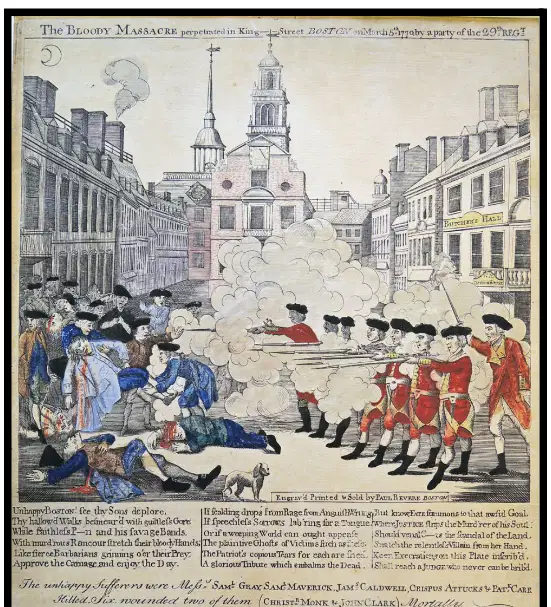
Who created this source? (Refer to the illustration of the Boston Massacre)
Paul Revere
Samuel Adams
John Hancock
Benjamin Franklin
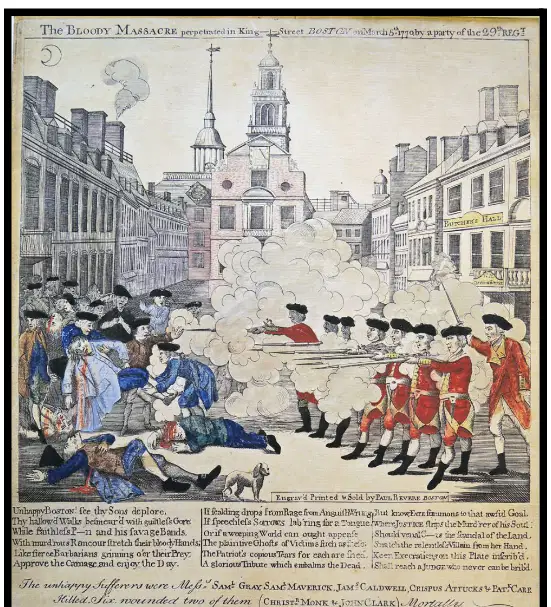
What is the message or main idea of this source? (Refer to the illustration of the Boston Massacre)
The message was that they wanted to convince colonists that the British soldiers were cruel attackers who violently murdered innocent colonists.
The message was that the British soldiers were peacefully protecting the colonists from danger.
The message was that the colonists were celebrating a festival with the British soldiers.
The message was that the British soldiers and colonists were working together in harmony.
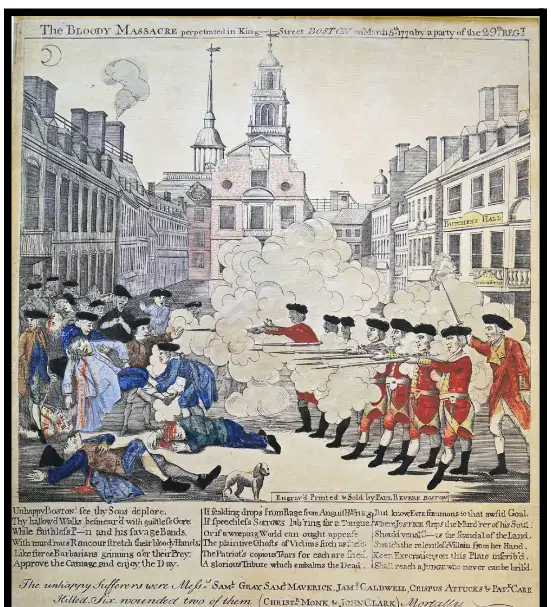
How is this source an example of propaganda? (Refer to the illustration of the Boston Massacre)
It was designed to shape people’s opinions by showing a biased, one sided version of the event.
It provides a completely accurate and neutral account of the event.
It was created to entertain people with fictional stories.
It encourages people to ignore historical events altogether.
The basic events of the Boston Tea Party included which of the following?
Colonists, disguised as Native Americans, boarded British ships and dumped tea into Boston Harbor
British soldiers fired on colonists, killing five people
Colonists signed the Declaration of Independence
The British Parliament repealed the Stamp Act
Describe the different measures put in place by the Intolerable Acts.
The Intolerable Acts included closing Boston Harbor, restricting town meetings, allowing British officials to be tried in Britain, and expanding the Quartering Act.
The Intolerable Acts abolished slavery in the colonies and granted independence to Massachusetts.
The Intolerable Acts established new trade agreements with France and Spain.
The Intolerable Acts created a colonial parliament to govern the colonies independently.
The significance of the Battles of Lexington and Concord on the Road to Revolution was that they:
marked the beginning of armed conflict between the colonies and Britain
ended the Revolutionary War
led to the signing of the Declaration of Independence
resulted in peace between the colonies and Britain

