
 Worksheets
MMP | Final Exam
Total questions: 98
Worksheet time: 2hrs 26mins
Each Cx vertebra has ..... processes
3
5
7
2
Atlantoaxial joint is mostly contributing in Cx
Side bending
Flexion and Extension
Rotation
Cx is .... joint complex
3
5
7
CAD may be misdiagnosed with
inner ear infection
DVT
greater occipital nerve entrapment
Greater occipital nerve may be entrapped due to
Suboccipital muscle spasms
Thoracic outlet syndrome
Flat cervical curve
Neurocentral joint arthritic changes cannot affect the neural tissues
True
False
The fibers of Lamellae are arranged in the same directions to protect the nucleus in all stress directions
True
False
The brachial Plexus passes
Above Scalenae
Below Scalenae
Bet. anterior and middle scalene
Bet. middle and posterior scalene
Pt. who reported diurnal pain (morning Stiffness) this indicates that the following component is part from his problem
Myogenic
Neural
Arthrogenic
Visceral
Vertebral arteries become basilar artery to supply
Mid-brain
Hind-brain
Occipital lope
Forehead
Early signs for CAD prediction including
Dizziness
Numbness
Uncontrolled DM
high BP
Late signs and symptoms of CAD including
loss of consiousness
Dysarthria
Migraine
Nausea
Dysdiadochokinesia
During your movement testing, pt. reported localized pain and limited ROM in Cx extension and end range rotation to the Rt., what is your clinical hypothesis
Neurocentral joint arthritis
internal disc disruption
Facet joint arthritis
Nerve root compression
During your movement testing, pt. reported localized pain with the end range of Rt. and Lt. Side bending with no pain with extension
Neurocentral joint arthritis
internal disc disruption
Facet joint arthritis
Nerve root compression

Considering sensitivity & specificity of transverse ligament stress test, this means
65% may be false positive
35% may be false negative
99% may be true negative
1% may be false negative
Your pt. complaints from tingling sensation and headache at the back of the skull, what are your MUST ttt options today
Tx mobility
Suboccipital release
Rotation Mobilization from Flexion
Low grade mobilization
Its agreed that pt. with thumb paresthesia may have Median nerve entrapment or nerve root affection
C5
C6
C7
C8
What can cause nerve root compression and upper limb paresthesia
Scalenus muscles guarding spasm
Neurocentral joint arthritic changes
Facet joint arthritic changes
Thoracic outlet syndrome
Internal disc disruption

Considering the clinical Correlation of this MRI, your pt. May have weakness in
Rt. elbow flexion
Lt. wrist extension
Lt. shoulder abduction
Rt. cervical rotation

Considering this MRI, the pt. complains from feeling of Instability and loosing the sensation in his both hands finger tips, what's your best clinical decision now
Cx traction
ttt based diagnosis
kick him out
Ask for familial history of idiopathic stenosis
Considering texting neck syndrome pt., one of your critical ttt options is
Milking mobilizations
protraction exersises
Cx Motor control
Cx traction
Whatever the cause, 22-year-old female complains of winging of scapula, weakness while lifting, pulling, and pushing heavy objects which often affects her ability to raise her arm above her shoulder.
The origin of the affected nerve is upper trunk of brachial plexus
The origin of the affected nerve is C5, C6, C7
Long thoracic nerve is mostly damaged
Musculocutaneous nerve is mostly damaged
Serratus Anterior muscle is supplied by this affected nerve
79-year-old woman worked as a volunteer at the information desk of our hospital, complained of numbness and paresthesia in her right thumb and index finger. Her symptoms were constant, but worse when she would drive to work in the morning and during the night when she was trying to sleep. She noted that rubbing or shaking her hand improved the symptoms slightly. She denied weakness; however, she reported dropping objects that she was holding in her hand on occasion. She did not experience any similar symptoms in her left hand.
Median nerve is suspicious nerve to be injured
Ulnar nerve is suspicious nerve to be injured
we can make motor nerve conduction study for this nerve from pronator teres muscle
we can make motor nerve conduction study for this nerve from adductor digiti-minimi muscle

The name of the Legend Al Pacino in Scent of a Woman movie was?
Colonel Frank Slade
Colonel Chris O'Donnell
Colonel James Rebhorn
Colonel Charlie Simms
Posterior rotation of the clavicle is achieved directly by
the tension of serratus anterior muscle
the tension of coracoclavicular ligaments
the tension of upper trap. muscle
Posterior rotation of the clavicle is achieved indirectly by
the tension of serratus anterior muscle
the tension of coracoclavicular ligaments
the tension of upper trap. muscle
Considering the resting position of the ST articulation
Anterior tilted
Posterior tilted
Upward rotated
Internally Rotated
Externally Rotated
Considering the upper trap muscle
Initiate upward rotation
Static stabilizer for the scapula
act as extensor if activated unilaterally
Common site for trigger points
Considering the dynamic centralization mechanism of the shoulder, Deltoid contribute in
Suction or Compressive force
Superior migration
Inferior gliding
Dynamic co-contraction
Considering the dynamic centralization mechanism of the shoulder, Supraspinatus contribute in
Suction or Compressive force
Superior migration
Inferior gliding
Dynamic co-contraction
Your pt. has obvious rounded shoulders, what are your ttt options for this case
Tx mobility in extension
Release pectoralis minor
Stretch pectoralis minor and major
Triceps activation
All of them
MR machine can just deal with proton
H
O2
Ca
K
H2o

Considering this article, the 3 stages of tendinopathy (by sequence) are
Inflammatory
Remodeling
Proliferation
Inflammatory
Deterioration
Proliferation
Proliferation
Inflammatory
Remodeling
Inflammatory
Proliferation
Remodeling
Inflammatory
Deterioration
Reformation

Considering this article, high percentage of collagen type III composed in
Inflammatory stage
Proliferation phase
Remodeling phase
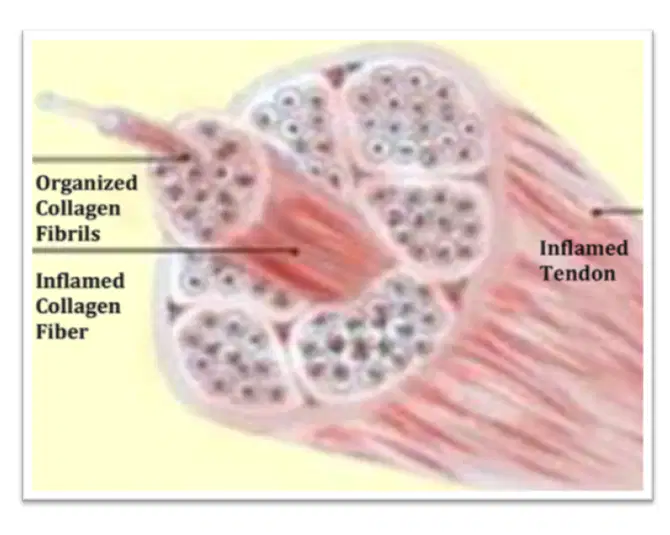
This characteristics describe
Tendinitis
Tendinopathy
Tendinosis
Tenosynovitis

This characteristics describe
Tendinitis
Tendinopathy
Tendinosis
Tenosynovitis

Considering this RST, the acromion morphology (i.e. Hooked shape) has .... association with SIS
Direct
Indipendent

Your report for this MRI will include
Supraspinatus tendinitis
Supraspinatus tendinopathy
Infraspinatus tendinopathy
Subscapularis tendinopathy

Your report for this MRI will include
Supraspinatus full thickness tear
Supraspinatus tendinopathy
Infraspinatus tendinopathy
Acromion bursitis

Who is her?
Geffrey Maitland
Ann Cools
Ali Abd El-Aziz
Scarlett Johansson
Ignoring the Convex-concave rule, if you want to gain full GH flexion ROM, what are your clinical ttt options from here
Tx mobility in extension
GH internal rotation MWM
GH scaption MWM
Considering GIRD pt. before you order by the Guidelines exercises, you have to gain internal rotation ROM by
Release subscapularis
Release deltoid
Hand behind back MWM
Activate infraspinatus

Considering this AIOS pt. the key ttt option to avoid recurrence is
Release pictoralis major
Strength infraspinatus
Tx mobility in extension
Tx mobility in rotation
8 years old boy fracture medial epicondyle may cause
Cubitus varus
Cubitus valgus
None of them
8 years old boy fracture medial condyle (trochlea) may cause
Cubitus varus
Cubitus valgus
None of them

Galeazzi fracture
Montaggia fracture
Considering the clinical findings of Resistive movement testing, Strong and painful elbow flexion may indicate
Muscle strain
Tendinopathy
Muscle tear
Carcinoma
Total nerve disruption
Considering the clinical findings of Resistive movement testing, Weak and painless elbow flexion may indicate
Muscle strain
Tendinopathy
Complete muscle tear
Carcinoma
Total nerve disruption

OK sign for
Posterior interosseous nerve entrapment
Anterior interosseous nerve entrapment
Ulnar nerve entrapment
Radial nerve entrapment

Hitchhike sign for
Posterior interosseous nerve entrapment
Anterior interosseous nerve entrapment
Ulnar nerve entrapment
Radial nerve entrapment
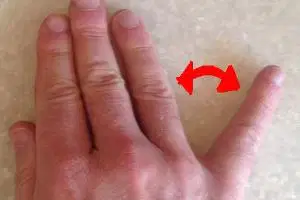
Wartenberg sign for
Posterior interosseous nerve entrapment
Anterior interosseous nerve entrapment
Ulnar nerve entrapment
Radial nerve entrapment
Signs of million dollar nerve involvement may include
Weak thumb adduction
Weak wrist flexion
Paresthesia at the thenar eminence
Atrophied thenar eminence

Your report for this plane x-ray will include
Triceps tendinitis
Triceps avulsion tear
Elbow OA
Elbow RA
According to recent evidence-based practice, your ttt options for LET may include
Tx involvement
Scapular stability ex.
Eccentric loading on flexor-pronator group
Eccentric loading on extensor-supinator group
MWM
The most common affected tendon in LET is
FPL
EPL
ECRL
ECRB

This pt. maybe diagnosed as
OA
RA
Generalized hyperlaxity
Direct trauma
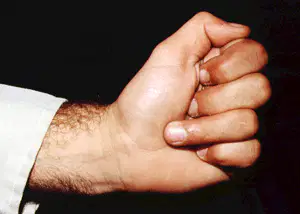
What is your clinical hypothesis
Ape hand
Mallet finger
Jersey finger
Ulnar nerve entrapment
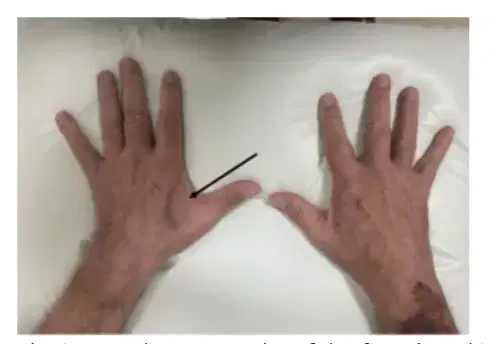
What is your clinical hypothesis
Ape hand
Mallet finger
Jersey finger
Ulnar nerve entrapment

This point of pain which radiate proximally may be due to
Dequervain's tenosynovitis
Intersection syndrome
Extensor indices tendinopathy
Medial nerve entrapment
Your pt. complaints from tingling and burning sensation at the palm of the hand on the thenar eminence area, what is your clinical hypothesis
Deep branch of median nerve entrapment
Anterior interosseous nerve entrapment
Palmar cutaneous branch of median nerve entrapment
Palmar cutaneous branch of ulnar nerve entrapment
Your pt. complaints from tingling and burning sensation at the lateral finger tips bilaterally , what are your clinical hypotheses
Cervical spine may be the source
Bilateral carpal tunnel syndrome
Foraminal disc extrusion C5,C6
Extraforaminal disc extrusion C6,C7

Terry Thomas sign describes
Tear TFCC
Scapho-Lunate dissociation
Ulnar Impaction Syndrome
Scaphoid fracture
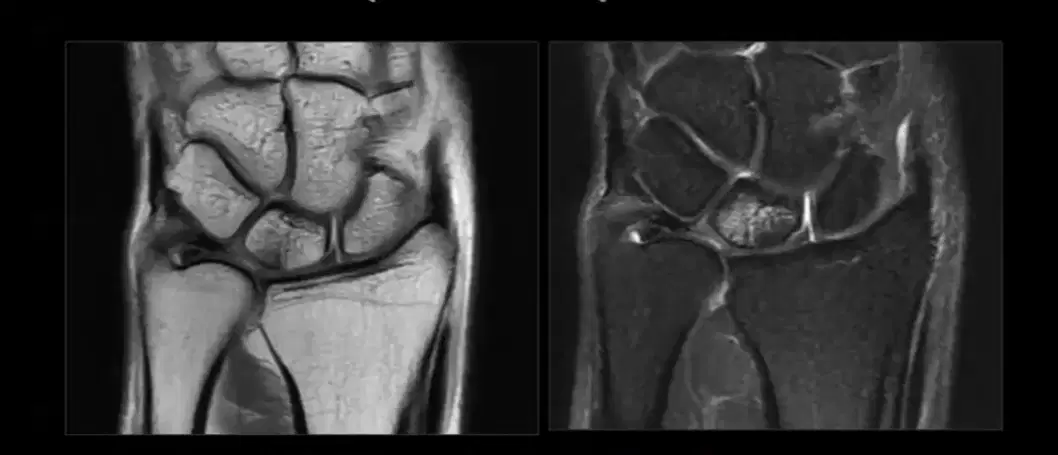
Considering this MRI, the bone marrow contusion on the lunate is due to
tear TFCC
-Ve ulnar variance
+Ve ulnar variance
Trauma

According to this RCT, the highest quality evidence ttt options for dequirvan's tenosynovitis are
Paraffine bath
Concentric loading
Thumb spika
Eccentric loading
The 1st line of treatment after immediate scaphoid fracture is
Low grade mobilization
Corticosteroids
Internal or External good fixation
Stability program for the surrounding muscles
Guidelines for rehabilitation of carpal tunnel syndrome can be explained easily by our words
(a)
The most common carpal bone to be fractured
Scaphoid
Lunate
Hamate
Capitate
The most common carpal bone to be dislocated
Scaphoid
Lunate
Hamate
Capitate

ما هي عاصمة فلسطين الأبدية
رام الله
غزة
بئر السبع
القدس
حيفا
Lumbar puncture is considered safe below L2 mainly because
The spinal cord becomes wider below L2
Only cauda equina roots are present
The dura ends at L2
The lumbar plexus disappears below L2
The nerve supply of the intervertebral disc is mainly through
Femoral nerve
Nervo nervorum
Sinuvertebral nerve
Sciatic nerve
Because of the vertical orientation of lumbar nerve roots, a paracentral disc extrusion may affect
The same exiting nerve root only
The spinal cord
Only the sympathetic chain
A different nerve root from the exiting root
A patient who cannot walk on his heels may have involvement of
L3
L4
L5
S1

In clinical correlation, this patient is mostly suspected to report numbness over
The lateral lower Rt. leg
The middle three toes on the dorsum of the Lt. foot
The medial aspect of the Rt. knee
The Big toe and medial aspect of the Lt. foot
In a patient with severe irritability who cannot tolerate SLR on the symptomatic side, what are your clinical decisions that may help
performing the SLR NM on the opposite limb
Low grade mobilization for Lx
SLR from Lx decompression
NM from SLUMP position
A patient with painful ASLR. When pelvic compression is applied, the ASLR becomes easier and less painful. This finding is most consistent with
Excessive force closure (taught control)
Reduced force closure
(loose control)
Reduced form closure
Excessive form closure
A patient with reduced force closure may benefit primarily from
Local muscle activation and core stability exercises
Fire Hydrants exercise
Iliopsoas march exercise
Muscle release
Relaxation techniques
Cardiovascular exercises
A patient with excessive force closure may benefit primarily from
Local muscle activation and core stability exercises
Fire Hydrants exercise
Iliopsoas march exercise
Muscle release
Relaxation techniques
Cardiovascular exercises
Ely's test is used to assess
Hamstring flexibility
Gluteus medius strength
Rectus femoris flexibility
Quadriceps flexibility
Proximal stability insufficiency may produce
Trendelenburg gait
Waddling gait
Femur Adduction and internal rotation
Lateral patellar tracking
The ideal position in EBP described for the clamshell assessment is approximately
45° hip flexion and 45° knee flexion
60° hip extension and 90° knee flexion
90° hip flexion and 90° knee flexion
30° hip flexion and 90° knee flexion

FBSS

Report
AVN Stage I
AVN Stage II
Transiant osteoprosis
Stress fracture
Which of the following considered self-limiting disease
Scaphoid fracture
AVN
Femoral head stress fracture
Transiant osteoprosis
Severe's disease

According T-Score, this hip is
Osteoprosis
Osteopenia
Normal

Those positions are aggravating factors for
GTPS
Hip OA
AVN
FAI
GTPS Diagnostic criteria may include
+Ve Palpation
+Ve FADDER
+Ve FABER
+Ve SLS
+Ve Resisted Ext. Derotation Test
Which test is most valuable associated with ACL integrity?
Slocum test
Pivot shift test
Anterior drawer test
Lachman test
During PFPS, anterior knee pain is often aggravated by going downstairs because
The meniscus is not loaded
Proximal insufficincy
The quadriceps works eccentrically and patellofemoral compression increases
The hamstrings work as neutralizer
The major early postoperative goals after ACL reconstruction is to
Prevent extension lag
Subside edema
Reduce pain
Improve proximal stability
Proprioceptive training

Degenarative tear
Posterior horn of lateral meniscus
Posterior horn of medial meniscus
Traumatic tear

Doubble PCL sign
Pocket handle tear
Complex meniscal tear
PCL tear

MCL sprain grade I
MCL sprain grade II
MCL sprain grade III
LCL sprain grade III
LCL sprain grade II

Chronic injury
ACL full thickness tear
Doubble PCL sign
Bone marrow contusion
Empty notch sign

Graft mal-positioning
A football player sustains an ankle injury with pain located above the ankle joint, relatively little swelling, and pain reproduced during a dorsiflexion + external rotation stress test. Which diagnosis is MOST likely?
Achilles tendon injury
High ankle sprain involving the distal tibiofibular syndesmosis
Deltoid ligament injury
Lateral ankle sprain involving the ATFL
A 12-year-old soccer player develops posterior heel pain that increases with running and jumping. The pain is absent in the morning, and medial/lateral compression of the heel reproduces the symptoms. He also has tight calf muscles and limited ankle dorsiflexion. What is the MOST likely diagnosis?
Tarsal tunnel syndrome
Sever's disease (calcaneal apophysitis)
Achilles tendinopathy
Plantar fasciopathy
A patient has completed the initial management phase following a severe lateral ankle sprain. The clinician wants to reduce the risk of recurrence and restore functional ankle control. Which rehabilitation approach BEST matches the recommendations in the EBP?
Avoid weight-bearing exercises until full ligament healing is confirmed on imaging
Progressive loading combined with sensorimotor/proprioceptive training, balance activities, and sport-related functional training
Ultrasound is not recommended as the primary intervention
Immobilization until all symptoms completely disappear

