
 Worksheets
Chemical Bonds and the periodic table
Total questions: 55
Worksheet time: 55mins
What type of bond is formed when electrons are transferred from one atom to another?
Metallic bond
Hydrogen bond
Ionic bond
Covalent bond
What type of bond is found in metals?
Metallic bond
Covalent bond
Hydrogen bond
Ionic bond
Describe the properties of metallic bonds.
Metallic bonds are not characterized by delocalization of electrons
Metallic bonds are formed between non-metal atoms
Metallic bonds are formed between metal atoms and are characterized by the delocalization of electrons, high electrical and thermal conductivity, malleability, and ductility.
Metallic bonds have low electrical and thermal conductivity
The 3 types of chemical bonds are ________, ________, and ______. (Choose 3)
ionic
valence
covalent
metallic
atomic
A bond between two nonmetal atoms is a __________ bond.
ionic
nuclear
metallic
covalent

Which of the following is NOT a covalent bond?
K2S
H2O
I2
CO2
Which of the following describes covalent bonds?
Bonds form because of opposite charges
electrons are shared to fill outer electron shells
Electrons are transferred between atoms
Covalent bonds are magical
The octet rules states that most elements want to have _____ valence electrons.
2
4
6
8
Complete the general equation:
Metal + Acid ->
Salt + Water
Salt + Hydrogen
Salt
Complete the equation:
Sodium + Hydrochloric Acid ->
Sodium Hydroxide + Hydrogen
Sodium Chloride + Hydrogen
Chloric Sodium + Hydrogen
Sodium Chloride + Water
The following are example(s) of transition metals (check all that apply):
sodium
gold
cobalt
boron
plutonium
Why do transition metals get different rules for their names and formulas?
atoms are larger
cations have many different charges
they have more protons
they are rare elements

What is the correct name for this compound?
fluorine chlorine
iron chloride
iron(II) chloride
iron(I) chloride
What is the formula for iron(III) oxide?
FeO
Fe(III) O
Fe2O3
Fe3O2
What is the name of this compound? Na2S
nitrogen(II) sulfide
sodium(II) sulfide
sodium sulfide
sodium(I) sulfide
Correct diagram for HF


Correct diagram for CF4


What type of forces act between the ions in an ionic compound?
Electrostatic
Frictional
Gravitational
Magnetic
Which alkali metal is most reactive out of the following
rubidium
potassium
sodium
lithium
How many electrons do the alkali metals have in their outer shell?
1
2
8
7
What happens to the melting point of the alkali metals as you move down the group?
decreases
increases
How does a group 1 metal atom form an ion?
lose 1 electron
lose 2 electrons
gain 1 electron
gain 2 electrons
Which of the following is NOT a property of group 1 metals?
More dense than water
less dense than water
low melting point
soft
What is the formula of a group 1 metal oxide?
M2O
MO
MO2
Mo
What group are the Halogens?
6.9
7
8
3
As you move down the group, halogens' reactivity...
increases
decreases
doesn't change
shows no trend.
Which of the halogens could able to make the strongest ionic bond with Sodium metal?
Iodine
Bromine
Chlorine
Flourine
Complete the following equation: Iodine + Potassium Bromide -->
Potassium Iodine + Bromine
Iodine + Potassium Bromide
No reaction
Complete the following equation: Bromine + Potassium Iodide -->
Potassium Iodine + Bromine
Iodine + Potassium Bromide
No reaction
Which of the following is NOT a property of noble gases?
They have a complete outer shell.
They are highly reactive.
They are colorless, odorless, and tasteless.
They exist as monatomic gases at room temperature.
What is the primary use of Helium (He)?
In light bulbs as a filament
In refrigeration systems
In balloons and airships as a lifting gas
In fireworks to produce colors
Why are noble gases generally unreactive?
They have low atomic masses.
They have low melting points.
They have a complete outer electron shell.
They have high melting points.
Which noble gas is used in light bulbs to prevent the tungsten filament from oxidizing?
Neon
Xenon
Argon
Radon
Which noble gas has the highest boiling point?
Helium
Neon
Argon
Radon
Fe2+ and Fe3+ are both ions of iron. What is different about them?
they have different numbers of protons
they have different numbers of neutrons
they have a different charge
they are different elements

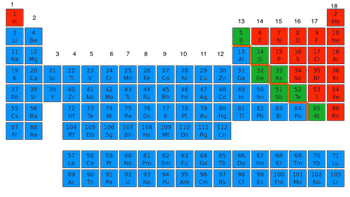
Where are the transition metals located on the periodic table?
blue square
red square
yellow square

The table shows information about two metals. One metal is cobalt and the other is potassium. Suggest which metal is cobalt.
(a)
Metal X: Reacts vigorously with oxygen to form a white compound.
Metal Y: Reacts slowly with oxygen to form a red compound.
Metal Z: Reacts slowly with oxygen to form a white compound.
Which metal is most likely to be a transition metal?
(a)

The following properties are all characteristics of ionic compounds EXCEPT
high melting and boiling points
soft
crystal lattice structure
conduct electricity when dissolved in water
Ionic compounds conduct electricity when dissolved in water. Which statement below best explains the property?
Ions are free to move.
Electrons are free to move.
Bonds are strong.
There are weak intermolecular forces of attraction.

Why do ionic compounds have high melting and boiling points?
Their ions are free to move.
Their ions are held in fixed positions.
They have many strong bonds.
They have many weak bonds.
Which two elements would NOT form an ionic bond?
calcium and lithium
calcium and oxygen
lithium and oxygen
calcium and carbon
Compound X conducts electricity in aqueous solution or molten state. It also has a high melting point and boiling point.
What is X?
CCl4
MgCl2
CO2
NH3
Compound X has high melting and boiling point. Which of the following explains the statement.
Compound X has strong covalent bond between ions.
Compound X has strong electrostatic force between ions.
Compound X has strong electrostatic force between molecules.
Compound X has strong covalent bond between atoms and giant lattice structure.

What is the property of the compound?
Can conduct electricity in solid state
Exists as liquid at room temperature
Has low melting and boiling points
Soluble in water
Which is the correct molecular structure for carbon dioxide?


H2O, Cl2, NH3
Do the bonds above require a high temperature to melt?
Yes, because they have strong forces holding them together.
No, those are ionic bonds.
No, those are all covalent bonds that have weaker forces holding them together.
Yes, because they are metallic bonds.


