
Font size
 Worksheets
8th Grade Weather and Climate
Total questions: 76
Worksheet time: 2hrs 31mins
What causes global convection currents
Forests
greenhouse gases
more land forms
uneven heating of the Earth's surface
Where do warm ocean currents come from
the poles
near the land
the equator
middle of the oceans

What city will experience decreasing temperatures in the next day?
Denver
El Paso
Memphis
Los Angeles

What does this symbol represent?
Cold Front
Warm Front
Stationary Front
Occluded Front
A low pressure system usually causes
Clearing Weather
Wet Weather
Fair Weather
No weather

Cold fronts bring _____ temperatures and ______ conditions.
warm; clear
cool; clear
warm; stormy
cool; stormy

What do ocean currents do for Earth's climate?
They cause earthquakes
They cause tectonic plates to shift
They redistribute Earth's heat
They carry trash from Africa to South America


Why do you see precipitation near the L?
because that is low pressure and that is where air rises, forming clouds
because that is where air is falling and it brings rain with it
because the mid-west is always rainy this time of year
because cold more dense air is sinking forming clouds
When convection occurs
cool and warm gases or liquids sink.
cool and warm gases or liquids rise.
warm gases or liquids rise and cool gases or liquids sink.
warm and cool gases or liquids sink and cool gases or liquids rise..
Tropical, temperate, and polar climate zones occur because of
the jet stream.
unequal heating of the Earth.
altitude.
the Coriolis Effect.
Winds are caused by differences in
precipitation.
air pressure.
latitudes..
fronts
Factors that affect climate are
global and local winds.
topography and ocean currents.
latitude and altitude.
all of the above.

Global winds curve because of the Earth's rotation. This is called
Local Winds.
Jet Stream.
Coriolis Effect.
Convection
Global winds curve because of the Earth's rotation. This is called
Local Winds.
Jet Stream.
Coriolis Effect.
Convection
Global winds curve because of the Earth's rotation. This is called
Local Winds.
Jet Stream.
Coriolis Effect.
Convection

Ocean currents are the result of uneven heating of the water, which leads to
conduction
convection
reflection
condensation

Which type of front is pictured in the diagram?
cold front
stationary front
warm front
occluded front
The weather forecaster says there will be rain over the next several days. This indicates a(n):
cold front
stationary front
warm front
occluded front

In which city are thunderstorms likely to occur? (look carefully; there could be two fronts connected in a single line)
San Diego
Chicago
Tulsa
Boston
This weather instrument measures air pressure.
Anemometer
Thermometer
Barometer
Weather Balloon
This weather instrument measures wind speed
Anemometer
Thermometer
Barometer
Weather Balloon

This type of front pushes moist air up. Pressure increases.
Warm Front
Cold Front
Stationary Front
Occluded Front
Cool air mass typically have....
High pressure and clear weather
High pressure and rainy/stormy weather
Low pressure and clear weather
Low pressure and rainy/stormy weather
Warm air masses typically have....
High pressure and clear weather
High pressure and rainy/stormy weather
Low pressure and clear weather
Low pressure and rainy/stormy weather
Warm air rising and cool air falling produce a....
Direct Current
Convection Current
Alternating Current
Indirect Current

The top floor of your house always seem to have a higher temperature than the 1st floor. What heat transfer method is responsible for this process?
radiation
convection
conduction
condensation

The climate of a location is constantly changing.
true
false

What type of air mass would form over the warm waters of the southern Atlantic Ocean?
Maritime polar (mP)
Maritime tropical (mT)
Continental polar (cP)
Continental tropical (cT)
Cold fronts bring _____ temperatures and ______ conditions.
warm; fair
cool; fair
warm; stormy
cool; stormy

What type of conditions are associated with low pressure systems?
cloudy, rainy, or stormy conditions
fair skies with no chance of precipitation

A warm front usually brings what type of weather conditions?
cold temperatures with stormy conditions
warmer temperatures with a slight chance of precipitation
cooler weather all day
warmer temperatures with strong storms
Oklahoma saw 2 tornadoes, 57 lightning strikes, 9 inches of rain, and high winds every day this week.
It is usually mild during the winter in the southern states of the United States.
Which statement describes why the Earth has seasons?
The Earth's axis is titled as it revolves around the sun.
The Earth's distance changes as it revolves around the sun.
The moon revolves around the Earth.
The sun's axis is tilted.
Many factors are used to determine the climate of an area. Which of the following is one of the two main factors that determine climate?
humidity
air pressure
wind conditions
precipitation
Earth's tilt on its axis and movement around the sun create ____.
seasons
day and night
ocean currents
rain shadows
Earth's spherical shapes causes places near the ___ to be closer to the sun, thus warmer.
poles
equator
As warm air rises, cooler air moves in to take its place, creating ___.
ocean currents
wind
storm surges
fronts

How are the convection currents in the lava lamp different than convection currents in the atmosphere?
warm air in the atmosphere sinks instead of rises
The earth gets its heat from the sun and the lava lamp gets its heat from the light bulb below.
Convection cells in the atmosphere flow in the same direction instead of opposite
Cold air is less dense instead of being more dense.
One of the major ways oceans contribute to weather systems is that the oceans -
provide a diverse habitat for many organisms
store and transport the Sun's heat energy.
experience changes in amounts of dissolved salt.
reach depths that can be as much as 12,000 meters.
What is considered the driving force for Earth's climate
Rain
Moon phases
Earth Rotation
The Sun

Cold air is denser than warm air, so it sinks. What kind of pressure area does this create?
Dense pressure
High pressure
Low pressure
No pressure

What is wind?
Large scale movement of air caused by differences in air pressure and temperature
Large scale movement of CO2 caused by differences in air pressure
Large scale movement of air caused by differences in temperature
Large scale movement of temperature caused by differences in air pressure

In a convection current, rising warm air is replaced by cooler, _________________ air that sinks beside it.
A. denser
B. less dense
C. stable
What causes the global wind patterns?
A. Differences in pressure and temperature
B. Differences in humidity
C. Differences in salinity

Weather fronts are caused by interactions between air masses of different ________________________.
A. latitude and logitude
B. temperature and humidity
C. forms of precipitation

The weather map below shows the locations of a high-pressure center (H) and a low-pressure center (L), air masses cP and mT, and city A. Explain why city A has clear sky conditions.
City A is near a high pressure system
City A is near a low pressure system
At the equator, the air is:
warm, less dense, and rising
warm, more dense, and rising
cool, more dense, and sinking
cool, less dense, and sinking
Global winds travel from:
high to low pressure
low to high pressure
high pressure to cool temperatures
low pressure to cold temperatures
Atmospheric convection helps to distribute —
magnetic energy from Earth's core, which flows to the surface unevenly
gravitational energy from Earth's core, which is strongest at the equator
visible light from the Sun, which strikes Earth only at the poles
thermal energy from the Sun, which strikes Earth unevenly
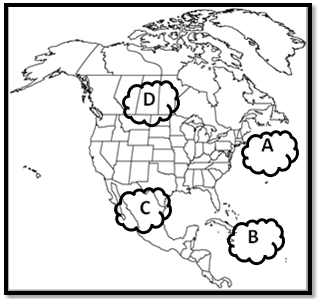

Which type of weather front can produce precipitation (rain or snow)?
Cold
Warm
Stationary
Occluded
All of the above

