
 Worksheets
AP-GOV_Unit 2 MCQ Practice
Total questions: 121
Worksheet time: 1hrs 20mins
What article of the U.S. Constitution deals with the Executive Branch?
Article 1
Article 2
Article 3
Article 4
How old do you have to be to run for President?
25
30
35
40
Which of the following requirements is ONLY for the president and no other political position?
Specific age requirement
Residency in the U.S. for a specific number of years
Political background
Natural born citizen
What president caused the 22nd amendment (2 term limits) to be passed?
Theodore Roosevelt
Franklin D. Roosevelt
John F. Kennedy
Woodrow Wilson
What happens if the President is no longer able to serve?
The Speaker of the House takes over
Congress picks a new president
The Vice President becomes president
The country reelects a new president in a special election
Which of the following is the correct explanation of an "open" primary?
An open primary allows you to vote for whoever you want, regardless of political party.
An open primary allows anyone to vote, regardless if they're registered or not.
An open primary allows anyone to run, regardless if they have political experience or not.
An open primary only allows you to vote for what political party you're registered with.
What is the Electoral College?
A political institution where people go to become politicians.
The people solely in charge with picking the president.
A group of people who accurately guess who the president will be every election.
A set of electors who are selected to elect a candidate to particular offices.
Which of the following is NOT a reason why the Electoral College has not been abolished?
Requires a constitutional amendment
Benefits large states that typically allow election outcomes to be decided faster
Benefits racial minorities and interest groups located in key states
No consensus on how to reform the electoral college
What is the difference between gerrymandering and redistricting?
Gerrymandering is beneficial to all political parties, redistricting only benefits the majority party.
Gerrymandering is legal, redistricting is illegal.
Redistricting changes district lines, gerrymandering does not.
Gerrymandering is illegal, redistricting is not.
Which of the following BEST describes the Bureaucracy?
A small, complex organization of elected officials.
A small, complex organization of appointed officials.
A large, complex organization of appointed officials.
A large, complex organization of elected officials.
What is a "bicameral legislature" composed of?
One governing body/chamber
Two governing bodies/chambers
One head body with a sub-chamber
The President and the heads of each chamber
Which of the following WAS NOT a reason for the Framers wanting a bicameral legislature?
The Connecticut Compromise
Historical tradition
It was President Washington's idea
Federalism
What article of the U.S. Constitution deals directly with the Legislative Branch?
Article 1
Article 2
Article 3
Article 4
Which of the following is NOT an example of an expressed power?
Declaring war
Coining money
Borrowing money
Creating the IRS to collect taxes
How many votes are needed from Congress to pass an amendment?
1/3
At least half
2/3
Every member has to vote in favor
How many members are in the House of Representatives?
100
335
435
535
What determines how many senators we have?
We always have 100
It's always 2 per state
The population of each state
The House of Representatives votes to add more
What article of the Constitution deals with the Judicial Branch?
Article 1
Article 2
Article 3
Article 4
How many years is a Representative's term?
2 years
4 years
6 years
8 years
How long is a Senator's term?
2 years
4 years
6 years
8 years
A Senator and Representative can run and serve as many times as they'd like to.
True
False
What is the name of the head of the House of Representatives?
House Leader
Speaker of the House
President
Majority Leader
How many federal judges are there on the Supreme Court?
7
8
9
10
Why do we have 9 justices?
Franklin D. Roosevelt chose to have 9 while he was president. It stuck.
So there's no possibility of a tie (ex: 8 or 10 could cause a tie)
The Constitution says so
¯\_(ツ)_/¯
What analogy did I use to explain majority opinion versus concurring opinion?
Burger King burger vs. chicken nuggets
Chik-Fil-A versus McDonalds
McDonalds burger vs. chicken nuggets
Wawa vs. Sheetz
When a justice agrees with the outcome of a case but for a different reason, this is called a...
Majority opinion
Minority opinion
Concurring opinion
Dissenting opinion
How many justices need to vote in order for it to be a MAJORITY opinion?
3/9
4/9
5/9
6/9
True or False: "I know the names of important people in our government including the Speaker of the House, the President of the Senate, and our U.S. Senators and Representatives for Pennsylvania."
True
False
Not yet but I will for the test!
True or False: "I know it's important to study off my 'Powers of the President' Project because I can use those vocabulary words on a FRQ."
True
False
True or False: "I feel confident in being able to explain how a bill becomes a law."
True
False
I'm going to recite "I'm Just A Bill" verbally to myself until I learn it
House of Congress based on equal representation for all states. Members have 6 year terms and 1/3 of the seats are up for election every 2 years. Has 100 members and has been viewed viewed as the upper house with more powers and a responsibilities of the 2 houses.
Senate
House of Representatives
Parliament
Established the principle of "one person, one vote", ordered state legislative districts to be as near equal as possible in population. The Court asserted that the federal courts had the right to tell states to reapportion their districts for more equal representation.
Baker v. Carr (1962)
Shaw v. Reno (1993)
Shelby v. Holder (2013)
Drawing the boundaries of legislative districts in bizarre or unusual shapes to favor one party.
Minority-Majority District
Gerrymandering
Redistricting
Reapportionment
Power of the Senate to approve, or not approve of, the president's nominations to federal courts, agencies, ambassadors, etc.; the Senate also ratifies treaties agreed to by the president
Enumerated Powers
Implied Powers
Advice and Consent Powers
Reserved Powers
One party controls the White House, and another controls one or both houses of Congress.
Divided Government
Unified Government
Gridlock
Coalition Building
The main function of the bureaucracy is:
communicate with foreign nations
prosecute citizens of our nation
make the president happy
perform the day to day business of the federal government
A group of advisers to the President that include the heads of departments are called the what?
The Senate
The Cabinet
The Ambassadors
The Diplomats
Which of the following statements about the Senate is true?
Each state is represented in the Senate according to its population.
The Senate, unlike the House, has a Rules Committee.
The Senate is more responsible than the House for initiating appropriations legislation.
Individual senators can exercise substantial influence over the legislative process.
All of the following are ways that the legislative branch can check the powers of the executive branch EXCEPT:
Congress may pass a law declaring a presidential action unconstitutional.
The Senate may refuse to approve a presidential appointment.
Congress may override a presidential veto.
Congress may remove the president through its impeachment and conviction powers.
Which of the following is an example of congressional oversight?
Assisting constituents with particular problems
Holding hearings for review of an executive agency's activities
Reporting campaign contributions to the Federal Election Commission
Conducting ethics investigations of congressional leadership
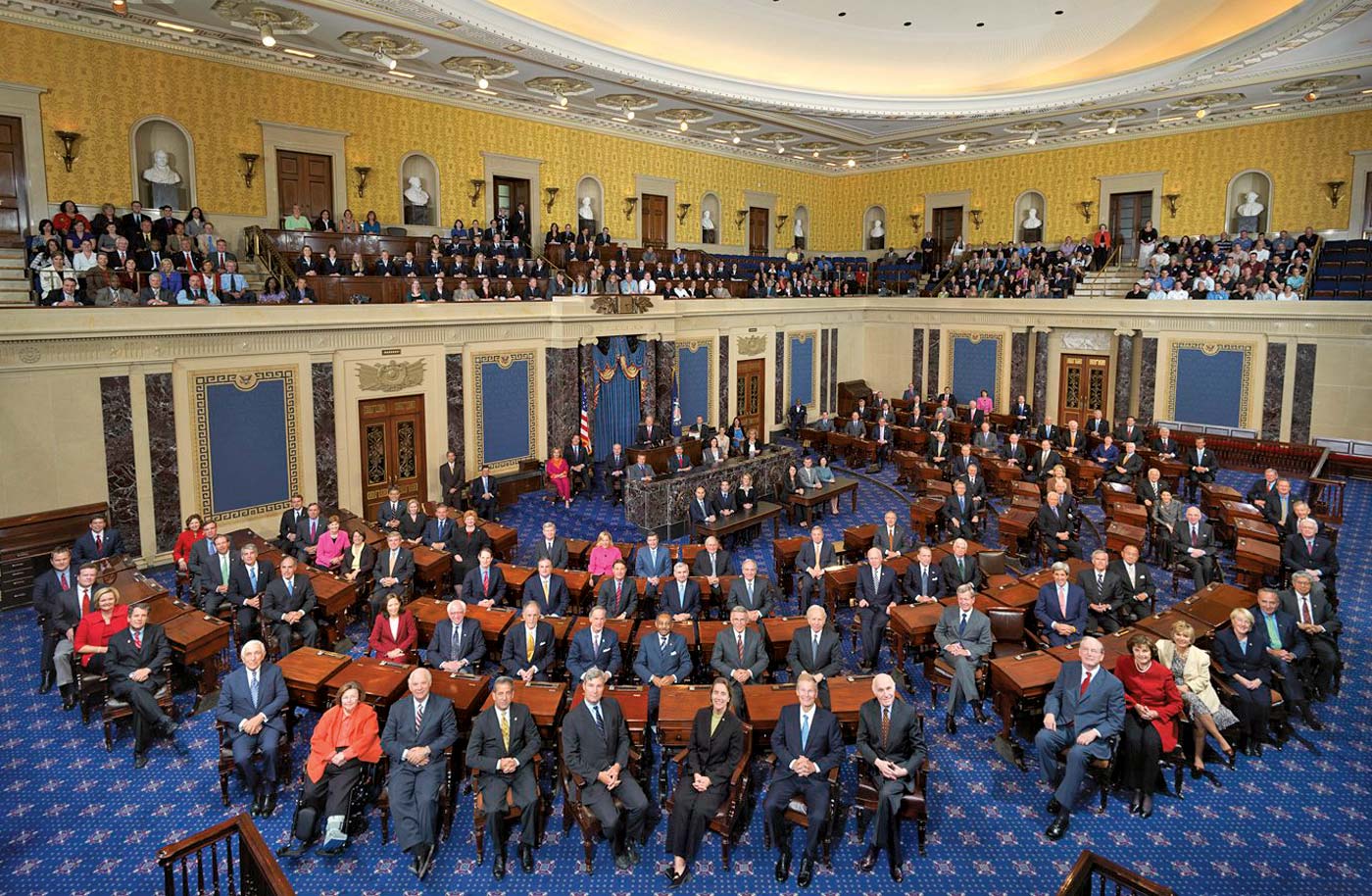
Which of the following is NOT true of the Congress?
Each house determines its own leadership and rules
Terms of Congress last for two years
Congress is unicameral in nature
Only the president may call special sessions of Congress
An informal group advocating for a $15 minimum wage collects 590,000 signatures from registered voters in their state. In the next election, this initiative appears on the ballot for voters to decide whether it becomes a state constitutional amendment.
This is an example of which of the following models of democracy?
Pluralist democracy
Elite democracy
Representative democracy
Participatory democracy
Which statement BEST describes the Constitutional Convention?
A meeting held to establish a completely new form of government
A meeting held to discuss trade and navigation issues
A meeting held to fix the Articles of Confederation.
A meeting held to decide who the president should be
Constitutional checks and balances, especially applied to the president are designed to:
Provide for a balanced budget
Ensure that the states do not become too powerful
Ensure efficient government
Minimize the threat of tyranny from any branch of government
Which of the following is a member of the White House Staff?
The chair of the Federal Reserve Board
The secretary of commerce
The attorney general
The national security advisor
The Supreme Court’s power of judicial review permits the Court to overrule all of the following EXCEPT:
Lower-court decisions
State legislation
Executive orders
The Bill of Rights
Which of the following United States Supreme Court cases established the principle of judicial review?
McCulloch v. Maryland
Gibbons v. Ogden
Roe v. Wade
Marbury v. Madison
The doctrine of sovereign immunity states that a citizen cannot:
Be charged with the same crime twice
Appeal a case that was decided more than a year before
Enlist in a foreign military
Sue the government without its consent
Which of the following statements about writs of certiorari is accurate?
Cases appealed by the solicitor general are automatically granted certiorari.
The Supreme Court has historically granted certiorari to all separation of powers cases.
The Supreme Court does not grant certiorari to cases involving state laws.
The Supreme Court grants certiorari for less than 5% of cases appealed to it.
The difference between an appellate court and a district court is that an appellate court:
Conducts trials by jury
Has original jurisdiction
Hears civil cases but not criminal cases
Reviews previous court decisions
Supreme Court justices were given tenure subject to good behavior by the framers of the Constitution in order to ensure that:
Justices remain accountable to the public
Justices are encouraged to make politically popular decisions
Cooperation between the judicial and legislative branches is assured
Justices are free from direct political pressures
Which of the following best explains the principle of stare decisis?
It requires that at least four Supreme Court justices agree to hear a case.
It encourages president to take judicial experience into account when nominating judges.
It reinforces the philosophy of judicial activism
It encourages judges to follow precedent when deciding cases.
Court packing refers to the practice of:
Removing appellate jurisdiction from courts
Appointing justices who agree with Congress’s political philosophy
Appointing only judicial activists
Appointing justices who agree with the president’s political philosophy
The United States Constitution mandates the:
Supreme, appellate, and district courts
Only legislative courts
None of the above
Supreme Court only
When the president chooses district court nominees it is traditional that members of Congress from the state where the court is are consulted. This is called:
House of Representative consultations
Court packing
Judicial scrutiny
Senatorial courtesy
All of the following are presidential powers EXCEPT the authority to:
Negotiate treaties
Veto legislation
Nominate cabinet members
Declare war
Presidents have had the most success in changing the direction of the decisions of the federal judiciary by:
Using the media to build consensus for the President’s position
Requesting that Congress reduce the term of office that judges may serve
Pressuring Congress to pass the appropriate legislation to override judicial opinions
Using the appointment process to select judges with judicial philosophies similar to those of the President
Policy that sets emission standards for automobiles is an example of:
Fiscal policy
Distributive policy
Monetary policy
Regulatory policy
Enumerated powers of the federal government include all of the following EXCEPT the power to:
Coin money
Declare war
Regulate interstate commerce
Regulate intrastate commerce
Which of the following is articulated in the War Powers Resolution?
The President may declare war.
The President must finance any war efforts from a special contingency fund.
The President may not send troops into hostilities without a declaration of war from Congress or a resolution from the United Nations.
The President must bring troops home from hostilities within 60 to 90 days unless Congress extends the time.
Which of the following is true of the relationship between Congress and executive agencies?
The agencies were created by and work under the direction of Congress.
Agencies, once created, work totally independent of Congress.
Congress creates, staffs, and supervises all executive agencies.
Because the agencies have bureaucratic expertise, Congress delegates “rule-making” authority to them.
The Senate must confirm all of the following presidential appointments EXCEPT:
United States attorneys
United States Supreme Court justices
Federal judges
White House staff
Congress is most likely to exert oversight of the executive bureaucracy in which of the following ways?
Directly selecting the head of an executive agency
Impeaching the head of an executive agency
Changing the term length of heads of independent regulatory commissions
Controlling an executive agency’s annual budget
The National Aeronautics and Space Administration (NASA) and the Environmental Protection Agency (EPA) are examples of:
Cabinet departments
Executive office bureaus
White House staff agencies
Independent agencies
To influence policy making by the federal courts, the president may do all of the following EXCEPT:
Take political ideology into account in making judicial appointments
Make public statements about issues that might appear before the courts
Encourage the Justice Department to get involved in cases that test certain issues
Fire and replace federal judges
The request of recent Presidents for the line-item veto is a challenge to which of the following principles?
Eminent domain
Executive privilege
Congressional oversight
Separation of powers
If Congress adjourns during the ten days the president has to consider a bill passed by both houses of Congress, but which the president has not yet signed, what is the result?
Line-item veto
Legislative veto
Executive veto
Pocket veto
Nominations to the Supreme Court must be approved by a:
Simple majority vote in both the House of Representatives and the Senate
Two-thirds vote in both the House of Representatives and the Senate
Two-thirds vote in the House of Representatives and the Senate and a majority of the sitting justices on the Supreme Court
Simple majority vote in the Senate only
When a bill passes the House and the Senate in different versions, the bill is resolved by which of the following types of committee?
Select
Reconciliation
Standing
Conference
Which of the following actions can Congress take if the Supreme Court finds a federal law unconstitutional?
Formally request the President to veto the Court’s decision.
Remove certain members of the Court and replace them with new members.
Reenact the same law.
Try to amend the Constitution.
Which of the following procedures results in the removal of the President from office?
The House and Senate vote for impeachment, and the Supreme Court reaches a guilty verdict.
The House and Senate both vote for a bill of impeachment.
A criminal court finds the President guilty of “high crimes and misdemeanors.”
The House votes for impeachment, and the Senate conducts a trial and reaches a guilty verdict.
Which of the following statements about the rules of procedure in the House and Senate is correct?
The rules in each chamber are determined by the majority whip
The rules are specified in Article I of the Constitution
The rules can be changed by the President during a national emergency
The House operates more by formal rules while the Senate operates more on informal understandings.
Which of the following identifies the formal procedure for ending a filibuster?
Oversight
Logrolling
Pocket veto
Cloture
The practice in Congress whereby Representative A promises to vote for Representative B’s legislation, provided that Representative B will support Representative A’s legislation, is referred to as:
Personal casework and services
Pork barrel legislation
Filibustering
Logrolling
Of the following, which is the most powerful figure in Congress?
The Chair of the House Ways and Means Committee
The Majority Whip of the House
The Chair of the Senate Finance Committee
The Speaker of the House
Congressional legislative powers include all of the following EXCEPT:
Approval of treaties
Establishing a lower-court system
Passing federal laws
Pardoning felons
If Congress wanted to effect a change in the Social Security payroll tax, to what congressional committee would the task initially be assigned?
House Appropriations Committee
Senate Appropriations Committee
Senate Finance Committee
House Ways and Means Committee

Which of the following is a consequence of the way the district is drawn on the map?
It will likely lead to a highly contentious and competitive election.
It will lead to a seat that will be occupied by a member of a third party.
It will lead to very high turnout in the election.
It will likely lead to a less competitive general election, which could lead to increased partisanship.

The map shows the outline of a congressional district. Which of the following statements best explains the motivation behind the way in which it is drawn?
It has been drawn by a political party to group together moderate voters.
It has been drawn cooperatively by both political parties to ensure a fair election.
It has been drawn to group together diverse voters to foster highly competitive elections.
It has likely been drawn to pack together voters who are registered with the same party.
The president is most likely to use an executive order to make important policy when:
Congress is dominated by the president’s party
The Supreme Court is divided along ideological lines
A negotiation with foreign heads of state reaches an impasse
A compromise cannot be reached with Congress
Bureaucratic rule-making is best defined as:
Legally binding decisions made by Congress to constrain regulatory agencies
Directions given by the president to the bureaucracy regarding how a specific policy will be applied
Review and supervision of departments and agencies conducted by congressional committees
Guidelines issued by government agencies, which provide specific details about how a policy will be implemented
Appointments for the federal judiciary are often contentious for which of the following reasons?
The House of Representatives can undermine presidential authority by overriding judicial appointments.
The president selects nominees based on political orientation, while the Senate focuses on the academic credentials of nominees.
Federal judges are given a platform to legislate from the bench, and the Senate is hesitant about relinquishing power to the judiciary.
Life terms for federal judges mean that presidential appointments will continue to have influence long after the president’s term is over.
Senator Smith votes her conscience on bills that her constituents care little about, but she votes according to the wishes of the majority of her constituents on other bills. Which model of representation do her actions embody?
The trustee model
The majoritarian model
The delegate model
The politico model
A new president has been elected and has a number of positions to fill within the federal bureaucracy. Which of the following is an example of filling a position based on political patronage?
Choosing a secretary of state to appease members from the opposite party.
Reappointing the secretary of defense even though he or she was appointed by the previous president, who is a member of the opposite party.
Asking the chair of a prestigious university’s economics department to serve as chair of the Council of Economic Advisers.
Nominating a high-level campaign fund-raiser to serve as an ambassador to New Zealand
Which of the following statements describes a difficulty presidents face in the policy implementation process?
Members of the bureaucracy often lack the expertise to carry out the president’s preferred policies.
Members of the president’s Cabinet can be removed at any time by Congress.
Congress generally gives specific details about how the laws they pass will be executed by members of the professional bureaucracy.
Because of civil service laws, it is not easy for the president to remove professional bureaucrats when they disagree with the president’s agenda.
A member of the House of Representatives has introduced a bill to raise the minimum wage, but it has been in committee for 36 days and is unlikely to make it to the floor. Which of the following is the best course of action for the representative to take to get a vote on the bill?
Presenting a cloture motion
Placing a hold on the bill
Introducing a concurrent resolution
Filing for a discharge petition

Based on the information in the line graph, which of the following is the most likely implication of entitlement and defense spending as a portion of the federal budget?
Discretionary spending levels are set by law and cannot be changed.
Congressional budget committees can ignore entitlement spending.
Democrats and Republicans generally agree on increasing entitlement spending.
Changes in entitlement spending put pressure on discretionary spending.

Which of the following is an accurate statement about the information in the line graph?
Defense spending has consistently been a larger part of the federal budget than entitlement spending.
Between 1980 and 2000, defense spending increased faster than entitlement spending.
In 2000 entitlement spending passed defense spending as a share of the federal budget.
Entitlement spending has steadily become a larger portion of the federal budget.

Which of the following best explains the difference in the number of bureaucrats employed by the Department of Education and the Department of Homeland Security?
The Department of Homeland Security was created before the Department of Education.
The Department of Education receives its funding from Congress, while the Department of Homeland Security works directly for the president.
The Department of Homeland Security hires more employees at the state level than the Department of Education.
The Department of Education primarily addresses state issues, whereas the Department of Homeland Security primarily addresses national issues.

Which of the following accurately describes the information presented in the pie chart?
The legislative, judicial, and executive branches employ more bureaucrats than does the Department of Veterans Affairs.
The number of federal employees working in Washington, D.C., outnumbers those working in the states.
Congress has allocated more money to the Department of Homeland Security than to the Department of Defense.
The United States Postal Service has the largest number of employees within the federal bureaucracy.
Members of the United States House of Representatives Committee on Veterans Affairs are concerned about the quality of services at hospitals run by the Department of Veterans Affairs. Which of the following is an action the committee can take to address the problem?
Impounding funding for veterans hospitals until problems are resolved
Placing a referendum on the ballot in each state to increase health-care funding for veterans
Appointing a new secretary of the Department of Veterans Affairs
Holding a hearing and subpoenaing high-level officials in the Department of Veterans Affairs to testify

Which of the following is an accurate comparison of the House of Representatives and the Senate?
A
B
C
D
Which of the following may the president do to limit the Supreme Court’s power?
Fire and replace justices
Adopt new constitutional amendments
Veto parts of the Court’s decisions
Refuse to enforce a ruling by the Court
What is the term for a group of presidential advisers, including the heads of the executive departments, the attorney general, and other officials chosen by the president?
Bureaucratic Managers
Department Officials
Cabinet
Council
What is the term for an international agreement between the president and another country, which does NOT require the consent of the Senate?
Treaty
Diplomatic Agreement
Executive Agreement
Foreign Agreement
What is the term for a presidential order to the executive branch that carries the force of law. The Supreme Court can rule executive orders unconstitutional?
Executive Order
Executive Command
Proclamation
Declaration
What is the term for a presidential statement upon signing a bill into law, which explains how a president’s administration intends to interpret the law?
Executive Assent
Judicial Opinion
Signing Statement
Executive Statement
What is the term for the president’s annual message to a joint session of Congress, which includes recommended legislation and evaluations of the nation’s top priorities and economic health?
Status Update
State of the Union
State of the Republic
Executive Update
What is the term for a president’s formal proposal of a candidate to fill a position, such as a cabinet member or Supreme Court justice.
Nomination
Appointment
Hiring
Acquirement
What is the term for Senate approval of a presidential nomination.
Ratification
Agreement
Endorsement
Confirmation
Which amendment limited the term of office for President to two terms?
The 14th Amendment
The 19th Amendment
The 22nd Amendment
The 11th Amendment
Which of the following put tight limits on the President's ability to deploy and station US Armed Forces?
The Patriot Act
The War Powers Act
The Homeland Defense Act
The Foreign Military Intervention Act
What term refers to an indirect veto, which the president can use by neither signing or vetoing a bill passed by Congress fewer than 10 days before it adjourns.
Hidden Veto
Slight of Hand
Pocket Veto
Executive Veto
Developments in __________ have drastically increased the communicative power of the Presidency and politicians at large.
Medicine
Technology
The highest court of the United States is called the __________. If you get this wrong you have to leave the class forever.
Supreme Court
House of Representatives
Who was the Chief Justice for several important Supreme Court decisions, such as McCullough v Maryland, Marbury v Madison?
John Roberts
John Marshall
Clarence Thomas
Frank Kennedy
"Let the Decision Stand" refers to which term in latin?
Arbitrium Stare
Iudex Dominare
Ad Victoriam
Stare Decisis
What is the term for the court's power to review whether acts of the legislative branch, the executive branch, and state governments are consistent with the Constitution, and to strike down acts it finds unconstitutional?
Overturning Precedent
Judicial Review
Judicial Revision
Reevaluation
What term refers to factors that prevent members of the legislative and executive branches from influencing Supreme Court justices, including lifetime appointments for justices and a ban on salary decreases for sitting justices?
Judicial Independence
Judicial Immunity
Judicial Impotency
Judicial Protection
Courts below the Supreme Court are called __________ courts.
Superior
Inferior
Which court case affirmed the Court’s power of judicial review by striking down a law made by Congress as unconstitutional?
McCullough v Maryland
US v Lopez
Baker v Carr
Marbury v Madison
Which Federalist paper established the foundations for life tenure within the Supreme Court, and judicial review?
Federalist no. 78
Federalist no. 10
Federalist no. 51
Federalist no. 63
Which of the following court cases overturned the decision made in Plessy v Ferguson, regarding the "Separate but Equal" debate?
Marbury v Madison
US v Lopez
Brown v Board of Education
Baker v Carr
Which of the following is NOT a power that Congress can use to check the Bureaucracy?
Power of the Purse
Congressional Oversight
Department Forfeiture
The House Committee on Veterans Affairs, the Department of Veterans Affairs, and the VFW (Veterans of Foreign Wars) work together to achieve policies that benefit veterans. This is an example of what?
Bureaucracy
Issue Network
Red Tape
Iron Triangle
A group of citizen activists work alongside and interest group to bring an important issue regarding the environment to the attention of the press, Congress, and the EPA. This is an example of what?
Iron Triangle
A waste of time, because "the concept of global warming was created by and for the Chinese in order to make U.S. manufacturing non-competitive" (@realdonaldtrump, Twitter, 6 Nov 2012)
Issue Network
Bureaucracy

