
Font size
 Worksheets
Unit 1 & 2 Physic Final Review
Total questions: 65
Worksheet time: 3hrs 1mins
Choose the correct formula for this question:
A jet plane lands with a speed of 100 m/s and can accelerate uniformly at a maximum rate of -5.0 m/s2 as it comes to rest. Can this plane land at an airport where the runway is 800 m long?
d = vit + 21 at2
vf2 = vi2 + 2ad
vf = vi + at
v = tΔx
Choose the correct formula for this question:
An automobile with an initial speed of 4.30 m/s accelerates uniformly at the rate of 3.0 m/s2. Find the final speed after 5.0 s.
d = vit + 21 at2
vf2 = vi2 + 2ad
vf = vi + at
v = tΔx
Choose the correct formula for this question:
A driver of a car traveling at 15.0 m/s applies the brakes, causing a uniform acceleration of -2.0 m/s2. How long does it take the car to accelerate to a final speed of 10.0 m/s?
d = vit + 21 at2
vf2 = vi2 + 2ad
vf = vi + at
d = tΔv
Choose the correct formula for this question:
A car traveling initially at +7.0 m/s accelerates uniformly at the rate of +0.80 m/s2 for a distance of 245 m. What is its velocity at the end of the acceleration?
d = vit + 21 at2
vf2 = vi2 + 2ad
vf = vi + at
a = tΔv
Choose the correct formula for this question:
A car accelerates uniformly in a straight line from rest at the rate of 2.3 m/s2. How long does it take the car to travel 55 m?
d = vit + 21 at2
vf2 = vi2 + 2ad
vf = vi + at
d = vt
Choose the correct formula for this question:
A car with an initial speed of 6.58 m/s accelerates at a uniform rate of 0.92 m/s2 for 3.6 s. Find the displacement of the car during this time.
d = vit + 21 at2
vf2 = vi2 + 2ad
vf = vi + at
a = tΔv
Choose the correct formula for this question:
Turner’s treadmill runs with a velocity of -1.2 m/s and speeds up at regular intervals during a half-hour workout. After 25 min (1500 s), the treadmill has a velocity of -6.5 m/s. What is the average acceleration of the treadmill during this period?
d = vit + 21 at2
vf2 = vi2 + 2ad
vf = vi + at
v = tΔd


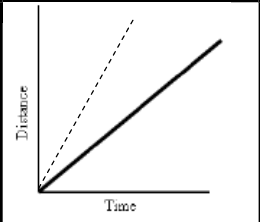
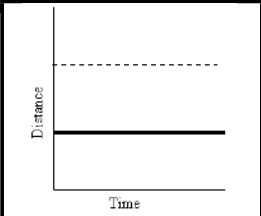
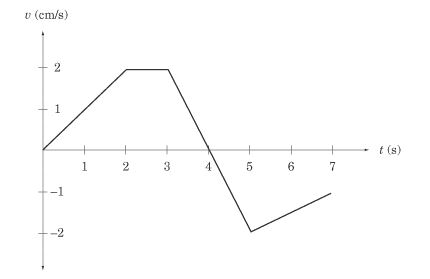
What is happening between 2 and 3 seconds?
The object is not moving.
The object is not accelerating.
The object is slowing down.
The object is speeding up.
What is happening between 4 and 5 seconds?
The object is not moving.
The object is not accelerating.
The object is slowing down in a negative direction.
The object is speeding up in a negative direction.



On this position vs time graph, what is the velocity?
40 m/s
8 m/s
5 m/s
0 m/s

On this position vs time graph, what is the velocity from 15 to 40 seconds?
-4 m/s
-10 m/s
-25 m/s
-100 m/s

What is the acceleration during interval A?
0 m/s/s
2 m/s/s
10 m/s/s
20 m/s/s
What is the acceleration during interval B?
0 m/s/s
2 m/s/s
10 m/s/s
20 m/s/s
What is the displacement from 0-10 seconds?
10 m
10 m
100 m
200 m
Imagine you are driving a car. Kinematic equations can only be used to calculate your car's motion when you have a constant ....
Position
Speed
Acceleration
Time
Imagine you are in a car race. Your car is at rest at the starting line. If your car accelerates uniformly in a straight line at 5 m/s2, how long would it take to cover a distance of 200 m?
9.0s
10.5s
12.0s
15.5s
The speed of an object undergoing constant acceleration increases from 8.0 m/s to 16.0 m/s in 4 s. What is the acceleration of the object?
8 m/s2
4 m/s2
2 m/s2
1 m/s2
A child pushes his toy car, giving it an initial velocity of 4 m/s. The car rolls down a slope, gaining a constant acceleration of 6 m/s2. What would be the car's velocity after 5 seconds?
24 m/s
10 m/s
34 m/s
6 m/s
Imagine you're driving a car at 20.0 m/s. Suddenly, you see a red light ahead and you start slowing down to a stop over 5 seconds. What is the acceleration of your car while it is coming to a stop?
4 m/s2
-4 m/s2
5 m/s2
-5m/s2
Imagine you're in a race. Your car starts from a standstill and accelerates uniformly to a speed of 18 m/s in 12 seconds. Can you calculate the distance your car travels during this time?
98 m
108 m
118 m
128 m
The slope of a position-time graph gives us
distance
velocity
acceleration
displacement
The slope of a velocity-time graph gives us
speed
distance
displacement
acceleration

The graph above describes the motion of a cyclist. During the interval shown, the cyclist is
slowing down
speeding up
constant
changing direction

According to the graph at what time is the cat at rest?
0.0s-5.0s
5.0s-10.0s
10.0s-15.0s
15.0s-20.0s
A dog named Max was chasing a squirrel with an initial speed of 7.5 m/s but stopped after 5 seconds. How far did Max run?
0 m
7.5 m
37.5 m
18.8 m
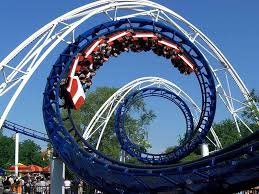
A roller coaster at an amusement park accelerates from an initial speed of 6.0 m/s to a final speed of 70 m/s in a span of 4 seconds. What is the acceleration of the roller coaster?
24 m/s2
18 m/s2
16 m/s2
16 m/s
Imagine you are in a race. Your car is at rest at the starting line. Suddenly, the race begins and your car starts accelerating uniformly in a straight line at 5 m/s2. How long would it take for your car to cover a distance of 200m?
9.0s
10.5s
12.0s
15.5s


Which one of the choices below is always "constant"?
hair length
time
your pant size after quarantine
your grade in Physics
A brand new car has an odometer reading of 10,000 meters after 45 minutes of driving. What was the average speed of the car?
2.9 m/s
4 m/s
15 m/s
222 m/s

Which time segment shows the object at rest?
10-15 seconds
30 seconds
15-40 seconds
55 seconds
When is the object moving with a negative velocity towards the origin?
15 - 40 seconds
15 - 30 seconds
40 5
55 seconds

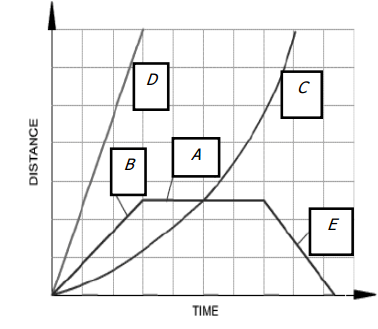
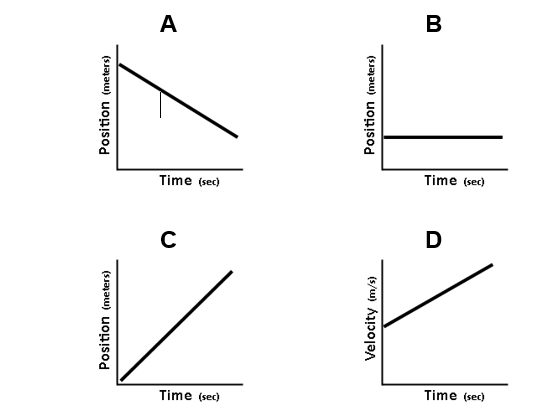
The graphs show 4 cyclists on an afternoon ride. Which cyclist stops for a water break during their ride?
A
B
C
D
Which cyclist is constantly moving away from their starting place?
A
B
C
D
Which cyclist(s) have a displacement of 0m?
A
B
C
D
Which cyclist(s) have traveled the farthest total distance?
A
B
C
D

