
 Worksheets
STPM Sem 3 Ch 15 Ecology
Total questions: 20
Worksheet time: 10mins

The graph to the right shows the interaction of the wolf and moose populations on Isle Pekie. If the moose population continues to increase, the wolves' food supply will increase. What will most likely happen to the wolf population as a result?
It will decrease.
It will increase.
It will remain the same.


What is the carrying capacity of the graph?
1000
8000
800
600
A scientist was studying a population of fish in a pond over a period of 10 years. He observed that the population increased each year for 3 years, and then remained nearly constant for the rest of the study. The best explanation for this observation is that the population had _____.
stopped reproducing
reached carrying capacity
mutated into a different species
run out of food and all died
Which 2 limiting factors would increase due to the number of individuals in a population (i.e. density-dependent)?
Unusual weather
Natural disaster
Rate of infection
Competition for resources


Something that regulates the size of a population is called...
a limiting measure
a limiting factor
carrying capacity
biodiversity
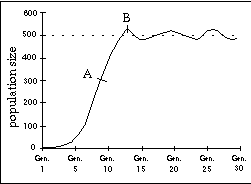
What is the carrying capacity of the graph?
around 500
more than 800
less than 300
around 700
What is interdependent relationship?
A condition that occurs when two or more organisms compete for the same resources within an ecological community
All the biotic and abiotic factors and the interactions among them in a given area
The maximum number of organisms an ecosystem can support
A relationship in which two organisms are mutually dependent on each other for survival
Which limiting factor would increase due to the number of individuals in a population (aka; density-dependent)?
Unusual weather
Natural disaster
Disease


The ability to reproduce under ideal conditions, enough space, food, water, lack of predators.
Primary Consumers
Pioneer Species
Biotic Potential
Abiotic Factors

The population limit in an ecosystem due to limited resources or predators.
Biodiversity
Biotic factors
Abiotic factors
Carrying capacity

