wayground logo

Free Printable Worksheets

NEW

Font size

S
M
L
XL
Worksheets

MUTATION

Total questions: 20

Worksheet time: 10mins

Name
Class
Date
1.
Any change in the sequence of DNA is...
a)
transgenic shift
b)
Single Genotype
c)
Monohybrid Trait
d)
Mutation
2.
Where do mutations occur?
a)
DNA and RNA
b)
DNA 
c)
RNA
d)
mRNA and tRNA
3.

What type of mutation is shown in the diagram?

a)

Point mutation - missense

b)

Frameshift Mutation - deletion

c)

Frameshift Mutation - addition

d)

Point mutation - nonsense

4.

A type of mutation that affect every codon beyond the point of mutation.

a)

Point Mutation

b)

Silent Mutation

c)

Nonsense Mutation

d)

Frameshift Mutation

5.

What type of mutation is this?

a)

Nonsense mutation

b)

Missense mutation

c)

Silent mutation

d)

Frameshift mutation

6.

DOES THE DNA MUTATION ALWAYS ALTER THE AMINO ACID SEQUENCE?

a)

Yes

b)

No

7.
Which shows a mutated segment of DNA? 
ATTCGC
a)
UAAGCG
b)
TAAGCG
c)
TAGGCG
8.
Mutations affect the ________ of a protein. Because of this the proteins ______ is affected as well. 
a)
gene, function 
b)
sequence, gene
c)
shape,function
9.
if a single nucleotide base is added or deleted the entire reading frame will?
a)
shift, causing a frameshift mutation
b)
move, causing a delection
c)
move, causing an addition
d)
shift, causing a deletion
10.
What situation causes a deletion?
a)
Part of the chromosome is missing
b)
Part of the chromosome is attached backwards
c)
Part of the chromosome breaks off and attaches to a different chromosome
d)
Part of a chromosome is duplicated 
11.
Why are insertion and deletion mutations so harmful?
a)
They change all of the codons from the mutation on down the line, which changes the amino acid sequence
b)
They insert things that an organism doesn't need.
c)
They often delete things that organisms need.
d)
Insertion and deletions are not any more harmful than substitution mutations.
12.

Point mutation involves

a)

deletion

b)

insertion

c)

duplication

d)

changes in single base pair

13.

Which of the following genetic disorders is caused by chromosomal deletion?

a)

Down syndrome (Trisomy 21)

b)

Turner syndrome (Monosomy X)

c)

Cri-du-chat syndrome

d)

Chronic Myelogenous Leukemia (CML)

14.

The failure of one or more pairs of homologous chromosomes or sister chromatids to separate "normally" during meiosis is called _____________________.

a)

nondisjunction

b)

duplication

c)

deletion

d)

translocation

15.

Non-disjunction involving the X chromosomes occurs during oogenesis and produces two kinds of eggs, XX and O (no X chromosomes). If normal sperms fertilize the two types of eggs, which are the possible genotypes produced?

a)

XX AND XY

b)

XYY AND XO

c)

XXY AND XO

d)

YY AND XO

16.
Notice the abnormal 23rd chromosome.  This individual suffers from which chromosomal genetic disorder?
a)
Klienfelter's Syndrome
b)
Down Syndrome
c)
Cris-du-Chat Syndrome
d)
Andrew's Syndrome
17.
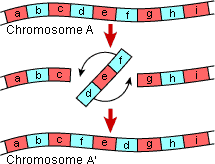
What type of chromosomal mutation is this?
a)
Translocation
b)
Inversion
c)
Deletion
d)
Duplication
18.
DNA molecule segment is : TTACGCAAG
The mutated DNA segment is TTACGCAAC. This is an example of ___ mutation.
a)
Base Substitution
b)
Base Insertion
c)
Base Inversion
d)
Translocation
19.

A mutation that does NOT alter the protein production is called a

a)

silent mutation

b)

nonsense mutation

c)

missense mutation

d)

inversion mutation

20.

Which ONE is NOT a type of gene mutation?

a)

Base substitution

b)

Base duplication

c)

Base deletion

d)

Base inversion