
 Worksheets
G L A U C O M A - WUP
Total questions: 20
Worksheet time: 30mins
Which statement is correct about glaucoma?
The vision loss that occurs with glaucoma is reversible with medications
Normal IOP is about 11-21 mm Hg and is elevated in most patients with glaucoma
Glaucoma occurs due to decreased IOP, which damages the optic nerve
Surgical treatment can effectively cure glaucoma
Which of these is NOT a likely cause of painful red eye in a patient?
Open Angle Glaucoma
Conjunctivitis
Corneal Laceration
Closed Angle Glaucoma
You are asked by a patient on the differences between open angle and closed angle glaucoma.
They ask what type of examination can be performed to assess the anterior chamber of the eye.
Your response is?
Ophthalmoscopy
Retinoscopy
Gonioscopy
Tonometry
The following risk factors that should prompt you to refer a patient for glaucoma screening, EXCEPT:
Systemic diseases
Elevated IOP
Family history of glaucoma
Younger age
Function of the aqueous humor, EXCEPT:
Elevates IOP
Provides optical transparency to the eye
Source of nutrition to the cornea and lens
Maintains the shape of the eye
All of the following are examples of contact tonometers, EXCEPT:
Schiotz Tonometer
Tonopen
Air puff tonometer
Goldmann Applanation Tonometer
Timolol is a/an:
Alpha Adrenergic Agonist
Carbonic Anhydrase Inhibitor
Beta Blocker
Calcium Channel Blocker
Aqueous fluid is produced in which chamber?
Posterior chamber
Anterior chamber
Aqueous chamber
Trabecular chamber
A patient presents with red eye, decreased visual acuity, raised IOP and shallow anterior chamber.
The most likely diagnosis is?
Mature Cataract
Retinal Detachment
Open Angle Glaucoma
Acute Angle Closure Glaucoma
Which medication is an example of an Alpha Adrenergic Agonist?
Brinzolamide
Betaxolol
Brimonidine
Dorzolamide
The 4 structures that should be visible in open angle glaucoma on examination include the following, EXCEPT:
Pigmented Spur
Trabecular Meshwork
Ciliary Body
Schwalbe's Line
Which statement on Peripheral Laser Iridotomy is correct?
Decrease the production of aqueous humor
Increase the outflow of aqueous humor through the ciliary body
Provides a pathway in open angle glaucoma
Relieves the obstruction in the outflow tract
All of the following are associated with Open Angle Glaucoma, EXCEPT:
Enlarged blind spot
Loss of central visual field
Nasal step
Bjerrum scotoma
Early glaucomatous changes in the Optic Nerve Head include the following, EXCEPT:
Atrophy of retinal nerve fiber layer
Large cup of 0.6 or more
Asymmetry of >0.1 between 2 eyes
A large, vertically oval cup
Which of the following statements is correct regarding Visual Field limits?
Nasal 60 degrees, Inferior 70 degrees, Temporal 100 degrees, Superior 60 degrees
Nasal 60 degrees, Inferior 60 degrees, Temporal 100 degrees, Superior 70 degrees
Nasal 70 degrees, Inferior 60 degrees, Temporal 100 degrees, Superior 60 degrees
Nasal 70 degrees, Inferior 70 degrees, Temporal 100 degrees, Superior 60 degrees
All of the following are associated with Acute Angle Closure Glaucoma, EXCEPT:
Sudden painless blurring of vision
Elevated IOP
Haloes around lights
Mid-dilated, non-reactive pupil
Essential feature of Glaucoma is:
Red, painful eye
Reduced or poor vision
Elevated IOP
Optic nerve damage
Which statement is correct regarding the ISNT Rule?
The neuroretinal rim is thinnest to thickest in the order of ISNT
The neuroretinal rim is thickest to thinnest in the order of ISNT
Deviations from the ISNT rule should not make you suspect a patient has glaucoma
Horizontal cup to disc ratio is more important than vertical cup to disc ratio
On examination, these signs raise suspicion for glaucomatous optic nerve damage, EXCEPT:
Thin neuroretinal rim in one or two sectors of the optic nerve
Notching of the rim
Symmetrical cup to disc ratio on both eyes
Hemorrhage on the neuroretinal rim
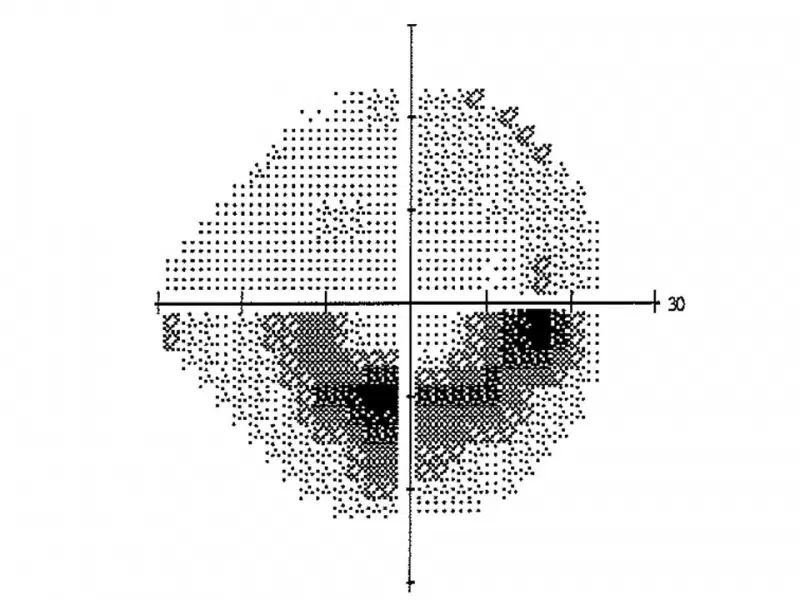
What is the Visual Field defect shown?
Nasal step
Temporal wedge scotoma
Superior arcuate scotoma
Inferior arcuate scotoma

