wayground logo

Free Printable Worksheets

NEW

Font size

S
M
L
XL
Worksheets

Jellyfish Quiz

Total questions: 55

Worksheet time: 39mins

Name
Class
Date
1.

What is the phylum to which jellyfish belong?

a)

Fungi

b)

Animalia

c)

Plantae

d)

Nideria

2.

What is the shape of a jellyfish's body?

a)

Cylinder

b)

Cube

c)

Umbrella

d)

Sphere

3.

What is the function of a jellyfish's nematocysts?

a)

Sensation and movement

b)

Reproduction and growth

c)

Digestion and circulation

d)

Offense, defense, and attachment

4.

Which type of body form is found in jellyfish?

a)

Medusa

b)

Polyp

c)

Gametophyte

d)

Sporophyte

5.

What is the purpose of the gastrovascular cavity in jellyfish?

a)

Digestion and circulation

b)

Respiration and excretion

c)

Reproduction and growth

d)

Sensation and movement

6.

What is the name of the cell in jellyfish that contains the sting?

a)

Medusocyte

b)

Polypocyte

c)

Nematocyst

d)

Gastrocyte

7.

Which type of reproduction occurs when a jellyfish buds off to form a new individual?

a)

Budding

b)

Binary fission

c)

Sexual reproduction

d)

Asexual reproduction

8.

What is the purpose of the skeleton in corals?

a)

Enable sensation and movement

b)

Facilitate reproduction and growth

c)

Assist in digestion and circulation

d)

Provide support and protection

9.

What is the name of the larval stage in jellyfish?

a)

Planula

b)

Pupa

c)

Nymph

d)

Caterpillar

10.

What is the process called when a jellyfish changes from the polyp form to the medusa form?

a)

Meiosis

b)

Metagenesis

c)

Metamorphosis

d)

Mitosis

11.

What is the primary diet of most jellyfish?

a)

Plankton

b)

Small fish

c)

Seaweed

d)

Other jellyfish

12.

What is the term for a group of jellyfish?

a)

A school

b)

A swarm

c)

A bloom

d)

A pod

13.

What is the function of the oral arms in a jellyfish?

a)

Locomotion

b)

Defense

c)

Catching and transporting food

d)

Reproduction

14.
The hard "skeleton" structures in a sponge are called...
a)
Spongin
b)
Spicules
c)
Amebocytes
d)
Pinococytes
15.
What kind of symmetry does a Cnidarian have?  
a)
No Symmetry 
b)
Bilateral Symmetry 
c)
Radial Symmetry 
d)
Square
16.
What type of symmetry do sponges (Porifera) have?
a)
asymmetrical
b)
radial
c)
bilateral 
d)
both radial and asymmetrical
17.
What phylum has two different forms that exist which are called the medusa and the polyp?
a)
Phylum Porifera
b)
Phylum Cnidaria
c)
Phylum Platyhelminthes
d)
Kingdom Animalia
18.
Which of the following is a correct description of the Cnidarian digestive tract?
a)
A complete digestive tract consisting of two openings.
b)
A complete digestive tract consisting of one opening
c)
An incomplete digestive tract consisting of two openings.
d)
contains only a mouth and an internal cavity.
19.
Which part of the sponge body is a large opening at the top of the central cavity through which water leaves the sponge?
a)
Ostia
b)
Meenchyme
c)
Spongecoel
d)
Osculum
20.
What kind of feeders are Cnidarians?
a)
autotrophic
b)
mostly carnivorous with some filter feeders
c)
omivores
d)
only filter feeders
21.
What phylum of invertebrates does the following picture belong?
a)
Platyhelminthes
b)
Cnidaria
c)
Porifera
d)
Mollusca
22.
What type of sponge does the following diagram belong?
a)
Leuconoid sponge
b)
Syconoid sponge
c)
Asconoid sponge
d)
Sponge Bob type
23.
What phylum of invertebrates does the following picture belong?
a)
Cnidaria
b)
Porifera
c)
Platyhelminthes
d)
Animalia
24.
What group of Cnidarian does the following image belong?
a)
jellyfish
b)
coral
c)
sea anemone
d)
hydrozoan
25.
The structure of a sponge that attaches to the rocks and other substrate is called a/an ________________________?
a)
holdfast
b)
false foot
c)
root
d)
spicule
26.
Tentacles contain cnidoblasts that hold/secrete coiled thread with an attached barb called a ...
a)
nematocyst
b)
spicule
c)
ectoderm
d)
spirocyst
27.
The image represents a nematocysts which Cnidarians use to subdue their prey.  What is the name of the specialized cell that secretes the nematocyst?
a)
cnidocyst
b)
barb capsule
c)
gastroblast
d)
nematocyst
28.
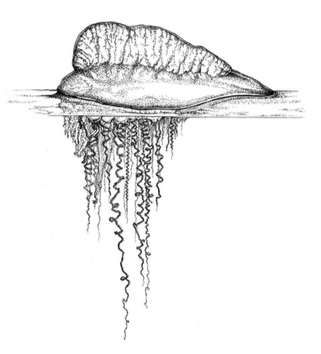
What phylum does this animal belong in the image?
a)
Platyhelminthes
b)
Cnidaria
c)
Porifera
d)
Plantae
29.
Instead of a brain or central nervous system, jelly fish have what in place to help them respond to the environment.
a)
Stinging Cells
b)
Nerve Net
c)
Nematocysts
d)
Chloroplast
30.
Jellyfish can reproduce
a)
sexually only
b)
asexually only 
c)
both sexually and asexually
d)
neither sexually or asexually
31.
What do organisms from the phylum Porifera eat?
a)
small marine fish
b)
plankton,bacteria, and detritus
c)
choanocytes
d)
krabby patties
32.
About how many species of Cnidaria are divided between 3 different classes?
a)
2,500
b)
1,000
c)
25,000
d)
10,000
33.
The phyla Porifera and Cnidaria all have what method of respiration in order to obtain oxygen?
a)
diffusion through a membrane/body wall
b)
gas exchange through a lung type organelle
c)
gas exchange through a specialized organ
d)
diffusion through the blood of a host
34.
What kingdom do invertebrates such as the Porifera and Cnidaria belong?
a)
Plantae
b)
Animalia
c)
Fungi
d)
Porifera
35.
Sponges can reproduce asexually through a process called __________________.
a)
budding
b)
regeneration only
c)
fusion
d)
amphiblastula
36.
A flexible, fibrous material that can make up the skeleton of a sponge?
a)
spicule
b)
spongin
c)
grass sponge
d)
spongocoel
37.
What are some predators to the sponge population?
a)
sea turtle
b)
fish
c)
sea slug/nudibranch
d)
all of the above
38.

What type of symmetry do sponges (Porifera) have?

a)

asymmetrical

b)

radial

c)

bilateral

d)

medial

39.

What is the outer most layer of Porifera?

a)

epidermis

b)

gastrodermis

c)

mesoglea

d)

spongin

40.

The level of organization cnidarians have is...

a)

specialized cells

b)

tissues

c)

organs

d)

organ systems

41.

What type of symmetry do cnidarians have?

a)

asymmetrical

b)

radial

c)

bilateral

d)

medial

42.

The hard "skeleton" structures in a sponge are called...

a)

Spongin

b)

Amoebocytes

c)

Spicules

d)

Nematocysts

43.

Which of the following is a correct description of the Cnidarian digestive tract?

a)

A complete digestive tract consisting of two openings.

b)

A complete digestive tract consisting of one opening.

c)

An incomplete digestive tract consisting of two openings.

d)

An incomplete digestive tract consisting of one opening.

44.

What phylum has two different forms that exist which are called the medusa and the polyp?

a)

Phylum Porifera

b)

Phylum Cnidaria

45.

Which of the following is a correct description of the polyp body form?

a)

It is sessile and the tentacles and mouth point downward.

b)

It is sessile and the mouth and tentacles point upward.

c)

It is mobile and the tentacles and mouth point downward.

d)

It is mobile and the tentacles and mouth point upward.

46.

What are the organelles inside the stinging cells that inject paralyzing toxins into their prey?

a)

pinacocytes

b)

lysomatocyts

c)

choanocytes

d)

nematocysts

47.

Cnidarians can reproduce...

a)

sexually only

b)

asexually only

c)

both sexually and asexually

d)

neither sexually or asexually

48.

What kingdom do invertebrates such as the Porifera and Cnidaria belong?

a)

Plantae

b)

Porifera

c)

Animalia

d)

Fungi

49.

Porifera and Cnidaria can reproduce asexually through a process called...

a)

replication

b)

amphiblastula

c)

fusion

d)

budding

50.

Which part of the sponge body is a large opening at the top of the central cavity through which water leaves the sponge?

a)

meenchyme

b)

Spongecoel

c)

Osculum

d)

Ostia

51.

What part of the sponge body is the openings along the sponge's body that allow in water?

a)

osculum

b)

spongecoel

c)

mesenchyme

d)

pores

52.

Members of the what phylum include sea anemones and coral?

a)

Animalia

b)

Cnidaria

c)

Porifera

d)

Plantae

53.

What creates the flow of water in a sponge?

a)

pores

b)

osculum

c)

collar cells

d)

amoebocytes

54.

Sponges can reproduce asexually by budding and creating...

a)

spicules

b)

larvae

c)

amoebocytes

d)

gemmules

55.

Which live on land?

a)

porifera

b)

cnidaria

c)

both

d)

neither