wayground logo

Free Printable Worksheets

Font size

S
M
L
XL
Worksheets

Unit Review

Total questions: 38

Worksheet time: 57mins

Name
Class
Date
1.

What type of bond do a cation (+) and anion (-) form?

a)

Metallic Bond

b)

Ionic Bond

c)

Covalent Bond

2.

Elements in Group IIA form

a)

+2 ions

b)

-2 ions

c)

+3 ions

d)

-1 ions

3.

Compounds containing transition metals (aka "Funny Metals") always require what in their name?

a)

Subscripts

b)

Parenthesis

c)

Roman Numerals

d)

Polyatomic Ions

4.

What does the Roman Numeral represent?

a)

The number of cations

b)

The charge of the cation

c)

The number of anions

d)

The charge of the anion

5.

What is the name of MgCl2?

a)

Magnesium Chlorate

b)

Magnesium Chloride

c)

Magnesium Chlorine

d)

Magnesium Chlorite

6.

When does a Polyatomic Ion need parenthesis?

a)

When the subscript of the polyatomic ion changes

b)

When there is more than one set of the polyatomic ion present

c)

When there is only one polyatomic ion present

d)

All the time

7.

What is the formula when Mg and N combine?

a)

Mg2N3

b)

Mg3N2

c)

N2Mg3

d)

N3Mg2

8.

What is the name of K2O?

a)

Potassium oxygen

b)

Potassium dioxide

c)

Potassium oxide

d)

Potassium (I) oxide

9.

Which of the following is/are an ionic compound? (Select all that apply)

a)

CaCl2

b)

CO2

c)

H2O

d)

KCl

10.
According to the octet rule, all atoms want to have _____ electrons in their outer shell?
a)
1
b)
2
c)
6
d)
8
11.
Covalent bonds are formed through the ____ of valence electrons
a)
Transfer
b)
Sharing
c)
Donation
d)
Removal
12.
What is the name of the covalent molecule BF3
a)
Bromide Trifluoride
b)
Bromine Trifluoride
c)
Monobromine Trifluoride
d)
Bromine Tetrafluoride
13.
What is the name of the covalent molecule C4H10?
a)
Tetracarbon Decahydroxide
b)
Tetracarbon Decahydride
c)
Carbon Hydroxide
d)
Tetracarbon Decahydrogen
14.
What is the formula of Tricarbon Octafluoride?
a)
C3F8
b)
CF
c)
F3C8
d)
3C8F
15.
How many bonds does Carbon ALWAYS make?
a)
4
b)
1
c)
8
d)
3
16.
How many bonds does Fluorine ALWAYS make?
a)
1
b)
7
c)
3
d)
8
17.
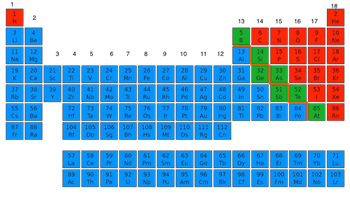
Where are the nonmetals located on the periodic table? 
a)
Blue
b)
Red
c)
Green
18.

Typically, atoms are more stable when they are

a)

bonded together

b)

apart from each other

19.

P4 + 3 O2 ----> 2 P2O3

a)

Synthesis (or combination)

b)

Decomposition

c)

Single replacement

d)

Double replacement

20.

MgCl2 + Li2CO3 ----> MgCO3 + 2 LiCl

a)

Synthesis (or combination)

b)

Decomposition

c)

Single replacement

d)

Double replacement

21.

CaCO3 ----> CaO + CO2

a)

Synthesis (or combination)

b)

Decomposition

c)

Single replacement

d)

Double replacement

22.

Pb + FeSO4 ----> PbSO4 + Fe

a)

Synthesis (or combination)

b)

Decomposition

c)

Single replacement

d)

Double replacement

23.

1 Li3N + 3 NH4NO3 ----> 3 LiNO3 + 1 (NH4)3N

a)

Synthesis (or combination)

b)

Decomposition

c)

Single replacement

d)

Double replacement

24.

2 NH3+ 1 H2SO4 ----> 1 (NH4)2SO4

a)

Synthesis (or combination)

b)

Decomposition

c)

Single replacement

d)

Double replacement

25.

2 NaBr + 1 Ca(OH)2 ----> 1 CaBr2 + 2 NaOH

a)

Synthesis (or combination)

b)

Decomposition

c)

Single replacement

d)

Double replacement

26.

3 Pb + 2 H3PO4 ----> 3 H2 + 1 Pb3(PO4)2

a)

Synthesis (or combination)

b)

Decomposition

c)

Single replacement

d)

Double replacement

27.

Pb(NO3)2 --> PbO + NO2 + O2

a)

Synthesis (combination)

b)

Decomposition

c)

Single replacement

d)

Double replacement

28.
Si + S8 --> Si2S4
a)
Synthesis (combination)
b)
Decomposition
c)
Single replacement
d)
Double replacement
29.
__Na + __Cl2 --> __NaCl
a)
1,1,2
b)
2,1,2
c)
2,1,1
d)
already balanced
30.
__NaClO--> __NaCl + __O2
a)
2,2,2
b)
2,2,3
c)
3,2,2
d)
1,2,3
31.
Balancing this reaction: ____ CH4 + ____ O2 ---> ____ CO2 + ____ H2O
a)
2,1,3,1
b)
1,2,1,2
c)
1,2,2,1
d)
2,1,1,2
32.
Balance this reaction: ____ NaF + ____ Br2 ---> ____ NaBr + ____ F2
a)
3,1,2,1
b)
1,2,3,4
c)
2,1,2,1
d)
1,2,1,2
33.
Balance this reaction: ____ BaS + ____ PtF2 ---> ____ BaF2 + ____ PtS
a)
1,1,1,1
b)
1,2,1,1
c)
1,1,1,2
d)
2,1,1,1
34.
What do the coefficients need to be in the following equation in order to be balanced?
_Mg + _Cl→ _MgCl2
a)
1, 2,1
b)
already balanced
c)
2,1,1
d)
1,1,2
35.
Balance this equation:
Al2O3 -> Al + O2 
a)
2Al2O3 -> 2Al + 3O2 
b)
2Al2O3 -> 4Al + 3O2 
c)
3Al2O3 -> 2Al + O2 
d)
2Al2O3 -> 3Al + 2O2 
36.
Balance this equation
_Zn+_HCl-->_ZnCl+_H2
a)
1,1,2,1
b)
1,1,1,2
c)
1,2,1,1
d)
2,1,1,1
37.
Balance this equation
_N+ _H--> _NH3
a)
1,2,3
b)
1,3,2
c)
1,1,2
d)
2,1,1
38.
Balance this equation:
MgCl2 --> Mg4+ Cl2
a)
It's already balanced.
b)
4MgCl2 --> Mg4+ 4Cl2
c)
4MgCl2 --> Mg4+ 5Cl2