
 Worksheets
APES 4.1-4.3
Total questions: 40
Worksheet time: 27mins
forms rift valleys and sea-floor spreading.
convergent boundary
divergent boundary
transform boundary
rift valley
two tectonic plates slide past one another; causes earthquakes.
convergent boundary
divergent boundary
tranform boundary
mountain range
oceanic plate collides with a continental plate and slides beneath it; the older, denser crust slides under the younger, less-dense crust.
convergent boundary
divergent boundary
transform boundary
subduction
tectonic plates split apart due to mantle convection; forms mountain ridges on the seafloor.
subduction
trench
sea floor spreading
earthquake
molten rock (magma) in the mantle as it heats up, rises, cools down and sinks
convection
conduction
radiation
volcanoes
Mountains on the ocean floor created by Sea Floor Spreading
Sea Floor spreading
Subduction
Volcanoes
Mid-ocean ridges

The rate at which water flows through the soil is called soil percolation or ______.
Groundwater
Permeability
Soil Pores
Porosity

The type of plate boundary where two plates come together is a .....
Convergent Boundary
Divergent Boundary
Transform Boundary
Plate Boundary

What type of event will occur at this boundary?
Earthquake
Volcano Eruption
Tornado
Mountain Building
The rate at which water flows through the soil is called soil percolation or ______.
Groundwater
Permeability
Soil Pores
Porosity

What are the proportions of sand, silt, and clay for the soil at point X ?
5% Sand, 90% Silt, 5% Clay
5% Sand, 20% Silt, 5% Clay
65% Sand, 30% Silt, 10% Clay
60% Sand, 30% Silt, 10% Clay
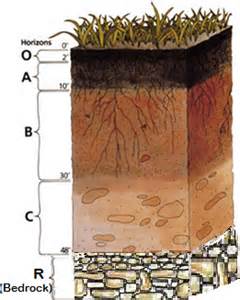
The layer(s) of soil in which most of the humus and soil organisms are contained:
1- leaf litter, horizon O
2- topsoil, horizon A
3- subsoil, horizons B and C
1 only
2 only
1 and 2 only
2 and 3 only
1, 2, and 3
Porosity is a measure of void space in a soil sample. Larger soil particles have larger void spaces. Smaller soil particles have smaller pore spaces, but a greater number of them, which leads to higher surface tension and higher % porosity. With this is mind, which statement is true:
Sandy soil has a higher porosity than clay soil
Sandy soil has a higher porosity than silty soil
Clay soil has a higher porosity than sandy soil
Porosity is directly proportional to soil particle size
What is porosity
Rocks
The percent of the volume of open spaces in rock or sediment
Ability rock sediment fluids pass through open spaces/pores
Nothing
What are properties of the soil determined by
time
parent material
climate
topography
ALL of these determine the properties of the soil
How does compacting soil from anthropogenic means impede water drainage?
Drying at deeper layers of soil
Waterlogging-water not draining
preventing soil development
Each of these is an affect of compacted soil
Which of the following has the greatest permeability?
gravel
sand
clay
silt

Why might very old soil be nutrient poor in the picture above?
more organic material is present
plants and water leaching nutrients
less biodiversity
soil is compacted
What horizon is decomposed organic material and is most pronounced in forests
O horizon
A horizon
E horizon
D horizon
Which horizon is considered the topsoil, is the organic mixed with mineral material, and has the most biological activity?
O Horizon
A horizon
E horizon
B horizon
This soil layer is found in some acidic soils and it is where metals such as iron, aluminum, and other nutrients are leached from above.
O horizon
A horizon
E horizon
B horizon
The layer of soil that is partially/slightly weathered and similar to the parent material.
O horizon
A horizon
B horizon
C horizon
What type of Biome has a Thick O-layer (leaf litter, etc.)
Bleached E-layer. One of the only biomes to have an E layer
Deciduous and Coniferous Forests
Desert
Rainforest
Grassland
Which of the following is NOT a soil service?
plant growth
cycling of nutrients
physical weathering
water storage and filtration

