Wayground logo

Free Printable Worksheets

Font size

S
M
L
XL
Worksheets

Review for TBA 4

Total questions: 46

Worksheet time: 1hrs 1mins

Name
Class
Date
1.

In the graph, which runner is the fastest?

a)

Red

b)

Blue

2.

What happens to the runner at 1-3 seconds?

a)

The runner slowed down

b)

The runner stopped

c)

The runner sped up

3.

What does the runner do between 3-4 seconds?

a)

The runner sped up

b)

The runner slowed down

c)

The runner went back towards the start line

4.
What is the equation to calculate speed?
a)
speed = distance/time
b)
speed = time/distance
c)
speed = time x distance 
d)
speed = speed/time 
5.
What is the speed of a man who runs 10 miles in 1 hr?
a)
20 miles
b)
10 m/min
c)
10 miles/hr
d)
20 hrs
6.

A runner races in the 100-meter dash. It takes her 10 seconds to finish. What is her average speed?

a)

10 m/s

b)

1000 m/s

c)

100 seconds

d)

10 seconds

7.
What is the speed of an object that travels 60 meters in 4 seconds?
a)
240 m/s
b)
15 m/s
c)
0.067 m/s
d)
15 mph
8.

A runner races in the 100 meter dash. It takes her 10 seconds to finish. What is her average speed?

a)

10 m/s

b)

1000 m/s

c)

100 seconds

d)

10 seconds

9.
Bill jogs 400 meters to Andy's house, turns around, and runs 400 meters back home.  He does so in 267 seconds.  What is Bill's average speed?
a)
about 3 m/s
b)
about 1.5 m/s
c)
0
d)
about 4 m/s
10.
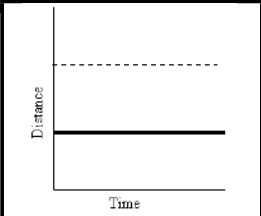
What does this graph represent?
a)
Constant speed
b)
Acceleration
c)
Not moving
11.
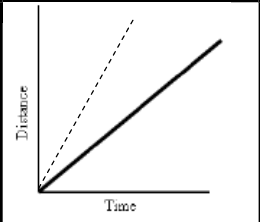
What does this graph represent?
a)
Constant Speed
b)
Acceleration
c)
Not moving
12.

Which runner won the race?

a)

Albert

b)

Bob

c)

Charlie

13.
This is a rocket.The rocket pushes the fuel down.What is the other force in this interaction pair?
a)
The fuel pulls the rocket up.
b)
The fuel pushes the rocket up.
c)
The rocket pulls the earth up.
d)
The earth pulls the rocket down.
14.
If these boys are pulling with the same amount of force.  What will happen?
a)
The boy in blue will win.
b)
They will not move at all.
c)
The boy in red will win.
d)
Both will fall down.
15.
How could you make an object increase its speed?
a)
use less force
b)
use more force
c)
use no force
16.
What will cause an object to move?
a)
Applied forces
b)
Balanced forces
c)
Unbalanced forces
17.
A ____________ is a push or a pull on an object.
a)
friction
b)
force
c)
magnet
d)
gravity
18.
What are balanced forces?
a)
Forces in the same direction
b)
Forces of the same size
c)
forces of the same size in opposite directions
19.
What is happening in this graph from point B to C?
a)
The object is going down a hill.
b)
The object is returning to its starting location.
c)
The object is slowing down.
d)
The object is staying still.
20.
How long did it take this object to travel 10 m?
a)
0 s
b)
10 s
c)
15 s
d)
20 s
21.
At 60 seconds, how far had this object traveled? 
a)
0 m
b)
10 m
c)
20 m
d)
40 m
22.
An inclined plane reduces the amount of force needed to move an object by - 
a)
increasing the distance the object moves.
b)
transferring more of the force to the object
c)
reversing the direction the object is moved.
23.
Soccer ball A goes 15 feet in 3 seconds, and Ball B goes 12 feet in 2 seconds. Which ball moved the fastest?
a)
Soccer Ball A
b)
Soccer Ball B
c)
Their speeds are equal.
24.
A dog can run 50 km in 5 days and a cat can run 15 km in 3 days. What is the difference in the two speeds? (Hint: You need to subtract!)
a)
10 km/day
b)
5 km/day
c)
15 km/day
d)
50 km/day
25.
What is the equation to calculate speed?
a)
speed = distance/time
b)
speed = time/distance
c)
speed = time x distance 
d)
speed = speed/time 
26.
If an object travels 42 meters in 6 seconds, what is its average speed?
a)
6 m/s
b)
7 m/s
c)
48 m/s
d)
252 m/s
27.
A unusually fast zombie was chasing after Carl to eat him. What was the zombie’s speed at 6 seconds if he traveled 36 meters?
a)
6 meters/seconds
b)
6 seconds/meters
c)
.17 meters/second
d)
None of the above
28.
Marni runs 1500 meters around the  school  track.  What does she need to know in order to  find out her speed? 
a)
her time from  start  to  finish 
b)
the  number of steps  she  took 
c)
her  heart rate  at  the finish line 
d)
the direction  she began  running 
29.
Marlon decided to visit Dallas, which is 210 miles away from Houston. His trip took him 3 hours to complete. Calculate his average speed. 
a)
60 mph
b)
64 mph
c)
70 mph
d)
3 mph
30.
A ladybug moves from 2 cm to 7 cm in 25 seconds. What is the speed of the ladybug? (Hint: To find the total distance, you have to subtract!)
a)
5 cm/second
b)
0.2 cm/second
c)
12 cm/second
d)
3.57 cm/second
31.
What is the average speed of the ball if it falls 20 meters 40 seconds?
a)
A.  20 m/s
b)
B.  10 m/s
c)
C.  0.5 m/s
d)
D.  2 m/s 
32.
What is this graph representing?
a)
Constant Speed
b)
Acceleration (speeding up)
c)
Deceleration (slowing down)
d)
No motion
33.
What is happening in this graph from point B to C?
a)
The object is going down a hill.
b)
The object is returning to its starting location.
c)
The object is slowing down.
d)
The object is staying still.
34.

Energy is found in many different forms, but it can be classified into two distinct categories: kinetic energy and ________________ energy.

a)

electrical

b)

potential

c)

radiant

d)

thermal

35.

Potential energy is also known as _____ energy.

a)

Mechanical

b)

Electrical

c)

Thermal

d)

Stored

36.

Energy of motion is ____________.

a)

potential energy

b)

kinetic energy

c)

friction

d)

mass

37.
At which point is potential energy greatest?
a)
W
b)
X
c)
Y
d)
Z
38.

A kid sitting at the top of a slide has more _______ energy than at the bottom.

a)

Potential Energy

b)

Kinetic Energy

39.
At which point is kinetic energy greatest? 
a)
W
b)
X
c)
Y
d)
Z
40.
When riding a roller coaster, you go up and down many hills. As you get to the top of a roller coaster, what energy change is taking place.
a)
Potential energy is changed into kinetic energy.
b)
Kinetic energy is changed into potential energy.
c)
Chemical energy is changed into heat energy.
d)
Heat energy is changed into chemical energy. 
41.
When riding a roller coaster, you go up and down many hills. When do you have the maximum (most) kinetic energy?
a)
At the top of each hill.
b)
As you go down each hill.
c)
At the bottom of each hill.
d)
As you go up each hill.
42.

Where is kinetic energy at its minimum?

a)

Z

b)

W

c)

X

d)

Y

43.

Where is potential energy at its minimum?

a)

W

b)

X

c)

Y

d)

Z

44.
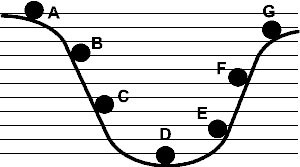
Which point has the most potential energy?
a)
G
b)
f
c)
b
d)
a
45.

Which cart has a little less kinetic energy than cart C?

a)

A

b)

B

c)

C

d)

D

46.

Which point has the least kinetic energy

a)

A

b)

B

c)

C

d)

D