
 Worksheets
Beaks of Finches State Lab
Total questions: 72
Worksheet time: 24mins
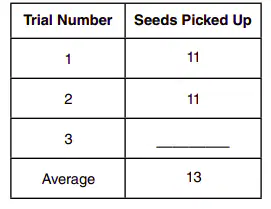
A student completed two trials of the Beaks of Finches lab, each time picking up eleven seeds, as shown in this picture. If the student needs to collect an average of thirteen seeds to survive, how many seeds must he pick up in round 3? Record your answer in the space provided in the table below.
10
12
17
13

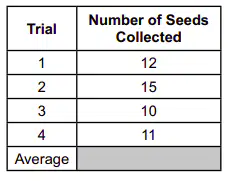
A student using a clothespin “beak” during the Beaks of Finches lab obtained the results shown in this picture. Over the course of the four trials, an average of at least 13 seeds must be “eaten” in order to go to the next round. Will the student go on? Support your answer
The student will go on because the average is 13.
The average is 15 and the student will go on.
The student will not go on because the average = 12.
Individuals can not evolve.

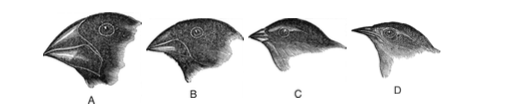
The four different types of beaks shown are most likely the result of
biology.
Several of the Galapagos Islands are inhabited by grasshoppers, beetles, flies, bees, and butterflies. Finches that feed on these consumers would have beaks adapted for
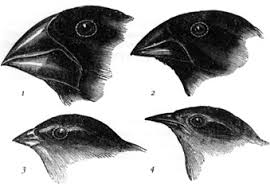
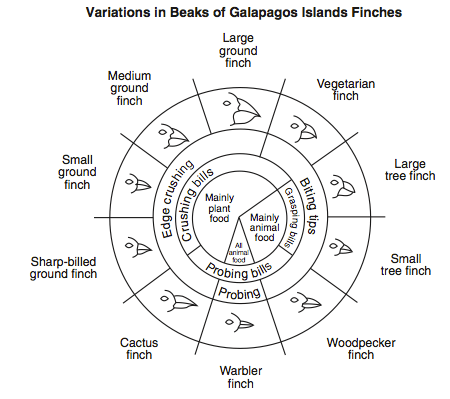
Which two finches would compete the least for food?
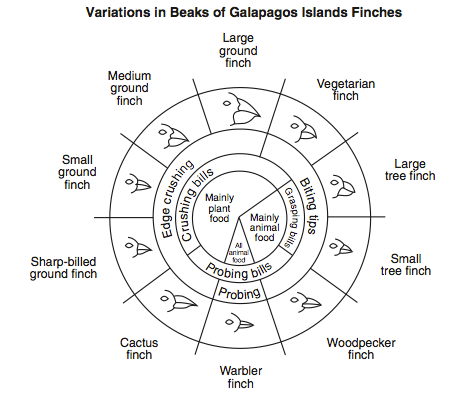
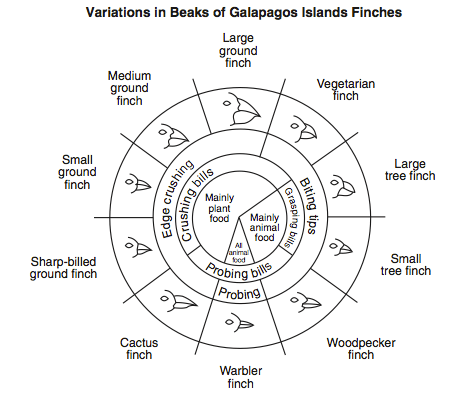
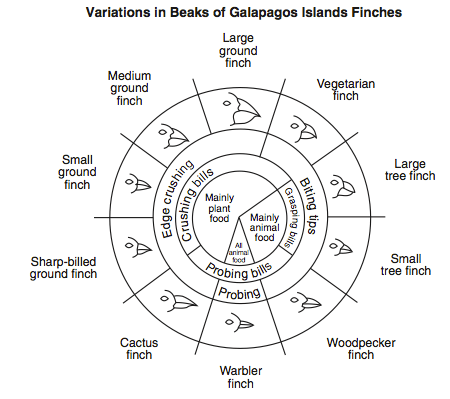
Which factor most directly influenced the evolution of the diverse types of beaks of these finches?

Red onion cells undergo the change represented in the diagram below. This change is most likely caused by the cell being transferred from
distilled water to starch indicator
distilled water to salt water
salt water to tap water
salt water to distilled water

Cell membranes are said to be selectively permeable. Which statement best explains what selectively permeable means?
The cell membrane prevents any harmful substance from entering the cell.
The cell membrane lets certain substances enter the cell and keeps certain substances out of the cell.
The cell membrane allows only large molecules to diffuse into the cell.
The cell membrane has pores that let only water and glucose into the cell and carbon dioxide out.

Diffusion is the movement of molecules from an area of _____ concentration to an ______ concentration
High, low
Low, high
Low, low,
High, high

Which is true about active transport?
It requires energy
it does not require energy
It moves substances down the concentration gradient
it moves material from high to low concentration

The top figure shows the beak depths of the 1976 finch population (red bars) before the drought, and the population after the drought (black bars). The lower figure shows the beak depths of the offspring of the drought survivors in 1978. What do these figures tell us?
The average beak depth of the 1978 offspring population is larger than that of the original 1976 population.
The finches that survived the drought (black bars in first graph) had offspring (red bars in second graph) with on average much larger beaks than their parents.
The offspring (red bars in second graph) had a smaller range of beak depths - from smallest to largest - than their parents (black bars).
The size of the offspring population in 1978 is much larger than the initial 1976 population, before the drought.
The Grants witnessed strong selection during the droughts in 1977 and 1985. Compare the two droughts. Select all that apply.
In both droughts, larger-beaked medium ground finches had the highest survival rates.
Both droughts resulted in strong natural selection on medium ground finch populations.
Both droughts resulted in changes to available food, which favored survival of some medium ground finches over others.

Which trait most suggests that the mammoth was adapted to live in a cold climate?
its thick, furry coat
its long, flexible trunk
Its sharp, curved tusks
Its broad, powerful body
Why do birds have different beaks?
they migrate different places
the beaks help with hibernation
they eat different things
no one knows
Which of the following is true about natural selection?
Natural selection usually causes a species to change slowly.
Natural selection does not cause a species to change
Natural selection usually causes a species to change suddenly.
Natural selection is the only cause of changes in a species

The figure below shows two spotted salamanders. They are the same species of salamander, but they live in different areas. Which of these terms is used to describe the difference between them?
extinction
population
overpopulation
variation
Which adaptation would be most beneficial in a jungle environment?
Flippers
Green coloring to blend in with leaves
Sharp claws
The goal of all organisms is to
survive
reproduce
be the best
help other species

Which evidence of evolution is shown here?
Vestigial organs
Analogous structures
Homologous structures
Embryo development
The similar bone structures show here suggests that these species
have no common ancestors
all fly
share a common ancestor
all swim
The stomach of the finches in lab was represented by
different tools
petri dish
tray
seeds
The island for the finches in lab was represented by
different tools
petri dish
tray
seeds
The beaks for the finches in lab were represented by
different tools
petri dish
tray
seeds
Explain how the Beaks of Finches laboratory activity demonstrated the concept of competition.
there was no competition
Competition for food occurred when the seeds became scarce, as in the second round
Several students competed when they tried to get food/seeds out of a small dish.
finches ate the seeds
Which part of the Beaks of Finches lab activity was changed in order to simulate the different conditions on various islands?
types of beaks
size of beaks
types of seeds present
size of stomach container
Over many years, one particular species of finch has been studied on one of the Galapagos Islands. A family tree representing many generations has been constructed. It includes every bird of that species. Some family groups (branches of the tree) produced offspring that survived and other family groups did not. Provide one possible reason why some family groups did not survive.
Some groups lacked traits that would have made them better adapted
Some had beaks that could not break open the kinds of seeds available.
Maybe some died due to a disease outbreak.
types of seeds present
size of stomach container
The finches of the Galapagos Islands likely came from a few birds that were able to fly there from Ecuador about two to three million years ago. Once the finches reached the islands, some
quickly changed to fit the new environment of the islands
outcompeted all other bird species native to the islands
survived based on the adaptations that they had to the new environment
mated with other bird species on the islands, resulting in birds better adapted to the new environment
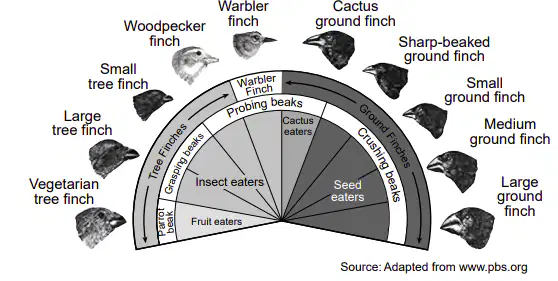
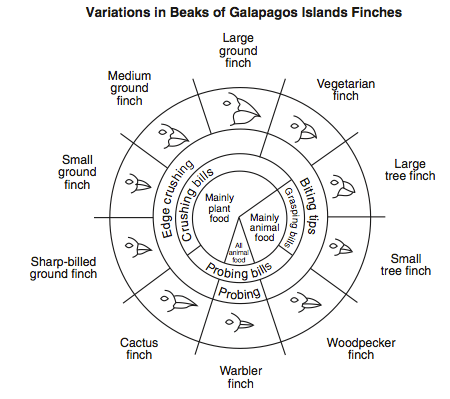
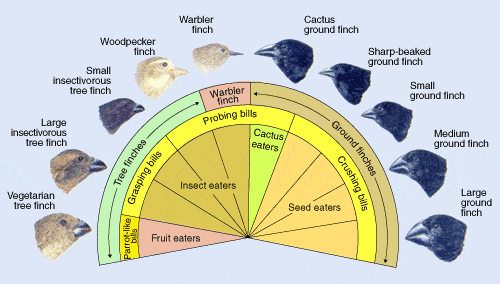
Which two species of finch would be affected if a bird with a grasping beak that ate ants and beetles was introduced into their habitat?
large ground finch and warbler
woodpecker finch and small ground finch
large tree finch and small tree finch
cactus finch and medium ground finch

Which finch eats all animal food and has a probing bill?
Warbler Finch
Small Ground Finch
Small Tree Finch
Vegetarian Finch

Which finch eats mainly plant food and has a probing bill?
Cactus Finch
Small Ground Finch
Large Tree Finch
Sharp Billed Ground Finch

Which finch has a grasping bill with biting tips?
Medium Ground Finch
Cactus Finch
Woodpecker Finch
Large Tree Finch

Select the 2 finches that would most likely compete for the same food.
Small Tree Finch
Large Tree Finch
Cactus Finch
Medium Ground Finch

The different beak variations found on different islands are the result of adaptations to what?
Temperature
Amount of Rainfall
Different food sources
Different nesting sites

Which finch or finches eats mainly animal food and has a probing bill?
Woodpecker finch
Cactus Finch
Sharp billed ground finch
Medium Ground finch
According to Darwin, all organisms are in constant competition for which of the following? Select all that apply
Food
Mates
Mountain Dew
Shelter

How many finches eat mainly plant food and have crushing bills?
1
3
2
5

How many finches eat mainly animal food and have grasping bills?
1
2
3
4
Genetic evidence supports which of the following explanations for the presence of 13 different finch species on the Galapagos Islands?
Each of the 13 species was founded by the independent migration of a different species from the mainland to the islands.
Many years ago, more than 13 different species of birds migrated to the islands. The current 13 finch species are the only species that survived.
It's not clear based on the DNA evidence whether the 13 species arose from a single migration of one species or multiple migrations of several species from the mainland to the islands.
Many years ago, a small population of a single finch species migrated to the islands and evolved into the current 13 species.
The film defines species as populations whose members don't interbreed. What keeps different Galápagos finch species from mating? Select all that apply.
Individuals only recognize and respond to songs of their own species.
One population eats mostly small, soft seeds and the other population eats mostly large, hard seeds.
Geographic isolation and different environments led to changes in traits that affected mating.

According to this graph,
Finches with larger beaks survived the drought of 1977.
Finches with medium beak depth eat only seeds of medium size.
Finches with smaller beak depth prefer smaller seeds.
Finches with large beak depth eat only seeds of large size.

Which statement is correct about the graph?
The amount of seeds available increased from 1976 to 1977.
The total seed biomass available for finches to eat decreased from January to July of 1976.
The total seed biomass available for finches to eat increased from January to July of 1978.
The total seed biomass available for finches to eat was the highest in January, 1976.

Which of the following statements best summarizes this data?
Average beak size stayed about the same except during wet years.
Average beak size decreased during dry years and increased during wet years.
Average beak size increased during the dry years and decreased during wet years.
Average beak size changed randomly.

Beak sizes of 200 ground finches in 1976 are shown in the graph. What is the most common beak depth in 1976?
8.3 mm
8.8 mm
9.3 mm
9.8 mm

Using the above graph, what observation can you make?
Birds like bigger seeds
Finch's average beak size are larger during a drought year
Finch's average beak size are larger during a rainy year
More finch's have a medium size beak

