
NEW
Font size
 Worksheets
genetics
Total questions: 69
Worksheet time: 35mins
During base excision repair, what is the enzyme that removes the deaminated uracil?
Glycoslyase
DNA exonuclease
AP endonuclease
DNA ligase
What is the enzyme that catalyzes the phosphodiester bond between adjacent nucleotides during DNA replication?
DNA polymerase III
Hydroxylating agent
Name two chemical mutagenic agent?
Hydroxylating agent, Alkylating agent, Deaminating agent, Intercalating agent
Exonuclease
Where does transcription occur in a cell?
Nucleus
DNA polymerase III
Peptidyl transferase catalyzes formation of peptide bonds between amino acids during translation
T
F
What is the enzyme that removes the primer during DNA replication?
Exonuclease
DNA polymerase III/DNA ligase/DNA polymerase
RNA polymerase and sigma factor
What is the enzyme and protein that binds to the promoter sequence located near the beginning of the gene during initiation of transcription?
RNA polymerase and sigma factor
DNA polymerase III/DNA ligase/DNA polymerase
Griffith experiment
Transformation
Bacteriophage
Pyrimidine
a virus that infects bacteria
Deoxyribose
Bacteriophage
Transformation
the sugar within the nucleotide subunits of DNA
Deoxyribose
Ribose
non-covalent bonds that hold the two strands together of the double helix together
Hydrogen bond
Origin
two nitrogenous bases that can pair via hydrogen bond
Complementary bases
Purine
Okazaki fragments
a short sequence of bases where unwinding of the double helix for replication begins
Origin
Purine
Semiconservative replication
short DNA fragments formed by discontinuous replication in one of the strands
Okazaki fragments
Lagging strand
a nitrogenous bases containing a double ring
Purine
Pyrimidine
Meselson and Stahl experiment
Semiconservative replication
Complementary bases
a nitrogenous base containing a single ring
Pyrimidine
Purine
What is the enzyme that catalyzes the phosphodiester bond between adjacent nucleotides?
RNA polymerase and sigma factor
DNA polymerase III/DNA ligase/DNA polymerase
Lagging strand
short DNA fragments formed by discontinuous replication in one of the strands
the strand that is synthesized discontinuously during replication
DNA stands for _______________.
Ribonucleic acid
Deoxyribosenucleic acid
Deoxyribusenucleic acid
Deoxyribonucleic acid
The sequence AACGTTATCG is changed to AATGTTATCG correspond to what type of mutation?
Transition substitution
Transversion substitution
Transformation mutation
Forward mutation
Transition substitution
a block or 1 nucleotide base pair lost from DNA
Purine replaced by another purine
a block or 1 nucleotide base pair added to DNA
Purine replace by pyrimidine
Transversion substitution
Purine replace by pyrimidine
a block or 1 nucleotide base pair added to DNA
a 180° rotation of a segment of DNA
Purine replaced by another purine
Deletion
a block or 1 nucleotide base pair lost from DNA
a 180° rotation of a segment of DNA
parts of two non-homologous chromosomes change places
Purine replaced by another purine
Insertion
a block or 1 nucleotide base pair added to DNA
a block or 1 nucleotide base pair lost from DNA
Inversion
a 180° rotation of a segment of DNA
a block or 1 nucleotide base pair lost from DNA
Purine replace by pyrimidine
Purine replaced by another purine
Reciprocal translocation
a 180° rotation of a segment of DNA
parts of two non-homologous chromosomes change places
A portion of one DNA strand for the human gene responsible of cystic fibrosis is
51 ATAGCAGACACCATTCTGGCC 31
Which of the following below is the corresponding region of the other DNA strand of this gene?
51 TATCGTCTGTGGTAAGACCGG 31
31 TATCGTCTGTGGTAAGACCGG 51
31 TATCGACAGTGGTAAGACCGG 51
31 TATCGTCTGTGGTAACTCCGG 51
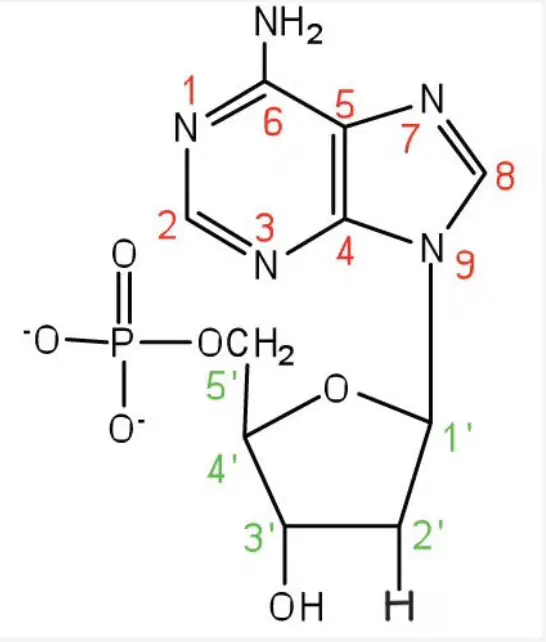
What does the nucleotide above show?
Ribose sugar, phosphate group and a purine group containing adenine
Deoxyribose sugar, phosphate group and a purine group containing guanine
Ribose sugar, phosphate group and a purine group containing guanine
Deoxyribose sugar, phosphate group and a purine group containing adenine
1 centiMorgan equals to recombination frequency of 100%
False
True
Initiation phase of the translation is described below:
Small subunit of the ribosome reads from the 51 methylated cap of the mRNA and encounters the start codon
Initiator tRNA carries whose 51 CAU 31 anticodon (carries methionine) is complementary to AUG
Initiator tRNA sits in the P site of the completed ribosome
All the above describes the initiation phase of the translation.
The list below shows the correct complementary base pairing between nitrogen bases of DNA molecules except for
A = U
A = T
G ≡ C
T = A
The recombination frequency between two genes is 60%. This means _________.
the two genes are not linked
the two genes are linked
the two genes are united on the same chromosome
the two genes are close together on the same chromosome
What occurs during termination phase of translation?
Release factors recognize the termination codons and binds to the stop codons
Last tRNA releases the complete polypeptide
mRNA separates from the ribosome
The large and small subunits of the ribosomes dissociates
All above is the correct sequence of termination phase of translation
During initiation of transcription what happens?
RNA polymerase and sigma factor binds at the promotor sequence
The region of DNA unwound to form an open promoter complex
Phosphodiester bonds are formed between the first two nucleotides
Sigma factor release from the open promoter complex
All above describes the process of initiation of transcription
What occurs during elongation phase of translation?
Initiating tRNA at the P site and the second tRNA at its A site so that peptidyl transferase can catalyze formation of a peptide bond between the amino acids carried by the two tRNAs
All the sequence above describes the elongation phase of translation
As the ribosome moves, the initiating tRNA, which no longer carries an amino acid, is transferred to the E site and the other tRNA carrying the dipeptide shifts from the A site to the P site.
The empty A site now receives another tRNA, whose identity is determined by the next codon in the mRNA.
The uncharged initiating tRNA is bumped off the E site and leaves the ribosome.
Hershey and Chase identified DNA as the genetic material in bacteriophages.
True
False
During methyl-directed mismatch repair, what does the adenine methylase do?
Adds methyl group on the adenine of the parent strand
Adds ethyl group on the adenine of the parent strand
Removes methyl group on the adenine of the parent strand
Removes ethyl group on the adenine of the parent strand
Avery, MacLeod, and McCarty performed an experiment that prove DNA was responsible for the genetic change from rough (R) cells into smooth (S) cells. The outcome where no S cells are formed is a result from following below:
The heat-killed S cells are treated with RNase first and mix with R cells.
The heat-killed S cells are treated with lipase first and mix with R cells.
The heat-killed S cells are treated with DNase first and mix with R cells.
The heat-killed S cells are treated with protease first and mix with R cells.
MutL and MutS detect and bind to mismatch nucleotides during methyl-directed mismatch repair
True
False
What is the enzyme that removes the primer during DNA replication?
Exonuclease
Mutation
A change in a DNA sequence of an organism due to the error in DNA replication during cell division, exposure to mutagens or a viral infection is called ____________.
Mutation
RNA polymerase and sigma factor
What is the enzyme and protein that binds to the promoter sequence located near the beginning of the gene during initiation of transcription?
RNA polymerase and sigma factor
MutL and MutS
What are the names of the proteins that detect and bind to mismatch nucleotides during methyl-directed mismatch repair?
MutL and MutS
Transposable elements
What are DNA segments several hundred to several thousand base pairs long that move or “transpose” or “jump” from place to place in the genome?
DNA ligase
Transposable elements
What is the enzyme that joins DNA fragments together?
DNA ligase
Mutation
What is the name of the proofreading function of the DNA polymerase that recognizes and excises mismatch base pairing?
Mutation
31-to-51 exonuclease
A change in a DNA sequence of an organism is called ___________.
Mutation
Mutagen
Mutensis
Mitosis
What mediate translation of mRNA codons to amino acids?
tRNA
mRNA
Amino acid
Viral RNA
The recombination frequency between two genes is 30%. This means _________.
the two genes are not linked on the same chromosome
the two genes are linked on the same chromosome
the two genes are on different chromosome
the two genes are not linked
Okazaki fragments are synthesized on the lagging strand
T
F
During termination, the last stage of transcription. Below describes the sequence of events, select which is true.
Terminators either within the RNA polymerase or with the help of rho proteins will signal the end of transcription
Terminators often form hairpin loops in which nucleotides within the mRNA pair with nearby complementary nucleotides.
RNA polymerase and complete RNA chain are released from the DNA
All the above is correct.
If recombination frequency is less than 50 %, the linked genes are close together on the same chromosome and they do not assort independently
T
F
What are the types of mutagenic agent that results in adding ethyl group?
Alkylating agents
Intercalating agents
Hydroxylating agents
Deaminating agents
Deaminating agent like nitrous acid can change adenine to hypoxanthine or modified adenine (A*). When this happens, the modified A will readily pair with what base during DNA replication?
Cytosine
Thymine
Guanine
Adenine
Recombinant phenotype is when offspring do not look like parents
T
F
Transcription occurs in cytoplasm of a eukaryotic cell.
T
F
Plant X with green leaves (Y) is dominant over yellow (y) leaves. Big stems (S) is dominant over small (s) stems. Wide roots (R) is dominant over thin (r) roots. Those genes are linked. A trihybrid (YySsRr) is testcrossed with a triple mutant (yyssrr). In this testcross the following number of offspring were produced for each of the possible phenotypes, with a total of 7000 offspring:
Green leaves (Y), big stems (S), wide roots (R): 2290
Yellow leaves (y), small stems (s), thin roots (r): 2400
Green leaves (Y), big stems (S), thin roots (r): 770
Yellow leaves (y), big stems (S), wide roots (R): 770
Green leaves (Y), small stems (s), thin roots (r): 360
Yellow leaves (y), small stems (s), wide roots (R): 300
Yellow leaves (y), big stems (S), thin roots (r): 54
Green leaves (Y), small stems (s), wide roots (R): 56
y ‒ s = 17.7 cM; s ‒ r = 16.2 cM; y ‒ r = 30.9 cM
y ‒ s = 17.7 cM; s ‒ r = 16.9 cM; y ‒ r = 31.4 cM
y ‒ s = 17.5 cM; s ‒ r = 14.5 cM; y ‒ r = 30.7 cM
y ‒ s = 17.7 cM; s ‒ r = 16.4 cM; y ‒ r = 31.9 cM
When the sigma factor separates from RNA polymerase during elongation, this do not allow the RNA polymerase to starts the formation of mRNA strand
T
F
What scientific name of organism was used in Thomas Hunt Morgan’s research in chromosome theory of heredity?
Pisum sativum
Anopheles gambiae
Musca domestica
Drosophila melanogaster
Ultraviolet (UV) light causes adjacent thymines to form abnormal covalent bonds. What are they called?
Thymine dimers
Timing dimers
Thyiomine dimers
Thymoid dimers
Damage bases can be repaired by the following repair mechanism:
Base excision repair
Baseless excision repair
Bond excision repair
Bonding excision repair
Genes located close together on the same chromosome are called linked genes
T
F
The ability of a substance to change the genetic characteristics of an organism is called ______________.
Transformation
Transcription
Translocation
Translation
DNA polymerase catalyze new phosphodiester bonds
T
F
An enzyme that synthesizes the RNA primer at the replication fork is called ___________.
Primatase
Primase
Helicase
Promase
Adenine methylase adds a methyl group to adenine in the sequence 51- GATC – 31
T
F
Below describes the elongation stage during transcription. Select the most apt description.
Sigma factor separates from the RNA polymerase in the open promoter complex
Core RNA polymerase loses affinity for promoter and moves in 31 to 51 direction on template strand
Core RNA polymerase extends the mRNA in the 51 to 31direction and moves in antiparallel 31 to 51 direction along the DNA template strand
The region of DNA unwound by RNA polymerase called transcription bubble, within this bubble nucleotides are added at 31 of growing mRNA strand
All the above is true
Removal of an adenine by the process of hydrolysis is called __________.
Depurination
Deamination
Radiation
Mutation

