
 Worksheets
Science DA Review
Total questions: 79
Worksheet time: 57mins
Heat is a form of _____.
fuel
minerals
energy
matter
Why do metal pans often have wooden handles?
Metal heats slower than wood
wood does not conduct heat as well as metal
metal gets heavier as it is heated
wood burns to make heat and metal does not
Steve rubs his hands together to warm them on a cold day. Which is he using to warm his hands?
conduction
magnetism
gravity
friction
On a sunny day, what would most likely happen to the temperature of a lake's water?
The temperature would not change from morning to afternoon.
The temperature would go down from morning to afternoon.
The temperature would go up from morning to afternoon
The temperature would go up and down all day long.
If you roast a marshmallow over a fire using a metal rod, it might burn your hand because _____.
the metal conducts heat well
the metal radiates heat.
the metal makes heat when held tightly
the metal makes electricity when heated.
Which of these is the best heat conductor?
metal pan
rubber glove
cloth pot holder
a block of wood
Which is NOT a way heat is produced?
friction
temperature
mixing chemicals
burning
Which color car will be the coolest on a hot summer day?
brown
black
dark blue
white
Which of these would make the BEST insulator?
a piece of paper
a metal pan
a fur coat
a steel fork
If an ice cube is placed into a hot glass of hot chocolate, which statement is true?
The hot chocoloate will freeze
The temperature of the hot cholcolate will increase
The temperature of the hot chocolate would stay the same
The temperature of the hot chocolate will decrease
Which statement describes how thermal energy moves?
It flows from warmer objects to colder objects
It flows in all directions
It flows from colder objects to warmer objects
It flows from colder objects to an insulator
Which tool is the most useful for finding the temperature at which water freezes?
a graduated cylinder
a ruler
a balance
a thermometer
A _ is an object that allows heat to move through easily.
insulator
convection
conductor
friction
If a black jar of water and a white jar of water were placed in sunlight all day ______.
the temperature in the white jar would increase the fastest
both jars would increase the same amount
the temperature in the black jar would increase the fastest
both jars would get so hot they would explode
A student is cooking some bacon in a pan. What transfer of heat is occurring?
friction
insulation
temperature
conduction
When the particles of an object move faster, what happens to the temperature?
The temperature goes up.
The temperature stays the same.
The temperature goes down.
The temperature cannon be taken.
If the temperature of water is 0 degrees Celsius, what most likely is happening to the water?
the water is melting
the water is freezing
the water is turning into gas
the water is boiling
Lisa is boiling an egg in a pot of water. Which question can be asked to determine the source of the heat energy?
What type of material is the pot made of?
What is the temperature of the egg?
What is heating the water?
What is the temperature of the water
Kamaya goes to the park during the summer. She tries to go down the metal slide, but it is too hot. Which question will best help Maya understand why the slide is so hot?
Is the slide straight or curved?
Is the Sun shining on the slide?
Are there other slides to play on?
Are there other children near the slide?
Kason uses thermometers to measure the temperatures of four water samples sitting in sunlight. Which sample is the hottest?


Which graph shows the change in temperature for each color after two hours in the sunshine?


What property of rock is being observed when looking for whether it is shiny?
luster
hardness
streak
color

What property of rock is being observed when looking at its hue or shade?
streak
hardness
color
luster
A student found a rock in his backyard and wants to figure out whether it is a rock or a mineral. Which is NOT a question that we can ask to identify if the sample is a rock or mineral?
Is it all one color?
Could it have a fossil in it?
Is it smooth or rough?
How big is it?

Kevin was given the following clue card to help identify 2 samples as rocks or minerals.
What questions can Kevin ask to help determine which sample is a rock?
Does the sample have smooth, flat sides? Is the sample made up of only one material?
Is the sample hard to break? Does the sample have a rough surface?
Is the sample made of more than one type of material? Is the sample dirty?
Does the sample have a rough surface? Is the sample made of more than one type of material?
The students in Mr. Rowe’s third grade class are observing and classifying minerals. One group has decided they want to group their minerals by luster. Which question will best help the students classify the minerals?
What color is each mineral?
Can the mineral be scratched?
What does the mineral feel like?
Is the mineral metallic?

Use the Moh’s Scale provided to answer the question below.
A student found a mineral that can scratch talc and gypsum, but not apatite. Which mineral did the student most likely find?
diamond
fluorite
quartz
topaz
A plant can become a fossil.
True
False
Extinct animals may return one day.
True
False
Check the boxes that show things we can learn from fossils.
what the animal ate
if the animal was angry
the animal's size
how fast the animal was
if the animal was hungry
A scientist who studies fossils is called a
meteorologist
paleontologist
zoo keeper
fossilist
What can an animals fossilized teeth tell us?
how fast the animal was
if the animal smiled
the food the animal ate
where the animal lived
Which of the following IS NOT something we can learn from a foot print of an animal?
how fast the animal was
how many legs the animal had
if the animal traveled in groups
what the animal ate
All fossils come from animals that are extinct
True
False
Scientists can study fossils to learn about
the ___________.
past
present
future
none of the above

What most likely made this fossil?
Plant
Animal
Footprint
Bone
A fossil of a fish is found on top of a
mountain. You can argue that the area
was once
underwater
a desert
much colder
much warmer
Which is a fossil?
bone from a chicken dinner
a live plant
the preserved remains of a plant or animal that lived long ago
a piece of pottery

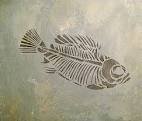
The body parts of this fossil tell you that this animal _________.
Flew
Hopped
Swam
Crawled

What is the correct listing of steps for a fossil?
1) Pressure created a rock.
2) Plant or animal is buried.
3) Plant or animal is left alone for years.
4) Plant or animal dies.
1) Plant or animal dies.
2) Plant or animal is left alone for years.
3) Pressure created a rock.
4) Plant or animal is buried.
1) Plant or animal dies.
2) Plant or animal is left alone for years.
3) Plant or animal is buried.
4) Pressure created a rock.
1) Plant or animal dies.
2) Plant or animal is buried.
3) Plant or animal is left alone for years.
4) Pressure created a rock.
Scientists discovered the fossilized remains of an unidentified animal. They can tell from its remains that it had gills and fins, but no legs. What conclusion about the animal can they draw from the evidence?
It was a land mammal.
It lived in the water all the time.
It had legs that did not fossilize.
It lived in the water and on land.
What must happen to an organism's body for it to become a fossil?
It must remain above ground.
It must dry out in the sunlight.
It must be buried right after death.
It must be eaten by other animals.
Where are most fossils formed?
near volcanoes, because the high heat of the lava helps to form fossils
in glaciers, because fossils are created when an organism is frozen quickly
in sedimentary rock, because being buried in sediment helps to form fossils
near earthquakes, because the shaking ground traps organisms to create fossils

The picture shows a tooth fossil of the extinct
Megalodon shark next to teeth from a great white
shark, which is still found today.
Which of the following best explains the
difference in the size of the teeth?
Sharks were once larger than the sharks that are living today.
The fossilized tooth was filled with water, which made it grow in size.
Sharks alive today do not live long enough to grow very large teeth..
The fossilized tooth had extra sediment around it, which became a part of it

Which feature helps the most to identify the organism as a plant?
size
color
smell
shape

The organism represented in this fossil
fed mostly on fish and algae.
moved by using many tiny legs.
lived in an environment that required a hard shell for protection.
had an internal skeleton that was used to maintain the organism's shape.

What happens to insects when they become trapped in amber?
they form molds
they are preserved (they stay the same)
they decay
they form casts
Long ago, small organisms became trapped in sticky tree sap that hardened. What is the hardened sap called?
a cast
an imprint
a mold
amber
Which is NOT a reason scientists study fossils?
They tell us how long a species existed on Earth.
To learn how organisms are related to each other.
How organisms communicated with each other.
Fossils tell scientists the types of environments that organisms lived in.
Which rock type would be best to find fossils?
Igneous Rock
Sedimentary Rock
Metamorphic Rock


What happens when hardened lava builds up over a long period of time?
a landslide
a flood
rivers form
mountains form

