
 Worksheets
Semester Exam with a focus on Waves
Total questions: 83
Worksheet time: 2hrs 3mins


The name for the range of electromagnetic waves placed in order of increasing frequency is...
Electromagnetic Spectrum
Electromagnesis
Visible light spectrum
The range of light
As frequency increases on the electromagnetic spectrum, what happens to the wavelength?
It stays the same
It decreases
It increases
It doubles

Which of the following is not in the electromagnetic spectrum?
Light waves
Sound waves
Radio Waves
X-rays

In which list are forms of electromagnetic energy arranged in order from longest to shortest wavelength?
Microwave -> Radio wave -> Infrared rays
Visible light -> x-ray -> radio wave
Microwave -> infrared -> visibile light
Infrared -> radio wave -> ultraviolet

Scientists observed a celestial object emitting a wavelength of 3 x 10⁻¹⁰m. What type of telescope did the scientists have to use to view this?
Radio wave
Infrared ray
X-ray
Gamma Ray
The highest part of a transverse wave is
the crest
the trough
the wave point
the hotel transylvania
The lowest part of a transverse wave are the
crests
troughs
wave points
low nodules
The distance between two corresponding parts of a wave is its
amplitude
frequency
wavelength
velocity
The height of the wave from its resting point is called its
wavelength
amplitude
velocity
frequency
A wave that needs a medium to travel is called a(n)
electromagnetic wave
mechanical wave
ocean wave
any way can do this
A wave that can travel with or without a medium is called a(n)
electromagnetic wave
mechanical wave
surface wave
all waves can travel in any way
Longitudinal waves have:
crests and troughs
crests and compressions
compressions and rarefactions
troughs and rarefactions
True or False: Amplitude can increase or decrease wavelength
True, amplitude can increase or decrease wavelength
False, frequency can increase or decrease wavelength
False, crests can increase or decrease wavelength

What is the amplitude of this wave?
3
-3
6
4

What is the wavelength of this wave?
3
10
4
8
A wave is a disturbance that transfers ________ from one place to another.
Matter
Mass
Energy
Which 2 types of waves require a medium to travel?
Electromagnetic
Mechanical
Light
Sound
What medium do sound waves travel fastest through?
Solids
Liquids
Gases
If a wave has a high amplitude, it will have __________ energy.
High
Medium
Low

Which list places the electromagnetic energies in order from most energy to least energy?
X-ray, Radio, Visible
Ultraviolet, Infrared, Radio
Radio, Visible, Gamma
Visible, Ultraviolet, X-Ray

Which of the following statements can be concluded from the table?
X-Ray waves have a lower frequency than infrared waves.
Microwaves have a smaller wavelength than visible light.
The speed of all electromagnetic waves are equal.
The frequency and wavelengths are equal for each type of radiation.

absorption
diffraction
reflection
refraction
transmission

When a wave transfers all of its energy into the material it strikes
Absorption
Diffraction
Reflection
Refraction
When a wave passes through a transparent object.
Absorption
Transmission
Diffraction
Reflection
When a wave bends (usually when it enters a new medium)
Absorption
Transmission
Refraction
Reflection


What is happening in this picture?
Reflection
Refraction
Diffraction

Screaming into a pillow is an example of sound waves being ______.
reflected
refracted
absorbed

The orca uses this behavior of waves to locate food.
Refraction
Reflection
Absorption
Diffraction
Interference
How does watching TV during studying affect a student’s test grades? Student's grades are the....
independent variable
dependent variable
Which type of graph represents data that changes over time?
line graph
bar graph
circle graph
In order to find DISTANCE...
multiply time with speed
divide time by speed
divide speed by time
add time and speed
a change in SPEED or DIRECTION over time
position
acceleration
motion
rate

What is happening from point D to E?
The object is accelerating
The object is moving at constant velocity
The object is decelerating
The object is NOT moving


A
B
C
D
Law of Inertia is
Newton's 1st law
Newton's 2nd law
Newton's 3rd law
Law of conservation of momentum
"For every action, there is an equal and opposite reaction" represents
Newton's 1st law
Newton's 2nd law
Newton's 3rd law
Law of conservation of momentum
F=ma represents
Newton's 1st law
Newton's 2nd law
Newton's 3rd law
Law of conservation of momentum

A net force of 15 N is exerted on an encyclopedia to cause it to accelerate at a rate of 5 m/s^2. Determine the mass of the encyclopedia.
m = 3.0 kg
m = 75 kg
m = 3.0 ml
m = 75.0 g
A unbalanced force means that an object is
zero net force
changing its motion
sitting still
object at rest

What explains a quantity that has BOTH speed and direction?
Inertia
Force
Speed
Velocity

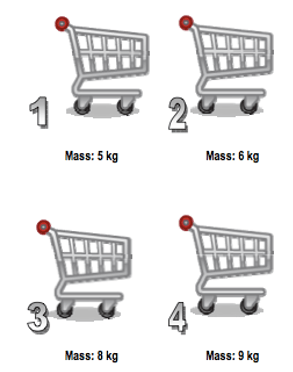

Identify which law applies.
Newton's 1st law of motion
Newton's 2nd law of motion
Newton's 3rd law of motion

Identify which law applies.
Newton's 1st law of motion
Newton's 2nd law of motion
Newton's 3rd law of motion

Identify which law applies.
Newton's 1st law of motion
Newton's 2nd law of motion
Newton's 3rd law of motion
___________ is when a wave changes direction as it moves through an opening or around a corner
reflection
absorption
diffraction
transmission

How would you describe this cup?
opaque
translucent
transparent
A white surface absorbs all the color of light.
TRUE
FALSE
Materials that do not let any light pass through them.
opaque
transparent
transluecent
reflective material

Which word means the bending or spreading of waves as they move around a barrier or pass through an opening?
interference
node
diffraction
antinode
Which word means the the interaction between waves that meet?
node
antinode
reflection
interference

Which word means the interference that occurs when two waves combine to make a wave with an amplitude larger than the amplitude of either of the individual waves?
constructive interference
control rod
node
standing wave

Which word means the interference that occurs when two waves combine to make a wave with an amplitude smaller than the amplitude of either of the individual waves.
constructive interference
node
destructive interference
antinode

In what context would would light travel even faster than through air?
Through vacuum/empty space
Through glass
Through water
Through a solid

A leaf is green because
All colors are reflected except green
The light is not part of the EM
All colors are absorbed except green
The sun light shining on the leaf is green

Our eyes detect different energies of light (wavelengths) as
different polarities
different intensities
different colors
different spectrum

Sunlight is special because
contains white OR black light
contains most of the colors of the rainbow.
contains the rainbow and microwaves
contains all the colors of the rainbow AND ultraviolet light.
Refraction happens when a wave enters a new ________ and changes its _________.
solid, medium
obstacle, air
speed, obstacle
medium, speed
By typing your name, you commit to the Honor Code:
"On my honor, I have neither given nor received help on this test, nor will I discuss it."

