
NEW
Font size
 Worksheets
Physical Properties and Solubility
Total questions: 37
Worksheet time: 30mins

Which object has the highest density in this picture?
A
B
C

Which object has the lowest density in this picture?
A
B
C
What is the density of an object if it has a mass of 6g and a volume of 3cm3? (Hint: Density = mass/volume)
6 g/cm3
3 g/cm3
2 g/cm3
1/3 g/cm3

You calculated the density of an unknown substance to be 7.8g/cm3. According to the chart, which of the substances doe you most likely have?
Zinc
Copper
Tin
Iron

You calculated the density of an unknown substance to be 5.7g/cm3. According to the chart, which of the substances do you most likely have?
Aluminum
Iron
Tin
Zinc

Which substance is the most dense in this picture?
Vegetable Oil
Dish Soap
Honey
Corn Syrup
Which of the following is the correct definition of density?
The amount of stuff in an object
A measure of the force of gravity on an object
The amount of space an object takes up
The amount of matter (mass) packed into a space (object)

Which substance has the highest density?
Oil
Water
Syrup
Which substance has the lowest density?
Plastic Block
Water
Grape
Which substance has the lowest density?
Oil
Water
Syrup
Compared to the Oil, does the plastic block have a higher or lower density?
higher
lower
Compared to the water, does the grape have a higher or lower density?
higher
lower

Rocks sink because they are
the same density as the water
less dense than the water
more dense than the water
because they're round
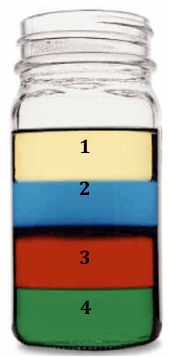

Students measured & recored the density of 4 samples. Using the density column & the data table shown, which of the samples will float on top?
Sample A
Sample B
Sample C
Sample D
The ability to shine is known as----
Luster
Brightness
Flammability
Combustion
Solubility, the ability to dissolve, is a --- property.
Chemical
Physical
Malleability, the ability to be flattened into thin sheets, is a ---property.
Physical
Chemical
Color change like in a drop of food coloring in water, is a --- change.
Physical
Chemical
The ability to conduct electric current is referred to as...
density
solubility
malleability
electrical conductivity
A characteristic that can be observed or measured such as color, state, or hardness is referred to as a...
Physical property
Chemical property
Physical change
Chemical change
If you poured three liquids (that do not mix completely) into a cup, how could you tell which one is the densest liquid?
The liquid that is floating on top is the densest liquid.
The liquid that settles to the bottom is the densest liquid.
The liquid with the deep red color is the densest liquid.
There is no way to tell which liquid is densest from the description.
Which of the following is NOT a mixture?
milk
lemonade
vegetable salad
carbon

Which method can you use to separate sand and iron filings?
Distillation
Magnetism
Filtration
Evaporation

Is this a mixture?
No
Yes

Is this a mixture
Yes
No

Based on the solubility curve, how many grams of sugar will dissolve in a 100 mL of water at 20°C?
100 g
150 g
200 g
250 g


This is an example of a
Solution
Mixture

Which substance is MOST soluble at 0 ºC?
KI
NaNO3
NaCl
Ce2(SO4)3

How many grams of CaCl2, are soluble in 100 g of water at approximately 17 ºC?
58 grams
70 grams
0 grams
12 grams
25 grams of NaCl are dissolved in 100 mL of water at 60 C. How many more grams need to be dissolved for the solution to be saturated?
13 grams
25 grams
6 grams
38 grams

At approximately what temperature does the solubility of sodium chloride, NaCl, match the solubility of potassium dichromate, K2Cr2O7?
60 ºC
30 ºC
50 ºC
83 ºC

