
 Worksheets
Periodic Table Test (Fall 2023)
Total questions: 71
Worksheet time: 43mins
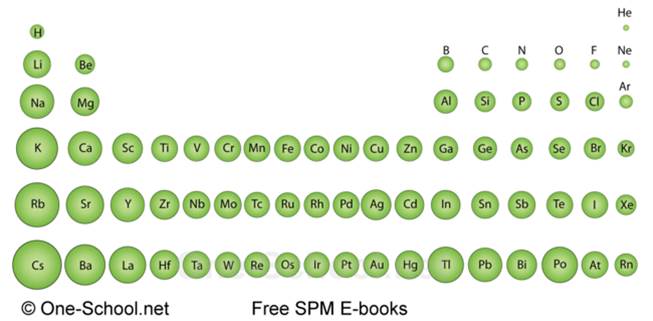
A horizontal row on the periodic table is called a ______________
Period
Group
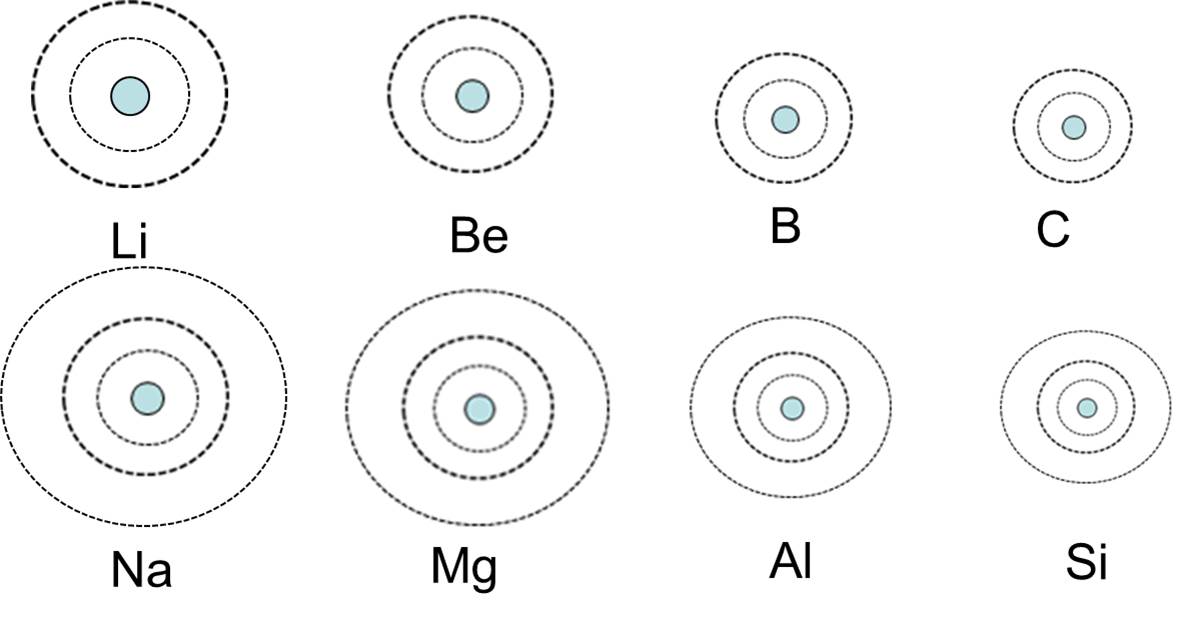
A vertical column on the periodic table is called a ___________
Period
Group
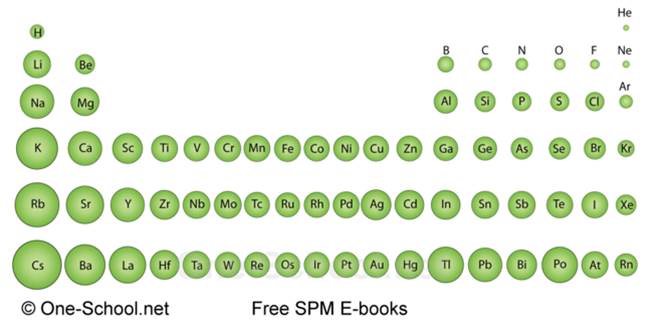
As you move across a row (period) on the periodic table, the atomic radius ______________________
Increases
Decreases
Stays the same
Explodes
Which statement is true concerning the periodic table?
rows go up and down and groups go across the table
groups go up and down and rows go across the table
rows go up and down and groups go up and down the table
rows go across the table and groups go across the table

The distance from the nucleus of an atom to the valence electrons is the __________
Atomic Radius
Ionization Energy
Electronegativity
Electrostatic
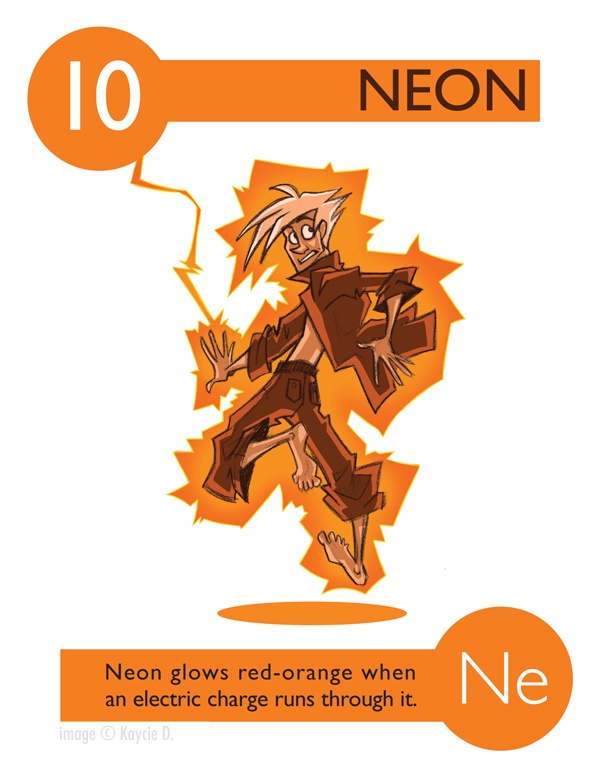
Which of the following elements would have the smallest atomic radius?
Li
Be
C
Ne
In a periodic table, a set of properties repeats from
element to element
group to group
column to column
row to row
Which subatomic particle has a negative charge?
electron
proton
neutron
alpha particle
Which statement about subatomic particles is true?
Protons, neutrons, and electrons all have about the same mass.
Unlike protons or neutrons, electrons have no mass.
Neutrons have no charge and no mass.
An electron has far less mass than either a proton or neutron.
Which of the following is unique for any given element?
the number of neutrons
the charge on the electrons
then number of protons
the mass of a neutron
The number of protons in one atom of an element is that element’s
mass number.
balanced charge
atomic number
isotope
To find the number of neutrons in an atom, you would subtract
mass number from atomic number
atomic number from mass number
atomic number from electron number
isotope number from atomic number
Suppose an atom has a mass number of 23. Which statement is true beyond any doubt?
The atom has an odd number of neutrons
the atomic number is less than 11
the atom is not an isotope
the number of protons in the nucleus does not equal the number of neutrons.
Which statement is true about oxygen-16 and oxygen-18 ?
They do not have the same number of protons
their atoms have identical mass
they are isotopes of oxygen
they have the same mass number
Which statement accurately represents the arrangement of electrons in Bohr’s atomic model?
Electrons vibrate in fixed locations around the nucleus.
Electrons travel around the nucleus in fixed energy levels with energies that vary from level to level.
Electrons travel around the nucleus in fixed energy levels with equal amounts of energy.
Electrons travel randomly in the relatively large space outside the nucleus.
Moving from left to right across a row of the periodic table, which of the following values increases by exactly one from element to element?
isotope number
atomic number
atomic mass unit
mass number
Which list of elements contains only metals?
carbon, iodine, tin
tin, copper, cesium
helium, iron, copper
iodine, carbon, argon
Which statement is true about the metalloid silicon?
Silicon is a better conductor of electric current than silver is.
Silicon does not conduct electric current under any conditions.
Silicon's ability to conduct electric current does not vary with temperature.
Silicon is a better conductor of electric current than sulfur is.
At room temperature, none of the metals are
soft.
liquids.
malleable
gas
Group 7A of the periodic table contains the
most reactive metals.
most reactive nonmetals.
least reactive nonmetals.
least reactive metals.
As you move from left to right across a period, the number of valence electrons
increase
stays the same
increases then decreases
decreases
A member of the boron family has three valence electrons, while a member of the nitrogen family has
none
five
four
three
Which of the following Group 1A elements is the most reactive?
Cs (cesium)
Li (lithium)
K (potassium)
Na (sodium)
Which of the following Group 7A elements is the most reactive?
Cl (chlorine)
I (iodine)
F (fluorine)
Br (bromine)
Which of the three subatomic particles—proton, electron, or neutron—has the least mass?
protons
neutrons
electrons
If an atom has 34 protons and 40 neutrons, what is its mass number?
34 + 40
40 - 34
34 - 40
34 / 40
If an atom of tin has a mass number of 118 and an atomic number of 50 , how many neutrons are in its nucleus?
50-118
118+50
118/50
118-50
Sulfur is often found in nature as an element, not combined with other elements in a compound. What does this fact tell you about the reactivity of sulfur?
Very reactive
Not reactive
Among the alkaline earth metals in Group 2A, which is more reactive—beryllium (element 4) or strontium (element 38)?
Be
Sr
Sodium chloride is a compound of sodium and chlorine. Which of these elements is the alkali metal, and which is the halogen?
Sodium is the metal, chlorine is the halogen
Sodium is the halogen, chlorine is the metal
Although lithium and neon are both in Period 2 of the periodic table, they have very different properties. Explain how this is possible
Lithium has a full electron energy level, neon only has one valence electron
Lithium has only one valence electron, neon has a full electron energy level.
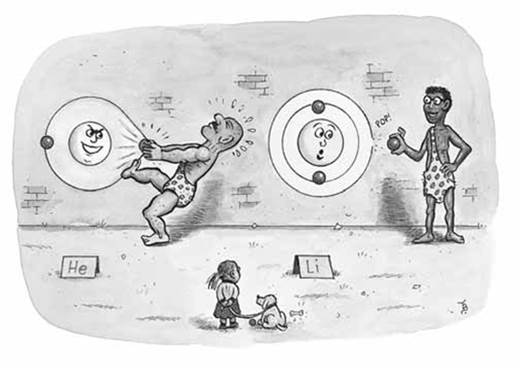
Ionization energy is the energy needed to _________ an electron.
Fission
Explode
Remove
Add
The reason the atomic radius increases down a group is due to
Greater attraction by protons
More energy levels (rings)
As you move across a row on the periodic table, ionization energy ______________________
Decreases
Increases
Stays the same
Why does ionization energy decrease down group?
More protons in nucleus
More energy levels (rings)
Which element has the highest electronegativity?
F
Na
K
Li

How many energy levels are in sodium?
1
2
3
4

Which element has the highest ionization energy?
Na
Li
Mg
Ne
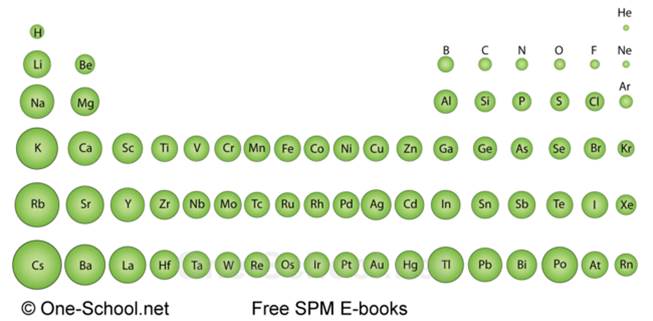
Which group of elements has the lowest ionization energy?
Group 1
Group 2
Group 3
Group 4
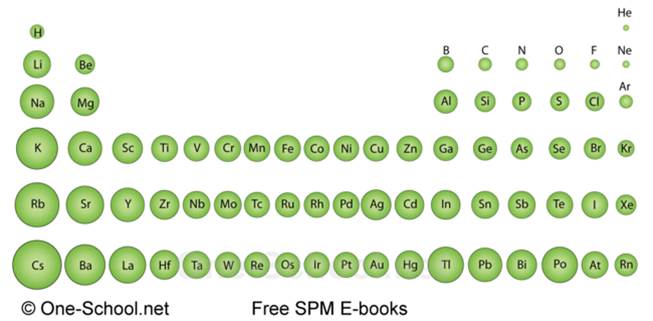
Group 18 elements are called ________________
Alkali metals
Transition metals
Halogen
Noble gases
Group 1 elements are called ________________
Alkali metals
Transition metals
Halogen
Noble gases

Which element would have the largest atomic radius?
Cs
K
Na
H
Group VIII A elements are called ________________
Alkali metals
Transition metals
Halogen
Noble gases
Group I A elements (not including hydrogen) are called ________________
Alkali metals
Transition metals
Halogen
Noble gases
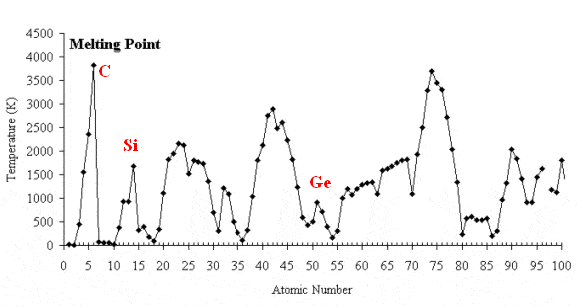
Which element in Period 3 has the highest melting point?
Silicon (Si)
Germanium (Ge)
Carbon (C)
Argon (Ar)
Which of the following is a nonmetallic element?
Calcium (Ca)
Carbon (C)
Cobalt (Co)
Copper (Cu)
Which has the largest atomic radius among the elements in Period 4?
Calcium (Ca)
Copper (Cu)
Krypton (Kr)
Potassium (K)
Which has the smallest atom among these 4 halogen elements:
Bromine (Br)
Chlorine (Cl)
Fluorine (F)
Iodine (I)
Which property, generally, decreases across a period?
Atomic number
Atomic radius
Electronegativity
Ionization energy
Which atomic property is increasing both across a period and down a group of the modern periodic table?
Atomic number
Atomic radius
Electronegativity
First ionization energy
The elements that display the greatest nonmetallic character are located toward which corner of the periodic table?
Dead center
Lower left
Lower right
Upper left
Upper right
Which two elements will display the most similar chemical properties?
Aluminum and calcium (Al & Ca)
Carbon and sulfur (C & S)
Chlorine and sulfur (Cl & S)
Nickel and phosphorus (Ni & P)
Lithium and potassium (Li & K)
An element that has a high first ionization energy and is chemically inactive would most likely be found among which group of elements?
Alkali metals (Group 1)
Alkaline earth metals (Group 2)
Halogen (Group 17)
Noble gases (Group 18)
Transition metals (Group 3 to 12)
As the elements of period 2 are considered from left to right, there is generally a decrease in which periodic property?
Electronegativity
Ionization energy
Metallic character
Nonmetallic character
None of these options are correct
Which element is a liquid at room temperature?
Iodine (I)
Krypton(K)
Magnesium (Mg)
Mercury (Hg)
Potassium (K)
Other than their tendency to be poor heat conductors, which of the following is another general tendency of nonmetals?
Nonmetals tend to be brittle
Nonmetals tend to be malleable
Nonmetals tend to lose valence electrons
Nonmetals tend to have shiny appearance
Nonmetals tend to be good conductors of electricity

Mendeleev was the first person to arrange the elements into a table. How did he arrange the rows?
Which of the following will have similar properties?
O, S, Se
O, F, Ne
N, Ne, Na
H, K, P


How many periods are on the periodic table?
5
6
7
8
Name this group: These metals contain familiar metals such as gold, iron, and copper.


Find an element with similar chemical properties to Barium (Ba).
Ca an Ra, because they are in the same group and have similar chemical properties.
Cs and La, b/c they are in the same period number.
Ca and Y, b/c they are 90 degree angle and have similiar properties.

The blue elements (left side) are called
The yellow elements (right side) are called

What do the periods (rows) represent?
an additional energy level
an additional proton
an additional group
an additional electron
Match the following elements to the group they belong to.
sodium
alkali metal
calcium
alkaline earth metal
chlorine
halogen
argon
noble gas

