
 Worksheets
Plate Tectonic
Total questions: 48
Worksheet time: 32mins
When a fossil of an animal is found on almost all continents, then it supports
the idea of a traveling animal
the idea of a connected original continent
the idea of a flying animal

Fossils can also give evidence for a Pangaea theory
True
False
What evidence of Wegener's Theory is shown in the remains of organisms that lived long time ago?
embryology
continental drift
seafloor spreading
fossils

One piece of evidence for Plate Tectonics is that--
some continents appear to fit together like a puzzle.
we have video footage of the plates actually moving.
all continents have formed from volcanic eruptions.
the continents are no longer moving.

Fossil records indicate that the continents were once connected. How do fossil records support this claim?
We have been able to transport the same types of fossils from one continent to another.
Fossils of the same organism that are chemically and physically similar have been found on continents that are now separated by oceans.
Some continents contain fossils of many different types of organisms.
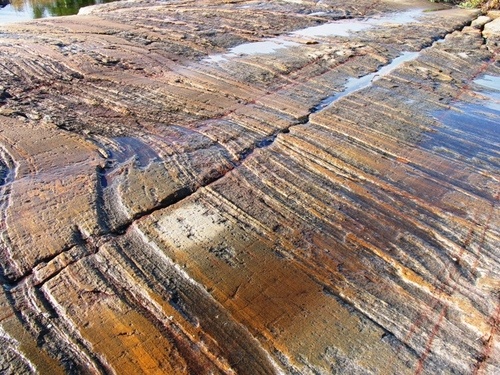


The age of the Earth is measured in _______ of years.
millions
billions

This is a model of sea floor spreading at a divergent boundary called a_________________________________
Divergent boundary
Transform boundary
Mid Ocean Ridge
Oceanic Crust
The formation of new areas of oceanic crust, which occurs through the upwelling of magma at midocean ridges and its subsequent outward movement on either side is called
Subduction
Seafloor Spreading
Divergent boundary
Convergent boundary
Wegener’s theory was rejected by scientists because he could not explain what ____________ pushes or pulls continents.
continent
magma
force
drift
Wegener’s theory that all continents had once been joined together in a single landmass and have drifted apart since.
Seafloor Spreading
Continental Drift
Subduction
Pangaea
The deepest parts of the ocean; long, narrow ditches
Trenches
Divergent Boundary
Lithosphere
Subduction
Tectonic Plates
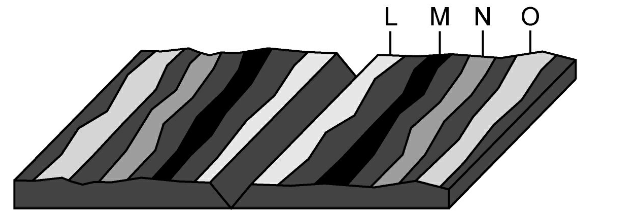
The magnetic pattern of ocean-floor rocks on one side of an ocean ridge is_____________.
a mirror image of that on the other side
younger than other side
much different pattern
at right angles to the ridge
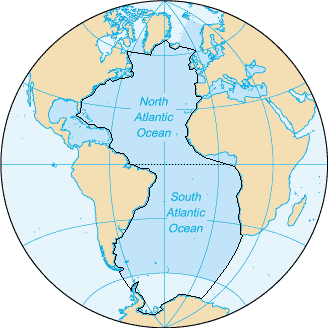
The OLDEST seafloor is located
closest to the mid-ocean ridge.
farthest from the mid-ocean ridge.
east of Hawaii
west of California
Scientists use ______ to map the ocean floor
radar
pulsar
lidar
sonar
How is it possible for new crust to be formed without increasing the surface area of the Earth?
Crust is recycled in subduction zones at the same time it is created at mid-ocean ridges
New crust is underwater where it sinks
New crust breaks more easily than old crust
The oldest crust just breaks apart as the plates move
A divergent boundary occurs where plates ....
Pull apart
Come together
Slide past each other
subducting
Earthquakes can cause ___.
mountains to form
tsunamis
hurricanes
none of these
Seafloor spreading is caused by ____.
volcanoes
earthquakes
convection currents in the mantle
magic
The mid Atlantic ridge is a ___ boundary.
convergent
divergent
transform
The San Andreas fault in California is a --- boundary.
convergent
divergent
transform
Plate tectonics explains the cause of ___.
volcanoes
earthquakes
trenches
all of these
What happens at a subduction zone?
two plates slide past each other
one plate is pulled down under another one
two plates move apart
What type of plate boundary has plates that are sliding past each other?
convergent
divergent
transform
Tectonic plates move quickly.
true
false
How do the plates move along transform boundaries?
They move towards one another
They move away from one another
They move past one another
one moves up and one moves down
How do the plates move along convergent boundaries?
They move towards one another
They move away from one another
They move past one another
One moves up and one moves down
How do the plates move along a divergent boundary?
They move towards one another
They move away from one another
They move past one another
One move up the other moves down
Subduction zones occur along
Transform boundaries
Continental-Continental boundaries
Divergent boundaries
Oceanic-Continental boundaries
Volcanoes are created along
Divergent and Convergent boundaries
Transform and Convergent boundaries
Divergent and Transform boundaries
The boundary between Illionois and Wisconsin
At this boundary, old crust is destroyed and deep earthquakes occur
Transform
Continental-Continental Convergent
Divergent
Oceanic-Continental Convergent
Mountains are created along
Transform boundaries
Continental-Continental Convergent
Divergent
Oceanic-Continental Convergent
At this boundary plates slide past one and other and earthquakes are created
Transform
Continental-Continental Convergent
Divergent
Oceanic-Continental Convergent
What is the process of convection?
The process of hot material rising and cooler material sinking in circular patterns
The process of hot rock solidifying and forming new crust
The process of explaining what goes up must come down
Strong ocean currents moving tremendous amounts of material
What is the driving force behind the movement of the tectonic plates?
Gravity
Convection
Wave motion
Seismic activity
Where does seafloor spreading take place?
Convergent boundaries
The continentals shelves
Transform boundary
Mid-ocean ridges
Who was the scientist who proposed the theory of continental drift?
Alfred Powell
Harry Hess
Alfred Wegener
Ernest Rutherford
Where are the youngest rocks on Earth found?
Along mid-ocean ridges
Along transform boundaries
On the edges of the continents
Near ocean trenches
What does the theory of Continental Drift explain?
Ocean currents move continents around the planet
Convection works deep within the asthenosphere
Mid-ocean ridges force tectonic plates to move
Continents were once together and slowly drifted to where they are today

