
 Worksheets
Unit Four: Stoichiometry
Total questions: 95
Worksheet time: 3hrs 27mins
What is used to convert between grams and moles?
Avogadro’s number
Molar mass
6.022 x 10^23
Mole ratio
What is used to convert between atoms and moles?
Molar mass
Mole ratio
Periodic table
Avogadro’s number
What is used to convert between moles of two different molecules?
Molar mass
Avogadro’s number
Periodic table
Mole ratio
The Mole Ratio comes from _______ and is used to convert between ________.
Periodic table, grams to moles
Balanced chemical equation, moles of two different molecules
Avogadro’s number, ions to moles
Balanced chemical equation, moles to grams
The molar mass of a compound is found by:
adding the atomic numbers
multiplying by 6.02 X 10²³
adding up the masses of all the atoms
multiplying the atomic mass by Avogadro’s number
What is the molar mass of Carbon Tetrachloride (CCl4)?
35.453 g/mol
83.49 g/mol
47.46 g/mol
153.82 g/mol
When the equation below is balanced, what is the mole ratio of Sodium (Na) to Sodium sulfide (Na2S)?
____Na + ____ K2S → ____K + ____ Na2S
1:1
1:2
2:2
2:1
There are 6.022 x 10²³ atoms in a mole
True
False
What is the molar mass of H2O?
18.02 g/mol
33.01 g/mol
17.01 g/mol
Avogadro's number is
used to convert moles to atoms
6.022 x 10²³ particles/mole
used to convert molecules to moles
all of the above
The amount of atoms in a mole varies by element
True
False
A mole is a unit
True
False
Balance the following equation:
____Na3PO4 + ____CaCl2 → ____NaCl + ____Ca3(PO4)2
4 : 6 : 12 : 2
2 : 6 : 6 : 1
4 : 3 : 6 : 2
4 : 6 : 4 : 2
What's the "given" in the following problem? How many particles are in 0.250 grams of potassium permanganate (KMnO4)?
0.250 grams KMnO4
particles
KMnO4
0.250
For the balanced reaction below, if 10 moles of NaOH react, how many moles of NaCl are formed?
HCl + NaOH → NaCl + H2O
1 mol NaCl
10 mol NaCl
20 mol NaCl
2 mol NaCl
Particles include
atoms only
molecules only
moles only
molecules and atoms
How many moles of hydrogen (H2) are needed to completely react with two moles of nitrogen (N2)?
____N2 + ____H2 → ____NH3
1 mol H2
6 mol H2
2 mol H2
3 mol H2
Stoichiometry is the:
calculation of amounts of substances in a chemical reaction from the balanced equation
calculation of the mass of substances in a chemical reaction from the chemical equation
calculation of the number of particles in a physical reaction from the balanced equation
bane of my existence
What is the most important piece of information necessary to perform a stoichiometric calculation?
Number of moles
Number of particles
Liters of gas
Mass of reactants
A balanced chemical equation
Using stoichiometry, you can determine which of the following? (more than one answer may apply)
mass of products given the mass of reactants
mass of a salt produced by the reaction between two volumes of gas
number of reactant molecules needed to produce 150 grams of product
how much water can be made by burning methane
A certain automobile contains 4 tires, 2 headlights, 1 steering wheel, and 6 spark plugs. How many of each part will be required to build 17 of these cars?
66 tires, 32 headlights, 15 steering wheels, 102 spark plugs
72 tires, 48 headlights, 17 steering wheels, 96 spark plugs
68 tires, 34 headlights, 17 steering wheels, 102 spark plugs
68 tires, 32 headlights, 17 steering wheels, 102 spark plugs
The reaction of sodium with water produces sodium hydroxide and hydrogen gas: 2 Na(s) + 2 H2O(l) → 2 NaOH(aq) + H2(g) How many moles of water are needed to react with 0.89 moles of sodium?
0.445
0.89
1.01
1.78
The reaction of aluminum metal with an aqueous solution of silver nitrate produces aqueous aluminum nitrate and solid silver metal. What is the balanced chemical equation describing this reaction?
Al (s) + 3 AgNO3 (aq) → Al(NO3)3 (aq) + 3 Ag (s)
Al + 3 AgNO3 → Al(NO3)3 + 3 Ag
Al (aq) + AgNO3 (s) → Al(NO3)2 (aq) + 3 Ag (g)
Al(s) + SiNi8 (aq) → AlNi8 (aq) + Si (s)
The reagent which determines how much product will be made is the _______ reagent
deficient
rate-limiting
limiting
restricted
The excess reagent is the material that is
used up in the reaction
left over
brings stoichiometric balance
makes extra product
True/False: All reactions need an excess reagent.
True
False
To identify the excess reagent, all data must be in ______ quantities
molal
molecular
mass
molar
True/False: A balanced equation allows us to determine the excess reagent.
True
False
The theoretical yield is
the amount you hope to get
the maximum amount that can be formed from the given amounts of reactants
the amount you need for the next reaction
the actual amount you obtain in the reaction
17. Actual yield is
the amount you obtain in the reaction
the amount you want to obtain in the reaction
the amount of product using excess reagent
the amount of product before purification
In the reaction A+B→C+D, 7.2 moles A form 5.4 moles C. The mole ratio A:C is
2:1
4:2
2:3
4:3

How many moles of I2 are produced if 4.7 moles Br2 are reacted with excess FeI3?
4.7
9.4
14.1
18.8

What mass of zinc oxide will be formed from 20.0 g of zinc?
10.5 g
19.8 g
24.9 g
32.3 g
How many grams of potassium chloride (KCl) can be produced from 356 g of potassium bromide (KBr)?
CaC₂(s) + H₂O(l) --> C₂H₂(g) + Ca(OH)₂(aq)
Fe2O3(s) + 3H2(g) → 2Fe(s) + 3H2O(l)
How many moles of iron can be made from 3 moles of Fe2O3?
How many grams of aluminum sulfate would be formed if 250g H2SO4 completely reacted with aluminum?
In the equation 2 Al2O3 --> 4 Al + 3 O2, what is the mole ratio of aluminum to oxygen (aluminum is asked for, oxygen is given)?
10/6
3/4
4/3
2/3
In the reaction 2 H2 + O2 → 2 H2O what is the mole ratio of oxygen to water
1/2
2/1
3/4
4/3
What is the molar mass of table salt (NaCl)?
116.89 g/mol
35.45 g/mol
22.99 g/mol
58.44 g/mol
What is the molar mass of NaOH?
40.00 g/mol
38.99 g/mol
23.99 g/mol
57.00 g/mol
How many grams of aluminum sulfate would be formed if 250g H2SO4 completely reacted with aluminum?
Pb5Cr5O20
You are given the following percentages: 40.05% S and 59.95% O. Find the empirical formula for these elements so that you can give the correct name of the compound formed.
Sulfur monoxide
Sulfur dioxide
Sulfur trioxide
Sulfur tetroxide
Calculate the percent water in strontium chloride hexahydrate
6.76%
59.45%
68.21%
40.55%

Na2CO3 · 10H2O is known as sodium carbonate ______


contains water in the compound

How do you calculate the percent by mass of an element in a compound?
Add up the mass of protons and neutrons, then divide by two.
Divide the mass of the element by the total mass of the compound and multiply by 100.
Add up the atomic masses of the elements, then divide by the number of the elements.
Find the relative mass of any atom by adding the number of protons to the number of neutrons, then dividing by that total number.
Determine the formula of CuSO4·?H2O hydrate given the following data:
Test Tube = 23.56 g
Test Tube + Hydrate = 26.06 g
Test Tube + Anhydrate = 25.16 g
CuSO4·H2O
CuSO4·2H2O
CuSO4·4H2O
CuSO4·5H2O
Name the following ionic compound: MgSO4 • 7H2O
magnesium sulfide hexahydrate
magnesium sulfite heptahydrate
magnesium sulfate heptahydrate
magnesium sulfide heptahydrate
A 5.018 gram sample of a certain hydrate of magnesium sulfate, MgSO4 • xH2O, is heated until all the water is driven off. The resulting anhydrous compound weighs 2.449 grams. What is the formula of the hydrate?
MgSO4 • 9H2O
MgSO4 • 8H2O
MgSO4 • 7H2O
MgSO4 • 6H2O
Find the percent composition of Cu2S?
Cu= 67.987%; S= 32.013%
Cu= 79.854%: S= 20.145%
Cu= 35.946%; S= 64.054%
Cu= 39.925%; S= 20.151%
Dried or without water
anhydrate/anhydride
hydrate
grapes
A 15.67 g sample of a hydrate of magnesium carbonate was heated to drive off the waters of hydration. The mass after heating was reduced to 7.58 g. Calculate the percent water by mass in the original hydrate.
7.58 %
8.09%
48.37%
51.63%
A 3.11 g sample of ZnSO4 ⋅ 7H2O is heated to dryness. Determine the mass of anhydrous salt remaining after all the water has been driven off.
3.11 g
1.75 g
1.36 g
0.562 g
What is the best method for removing water from a hydrated compound?
freezing
filtration
distillation
heating
Calculate the percent water by mass in cobalt(II) chloride dihydrate, CoCl₂•2H₂O.
36.0%
78.3%
21.7%
10.9%
13.9%
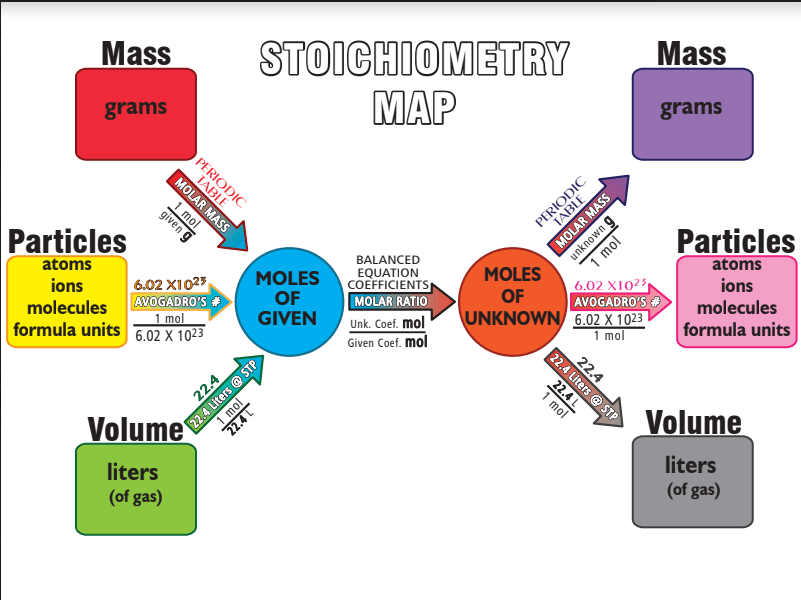
How many step will it take for me to go from moles given to moles unknown?
1
2
3
4
4 Al + 3 O2 –> 2 Al2O3 How much aluminum would be needed to completely react with 45 grams of O2?
1.05 moles
3.75 moles
0.875 grams
1.875 moles
How many grams of H2O will be formed when 32.0 g H2 is allowed to react with 16.0 g O2 according to
2 H2 + O2 → 2 H2O
9.00 g
16.0 g
18.0 g
32.0 g
36.0 g
When 2.00 g of H2 reacts with 32.0 g of O2 in an explosion, the final gas mixture will contain:
H2, H2O, and O2
H2 and H2O only
O2 and H2O only
H2 and O2 only
H2O only
The reaction of 7.8 g benzene, C6H6, with excess HNO3 resulted in 0.90 g of H2O. What is the percentage yield? Molar Mass (g/mol):
C6H6=78 HNO3=63 C6H5NO2=123 H2O=18
C6H6 + HNO3 → C6H5NO2 + H2O
100%
90%
50%
12%
2%
How many grams of nitric acid, HNO3, can be prepared from the reaction of 138 g of NO2 with 54.0 g H2O according to the equation below?
3NO2 + H2O → 2HNO3 + NO
92
108
126
189
279
Calculate the mass of hydrogen formed when 27 g of aluminum reacts with excess hydrochloric acid according to the balanced equation below. 2Al + 6HCl → 2 AlCl3 + 3 H2
1.5 g
2.0 g
3.0 g
6.0 g
12 g
Identify the limiting reactant when 6.00 g HCl combines with 5.00 g Mg to form MgCl2.
Mg + 2HCl --> MgCl2 + H2
Mg
H2
MgCl2
HCl
Actual yield = 62g
Calculate the percent yield.
4NH3+6NO --> 5N2 + 6H2O
Using the following equation:
Fe2O3(s) + 3H2(g) → 2Fe(s) + 3H2O(l)
How many moles of iron can be made from 6 moles H2 and excess Fe2O3?
4 moles Fe
6 moles Fe
9 moles Fe
2 moles Fe
2Pb(NO3)2 (s)→2PbO(s)+4NO2(g)+O2(g)
How many grams of potassium chloride can be produced from 356 g of chlorine and 356 g of potassium bromide?

Identify the limiting and excess reactants in the reaction shown.
N2 is limiting and H2 is excess.
H2 is limiting and N2 is excess.
NH3 is both limiting and excess.
There is no limiting reactant.
Aluminum reacts with hydrochloric acid according to:
2Al + 6HCl → 2AlCl3 +3H2
If 4.0 g of Al react with 10.0 g of HCl, which reactant is in excess?
Al
HCl
C3H8 + 5O2 → 3CO2 + 4H2O
A sample contains 5.0 g of propane and 20.0 g of oxygen. Which reactant is in excess?
Propane
Oxygen
2H2 + O2 → 2H2O
You mix 3.0 g of H₂ with 16.0 g of O₂.
After the reaction goes to completion, how many grams of the excess reactant remain?
2.0 g
4.0 g
8.0 g
1.0 g
2Na + Cl2→ 2NaCl
If 12 g of Na react with 15 g of Cl₂, what mass of the excess reactant is left over after the reaction?
2.3 g
5.6 g
7.2 g
9.4 g

