wayground logo

Free Printable Worksheets

Font size

S
M
L
XL
Worksheets

Into the Abyss Lesson 1 Quiz M

Total questions: 22

Worksheet time: 11mins

Name
Class
Date
1.
Two students are using a flashlight and a mirror to test the properties of light, and how light interacts with a mirror. They develop a model to show three places they might look to observe the reflected light. From what angle should the students look to see the reflected light?
a)
a
b)
b
2.
Kiara shines a flashlight on a mirror. Which arrow show the path the light would take when it reaches the mirror?
a)
Arrow B
b)
Arrow C
c)
Arrow D
3.
Stanley looks at his pet fish in its fish tank. Why does Stanley see the fish in a different location to where it actually is?
a)
Light waves are poorly transmitted through water, causing objects to seem as though they are in different locations.
b)
Light waves bend (refract) as they pass from one medium (water) to another (air)
c)
Light waves are partially absorbed by water, causing their paths to bend.
4.
Jo is sitting by a lake observing stars. She wants to develop a model that will help her explain why the starlight appears on the surface of the lake. What ideas should Jo include in her model to describe how the light interacts with the surface of the lake? Select all of the ideas about light that Jo should include in her model.
a)
Light transmits through the atmosphere
b)
Light reflects off the surface of the stars.
c)
Light reflects off the surface of the lake.
d)
Light transmits from the stars to the surface of the lake.
5.
Jo wants to show how light travels from one place to another. How should Jo show light traveling between the stars and the lake in her model? Select the term that best complete this sentence: Jo should draw the light traveling in a ________ line.
a)
straight
b)
curve
6.
A flashlight is used to produce a beam of light shining on a red pair of glasses as shown below. Which light wave property is being demonstrated.
a)
Reflection
b)
Absorption
c)
Refraction
7.

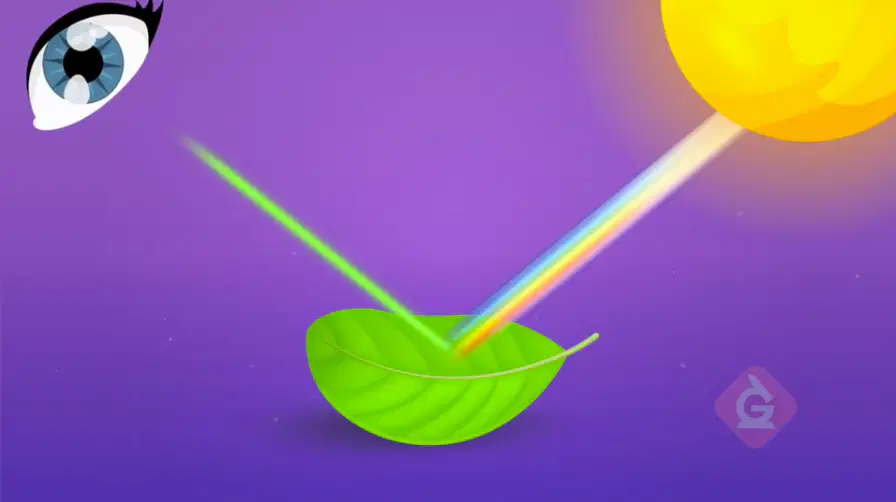
Use the diagram below to explain how wavelength is related to the colors that we see: Different colors of light have different _________________________.

a)
wavelength
b)
amplitude
8.

Use the diagram below to explain how wavelength is related to the colors that we see: When light is ___________________ from an object, its wavelength is what determines the color we see.

a)
absorbed
b)
reflected
9.
Look at the picture below. Why is the light bending?
a)
When the light wave reaches the water, the frequency and wavelength change which causes the light to bend.
b)
When the light wave reaches the water, the amplitude and reflection of the wave changes which makes the light wave bend.
10.
A flashlight is used to produce a beam of light shining on a lens as shown below. Which light wave property is being demonstrated.
a)
Reflection
b)
Absorption
c)
Refraction
11.
The tank below has a mirror at the bottom and is filled with water. A flashlight is used to produce a green beam of light as shown below. Which light wave property is being demonstrated?
a)
Reflection
b)
Absorption
c)
Transmission
12.
A flashlight is used to produce a green beam of light as shown below. Which light wave property is being demonstrated.
a)
Reflection
b)
Absorption
c)
Transmission
13.
Jack is in a submarine at a depth of 400m. His red shirt now appears blue. Select the description that accurately explains which zone he is in and why his shirt appears blue.
a)
Jack is in the aphotic zone where photosynthesis occurs because only green light waves remain.
b)
Jack is in the disphotic zone where there are no light waves.
c)
Jack is in the disphotic zone where only blue light waves remain.
14.

when light passes through an object

a)

Reflection

b)

Absorption

c)

Wavelength

d)

Transmission

e)

Refraction

15.

when light bounces off an object

a)

Reflection

b)

Absorption

c)

Wavelength

d)

Transmission

e)

Refraction

16.

the bending of a ray when it passes at an angle from one medium into another in which its speed is different

a)

Reflection

b)

Absorption

c)

Wavelength

d)

Transmission

e)

Refraction

17.

when light interacts with an object and its energy is taken in

a)

Reflection

b)

Absorption

c)

Wavelength

d)

Transmission

e)

Refraction

18.

the distance between two peaks in the pattern of a wave

a)

Reflection

b)

Absorption

c)

Wavelength

d)

Transmission

e)

Refraction

19.

Humans can see all of the waves in the electromagnetic spectrum.

a)

True

b)

False

20.

White light is composed of waves with many different wavelengths which are interpreted by the human eye as distinct colors.

a)

True

b)

False

21.

Below 1,000m is the aphotic zone, or midnight zone.

a)

True

b)

False

22.

Long green wavelengths are fully absorbed by water by around 10m below the ocean surface.

a)

True

b)

False