
 Worksheets
P1 - Motion - Revision
Total questions: 76
Worksheet time: 2hrs 16mins
The force of gravity. This keeps human standing on the Earth.
Weight
Friction
Air resistance
Upthrust
The standard unit of mass.
kilogram (kg)
Newton (N)
meter per second squared (m/s^2)
meter per second (m/s)
Mass is?
the force of gravity
the amount of matter that an object is made of.
the quantity shows how fast an object traveled
the quantity shows how fast the velocity of an object changes.
Weight is?
the force of gravity which keeps us standing on the Earth
the amount of matter that an object is made of.
the quantity shows how fast an object traveled
the quantity shows how fast the velocity of an object changes.
The equation linking, weight, mass and gravitational field strength.
weight = mass x time
weight = mass / gravitational field strength
weight = mass x gravitational field strength
weight = mass x velocity squared
The symbol equation linking weight, mass and gravitational field strength.
W = mg
W = m/g
W = g/m
The difference(s) between Mass and Weight is?
Mass changes while Weight unchanges with location.
Mass is measured in kilograms (kg) while Weight is measured in Newton (N)
Mass and Weight unchanges with location
Mass unchanges while Weight changes with location.
A ball has a mass of 200 g. What is the weight of the ball? Take gravitational field strength g = 9.8 N/kg
1960 N
196 N
19.6 N
1.96 N
A forklift truck lifts a crate that has a mass of 140 kg. The gravitational field strength, g = 9.8 N/kg.
What is the weight of the crate?
13.72 m/s
1372 m/s
13.72 N
1372 N
........................... is defined as the rate of mass per a unit of volume.
Velocity
Density
Acceleration
Distance
A solid cube is made from a material with density 0.60 g/cm3. The side of the cube is 2 cm.
What is the mass of this cube?
0.048 g
0.48 g
4.80 g
48.0 g
Five identical solid glass balls, each of mass 5.0 g, are put into a measuring cylinder containing water.
The water level in the measuring cylinder rises from the 30 cm3 mark to the 40 cm3 mark.
What is the density of the glass from which the balls are made?
0.50 g/cm3
1.20 g/cm3
1.60 g/cm3
2.5 g/cm3

Which quantity can be calculated by calculating the gradient of this graph?
elastic potential energy
original length of this graph
spring constant
velocity of spring
According to Hooke's law; Force is equal to -
Spring Constant × Extension
Spring Constant ÷ Extension
Spring Constant + Extension
If the original length of a spring is 20 m and its extended length is 30 m. What is the extension?
20m
12m
75m
45m
10m
If a bungee rope has a spring constant of 10 N/m. How far will it extend (stretch) if a person who weighs 300 N is placed on it?
21 m
30 m
31 cm
21 miles
None of the above

1 mm
2 mm
3 mm
0 mm
Why do objects sink or float in water?
Because their densities are higher or lower than compared to water
Because their densities are using gravity to pull down
Because their densities are heavier or lighter
Because their mass and volumes are equal

What is the volume of 150 grams of lead if it has a density of 11.3 g/cm3?
13.3 g
13.3 cm3
.075 g
1695 cm3
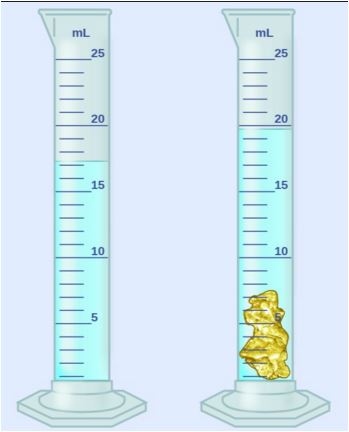
9 g/ml
10.5 g/ml
6.5 g/ml
8 g/ml

What pressure does a 4000N horse exert on the ground if total area of four feet is 40 cm2?
Pressure is equal to force divided by
Pressure can be measured in Pascals (Pa) or Newtons per square meter.
1 Pa = 1 N/m2
10 N/m2
pressure = force/mass
pressure = mass/volume
pressure = area/force
pressure = force/area

A ballet dancer en pointe (on tip toes) has a __________ contact area. Hence, pressure exerted on the floor is _________.
big, big
big, small
small, big
small, small

Ice cracks if the pressure on it is more than 3000 N/m². A man of weight 900 N wants to safely walk over the ice. What should be the area of each of his snowboots?
0.15 m2
0.30 m2
1.67 m2
3.33 m2

A brick of weight 80 N rests on the ground. What is the maximum pressure it can exert on the ground?
0.08 N/cm2
0.8 N/cm2
0.4 N/cm2
1.6 N/cm2
The force of gravity. This keeps human standing on the Earth.
Weight
Friction
Air resistance
Upthrust
The standard unit of mass.
kilogram (kg)
Newton (N)
meter per second squared (m/s^2)
meter per second (m/s)
A force which opposes motion, slowing an object down. The faster the object travels, the larger this force is.
Weight
Friction
Air resistance
Upthrust
The relationship between resultant force, mass and acceleration can be shown by equation:
resultant force = mass x acceleration
resultant force = mass / acceleration
resultant force = acceleration / mass
Mass is?
the force of gravity
the amount of matter that an object is made of.
the quantity shows how fast an object traveled
the quantity shows how fast the velocity of an object changes.
Weight is?
the force of gravity which keeps us standing on the Earth
the amount of matter that an object is made of.
the quantity shows how fast an object traveled
the quantity shows how fast the velocity of an object changes.
The equation linking, weight, mass and gravitational field strength.
weight = mass x time
weight = mass ÷ gravitational field strength
weight = mass x gravitational field strength
weight = mass x velocity squared
The symbol equation linking weight, mass and gravitational field strength.
W = mg
W = m/g
W = g/m
The difference(s) between Mass and Weight is?
Mass changes while Weight unchanges with location.
Mass is measured in kilograms (kg) while Weight is measured in Newton (N)
Mass and Weight unchanges with location
Mass unchanges while Weight changes with location.
A ball has a mass of 200 g. What is the weight of the ball? Take gravitational field strength g = 9.8 m / s2
1960 N
200 N
19.6 N
1.96 N
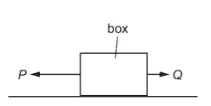
The diagram shows a large force of magnitude P and a small force of magnitude Q acting on a box.
Which expression gives the magnitude of the resultant force on the box?
P + Q
P - Q
P x Q
P / Q
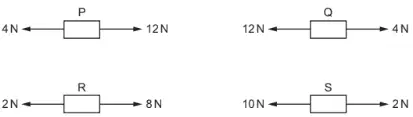
The diagrams show the two forces acting on four objects P, Q, R and S.
Which two objects experience equal forces acting in the same direction?
P and Q
P and R
Q and R
Q and S
A forklift truck lifts a crate that has a mass of 140 kg. The gravitational field strength, g = 9.8 N/kg. What is the weight of the crate?
13.7 m/s
1372 m/s
13.7 N
1372 N
........................... is defined as the rate of mass per a unit of volume.
Velocity
Density
Acceleration
Distance
A solid cube is made from a material with density 0.60 g/cm3. The side of the cube is 2 cm.
What is the mass of this cube?
0.048 g
0.48 g
4.80 g
48.0 g
Five identical solid glass balls, each of mass 5.0 g, are put into a measuring cylinder containing water.
The water level in the measuring cylinder rises from the 30 cm3 mark to the 40 cm3 mark.
What is the density of the glass from which the balls are made?
0.50 g/cm3
1.20 g/cm3
1.60 g/cm3
2.5 g/cm3

A
B
C
D

A
B
C
D

A
B
C
D
A train begins a journey from a station and travels 60 km in a time of 20 minutes.
What is the average speed of the train?
3.0 m/ s
5.0 m/ s
50 m/ s
60 m/ s

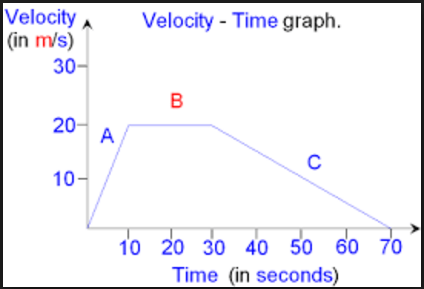
The graph shows how the speed of a van changes with time for part of its journey.
In which labelled section is the van decelerating?
A
B
C
D

A car travels along a straight road.
The speed-time graph for this journey is shown.
During which labelled part of the journey does the car have a constant speed?
A
B
C
D

The diagram shows the speed-time graph for a car.
Which area represents the distance traveled while the car is accelerating?
X
X + Y
Y
Y - X

The speed-time graph shows the motion of a car.
Which choice describes the motion?
accelerating between P and Q; moving at constant speed between Q and R.
accelerating between P and Q; not moving between Q and R.
moving at constant speed between P and Q; decelerating between Q and R.
moving at constant speed between P and Q; not moving between Q and R.

The graph represents the motion of a car.
What is the total distance traveled by the car while it is motion?
100 m
150 m
250 m
300 m
A change in speed over a given period of time is
velocity
motion
speed
acceleration


A car moves along a level road.
The diagram shows all of the horizontal forces acting on the car.
Which statement is correct?
The car is slowing down.
The car is speeding up.
The car is moving at a constant speed.
The car is moving backwards.
A resultant force of 4.0N acts on an object of mass 0.50 kg.
What is the acceleration of the object caused by this force?
2.0 m / s
8.0 m / s
2.0 m / s^2
8.0 m / s^2

The diagram shows a tug-of-war between team X and team Y. The arrows show the forces exerted by the teams on the rope.
What is the size of the resultant force on the rope and in which direction does the resultant force act?
size of resultant force = 75 N; direction of resultant force = to the left
size of resultant force = 75 N; direction of resultant force = to the right.
size of resultant force = 725 N; direction of resultant force = to the left
size of resultant force = 725 N; direction of resultant force = to the right.
A bag of flour has a mass of 540 g. The acceleration of free fall is 9.8 m /s2.
What is the weight of the bag of flour?
5.3 N
53 N
529 N
5292 N

Find the acceleration from A to B.
0.5 m/s2
0.5 m/s
2 m/s2
2 m/s
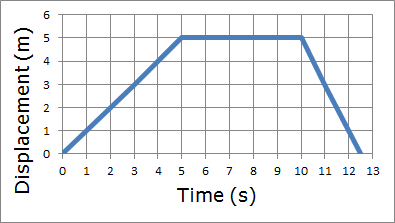
What can we find using displacement - time graph?
area below graph = velocity
gradient = acceleration
area below graph = acceleration
gradient = velocity
The slope of a velocity - time graph represents?
Velocity
Displacement
Acceleration
Time

1.6 Nm anti-clockwise
15 Nm clockwise
1.6 Nm clockwise
15 Nm anti-clockwise
The cyclist accelerates at 1.4 m/s2.
The mass of the cyclist and bicycle is 60 kg.
Calculate the resultant force.
(a)
upthrust
driving force

In a tug of war the left team pulls with a force of 200 N. The right team pulls with a force of 150 N.What is the resultant force?
50 N to the left.
350 N to the left.
350 N to the right.
50 N to the right.
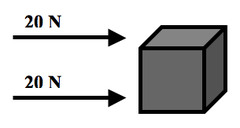
What is the resultant force?
40 N, Left
0 N, Balanced
400 N, Right
40 N, Right

What is the resultant force?
17 N, Left
6N, Right
11N , Left
12N, Left

