
 Worksheets
Light & Sound Waves
Total questions: 35
Worksheet time: 18mins
Name
Class
Date
1.
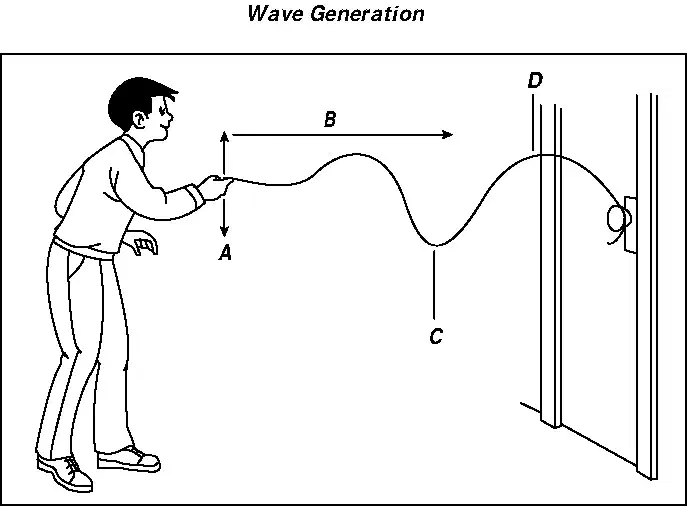
What does the person transfer to the rope by pulling it up and down at point A?
a)
movement
b)
energy
c)
wavelength
d)
frequency
2.
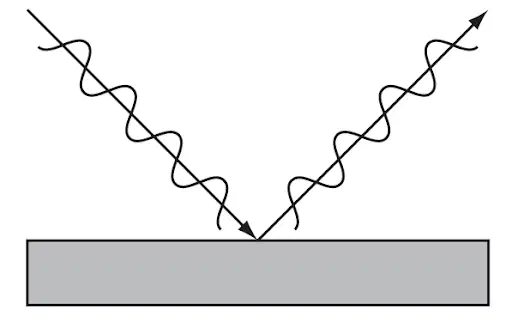
Hope drew a diagram to model a light wave being reflected when it meets a brick, as shown.
The teacher asked Hope to redraw the diagram in order to model some of the energy in the light wave being absorbed by the brick.
Which diagram best represents some of the energy in the light wave being absorbed by the brick?
a)
Option 1
b)
Option 2
c)
Option 3
d)
Option 4
3.
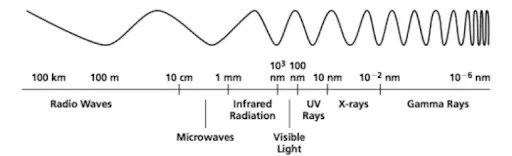
The diagram below shows an electromagnetic spectrum.
Based on the information shown, which statement is not true?
a)
Ultraviolet waves occur at a higher frequency than Infrared waves.
b)
Gamma Rays have the shortest wavelength of all wave types.
c)
Ultraviolet waves have a longer wavelength than visible light.
d)
Visible light waves carry more energy than microwaves
4.
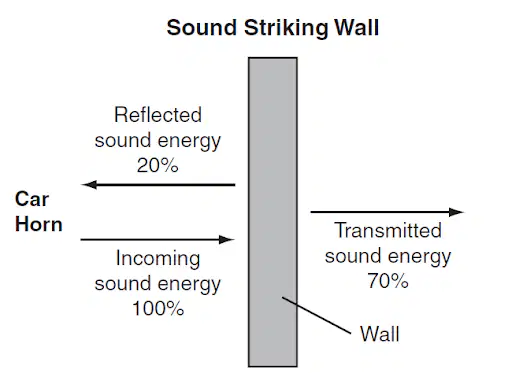
This diagram models a sound wave from a car horn hitting a wall.
According to the model, which statement best describes what happens to the sound energy when the sound wave hits the wall?
a)
Ten percent of the sound energy is absorbed by the wall.
b)
Thirty percent of the sound energy is absorbed by the wall
c)
Eighty percent of the sound energy is reflected by the wall.
d)
Eighty percent of the sound energy passes through the wall
5.
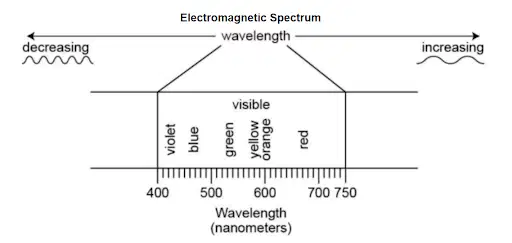
Students are researching what colors of visible light that different animals are able to see. They are given the following portion of the electromagnetic spectrum to aid in their research.
Nina has chosen to research bumblebees. Her research shows that bumblebees can see wavelengths ranging from 400-600 nanometers. Based on this information, what could Nina conclude about the sight of bumblebees?
a)
Bumblebees only see violet and blue.
b)
Bumblebees only see green and yellow.
c)
Bumblebees see every color but red.
d)
Bumblebees see every color but violet.
6.
Lila wants to call a friend using her cell phone. Which statement best describes what must take place in order for Lila’s friend to hear her over the phone?
a)
Sound waves travel directly from Lila’s phone to her friend’s phone.
b)
Radio waves travel to a satellite in orbit around Earth and then to her friend’s phone.
c)
Sound waves travel through a series of wires so that the phone receptor will pick up a signal.
d)
Radio waves travel through a series of towers before sending a signal to her friend’s phone.
7.
What is the relationship between the wavelength of a wave and its energy?
a)
They are directly proportional.
b)
The energy is always greater.
c)
The wavelength is always greater.
d)
They are inversely proportional.
8.
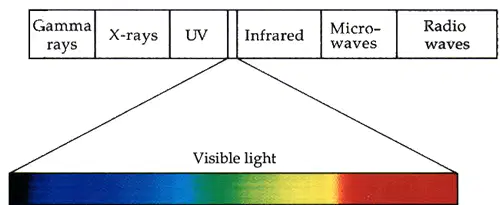
The picture lists light waves from left to right in order of highest to lowest energy. Which region of the electromagnetic spectrum has the longest wavelength?
a)
UV
b)
Radio
c)
Gamma
d)
Visible
9.
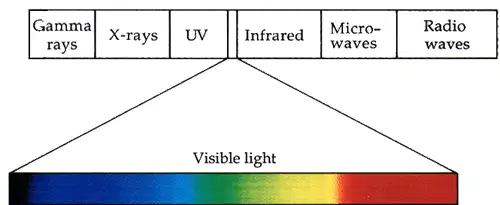
As you move from left to right across the electromagnetic spectrum in the image, the wavelength becomes
a)
taller
b)
shorter
c)
longer
d)
lower
10.
Low-frequency red light is used in dark rooms because it does not expose the film. This is because the red light has a low
a)
amplitude
b)
energy
c)
intensity
d)
wavelength
11.
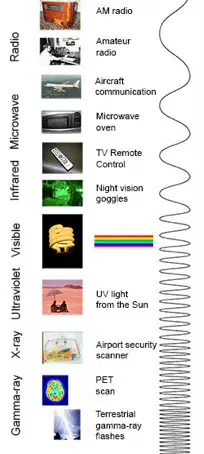
The wavelengths of radio waves are much _______________ than the wavelength of microwaves. Therefore, radio waves carry much __________ energy than a microwave.
a)
shorter, less
b)
longer, less
c)
longer, more
d)
shorter, more
12.

The progression of colors represented by the wavelengths shown here is MOST LIKELY described, from top to bottom, as
a)
orange, yellow, blue, violet.
b)
blue, red, yellow, green.
c)
red, yellow, blue, violet.
d)
violet, green, yellow, red.
13.

Which diagram BEST represents the light waves of a bright red brake light on the left side to a dim violet night light on the right side?
a)
A
b)
B
c)
C
d)
D
14.

Compare and contrast the wave characteristics in each pairing. Which wave diagram BEST represents a dim red sunset on the right side to the light from an intense ultraviolet bug light on the left side?
a)
A
b)
B
c)
C
d)
D
15.
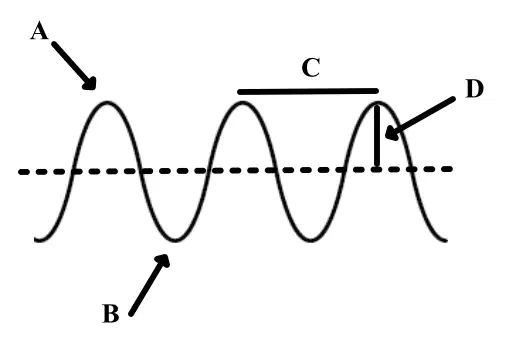
A note is played on a flute. Which of the parts of the wave would be affected by playing a higher pitch note and how?
a)
C, the wavelength would get shorter.
b)
C and D, the amplitude and wavelength would increase.
c)
A, B and D. The amplitude and crest would be higher, while the trough would be lower.
d)
D, the frequency would get higher.
16.
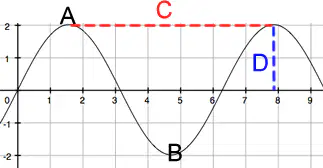
A person takes a string that tied to a chair. He takes the other end and moves it up and down. Which of the parts of the wave would be affected by the person's movement and how?
a)
A, B and D. The amplitude and crest would be higher, while the trough would be lower.
b)
C and D, the amplitude and wavelength would increase.
c)
C, the wavelength would get longer.
d)
D, the frequency would get higher.
17.
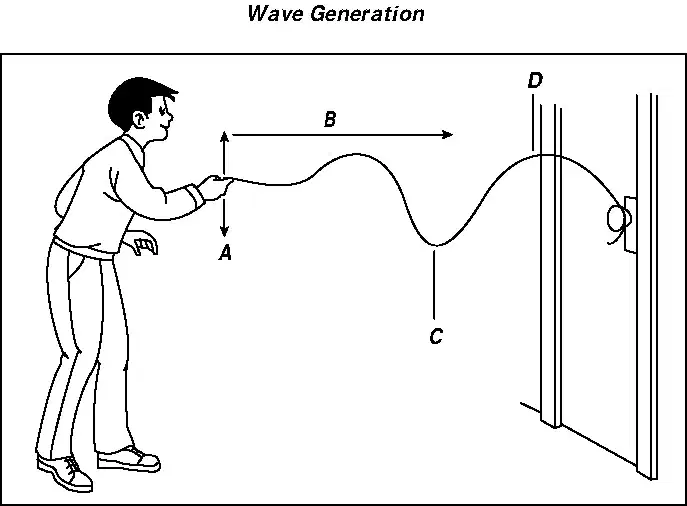
What does the direction of arrow B indicate?
a)
wave movement
b)
energy
c)
wavelength
d)
frequency
18.
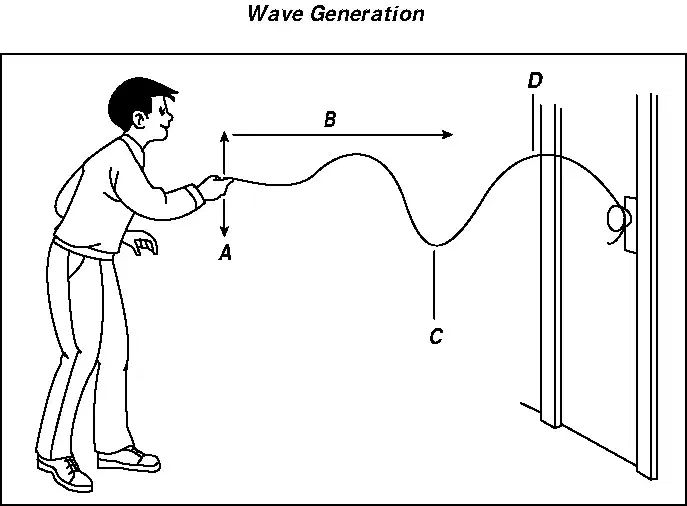
In what direction does the medium move relative to the direction of the wave?
a)
Since this is a transverse wave, the medium moves parallel to the wave.
b)
Since this is a transverse wave, the medium moves perpendicular to the wave.
c)
Since this is a longitudinal wave, the medium moves parallel to the wave.
d)
Since this is a longitudinal wave, the medium moves perpendicular to the wave.
19.
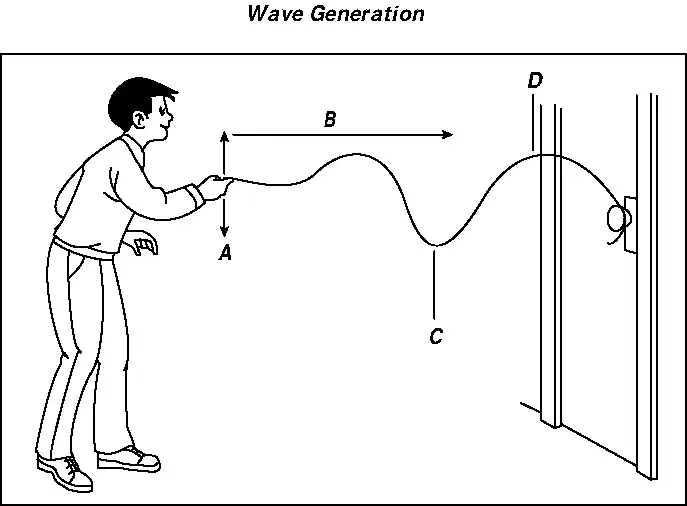
What does point C represent?
a)
The crest of a transverse wave
b)
The rarefaction of a longitudinal wave
c)
The compression of a longitudinal wave
d)
The trough of a transverse wave
20.
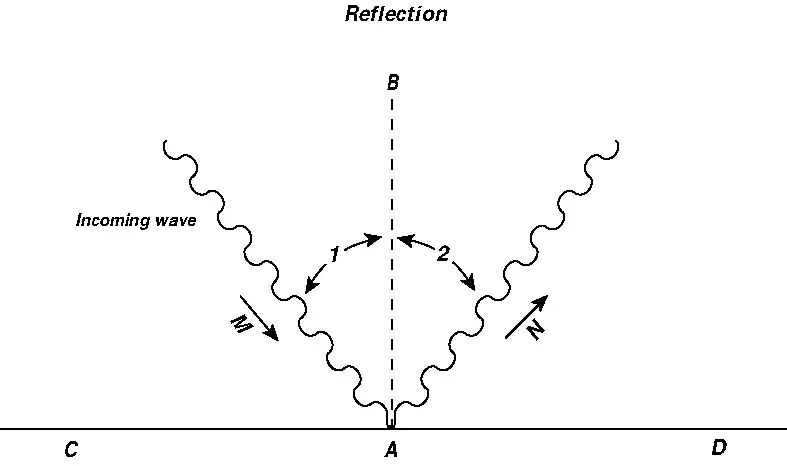
What does arrow M indicate?
a)
A light wave
b)
The reflected ray of light
c)
The incident ray of light
d)
a plane mirror
21.
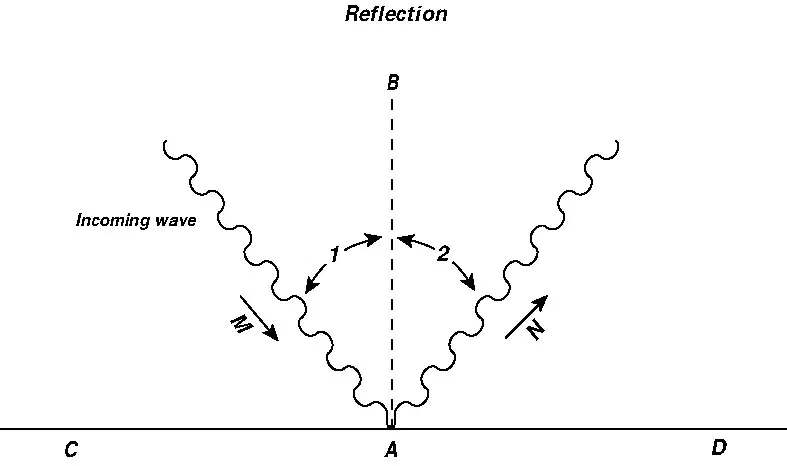
What does arrow N indicate?
a)
A light wave
b)
The reflected ray of light
c)
The incident ray of light
d)
a plane mirror
22.
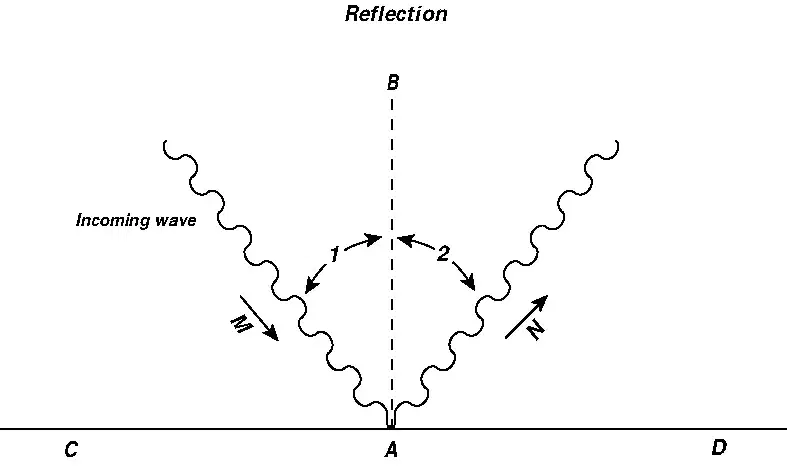
Which numbered angle represents the angle of incidence?
a)
Angle 1
b)
Angle 2
23.
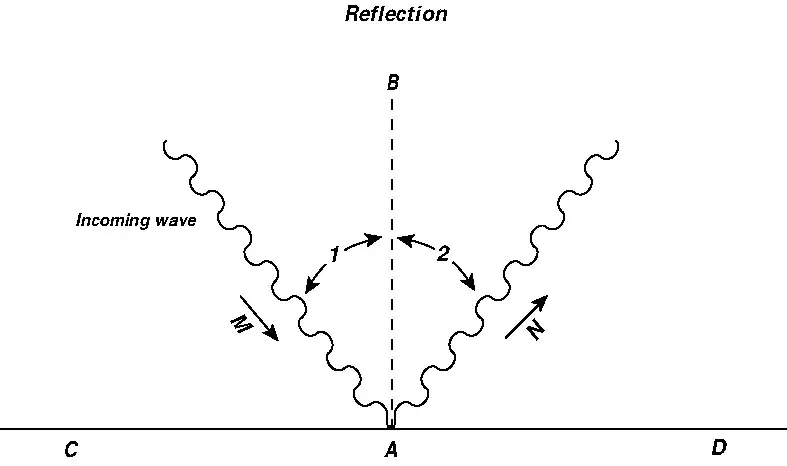
Which numbered angle represents the angle of reflection?
a)
Angle 1
b)
Angle 2
24.
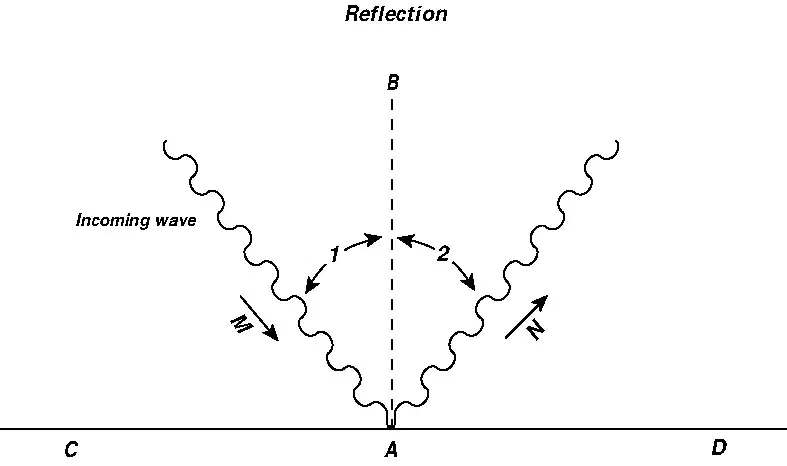
What does the line CAD represent?
a)
incident ray
b)
reflected ray
c)
normal line
d)
plane mirror
25.

In which medium listed in the table does sound travel slowest?
a)
steel
b)
glass
c)
air (20 degrees C)
d)
air (0 degrees C)
26.

In which medium listed in the table does sound travel fastest?
a)
steel
b)
glass
c)
air (20 degrees C)
d)
air (0 degrees C)
27.

Out of rubber, helium, and vinegar, which most likely conducts sound fastest? The slowest? Why do you think so?
a)
rubber conducts fastest because sound travels faster through solids.
b)
helium conducts slowest because sound travels slowest in gases.
c)
vinegar conducts fastest because sound travels faster through liquids
d)
helium conducts fastest because sound travels faster through gases.
e)
vinegar conducts slowest because sound travels slowest in liquids.
28.
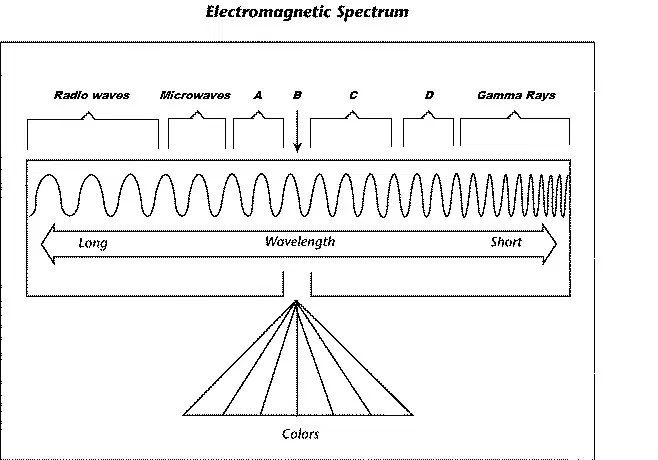
Name the type of wave that has the highest frequency.
a)
radio waves
b)
microwaves
c)
gamma rays
d)
UV rays
29.
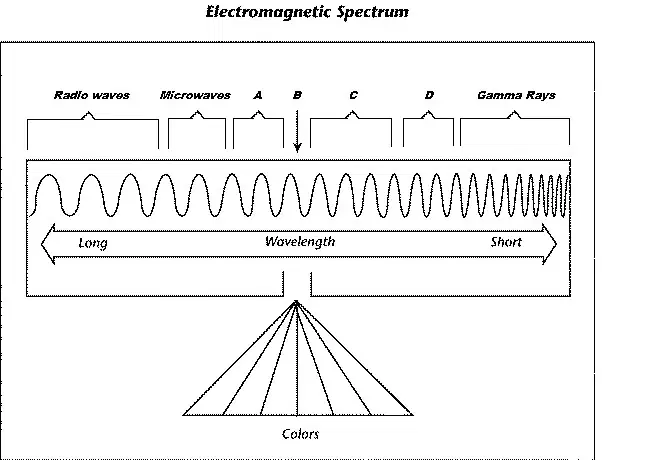
Name the type of wave labeled C
a)
infrared waves
b)
visible light
c)
x-rays
d)
UV rays
30.
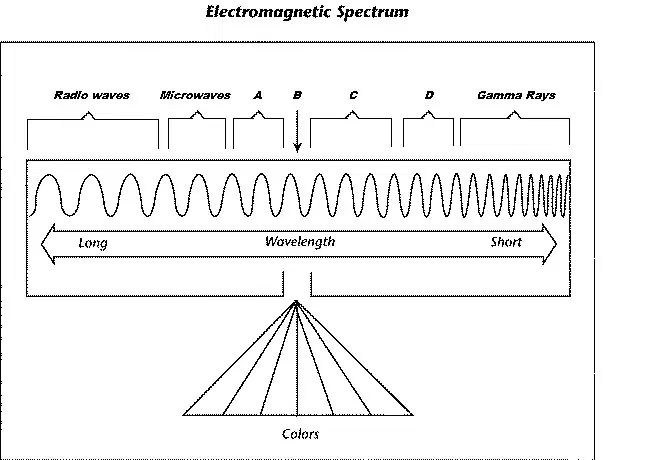
Name the type of wave that has the greatest energy.
a)
infrared waves
b)
gamma rays
c)
x-rays
d)
UV rays
31.
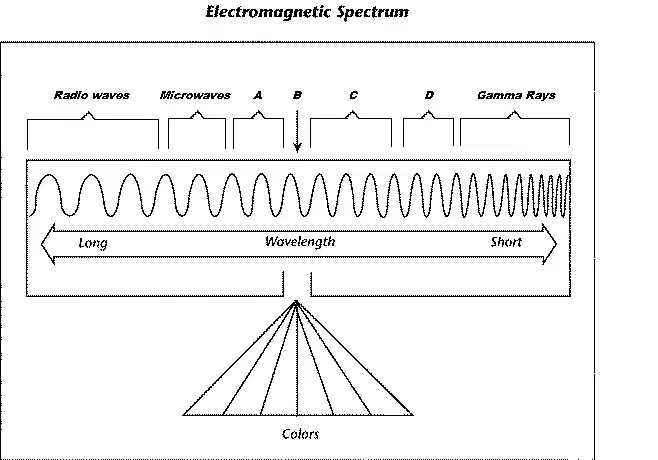
Which letter shows the type of wave that can be seen by the human eye?
a)
A
b)
B
c)
C
d)
D
32.
A material that reflects or absorbs any light that strikes it is
a)
opaque.
b)
transparent.
c)
translucent.
d)
concave.
33.
Frosted glass and wax paper are
a)
transparent.
b)
translucent.
c)
clear.
d)
opaque.
34.
The bending of light rays as they enter a new medium is called
a)
diffuse reflection.
b)
regular reflection.
c)
refraction.
d)
diffraction.
35.
Clear glass, water, and air are examples of what kind of material?
a)
opaque
b)
fluid
c)
translucent
d)
transparent
100 %

