
 Worksheets
12/4 Unit 2 Review
Total questions: 31
Worksheet time: 2hrs 33mins


Find h(5) using the equation.
-25
25
3
7
undefined
What is the degree of the polynomial function below?
y = x3 + 4x - 5
(a)
y = 2(x - 1)(x +3)(x - 4)


Which of the following helps determine end behavior?
The leading term
The number of terms in the function
The y-intercept
The x-intercepts
Determine the y-intercept of the function below:
(a)
Determine the end behavior of the polynomial by identifying the degree and leading coefficient.
f(x) = 5x4 - x + 6
UP-UP
UP-DOWN
DOWN-UP
DOWN-DOWN

Identify the degree of the polynomial and the sign of the leading coefficient
Degree - Even
Degree - Odd
Degree - Even
Degree - Odd

Identify the degree of the polynomial and the sign of the leading coefficient
Degree - Even
Degree - Odd
Degree - Even
Degree - Odd

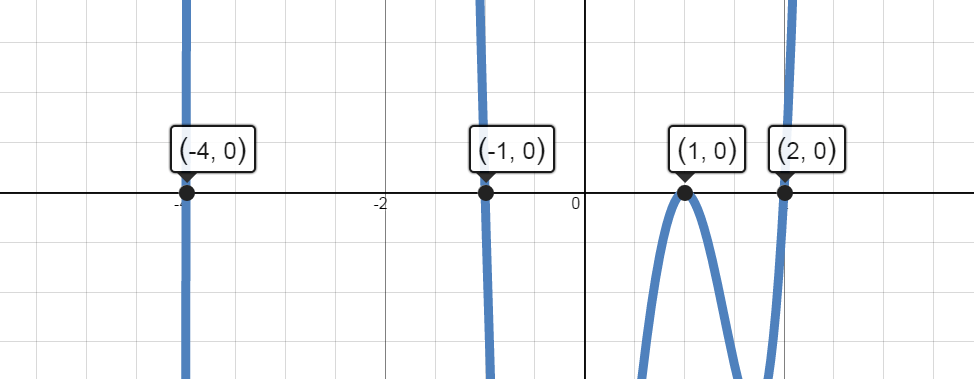

Use the graph of f(x) to determine the real solutions to f(x)=0.
-10
2, 5
0, 7
no real solution

Find the correct statement about the zeros.
−5 is a zero with multiplicity 1
−5 is a zero with multiplicity 2
−2 is a zero with multiplicity 1
2 is a zero with multiplicity 2
If the there is a turning point on the x-axis, what does that mean about the multiplicity of that zero?
Even
Odd
None
If the graph of a function crosses the x-axis, what does that mean about the multiplicity of that zero?
Even
Odd
None
What is the multiplicity of the zero x=1 for the function f(x)=x2(x−1)4(x+5) ?
2
1
4
3
How does a multiplicity of 1 affect the graph?
bounce
cross
wiggle (change direction)
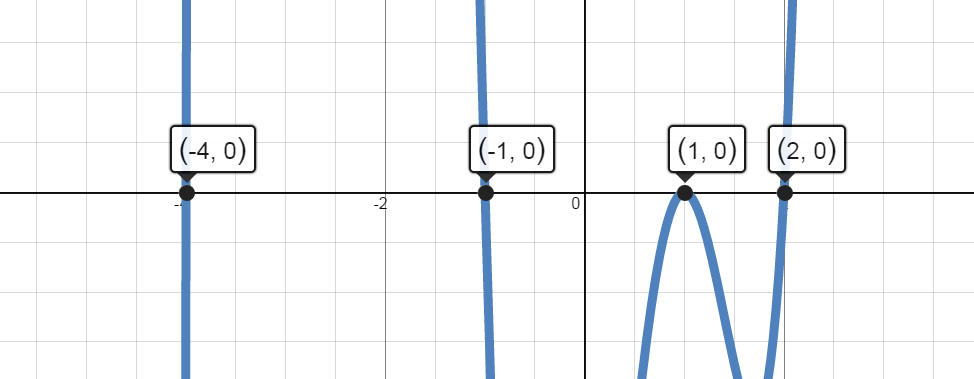

- Leading Coeff.
+ Leading Coeff.
- Leading Coeff.
+ Leading Coeff.

For each function, state the maximum number of turns the graph could make. f (x) = x2 + 6x + 9
6
5
1
4
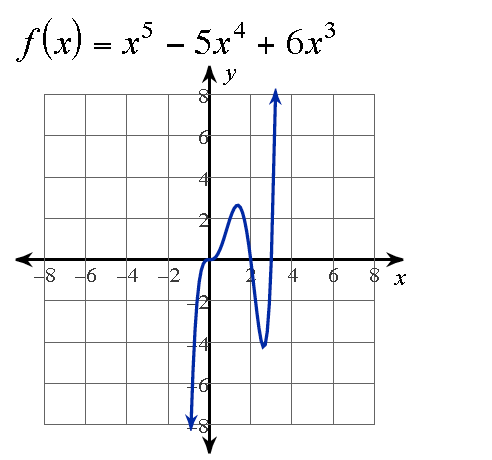
For each function, determine the real zeros and state the multiplicity of any repeated zeros.
{0 mult. 3, 5, 2}
{−2 mult. 3, 3, 1}
{0 mult. 3, 3, 2}
{2 mult. 3, 3, 3}
For each function, determine the real zeros and state the multiplicity of any repeated zeros.
{0 mult. 3, 5, 2}
{−2 mult. 3, 3, 1}
{0 mult. 3, 3, 2}
{2 mult. 3, 3, 3}

Complete the end behavior statement for the graph of f(x). As x→∞, y→ ?
∞
−∞
Complete the end behavior statement for the graph of f(x). As x→−∞, y→ ?
∞
−∞

